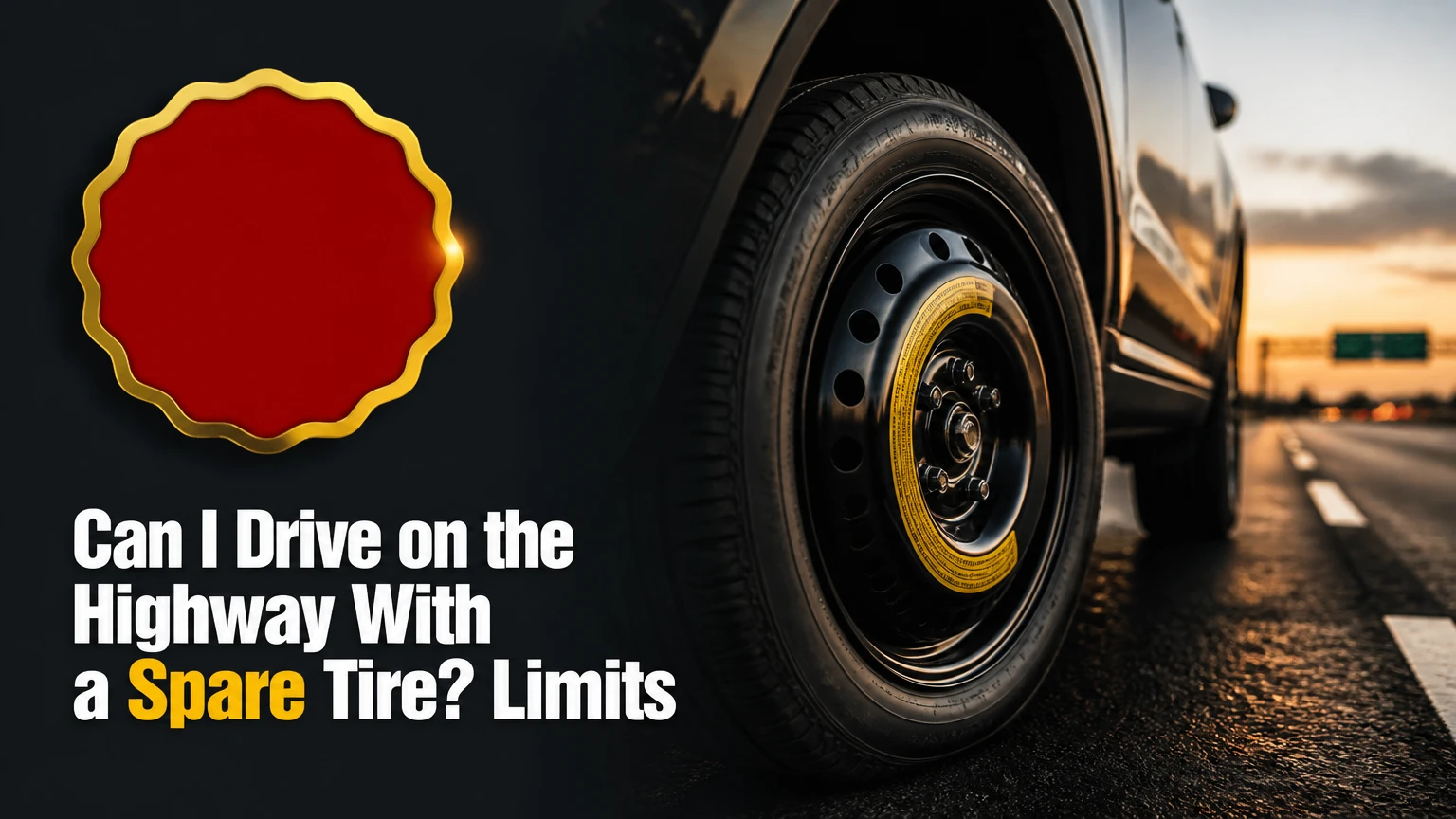
Yes, you can drive on the highway with a spare tire only when the spare is correctly inflated, compatible with the vehicle, and used within its manufacturer limits. A compact donut spare usually requires a maximum of 50 mph and about 50 miles, while a matching full-size spare may support normal highway driving. The vehicle owner’s manual and spare-tire label control.
Key Facts at a Glance
- A compact temporary spare commonly has a 50 mph maximum and an approximately 50-mile emergency range, but the label on the tire takes priority.
- A donut spare has less tread width and a different rolling circumference, so braking, cornering, stability control, and drivetrain behavior can change.
- A matching full-size spare is suitable for normal highway speeds only when its size, load index, speed rating, wheel, and tread condition match the vehicle requirements.
- AWD and some 4WD vehicles can suffer transfer-case or differential stress from a mismatched tire diameter, even over a short distance.
- A temporary spare needs the pressure printed on its sidewall or listed in the owner’s manual, which is often around 60 psi rather than the 30-35 psi used by ordinary tires.
- A spare tire is an emergency mobility device, not a permanent replacement for a damaged road tire.
Can I Drive on the Highway With a Spare Tire?
You can drive on the highway with a spare tire to reach a safe exit, tire shop, or repair location, but a compact donut should not be treated like a normal highway tire. Keep the temporary spare at or below its stated speed limit, avoid unnecessary miles, and drive conservatively because the vehicle may brake and turn differently.
The first decision is whether the spare is a compact temporary tire, a matching full-size tire, a nonmatching full-size tire, or a run-flat. Those categories do not have interchangeable limits. A 50 mph restriction printed on a donut does not automatically apply to a full-size spare, and a full-size wheel is not automatically safe if its diameter, offset, load rating, or tire circumference differs from the other wheels.
The second decision is whether the highway trip is necessary. A short journey to the next open tire facility is different from a 300-mile road trip. If the shoulder is narrow, traffic is fast, visibility is poor, or weather is hazardous, roadside assistance is safer than attempting a wheel change or continuing at highway speed.
What is the safest immediate decision?
Use the spare only to leave danger and obtain a proper repair. If the temporary tire is below its required pressure, visibly damaged, older than the vehicle manufacturer’s service recommendation, or installed on a vehicle with special AWD restrictions, do not drive on it until a qualified technician confirms that it is safe.
A vehicle with a temporary spare may show ABS, traction-control, ESC, or TPMS warnings. Those warnings do not prove that the spare is unusable, but they indicate that the vehicle’s systems have detected an abnormal wheel-speed or pressure condition. Reduce speed and stop driving if the vehicle pulls strongly, vibrates, makes drivetrain noises, or feels unstable.
How Fast and How Far Can a Donut Spare Travel?
A compact donut spare typically has a 50 mph maximum and an approximately 50-mile emergency range, although some vehicles specify different limits such as 55 mph or a shorter distance. The exact limit appears on the spare’s sidewall, the vehicle placard, or the owner’s manual, and the most restrictive applicable instruction should be followed.
| Spare configuration | Typical speed guidance | Typical distance guidance | Main restriction |
|---|---|---|---|
| Compact donut spare | 50 mph maximum | About 50 miles | Emergency use only |
| Matching full-size spare | Vehicle speed limit | No fixed emergency distance | Must match size and ratings |
| Nonmatching full-size spare | Manual-specific | Short-term use | Diameter and tread mismatch |
| Run-flat tire | Often 50 mph | Often 50 miles | Manufacturer-specific |
| Tire sealant and inflator | 50 mph or label limit | Repair-facility distance | Sealant compatibility and puncture size |
The 50/50 rule is a common industry convention, not a universal law for every temporary spare. Some compact spares carry a 50 mph marking but have no guaranteed mileage figure beyond the instruction to drive directly to a repair facility. A vehicle owner’s manual can also impose a lower limit for towing, passengers, weather, or AWD operation.
A donut spare should remain out of the fast lane. Maintain a large following distance, avoid abrupt steering, and do not use cruise control on a temporary tire. A 50 mph maximum is a ceiling, not a target, especially in rain, snow, crosswinds, construction zones, or heavy traffic.
Why Does a Donut Spare Change Highway Handling?
A donut spare changes the vehicle’s contact patch, rolling circumference, sidewall behavior, and wheel speed, so the vehicle may require more stopping distance and react differently during cornering. The narrower tread reduces available grip, while the smaller diameter can create wheel-speed differences that affect ABS, ESC, traction control, and drivetrain components.
Compact spares use a narrow tire and a stiff construction to save weight and trunk space. Their tread is intended for short emergency travel, not sustained heat cycles or normal cornering loads. The difference becomes most noticeable during an evasive maneuver, hard braking, standing water, or a high-speed lane change.
A tire with a smaller circumference must rotate more times than a normal tire to cover the same road distance. Wheel-speed sensors can detect that difference and cause warning lights or altered electronic intervention. On an open differential, the differential can accommodate ordinary cornering, but a large or prolonged mismatch still creates unwanted heat and wear.
On AWD and some 4WD systems, the problem is more serious. A center differential, viscous coupling, or transfer case may interpret different tire speeds as continuous slipping. Subaru, Audi, BMW, Honda, Toyota, and other manufacturers publish model-specific restrictions because acceptable tire-circumference differences vary by drivetrain design.
What can happen if a temporary spare is driven too fast?
Driving a temporary spare above its marked speed can overheat its casing, reduce steering control, increase stopping distance, and cause sudden tire failure. Speed also increases the energy involved in a collision, while the narrow tread and short sidewall provide less reserve grip than the vehicle’s regular tires.
Common consequences include:
- Longer braking distances on dry pavement and substantially poorer performance on wet pavement.
- Increased risk of oversteer or understeer, depending on the axle and corner carrying the spare.
- ABS, ESC, or traction-control warnings caused by unequal wheel speeds.
- Differential, transfer-case, or clutch-pack stress when tire circumferences differ.
- Reduced ground clearance if the temporary tire is substantially smaller.
- Heat buildup from sustained speed, heavy cargo, steep grades, or hot pavement.
The spare’s load capacity also matters. A heavily loaded SUV, pickup, or passenger vehicle can exceed the temporary tire’s intended operating conditions even when the inflation pressure is correct. Remove unnecessary cargo and avoid towing until the normal tire is repaired.
Which Spare Tire Is Safe for Highway Use?
A matching full-size spare is the best option for extended highway travel, while a compact donut is appropriate only for a short, cautious trip to a repair facility. A nonmatching full-size spare requires the same scrutiny as a donut because wheel diameter, tire circumference, tread pattern, and load rating can still differ.
| Decision factor | Compact donut | Matching full-size | Nonmatching full-size | Run-flat |
|---|---|---|---|---|
| Normal highway speed | No | Yes, if ratings match | Manual-specific | Manual-specific |
| Typical emergency distance | About 50 miles | No fixed limit | Short-term | Often about 50 miles |
| Typical pressure | About 60 psi | Vehicle placard value | Sidewall or manual value | Vehicle placard value |
| Tread width | Narrow | Normal | Variable | Normal |
| AWD suitability | Often restricted | Usually preferred | Model-dependent | Model-dependent |
| Towing suitability | No | Vehicle-manual dependent | Usually no | Manual-dependent |
| Typical replacement cost | $150-$300 assembly | $100-$400 or more | $100-$400 or more | $150-$500 per tire |
Is a full-size spare always safe?
A full-size spare is safe for normal highway driving only when the wheel and tire meet the vehicle’s requirements. The replacement must have an appropriate diameter, load index, speed rating, bolt pattern, center bore, wheel offset, and clearance around the brake assembly.
A full-size spare with a different tread depth can still affect AWD systems. New and worn tires of the same nominal size may have different actual circumferences. Tire Rack and vehicle manufacturers commonly advise keeping AWD tire circumference closely matched, but the allowed tolerance differs by model, so the owner’s manual remains authoritative.
A full-size winter tire used with three summer tires also changes grip and handling. Matching physical size does not make mismatched seasonal compounds equivalent during emergency braking.
Can I use a run-flat tire on the highway?
A run-flat tire can usually travel after losing pressure, but its permitted speed and distance depend on the tire model, vehicle, load, temperature, and the manufacturer’s instructions. Michelin, Bridgestone, Continental, and other tire makers publish different run-flat operating limits, so a generic 50-mile rule is not sufficient.
Run-flat systems also require a functioning tire-pressure monitoring system. After a pressure loss, drive directly to a tire facility and avoid repeated trips. A run-flat sidewall can conceal damage after a puncture, and many run-flat tires cannot be repaired after being driven deflated.
Where Should a Temporary Spare Be Installed?
Temporary-spare placement depends on the vehicle manufacturer’s instructions, drivetrain, steering axle, brake clearance, and the spare’s size. Many front-wheel-drive vehicles direct drivers to move a good rear tire to the front and install the donut on the rear, but that is not a universal rule.
The reason for the common FWD instruction is practical: the front axle handles steering, most braking, and power delivery. Moving a normal tire to the front can preserve steering and traction while placing the smaller temporary tire on the rear. However, some vehicles prohibit that arrangement because the spare may not clear rear brakes or may have a different wheel specification.
Use this process:
- Read the owner’s manual before choosing the axle.
- Confirm that the spare clears the brake caliper and suspension.
- Check whether the manual prohibits the spare on the drive axle or steering axle.
- Tighten lug nuts in the manufacturer’s sequence.
- Torque the nuts with a calibrated torque wrench after lowering the vehicle.
- Recheck the tire pressure and wheel security after a short drive.
Never rely on a general internet rule when the vehicle manual gives a different placement instruction.
Why is AWD different?
AWD vehicles are more sensitive to tire-size differences because all four wheels connect through a system that expects similar rotational speeds. A temporary spare can cause binding, excess heat, warning lights, or damage to a center differential, transfer case, coupling, or electronically controlled clutch.
Some AWD vehicles allow a temporary spare for a limited distance. Others require a full-size matching tire or prohibit driving with a mismatched tire entirely. The vehicle manual may instruct the driver to disable AWD, use a specific axle, or call for towing instead.
Do not assume that a spare is safe because the car moves normally during the first mile. Drivetrain damage can develop without a dramatic noise, particularly during straight-line travel.
How Should You Handle a Highway Flat Tire?
The safest highway response is to slow gradually, keep both hands on the wheel, move to the far-right shoulder when possible, activate hazard lights, and call roadside assistance if the stopping area is unsafe. A driver should never stop in a live traffic lane merely to reach a convenient place to change a tire.
What should you do before stopping?
Release the accelerator gradually and avoid hard braking. Steer toward a wide shoulder, emergency bay, off-ramp, service area, or nearby parking lot while maintaining control of the vehicle.
Once stopped, keep the wheels pointed away from traffic, apply the parking brake, turn on hazard lights, and exit only if the shoulder provides a safe route away from moving vehicles. Remain inside the vehicle with the seat belt fastened when walking beside traffic would create greater danger.
What if the tire must be changed roadside?
A roadside wheel change requires level, stable ground, a correctly rated jack, a wheel chock, gloves, a flashlight, and the vehicle’s designated jacking points. Do not work on a narrow shoulder, a bridge, a curve, soft ground, or a location where passing vehicles are close enough to strike the vehicle.
The practical sequence is:
- Park as far from traffic as the surface safely allows.
- Activate hazards and place warning devices only where local law permits.
- Loosen lug nuts slightly before lifting the vehicle.
- Use the specified jacking point, never a random suspension component.
- Install the spare and hand-tighten the lug nuts in a star pattern.
- Lower the vehicle and torque the nuts to the vehicle specification.
- Confirm pressure, remove tools, and drive slowly to a tire facility.
A rock is not a reliable wheel chock, and many factory jacks are intended only for emergency lifting. Roadside assistance is the better choice when traffic speed exceeds 50 mph or visibility is limited.
How Should You Drive After Installing a Donut?
Drive in the right lane at a speed below the spare’s marked maximum, leave at least four seconds of following distance, and avoid hard braking, sharp turns, abrupt lane changes, cruise control, towing, and unnecessary highway miles. The temporary spare should take the vehicle directly to a repair shop.
| Driving condition | Recommended response | Main reason |
|---|---|---|
| Dry road, short trip | Stay below label limit | Preserves handling margin |
| Heavy rain | Reduce speed further or stop | Narrow tread can lose grip |
| Snow or ice | Avoid driving if possible | Temporary tread has limited traction |
| Steep grade | Use lower speed and light load | Controls heat and braking demand |
| Heavy cargo | Remove nonessential weight | Protects load capacity |
| Trailer attached | Do not tow on a donut | Increases axle and stability loads |
| AWD warning light | Stop and consult manual | Possible drivetrain mismatch |
Expect the steering wheel to feel different. A front-mounted temporary spare may change steering weight, while a rear-mounted spare can alter turn-in and stability. Pull over if vibration increases because a loose lug nut, incorrect pressure, damaged wheel, or improperly seated spare can become dangerous quickly.
Can I drive in rain or snow with a spare?
Driving on a temporary spare in rain or snow is technically possible only within the vehicle and spare manufacturer’s limits, but the safety margin is much smaller. Water, slush, and ice reduce the already limited traction of a narrow emergency tire, so postponing the trip or calling roadside assistance is preferable.
Snow tires and all-season tires also differ in compound and tread design. A donut spare is not a substitute for a winter tire, even when its diameter matches the other wheels.
How Much Pressure Does a Spare Tire Need?
A compact spare often requires about 60 psi, but the correct pressure is the number printed on the spare sidewall or specified in the owner’s manual. The driver’s-door placard usually lists regular tire pressures, not the temporary spare’s pressure, so using the placard value alone can underinflate the donut.
Check pressure with an accurate gauge when the tire is cold. Inspect the sidewall for cracks, bulges, cuts, embedded objects, and valve-stem damage. A compact spare stored for years can lose pressure even when it has never touched the road.
Rubber also ages in storage. NHTSA advises drivers to inspect spare tires as part of tire maintenance, while manufacturers commonly recommend replacement based on age and condition, often around 6-10 years. The date code and vehicle manual provide better guidance than appearance alone.
What Does a Spare Tire Replacement Cost?
A replacement compact spare assembly typically costs about $150-$300, while a full-size wheel-and-tire assembly commonly costs $100-$400 or more; run-flat replacement can range from roughly $150-$500 per tire. Labor, wheel sensors, vehicle-specific wheels, shipping, and dealership pricing can raise the final bill.
| Replacement need | Typical parts cost | Typical labor or service time | Cost driver |
|---|---|---|---|
| Compact donut assembly | $150-$300 | 30-60 minutes | Vehicle-specific wheel |
| Full-size spare assembly | $100-$400+ | 30-75 minutes | Tire size and load rating |
| Tire-pressure sensor | $40-$150 | 30-60 minutes | Sensor programming |
| Roadside tire change | $0-$150 | 20-60 minutes | Membership and location |
| Tire repair | $25-$60 | 30-60 minutes | Puncture location |
| Tire replacement | $100-$500+ | 45-90 minutes | Vehicle and tire category |
A puncture in the central tread may be repairable when the tire has not been driven severely underinflated and the injury meets the repair facility’s standards. Sidewall damage, shoulder punctures, exposed cords, or a tire driven after a blowout usually require replacement.
Arrange repair as soon as practical, preferably the same day or within 24-48 hours. The time window is a safety recommendation rather than a universal legal deadline, because weather, shop availability, and the spare’s condition change the risk.
What Are the Most Common Spare-Tire Mistakes?
The most common spare-tire failures involve incorrect pressure, wrong installation location, excessive distance, and assuming that a full-size wheel automatically matches the vehicle. Each mistake can turn a temporary mobility solution into a handling or drivetrain problem.
- Using regular-tire pressure: Inflate the donut to its printed pressure, often around 60 psi, not automatically to 32 psi.
- Ignoring the speed label: The 50 mph marking is a maximum, not permission for sustained fast travel.
- Leaving the punctured tire unrepaired: A spare does not remove the need to restore four suitable road tires.
- Skipping lug-nut torque: Hand-tightened nuts can loosen; torque them to the vehicle specification.
- Using an expired spare: Inspect the date code and rubber condition before trusting stored equipment.
- Assuming AWD permits a short trip: Some AWD systems tolerate no mismatch, even for a few miles.
- Changing a tire in an unsafe location: A roadside repair is never worth exposure to moving traffic.
- Driving with a warning light without checking the manual: ABS, ESC, and drivetrain warnings may require immediate stopping.
One counterintuitive rule matters: a spare that looks larger or more robust is not necessarily compatible. Wheel offset, brake clearance, bolt pattern, and actual rolling circumference can matter as much as the tire’s advertised size.
What Can You Use Instead of a Spare Tire?
Roadside assistance, a professional mobile tire service, a manufacturer-approved sealant and compressor, or a properly rated replacement tire can replace the need to drive on a temporary spare. Sealant is useful only for eligible tread punctures and cannot safely repair sidewall damage, a separated belt, or a destroyed tire.
A plug-and-patch repair performed from inside the tire is generally more durable than an external plug alone, but the tire must first pass an internal inspection. Tire sealant can also contaminate a TPMS sensor and may be incompatible with certain tire constructions.
For remote travel, a matching full-size spare, torque wrench, pressure gauge, jack, wheel chock, reflective vest, and flashlight provide better resilience than relying on sealant alone. For urban commuting, roadside assistance may be lighter and safer than carrying a full-size assembly.
The Bottom Line
You can drive on the highway with a spare tire when the spare is properly inflated, correctly installed, compatible with the vehicle, and used within its stated limits. A donut is normally limited to about 50 mph and 50 miles, while a matching full-size spare can support normal highway driving when its specifications match.
Do not use a compact spare for a long trip, towing, aggressive maneuvering, or uncertain AWD travel. Follow the sidewall and owner’s manual, slow down for weather and traffic, and repair or replace the damaged road tire as soon as practical. The answer to “can I drive on the highway with a spare tire” is therefore yes for emergency relocation, not yes for ordinary highway travel.
Frequently Asked Questions
Can I drive 70 mph with a full-size spare?
You can drive at 70 mph with a full-size spare only when the replacement tire has the required speed rating, load index, diameter, and wheel compatibility, and the vehicle manual permits it. A full-size tire with a lower speed rating or different circumference still requires reduced speed or immediate replacement.
How long can I leave a donut spare on my car?
Leave a donut spare installed only for the shortest practical trip to a tire repair facility, typically within about 50 miles and below 50 mph. Do not use elapsed time alone as the limit, because heat, mileage, road conditions, cargo, and drivetrain mismatch determine how quickly risk increases.
Can I repair a tire after driving it flat?
A tire driven while severely underinflated may have hidden sidewall and inner-liner damage even if the puncture is small. A technician must remove and inspect the tire internally; sidewall, shoulder, exposed-cord, or run-flat damage commonly requires replacement rather than a repair.
Will a donut spare damage my transmission?
A donut spare can contribute to transmission, differential, or transfer-case stress when its circumference differs substantially from the other tires, especially on AWD and some 4WD vehicles. FWD and RWD vehicles are not automatically immune, so the drivetrain instructions in the owner’s manual determine whether the spare is permitted.
Should I buy a full-size spare for a road trip?
A matching full-size spare is a strong choice for remote road trips, towing, rural routes, and areas with limited tire-shop availability. Confirm that the assembly fits the vehicle, carries the correct load, includes the required TPMS equipment, and can be secured without exceeding the vehicle’s cargo capacity.