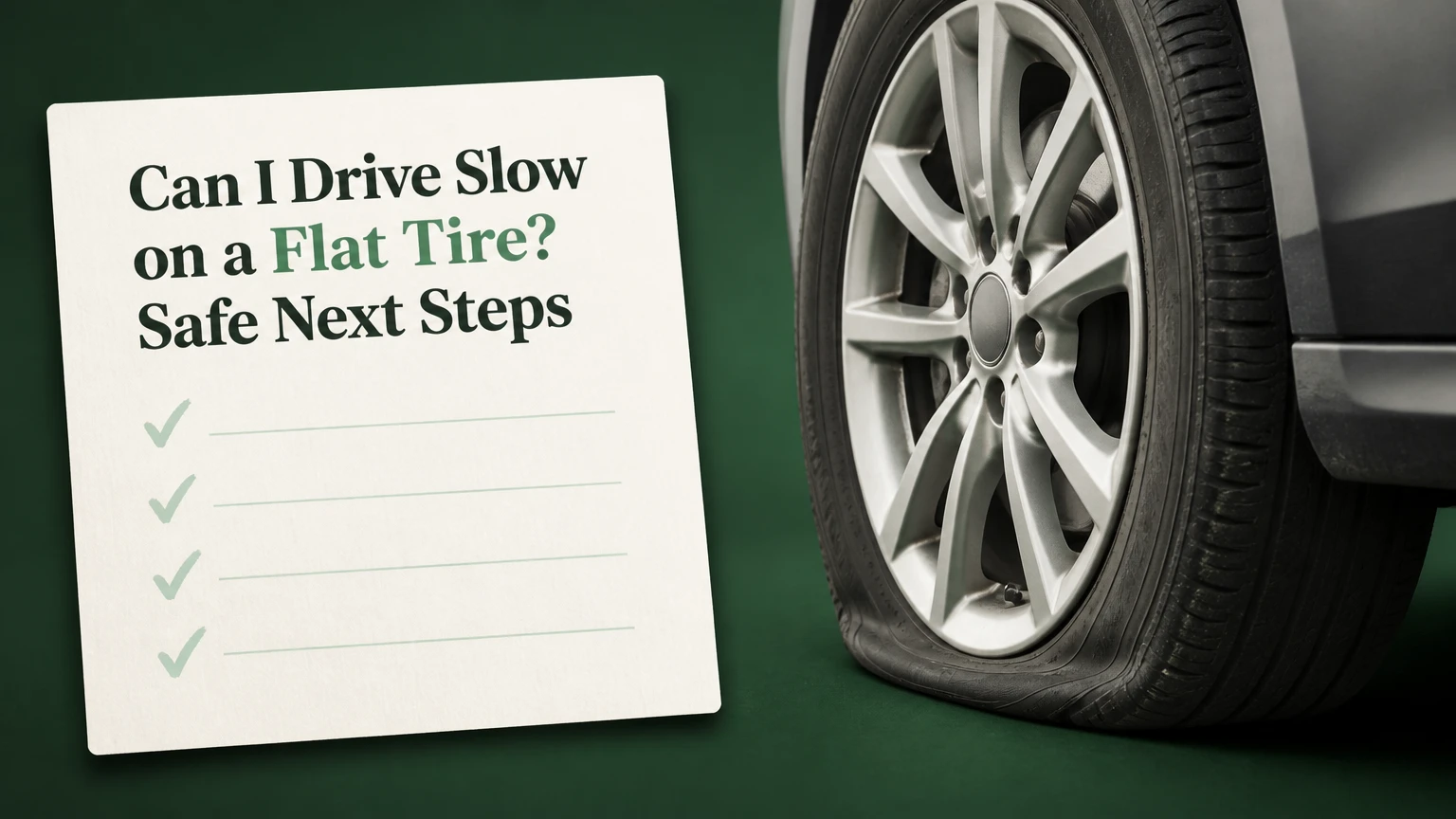
No, you should not drive slowly on a conventional flat tire. A fully deflated tire can lose control stability and suffer internal damage within a very short distance; if stopping immediately creates greater danger, drive only far enough, typically 100-200 meters, to reach a safer location at walking speed, then stop and arrange a spare, repair, or tow.
Key Facts at a Glance
- A conventional tire with little or no air pressure should not be driven to a tire shop.
- Driving on the tire can destroy its sidewall, bead, inner liner, and steel-belt structure before damage is visible.
- A run-flat tire is different, but its permitted distance and speed come only from the tire and vehicle manufacturer.
- A temporary spare commonly carries a 50 mph, or 80 km/h, maximum, but the owner’s manual controls.
- Tire sealant works only for certain small tread punctures and cannot safely repair sidewall, bead, or large-hole damage.
- A flashing TPMS warning usually indicates a sensor-system fault, while a steady warning commonly indicates detected low pressure.
Can I Drive Slow on a Flat Tire?
A driver may move a conventional flat-tired vehicle only the minimum distance needed to escape immediate danger, not to complete a trip. A slow speed reduces some impact energy, but it does not restore the tire’s missing structural support, so the rim can still compress the sidewall against the pavement.
The practical exception is a dangerous stopping location. On a freeway shoulder beside fast traffic, a narrow bridge, a railway crossing, or a live traffic lane, moving 100-200 meters to a wide refuge may be safer than remaining exposed. Keep the steering wheel firmly controlled, avoid abrupt braking or lane changes, activate hazard lights, and stop as soon as the vehicle is protected from traffic.
A flat tire is not defined by one universal PSI number. The correct cold inflation pressure appears on the driver-door placard or in the owner’s manual, and tire pressure can fall well below that value without reaching zero. A tire at 15 PSI is severely underinflated on many passenger vehicles, but the safe response depends on tire construction, load, speed, temperature, and the reason for pressure loss.
How far can you drive on a regular flat tire?
For a standard non-run-flat tire, the recommended distance is zero for normal travel. The 100-200-meter emergency figure is a risk-minimization rule for reaching a safer stopping point, not a manufacturer-approved operating range.
A tire may look repairable from outside after a short movement, yet the sidewall and inner liner can have folded, abraded, or overheated. Tell the tire technician that the tire was driven while deflated. That history changes the inspection decision.
What Happens Inside a Flat Tire?
A pneumatic tire uses air pressure to maintain its shape and spread the vehicle load across the tread, sidewalls, beads, and wheel. When pressure disappears, the vehicle’s weight forces the sidewall to bend sharply between the wheel rim and road surface, creating heat and mechanical abrasion.
The sidewall flexes repeatedly as the wheel rotates. Rubber compounds, fabric plies, steel belts, and bonding layers then experience loads for which they were not designed. The inner liner may develop abrasion marks, the bead can unseat, and the belt package can separate even when the outer tread still appears intact.
The U.S. National Highway Traffic Safety Administration identifies underinflation as a tire safety concern because it increases heat buildup and can contribute to tire failure. Michelin’s passenger-tire guidance also states, “Never drive on a flat tyre,” because a tire that has been run without pressure requires professional inspection even if it can be reinflated.
Why does a flat tire create heat?
A deflated tire creates heat because its unsupported sidewall flexes much farther on each rotation. That repeated deformation converts motion into heat inside the rubber, while the collapsed sidewall rubs against internal components and the road.
The often-repeated claim that every flat tire exceeds 95°C, or 200°F, within seconds is not a reliable universal measurement. Heat buildup varies with vehicle load, speed, ambient temperature, tire size, carcass design, and remaining pressure. The safety conclusion remains the same: damage can develop rapidly, and a driver cannot estimate tire survival accurately from speed alone.
Can the wheel or suspension be damaged?
Yes, a wheel can bend or crack when the rim contacts potholes or pavement after the tire collapses. Brake components, wheel bearings, steering parts, and suspension components can also be damaged by impact, although the tire is usually the first and most certain casualty.
Inspect the vehicle after a flat if the steering wheel is off-center, the car pulls, the wheel vibrates, a brake warning appears, or fluid leaks near the wheel. A tire shop can check wheel runout, bead seating, alignment, and the tire’s internal condition. Do not assume a new tire alone resolves every symptom.
How Do You Decide Whether to Stop Immediately?
The safest choice depends first on exposure to traffic, then on tire damage. A vehicle stopped in a travel lane presents an immediate collision hazard, while a vehicle already on a wide, protected shoulder may not justify any further movement.
| Location or situation | Immediate action | Maximum movement objective | Main risk |
|---|---|---|---|
| Vehicle stopped in a traffic lane | Hazards, firm steering, call emergency services | Move to nearest safe refuge only if controllable | Rear-end or side collision |
| Wide, level shoulder | Stop, secure vehicle, call roadside assistance | 0 meters | Passing traffic and roadside work |
| Narrow freeway shoulder | Remain belted if outside is unsafe; call 911 or roadside service | 100-200 meters only if necessary | High-speed traffic |
| Soft shoulder or steep slope | Avoid jack use; request a tow truck | Nearest stable area | Jack collapse or vehicle roll |
| Snow, darkness, heavy rain | Use hazards and reflective equipment; prioritize professional help | Nearest visible safe area | Poor visibility and unstable footing |
| Near a curve, bridge, or crossing | Move only if the vehicle remains controllable | Beyond the immediate blind spot | Limited sight distance |
Do not stand between the vehicle and traffic. If you cannot safely exit on the shoulder side, remain buckled inside with hazard lights on when local emergency guidance supports that choice. Children and passengers should not wait beside a live roadway.
What Should You Do When a Tire Goes Flat?
A driver with a flat tire should slow gradually, keep both hands available for steering, activate hazard lights, and stop in the safest controllable location. Once stopped, engage the parking brake, switch off the engine, and choose roadside assistance over a tire change whenever traffic, weather, ground conditions, or personal safety make the work hazardous.
Step 1: Control the vehicle
Release the accelerator smoothly and avoid a sudden steering correction. A front flat may create steering pull, while a rear flat can make the vehicle feel unstable or fishtail, particularly during braking.
Keep speed low and predictable. Do not accelerate hard to “clear” the road, and do not slam the brakes unless a collision is unavoidable.
Step 2: Warn other road users
Turn on the hazard warning lights. At night or in poor visibility, use legally permitted warning devices, such as reflective triangles, only if placing them does not expose you to traffic.
Pull as far from moving vehicles as the surface allows. A level, hard shoulder is preferable to soft soil, a live lane, or a slope.
Step 3: Secure and identify the problem
Place the transmission in Park, or in first gear or reverse for a manual vehicle, and apply the parking brake. Check the tire from a safe position without placing hands under the vehicle or crawling beside traffic.
Look for a nail or screw in the tread, a torn sidewall, a separated tread, a displaced bead, or a visibly bent wheel. Do not remove an embedded object before a repair assessment.
Step 4: Select the correct remedy
Use a spare only when the vehicle is stable, the ground is firm and level, and traffic conditions permit the change. Otherwise call a roadside provider, vehicle manufacturer assistance line, law-enforcement agency, or tow operator.
A sealant and compressor may help with a small tread puncture, but neither tool repairs a split sidewall or a tire that has been driven flat.
Step 5: Confirm the repair
After installing a spare, inflate it to the pressure listed on the spare or vehicle information label, not automatically to the regular tire’s pressure. Tighten wheel nuts in the vehicle manufacturer’s specified sequence and torque them with a torque wrench as soon as practical.
You know the temporary repair is complete when the spare holds pressure, the wheel is fully seated, no warning suggests a severe mechanical problem, and the vehicle drives without strong pull or vibration. Stop immediately if those conditions fail.
Which Replacement Option Is Safe for Your Vehicle?
A full-size spare provides the closest match to normal handling, while a temporary spare trades performance for compact storage. A run-flat tire supports limited travel through reinforced sidewalls, and sealant is a narrow emergency option rather than a replacement wheel.
| Option | Typical operating limit | Suitable damage | Typical U.S. cost | Important restriction |
|---|---|---|---|---|
| Full-size spare | Vehicle’s normal speed, subject to spare condition | Most ordinary punctures | $150-$350 for tire and wheel | Must match size, load, and speed requirements |
| Temporary donut spare | Commonly 50 mph, or 80 km/h; often 50-70 miles | Wheel replacement after a puncture | $100-$250 | Manual may restrict distance, axle, or AWD use |
| Run-flat tire | Commonly up to 50 miles at 50 mph, or 80 km at 80 km/h | Pressure loss with intact run-flat structure | $180-$450 per tire | Exact limit and replacement rules vary by model |
| Inflator and sealant kit | Usually a short trip to a tire shop | Small tread puncture within kit limits | $20-$80 | Not for sidewalls, beads, large holes, or some sensors |
| Roadside tow | No tire travel required | Any location or damage | Typically $75-$200 before membership or mileage | Wait time commonly ranges from 30-120 minutes |
Prices are typical consumer ranges, not guaranteed quotes. Labor, taxes, vehicle access, tire size, premium construction, location, and after-hours service can change the final amount.
Can you drive on a run-flat tire?
Yes, a run-flat tire can often be driven after pressure loss, but only within its manufacturer-rated distance and speed. Many models specify approximately 50 miles at no more than 50 mph, while some vehicles use different limits or require immediate replacement.
Run-flat capability is not the same as a conventional tire driven slowly. Reinforced sidewalls and compatible vehicle systems provide the support, but heat, puncture size, load, road conditions, and prior damage still matter. Follow the tire sidewall marking, vehicle manual, and roadside instructions.
Can you drive on a donut spare?
Yes, a temporary spare can be driven for a limited trip if it is correctly inflated and installed. A donut is not a normal tire: its smaller contact patch changes braking, cornering, acceleration, and wet-road behavior.
The common 50 mph limit is not permission to drive indefinitely. Many manufacturers recommend using a donut only to reach a tire retailer, often within 50-70 miles, but some specify shorter distances. Cruise control, towing, heavy loads, and certain axles may be prohibited.
Can you use a spare on an AWD vehicle?
An AWD vehicle may have strict temporary-spare restrictions because tire circumference differences force the center differential or electronically controlled coupling to compensate continuously. Excessive mismatch can create heat and drivetrain wear.
Check the owner’s manual before installation. Some AWD systems permit a temporary spare only on a particular axle, some require disabling a system, and some prohibit the spare entirely. Never assume that four-wheel drive makes a mismatched spare safe.
Is Tire Sealant a Real Alternative?
Tire sealant is suitable only for a limited puncture in the tread area, usually within the product’s stated hole-size limit, commonly around 6 millimeters. The compressor must restore pressure, and the tire should then be driven directly to a repair facility at the product’s stated speed and distance limits.
Sealant cannot repair sidewall cuts, bead leaks, valve-stem failures, wheel cracks, tread separation, or a tire shredded by driving flat. Some products can interfere with tire-pressure sensors or complicate later repairs, so tell the technician which product and quantity were used.
| Damage condition | Sealant suitability | Repair or replacement decision | Driving instruction |
|---|---|---|---|
| Nail in central tread, hole within product limit | Potentially suitable | Shop inspection still required | Drive directly to a shop |
| Screw near shoulder | Usually unsuitable | Professional inspection, often replacement | Do not continue normally |
| Sidewall cut or bulge | Unsuitable | Replace tire | Tow or install approved spare |
| Bead leak at wheel | Unsuitable | Check wheel and tire | Do not drive deflated |
| Large puncture or missing rubber | Unsuitable | Replace tire and inspect wheel | Tow vehicle |
| Tire driven while flat | Sealant does not restore structure | Internal inspection required | Do not rely on reinflation |
The counterintuitive point is that a tire holding air after sealant does not prove structural safety. Air pressure can temporarily mask internal abrasion that only appears during a later high-speed trip.
What Does the TPMS Warning Mean?
A steady tire-pressure monitoring system, or TPMS, warning generally indicates that one or more tires are substantially below the vehicle’s recommended pressure. A flashing light at startup commonly indicates a TPMS malfunction, although the exact display sequence varies by manufacturer.
Use a pressure gauge when the vehicle is safely stopped. Compare every tire with the cold pressure on the door placard, and inspect for visible damage. Do not use a universal 15 PSI cutoff as the sole decision rule: a tire at 15 PSI is unsafe for ordinary driving on most passenger vehicles, but any rapidly losing tire or visibly damaged tire warrants immediate stopping regardless of the number.
After correcting pressure, the warning may need several minutes of driving or a TPMS reset procedure. A repaired puncture, damaged sensor, dead sensor battery, or spare without a compatible sensor can keep the warning active.
What Are the Most Common Mistakes?
Several roadside decisions cause more damage than the original puncture. The main errors are treating reduced speed as protection, trusting a visual inspection, exceeding temporary-spare limits, and changing a tire in an unsafe traffic position.
- Driving several miles to save a tow: A short tow or mobile tire visit is usually less expensive than a tire, wheel, alignment, and suspension repair.
- Assuming reinflation makes the tire safe: A tire driven flat can have hidden inner-liner and sidewall damage; professional inspection is required.
- Using a donut without checking AWD instructions: Circumference mismatch can stress drivetrain components.
- Overloading a temporary spare: Passengers, cargo, towing, and high ambient temperatures increase the tire’s operating burden.
- Changing the tire on soft ground: A jack can sink or tilt, causing the vehicle to fall.
- Ignoring vibration after replacement: Vibration, pulling, grinding, or a displaced steering wheel can indicate wheel, brake, or suspension damage.
A practitioner rule of thumb is simple: if the tire sidewall touched pavement, treat the tire as suspect until a technician inspects its inside. The tread’s outward appearance is not a reliable safety certificate.
How Much Does Flat-Tire Repair Usually Cost?
A small tread-puncture repair commonly costs about $20-$40, while a standard replacement passenger tire commonly costs $100-$250 before mounting, balancing, disposal fees, and taxes. Premium, run-flat, low-profile, truck, and electric-vehicle tires can raise replacement costs substantially.
| Service or part | Typical price range | Typical time | Main variable |
|---|---|---|---|
| Tread puncture repair | $20-$40 | 20-45 minutes | Repair-zone eligibility |
| Mount and balance one tire | $25-$60 | 30-60 minutes | Wheel diameter and shop |
| Standard passenger tire | $100-$250 | 30-90 minutes installed | Brand, size, load rating |
| Run-flat replacement | $180-$450 | 45-120 minutes | Tire model and vehicle |
| Wheel replacement | $150-$600 | 1-3 hours | Steel versus alloy, availability |
| Local roadside tow | $75-$200 base | 30-120 minutes wait | Membership, mileage, time |
A tire shop may refuse a plug-only repair or any repair outside the manufacturer’s permitted zone. A proper repair normally requires removing the tire for an internal inspection and using an approved patch-plug method, not simply inserting an external string plug.
How Can You Prepare Before the Next Flat?
A prepared vehicle should carry a usable spare or a compatible mobility kit, a charged phone, a pressure gauge, gloves, a flashlight, reflective equipment, and the wheel-lock key if the vehicle uses locking nuts. Check the spare’s pressure at least every six months and before long trips because spare tires lose pressure while stored.
Confirm the jack’s lifting point, wheel-nut torque specification, spare speed limit, and AWD restrictions in the owner’s manual. Practice locating the equipment before an emergency, especially in vehicles that store the spare beneath cargo panels or outside under the body.
Drivers without a spare should verify roadside-assistance coverage, towing mileage, mobile tire availability along regular routes, and whether the sealant kit has expired. Sealant cartridges commonly have replacement dates, and a compressor can fail when its cable, fuse, or connector is damaged.
When Is a Flat Tire Repairable?
A tire is often repairable when the puncture is small, located in the central tread repair area, and the tire has not been driven while severely underinflated. A puncture in the sidewall or shoulder generally requires replacement because those areas flex too heavily for a safe permanent repair.
The technician should remove the tire, inspect the inner liner, confirm that the cords and belts are intact, and verify that the puncture meets the tire industry’s repair criteria. The vehicle’s tire manufacturer may impose stricter limits than a general repair guideline.
Replace rather than repair a tire with a bulge, exposed cords, separated tread, deep sidewall cut, bead damage, age-related cracking, or confirmed run-flat travel beyond its permitted limit. Matching tread depth may also matter on AWD vehicles and high-performance cars.
What If You Are on a Highway or in Bad Weather?
On a high-speed road, personal exposure often matters more than preserving the tire. If the vehicle has reached a broad shoulder, keep passengers away from traffic and call for assistance; if the vehicle remains in a live lane, contact emergency services immediately and move only when the vehicle remains controllable.
Do not attempt a roadside wheel change beside fast traffic, on a curve, in a travel lane, on a slope, or in deep snow. A professional roadside technician has warning equipment and a service vehicle designed to create more separation from traffic.
Weather changes the risk calculation. Rain reduces visibility, cold reduces pressure, heat increases tire stress, and snow can hide unstable ground. The correct objective is a protected location, not the nearest tire store.
Frequently Asked Questions
Can I drive a flat tire one mile to a tire shop?
No. One mile is far beyond the emergency movement needed to escape an immediate hazard and can destroy the tire, wheel, or related components. Install an approved spare, use a manufacturer-rated run-flat within its limits, or arrange roadside service instead.
Can I drive with low tire pressure if the tire is not completely flat?
A short, slow trip may be possible only when pressure is slightly low, the tire is undamaged, and the pressure remains stable after inflation. If pressure is rapidly falling, the tire is visibly deformed, or the TPMS warning returns, stop and seek inspection rather than continuing.
Can a tire with a sidewall puncture be repaired?
A sidewall puncture generally cannot be safely repaired because the sidewall carries repeated flexing loads. A tire with a cut, bulge, exposed cord, or abrasion in the sidewall normally requires replacement, even if a compressor temporarily restores pressure.
Does a flat tire always mean the wheel is damaged?
No. A flat tire does not automatically damage the wheel, but driving on it increases the chance of a bent rim, bead damage, and loss of wheel balance. Have the wheel inspected if the rim contacted pavement or the vehicle develops vibration, pulling, or air loss after tire replacement.
How long can a spare tire remain installed?
A temporary spare should remain installed only until the regular tire is repaired or replaced, commonly for less than 50-70 miles and at no more than 50 mph. A full-size spare can remain in service only if its age, condition, size, load rating, and tread match the vehicle’s requirements.
Should I turn off traction control with a temporary spare?
Do not change traction-control settings unless the vehicle manual specifically instructs you to do so. Electronic stability and traction systems are calibrated for the vehicle’s tire sizes, so an incorrect setting can worsen handling or trigger warnings.
The Bottom Line
Can I drive slow on a flat tire? Only far enough to leave an immediately dangerous position, typically 100-200 meters, and only if the vehicle remains controllable. Do not drive a conventional flat tire to a shop, do not trust reinflation after deflated travel, and do not exceed the exact limits for a run-flat or temporary spare. Stop safely, use the correct replacement or repair method, and have any tire driven without pressure professionally inspected.


