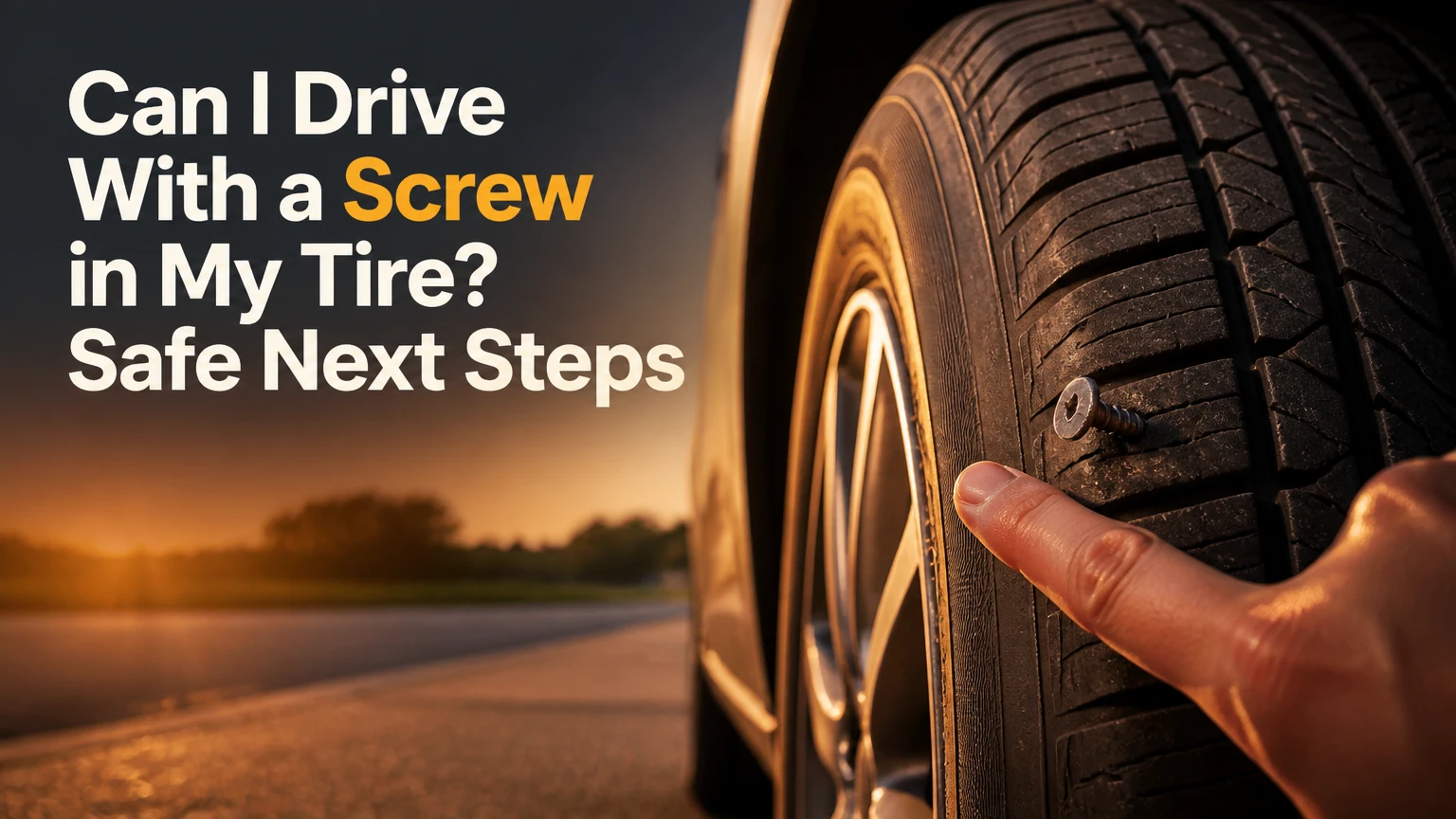
You should not drive normally with a screw in your tire. If the tire still holds pressure, you may be able to drive a very short distance directly to a tire shop at low speed, but a flat, rapidly leaking, sidewall-damaged, or visibly distorted tire requires a spare tire or tow.
Key Facts at a Glance
- A screw can temporarily slow an air leak, so removing it beside the road can cause rapid deflation.
- A tire with a screw should be checked immediately, even when the TPMS warning light is off.
- A puncture in the central tread may be professionally repairable when the internal structure remains sound.
- A puncture in the sidewall or shoulder normally requires tire replacement.
- Do not use 15 PSI as a universal driving threshold; vehicle load, tire type, distance, and leak rate all affect safety.
- A properly performed internal patch-plug repair is different from a quick external plug or liquid sealant.
Can I Drive With a Screw in My Tire?
You can sometimes drive a few miles with a screw in the tread if the tire is inflated to the vehicle manufacturer’s recommended cold pressure and is losing air slowly. Drive directly to a tire professional at approximately 30 mph or less, avoid highways, braking hard, cornering sharply, and carrying unnecessary load.
A tire with a screw is not safe for ordinary commuting. Driving adds repeated flexing, heat, and centrifugal force while the screw moves inside the puncture. Those forces can enlarge the hole, damage the inner liner, separate belts, or turn a repairable puncture into a replacement.
The key decision is not simply whether the screw remains visible. Check the cold tire pressure with a gauge, compare it with the driver-door placard, and determine whether pressure falls during a short observation period. A screw in the center tread with stable pressure presents a different risk from a screw near the shoulder, a tire below safe inflation, or a tire that visibly bulges.
When Is a Short Drive Acceptable?
A short drive is acceptable only as a controlled relocation to a nearby repair facility, not as permission to continue driving. The tire should have no sidewall bulge, exposed cord, severe vibration, wheel damage, or rapid pressure loss, and the route should avoid high-speed roads.
Typical roadside guidance is to remain below 30 mph and travel only the distance needed to reach help. The exact limit is not a universal engineering guarantee. Tire manufacturers, vehicle makers, and roadside technicians may give different instructions for specific tire constructions, run-flat systems, loads, and weather conditions.
If the shop is several miles away and pressure is falling, inflate the tire only to the vehicle placard pressure if the tire is structurally intact. Recheck it before leaving. A portable compressor can restore pressure temporarily, but it cannot repair damaged belts or a leaking sidewall.
Why a Screw in a Tire Can Become Dangerous
A screw can act as a temporary plug while the tire loses air slowly, but tire movement can enlarge the puncture and create internal damage. Underinflation then increases sidewall flexing and heat, which can cause structural failure even when the tread still looks acceptable.
A modern pneumatic tire contains tread rubber, steel or textile belts, an inner liner, sidewalls, beads, and, in some designs, noise-reduction foam or run-flat reinforcements. A screw passes through some of these layers at an angle that cannot be judged reliably from the outside.
The tire’s contact patch repeatedly flattens against the road. The screw may tilt, rotate, or cut rubber during each wheel revolution. The inner liner can be scraped by the screw or by the puncture channel, and moisture can reach steel components if the hole remains untreated.
Underinflation adds a second failure mechanism. A tire with insufficient air bends more deeply in the sidewall, generates heat, changes steering response, and places additional stress on the bead and belt package. The National Highway Traffic Safety Administration, or NHTSA, advises drivers to inspect tire condition and maintain the pressure specified by the vehicle manufacturer, rather than relying on the maximum pressure molded into the tire sidewall.
A TPMS warning is useful but limited. Federal TPMS requirements generally identify significant underinflation, not every slow leak or every structural injury. The warning may appear only after pressure has fallen substantially.
How Should You Check the Tire Before Moving?
Check pressure, leak speed, puncture location, and visible structural damage before deciding whether to relocate the vehicle. A pressure gauge, soapy water, flashlight, and tread inspection provide better evidence than the dashboard light alone.
Follow these steps:
- Park safely on level ground. Turn on hazard lights, engage the parking brake, and avoid working in a live traffic lane.
- Read the cold pressure. Use the driver-door placard or owner’s manual, not the tire sidewall maximum. Measure all four tires if practical.
- Inspect the screw’s location. Center tread is the most favorable area. Shoulder and sidewall locations are substantially less repairable.
- Listen and spray. A hiss or growing soap bubbles indicate active leakage. Do not press, twist, or remove the screw to test it.
- Look for structural warning signs. Bulges, cuts, exposed cords, tread separation, a bent rim, or a tire that has been driven flat require roadside assistance.
- Plan the route. Select the closest tire facility, avoid expressways, and stop immediately if steering, vibration, noise, or pressure changes.
You will know a controlled relocation is more reasonable when the tire reaches the placard pressure, the leak is slow, the puncture is in repairable tread, and the shop is nearby. A common mistake is to judge safety by appearance after adding air, because internal damage may remain invisible.
Is 15 PSI Safe Enough to Drive?
No universal 15 PSI threshold makes a damaged tire safe to drive. A tire at 15 PSI is severely underinflated for most passenger vehicles, and driving on it can damage the sidewall and wheel even if the tire is not completely flat.
Use the vehicle placard pressure as the reference. If the tire cannot hold that pressure, drops quickly, or has already been driven while visibly soft, use the spare tire or a tow truck instead of relying on a fixed PSI number.
Run-flat tires are an exception only within their manufacturer’s stated limits. Michelin, Bridgestone, Continental, and other manufacturers publish different distance and speed restrictions for run-flat products, and those limits assume particular conditions. A conventional tire cannot be treated like a run-flat tire.
Should You Pull the Screw Out?
Do not pull out a screw that is still in the tire unless a repair professional is ready to inspect and repair the puncture. Removing the object can open the channel and release air rapidly, leaving the vehicle immobile.
If the screw has already fallen out, do not insert another object into the hole. Measure pressure, use soapy water to locate the leak, and decide between a spare, tow, or carefully controlled trip to a nearby shop based on the result.
An external plug kit can be appropriate as an emergency measure in remote areas, but it should not be treated as proof that the tire is permanently repaired. The tire should still be removed and inspected from the inside because a plug cannot reveal belt, liner, or bead damage.
Where Is a Screw Puncture Repairable?
A screw puncture is most likely repairable when it is within the central tread, no larger than approximately 1/4 inch, entered without severe internal damage, and has not been driven while substantially underinflated. The final decision belongs to a qualified tire technician after demounting and inspecting the tire.
The U.S. Tire Manufacturers Association and tire-industry repair practices distinguish the tread repair zone from the shoulder and sidewall. Exact boundaries vary by manufacturer, but a screw close to the outer tread ribs is less suitable for repair because the shoulder flexes more than the center tread.
| Damage location or condition | Typical decision | Reason for decision | Required next action |
|---|---|---|---|
| Center tread, hole up to 1/4 inch | Repair often possible | Stable tread area with limited flexing | Internal inspection and patch-plug repair |
| Shoulder near outer tread rib | Replacement usually required | High flexing can cause repair failure | Replace tire |
| Sidewall puncture or bulge | Replacement required | Sidewall carries structural and steering loads | Fit spare or tow vehicle |
| Hole larger than 1/4 inch | Repair usually rejected | Rubber and belt damage may exceed repair limits | Replace tire |
| Tire driven while flat | Replacement or specialist inspection | Inner liner and sidewall may be hidden-damaged | Do not drive further |
| Previous repair overlapping puncture | Often replacement | Repair zones can weaken or leak | Follow tire-maker policy |
A puncture’s angle also matters. A straight, clean penetration through the tread is easier to assess than a diagonal tear, irregular hole, or screw that has enlarged the opening. Tires with sealant contamination, foam inserts, or unusual constructions may require special handling.
What Does a Professional Repair Involve?
A professional repair usually involves removing the tire from the wheel, locating the full injury, inspecting the inner liner, preparing the rubber, and installing a combination repair unit from inside the tire. The repair must seal the puncture channel and reinforce the inner liner.
The common patch-plug unit combines a stem that fills the puncture path with a patch that seals the inner liner. A technician may reject the tire if internal abrasion, belt separation, chemical contamination, or prior run-flat operation is found.
A proper repair generally takes about 30-60 minutes, depending on the shop queue and wheel assembly. The repair itself does not erase the tire’s age, tread wear, uneven wear, or previous damage. Tire pressure, valve condition, wheel balance, and TPMS operation should be checked before the vehicle leaves.
Which Repair Option Is Safest?
For a qualifying tread puncture, an internal patch-plug repair is normally the safest and most durable option. An external rope plug is a temporary roadside measure, while liquid sealant is an emergency alternative with compatibility and cleanup limitations.
| Repair method | Typical cost in the USA | Typical time | Appropriate use | Main limitation |
|---|---|---|---|---|
| Internal patch-plug | $25-$60 | 30-60 minutes | Qualifying center-tread puncture | Requires tire removal and inspection |
| External rope plug | $5-$20 DIY kit | 10-20 minutes | Emergency mobility in remote areas | Does not inspect internal damage |
| Aerosol or liquid sealant | $8-$25 | 5-15 minutes | Small leaks when vehicle kit permits | May foul TPMS and complicate repair |
| Tire replacement | $100-$350 or more | 30-90 minutes | Sidewall, shoulder, large hole, structural damage | Higher cost and possible pair replacement |
| Spare-tire installation | No repair cost | 15-30 minutes | Flat or unsafe damaged tire | Limited speed, distance, and handling |
Prices are typical United States consumer ranges, not fixed quotes. Run-flat tires, large SUV tires, premium EV tires, mounted-wheel service, regional labor rates, and tire disposal fees can raise the total.
An external plug may stop a slow leak, but its success depends on the hole, insertion technique, rubber condition, and plug material. A plug that is cut too short, inserted without proper preparation, or used in the shoulder can leak or pull out.
Liquid sealant is not a universal fix. Some vehicle manufacturers prohibit aftermarket sealants, and some products can interfere with tire-pressure sensors or make later internal inspection messier. Use only the product and procedure approved for the vehicle when the owner’s manual specifies one.
When Must You Replace the Tire?
Replace the tire when the screw punctures the sidewall or shoulder, the hole exceeds the manufacturer’s repair limit, cords are visible, the tire has a bulge, or the vehicle was driven on it while flat. Replacement is also appropriate when internal inspection finds liner abrasion, belt damage, or a previous repair in the same area.
| Replacement trigger | Why repair is unsuitable | Practical consequence |
|---|---|---|
| Sidewall puncture | Sidewall flexing defeats normal repairs | Replace the tire |
| Shoulder injury | Repair may sit in a high-flex zone | Replace unless manufacturer explicitly permits repair |
| Exposed steel or textile cords | Structural package is compromised | Do not inflate for road use |
| Severe underinflation driving | Heat can destroy the inner liner | Demount and inspect, often replace |
| Two overlapping punctures | Repair materials may interfere | Follow manufacturer limits |
| Tread too worn or tire aged | Puncture is not the only safety concern | Replace with a suitable matching tire |
Replacing one tire can create a tread-depth difference that affects traction and, on some vehicles, drivetrain operation. AWD manufacturers may specify maximum circumference or tread-depth differences. Ask the tire shop to compare the remaining tires and consult the vehicle manual before replacing only one tire.
Some vehicles require a tire with the same size, load index, speed rating, construction, and approved technology. EVs can place higher loads on tires because of battery weight and may require specific low-rolling-resistance or acoustic-foam products.
What Should You Do With a Flat Tire?
Do not drive on a completely flat or visibly collapsed tire. Driving even a short distance can destroy the wheel, damage the tire beyond repair, and create unstable handling.
Install the vehicle’s spare according to the owner’s manual, call roadside assistance, or arrange a tow. A temporary compact spare commonly carries a 50 mph maximum, but the exact speed and distance limits are printed on the spare or in the vehicle manual.
If the tire is flat on a busy roadway, move passengers away from traffic and do not attempt a repair in an unsafe location. A tow operator can often bring an air source, mount the spare, or transport the vehicle to a tire facility.
What If the Screw Is in the Sidewall?
A screw in the sidewall normally means tire replacement, not patching or plugging. Sidewalls flex continuously and carry important load and cornering forces, so ordinary puncture repairs cannot restore the original structure.
Do not inflate a sidewall-damaged tire to drive to a shop unless a qualified roadside professional instructs you after inspecting it. A sidewall bulge, cut, or exposed cord is an immediate stop condition even when the tire appears to hold air.
How Do Repair Choices Compare in Real Situations?
The best choice depends on the tire’s current condition and the distance to help, not on the lowest advertised price. A patch-plug is the normal shop solution, a plug kit supports emergency mobility, sealant suits limited vehicle-approved situations, and replacement handles structural or nonrepairable damage.
| Driver situation | Safest immediate choice | Acceptable temporary option | Avoid |
|---|---|---|---|
| City street, stable center-tread leak | Drive slowly to nearby shop | Add air and recheck pressure | Normal commute or highway speed |
| Highway shoulder, active leak | Spare or roadside service | Shop-approved inflation only | Repairing beside live traffic |
| Rural road, no signal, stable tread puncture | Plug kit plus compressor to reach help | Temporary external plug | Treating plug as permanent |
| EV without spare, approved inflator kit | Manufacturer’s sealant procedure | Tow if sidewall or large hole | Unapproved sealant |
| Flat tire with compact spare | Install spare | Tow service | Driving on the flat |
| AWD vehicle with one damaged tire | Confirm replacement matching rules | Replace a matched pair if required | Installing a mismatched tire |
A driver carrying a compressor should also carry a pressure gauge, tire gloves, flashlight, valve-core tool only when trained, and a correctly sized plug kit. These tools improve mobility but do not replace a professional internal inspection.
Typical Cost and Repair Time
A qualifying tire puncture repair typically costs $25-$60 and takes 30-60 minutes in the United States. Tire replacement commonly costs $100-$350 or more per tire, with mounting, balancing, taxes, disposal, specialty construction, and vehicle fitment affecting the final invoice.
The lowest-cost option is not automatically the lowest-risk option. A $10 rope-plug kit can be useful when a driver is remote, but a failed plug can cause another pressure loss and may prevent a shop from applying its preferred repair method.
A tire shop may also identify a damaged valve stem, bent wheel, uneven tread wear, or alignment problem during inspection. Those findings can explain why the tire lost pressure and prevent a repeat failure.
Common Mistakes and How to Fix Them
- Removing the screw immediately: The puncture may open and deflate the tire. Leave it in place until pressure can be controlled and repair is available.
- Driving at highway speed: Heat and flexing increase as speed and load rise. Exit safely, reduce speed, or stop for roadside assistance.
- Using the sidewall maximum pressure: The molded maximum is not the vehicle’s normal operating target. Use the door placard or manual.
- Trusting a silent TPMS system: A slow leak may not trigger the warning promptly. Check pressure with a gauge.
- Using a plug on the shoulder: The shoulder’s flexing can cause leakage or failure. Have the tire inspected and replace it when required.
- Driving after adding air without monitoring: Pressure may fall again within minutes. Recheck before departure and stop if the reading changes.
- Assuming a successful plug proves safety: A plug does not reveal inner-liner or belt damage. Request a full internal inspection.
One practitioner rule is especially useful: if the tire needs repeated inflation during the same trip, stop treating the problem as a minor leak. Repeated pressure loss indicates that the tire, valve, wheel, or repair requires diagnosis.
After-Repair Checks and Replacement Decisions
After repair, confirm the tire reaches the placard pressure, the TPMS warning resets according to the vehicle procedure, and no air bubbles appear around the repair or valve. A technician should also check balance when the tire has been demounted and inspect adjacent tread for additional objects.
Monitor the repaired tire daily for several days, then check it at least monthly when cold. The U.S. Tire Manufacturers Association recommends regular pressure inspection because pressure changes with temperature and leaks may develop gradually.
A repaired tire still needs normal service. Replace it later if tread wear reaches the legal or manufacturer limit, if new bulges or cracks appear, or if pressure loss returns. A repair addresses the puncture, not every condition affecting tire life.
FAQ
Can a screw in a tire cause a blowout?
A screw does not guarantee a blowout, but continued driving can turn a small puncture into a serious failure. Pressure loss increases sidewall flexing and heat, while the screw can enlarge the hole or damage internal components. Stop driving normally and arrange prompt inspection, especially after a low-pressure warning.
Can I leave my car overnight with the screw still installed?
Leaving a vehicle parked overnight with the screw in place is generally safer than removing it and causing an immediate leak. Park on level ground, measure pressure, and arrange inspection as soon as possible. Do not assume unchanged pressure means the puncture is harmless.
Will a tire plug last permanently?
A properly installed plug may last, but an external plug alone does not provide the same inspection or sealing method as an internal patch-plug repair. Tire manufacturers and repair shops may reject external-only repairs. Use a plug as an emergency mobility measure unless a qualified technician confirms the repair meets applicable standards.
Does a screw always mean the tire needs replacement?
No. A screw in the central tread may be repairable when the hole is within the manufacturer’s size limit and the tire has no internal damage. Sidewall or shoulder punctures, large holes, exposed cords, severe underinflation driving, and overlapping repairs usually require replacement.
Can I drive with a screw in a tire if the TPMS light is off?
An off TPMS light does not prove that the tire is safe. The system may not warn about a slow leak or structural damage. Measure pressure manually, inspect the location, and use a tire shop or roadside service for any doubt rather than continuing a normal trip.
Should I replace two tires instead of one?
Replace two tires when the vehicle manufacturer, tire shop, or AWD system requires closely matched tread depth and circumference. Replacing one tire can be acceptable when the remaining tires have similar size, model, condition, and tread depth. Check the owner’s manual before ordering a single replacement.
The Bottom Line
You should not continue normal driving with a screw in your tire. If pressure is stable and the screw is in the central tread, drive slowly and directly to a nearby tire shop; if the tire is flat, rapidly leaking, damaged on the shoulder or sidewall, or unstable, install the spare or call for a tow. A professional internal patch-plug repair is usually the preferred solution for a qualifying tread puncture.


