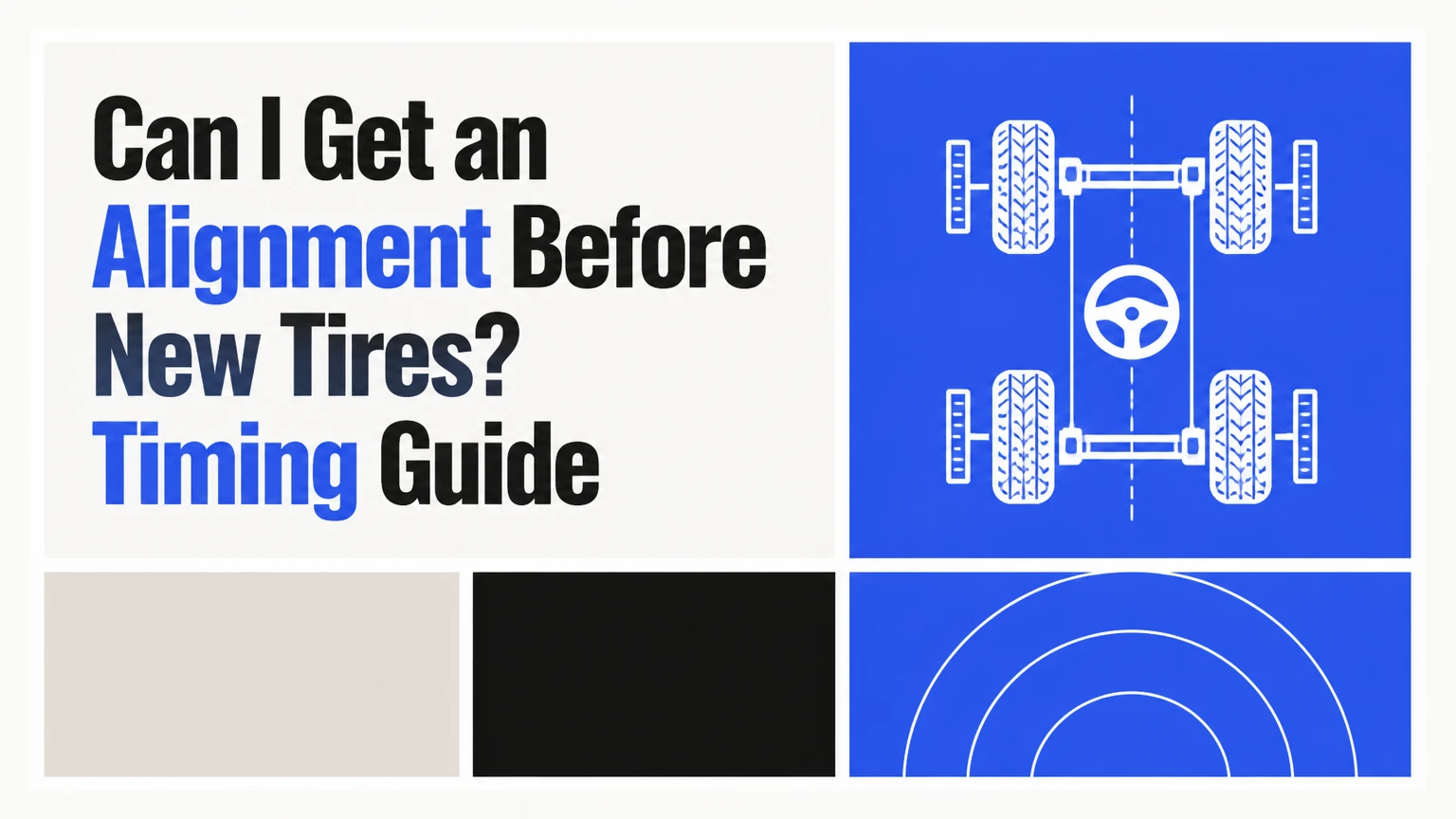
Yes, you can get an alignment before installing new tires, but the preferred sequence is to inspect the suspension first, mount and balance the new tires, then perform the final alignment. Wheel alignment adjusts suspension geometry, not the rubber itself. Aligning before tire installation is useful for diagnosis, but aligning only afterward gives the technician the correct final tire-and-wheel setup.
Key Facts at a Glance
- A final wheel alignment should normally follow new-tire installation and balancing.
- Old tires usually do not materially distort alignment-machine readings, although severe wear, incorrect tire size, or a damaged wheel can complicate diagnosis.
- New tires do not automatically require an alignment, but an alignment protects them when the old tires show one-sided or feathered wear.
- A four-wheel alignment measures all wheels and is normally the correct service for modern cars with independent rear suspension.
- Wheel balancing fixes vibration caused by weight imbalance; alignment fixes directional geometry, tracking, and certain wear patterns.
- A technician should inspect tie rods, ball joints, control arms, bushings, wheel bearings, tire pressure, and wheel condition before adjusting angles.
Can I Get an Alignment Before New Tires?
You can get a diagnostic alignment before new tires, but a final alignment before tire installation is usually the wrong service order. The most reliable sequence is suspension inspection, tire replacement, wheel balancing, tire-pressure adjustment, alignment, and a road test.
A pre-tire alignment can reveal bent suspension components, a shifted subframe, or severe toe error. It can also document the vehicle’s condition before parts are replaced. However, the technician should normally complete the final measurements after the new tires are mounted because the vehicle will then be evaluated in its actual driving configuration.
The common claim that worn tires routinely alter alignment-sensor readings through ride-height changes is overstated. Alignment heads measure wheel and rim relationships, while the suspension establishes the geometry. A badly worn tire can affect the vehicle’s stance or imitate a pull, but ordinary tread wear does not make a sound alignment machine inaccurate.
When Is a Pre-Tire Alignment Useful?
A pre-tire alignment is useful when a shop needs to diagnose abnormal wear, document collision damage, or determine whether a suspension repair is required before selling tires. Ask for a measurement printout rather than paying for adjustments that will immediately be followed by tire installation.
A technician may measure the vehicle first when:
- The current tires show extreme inside-edge wear.
- The steering wheel is substantially off-center.
- The vehicle struck a curb, pothole, or road debris.
- A collision insurer requires geometry documentation.
- The shop suspects a bent knuckle, control arm, tie rod, or subframe.
- The owner needs to decide whether new tires are economically sensible.
If the shop changes suspension parts after the preliminary reading, the alignment must be repeated. Replacing a tie rod, control arm, strut, spring, or rear suspension link changes measured geometry.
Why Should New Tires Usually Come Before the Final Alignment?
New tires should usually come before the final alignment because the alignment must protect the tires that will remain on the vehicle. Fresh tires provide uniform tread depth and the correct casing shape, while an old tire may have conicity, irregular wear, a damaged belt, or a different rolling resistance that affects the road-test diagnosis.
The final service order is:
- Inspect steering and suspension components.
- Confirm the replacement tire size and load rating.
- Mount the new tires on suitable wheels.
- Balance each tire-and-wheel assembly.
- Set cold inflation pressure to the vehicle placard specification.
- Measure and adjust alignment angles.
- Reset the steering-angle sensor when required.
- Road-test the vehicle on a reasonably flat road.
The technician should not use alignment to compensate for a defective tire. If the vehicle pulls after alignment, the shop should verify tire conicity, tire pressure, road crown, brake drag, wheel bearing condition, and suspension geometry instead of repeatedly adjusting toe.
Does Tire Wear Change the Alignment Reading?
Tire wear can change how a vehicle behaves on the road, but normal wear does not usually change the mechanical alignment value enough to justify a separate alignment before tire installation. Extreme wear can reduce effective tire diameter, alter ride height slightly, or create a tire-induced pull that makes diagnosis less clear.
Alignment equipment typically clamps targets to the wheels or uses cameras to calculate wheel angles. The rim provides the reference surface. A tire with a worn shoulder does not generally move the rim relative to the suspension.
The important exception is a vehicle with mismatched tire sizes, very low pressure, a collapsed sidewall, a separated belt, or unusually uneven tread. Those conditions can make the vehicle sit or track abnormally. They still do not mean the machine should be trusted blindly; they mean the technician should inspect and correct the tire problem before interpreting the road-test result.
What Does a Wheel Alignment Adjust?
A wheel alignment measures and, where the vehicle design permits, adjusts camber, caster, toe, and the rear thrust angle. These values describe how each wheel sits relative to the road, the vehicle centerline, and the other wheels.
| Alignment angle | Viewed from | What the angle controls | Common wear or handling result |
|---|---|---|---|
| Camber | Front of vehicle | Inward or outward wheel tilt | Inside- or outside-edge wear |
| Caster | Side of vehicle | Steering-axis forward or rearward tilt | Steering return, stability, pull tendency |
| Toe | Above vehicle | Whether tires point inward or outward | Feathering, scrub, wandering |
| Thrust angle | Behind vehicle | Rear axle direction versus centerline | Dog-tracking, crooked steering wheel |
Vehicle specifications are model-specific. A typical passenger-car target may show approximately -1 to +1 degree of camber, several degrees of positive caster, and a small fraction of a degree of total toe, but those figures are examples rather than universal targets. The shop should use the manufacturer’s specification for the exact year, trim, suspension, and ride height.
Which Alignment Angle Wears New Tires Fastest?
Toe error often destroys new tread fastest because the tires scrub sideways across the pavement on every mile. Even a small toe error can create feathering, and the driver may notice a sawtooth texture before seeing dramatic visual damage.
Camber usually produces concentrated inside- or outside-edge wear. Caster generally affects steering effort, return, and directional stability more than direct tread wear. A technician must evaluate all angles together because a toe adjustment can hide the effect of a bent component without repairing the underlying camber or thrust-angle problem.
A printout should show “before” and “after” values for each measured wheel. “Within range” is less informative than the actual readings, especially when one side is near the limit and the other is not.
Do You Need a Two-Wheel or Four-Wheel Alignment?
Most modern cars, crossovers, SUVs, and all-wheel-drive vehicles should receive a four-wheel alignment measurement. A two-wheel alignment may be appropriate only when the vehicle’s rear axle is a rigid, non-adjustable design and the manufacturer’s procedure supports front-end adjustment alone.
| Vehicle or axle design | Recommended service | Reason | Typical shop time |
|---|---|---|---|
| Front-wheel-drive sedan with independent rear suspension | Four-wheel alignment | Rear thrust angle affects front steering | 45-90 minutes |
| AWD crossover or SUV | Four-wheel alignment | All wheels influence tracking and tire wear | 60-90 minutes |
| Older rear-wheel-drive truck with solid rear axle | Front-end alignment or four-wheel measurement | Rear axle may have no routine adjustment | 30-60 minutes |
| Lifted, lowered, or modified vehicle | Specialty four-wheel alignment | Factory targets may no longer fit geometry | 60-120 minutes |
| Vehicle after suspension replacement | Four-wheel measurement when specified | Changed parts alter multiple angles | 45-120 minutes |
A “front-end alignment” can be cheaper, but measuring only the front wheels may ignore a rear thrust angle that forces the steering wheel off-center. Rear toe and camber are adjustable on many vehicles even when the owner assumes only the front axle matters.
What Happens During a Professional Alignment?
A professional alignment normally takes 45-90 minutes, including inspection, compensation, adjustments, and a road test. The technician first determines whether the vehicle is mechanically capable of holding the requested settings, because alignment cannot repair looseness or bent metal.
Step 1: Inspect the Vehicle
The technician checks tire pressure, tire condition, wheel runout, ride height, steering linkage, ball joints, control arms, bushings, wheel bearings, springs, and shock or strut condition. Some shops also check brake drag because a sticking caliper can imitate a pull.
If a joint has measurable play, the technician should explain the failed component before adjustment. An alignment performed on a loose tie rod or ball joint may look correct on the rack and become incorrect as soon as the vehicle moves.
Step 2: Mount and Compensate the Sensors
Alignment targets or sensor heads attach to the wheels, and the system is compensated for wheel runout according to the equipment procedure. Some systems require rolling the vehicle forward or backward, while others use a stationary compensation method.
Incorrect target mounting, damaged wheel lips, or failure to perform compensation can produce misleading readings. Ask whether the machine was loaded with the correct vehicle specification and whether the technician recorded before-and-after values.
Step 3: Adjust the Geometry
Technicians usually establish the rear thrust direction first, then adjust the front axle relative to that direction. Common adjustments include turning tie rods for toe, moving eccentric bolts for camber or caster, or installing approved shims or adjustment hardware on vehicles designed for them.
Not every factory angle is adjustable. If camber or caster is out of range, the correct repair may involve a bent part, worn bushing, shifted subframe, or manufacturer-approved replacement component.
Step 4: Center the Steering and Verify the Result
The steering wheel must be held correctly while toe is adjusted so the wheel remains centered when the vehicle travels straight. The technician then checks the final readings and road-tests the vehicle for pull, drift, steering return, noise, and abnormal behavior.
You should receive a printout with the vehicle specification, measured values, and final values. A centered steering wheel matters, but a centered wheel alone does not prove that all four wheels are correctly aligned.
What Does Alignment Cost With New Tires?
A typical North American wheel alignment costs about $80-$180, while a specialty or modified-vehicle alignment may cost $150-$300. Tire mounting and balancing commonly add $20-$50 per tire, and damaged suspension parts or ADAS calibration can increase the invoice substantially.
| Service | Typical price range | Typical time | What the charge covers |
|---|---|---|---|
| Front-end alignment | $60-$120 | 30-60 minutes | Front measurements and permitted adjustments |
| Four-wheel alignment | $80-$180 | 45-90 minutes | Four-wheel measurements and adjustments |
| Tire mounting and balancing | $20-$50 per tire | 45-90 minutes | Removal, mounting, inflation, and balancing |
| Suspension repair before alignment | $150-$1,500+ | 1-8 hours | Parts and labor, vehicle-dependent |
| ADAS calibration | $150-$500+ | 1-3 hours | Camera or radar calibration when required |
Prices vary with location, vehicle access, seized adjusters, specialty wheels, and whether the quoted alignment includes a recheck. A lifetime alignment plan can make sense for a driver who returns repeatedly, but calculate the break-even point and read exclusions for modified vehicles, commercial use, or vehicles that need repairs before adjustment.
New tires do not make an alignment free or automatically necessary. The economic case is strongest when the old tires show alignment-related wear, the vehicle recently suffered an impact, or the steering wheel and tracking are abnormal.
Alignment Versus Balancing: Which Service Do You Need?
Wheel alignment corrects suspension geometry, while wheel balancing corrects uneven mass distribution in the tire-and-wheel assembly. New tires normally require balancing, but they require alignment only when measurements, symptoms, tire wear, or recent suspension work justify it.
| Symptom or finding | More likely service | Why | Immediate check |
|---|---|---|---|
| Vibration at 55-75 mph | Wheel balancing | Rotating assembly has a weight imbalance | Inspect weights and wheel runout |
| Crooked steering wheel | Alignment | Front toe or thrust angle may be incorrect | Check all four wheel readings |
| Feathered tread | Alignment | Toe can scrub tread across pavement | Run a hand across tread carefully |
| Pull after tire replacement | Tire diagnosis and alignment check | Tire conicity can mimic geometry error | Swap front tires only if permitted |
| Clunk over bumps | Suspension repair | Loose or damaged component is present | Inspect joints and bushings |
| Steering shake during braking | Brake or front-end diagnosis | Rotor or hub runout may be involved | Measure runout and inspect caliper |
Balancing cannot correct a vehicle that wanders, and alignment cannot remove a high-speed vibration caused by an imbalanced assembly. A shop recommending both after installing tires is not automatically upselling; mounting and balancing are part of the installation, while alignment depends on evidence.
Can New Tires Fix a Pull Without an Alignment?
New tires can eliminate a pull caused by uneven tread, internal tire damage, or tire conicity, but new tires cannot repair incorrect suspension geometry. If the old tires pulled and the new tires track straight, the original symptom may have been tire-related, yet the shop should still inspect alignment-related wear before declaring the suspension correct.
A practical diagnostic sequence is:
- Check all four tire pressures against the driver-door placard.
- Confirm the replacement tires match the specified size and load rating.
- Inspect for bent wheels, belt separation, and irregular wear.
- Measure alignment if the old tires had one-sided or feathered wear.
- If a pull remains, test for tire conicity, brake drag, wheel-bearing play, and road crown.
- Follow the manufacturer’s tire-rotation direction before swapping positions for diagnosis.
A crowned road naturally encourages a vehicle toward the shoulder, so a brief test on a level road matters. Tire conicity can persist even when alignment readings are excellent, and repeated toe adjustments will not cure it.
What If Suspension Parts Are Worn?
A technician should repair worn steering or suspension components before performing the final alignment. Alignment settings cannot remain stable when a tie rod, ball joint, bushing, wheel bearing, or control-arm mount allows the wheel to move under braking, acceleration, or cornering.
This is the most important financial safeguard in the process. Buying tires, paying for an alignment, then replacing a loose control arm afterward creates a second alignment bill and may damage the new tires before the repair is complete.
Common Repair-Readiness Findings
- Loose tie rod: toe changes as the steering moves, producing feathered wear.
- Worn ball joint: wheel position changes under load and may create a safety risk.
- Collapsed control-arm bushing: caster or camber shifts during braking.
- Bent knuckle or control arm: one angle remains outside specification after adjustment.
- Shifted subframe: both front wheels may show related side-to-side errors.
- Damaged wheel bearing: play can invalidate measurements and create noise.
A reputable shop should distinguish “out of specification” from “not adjustable.” The first may require an adjustment; the second may require diagnosis and repair.
Does ADAS Calibration Follow a Wheel Alignment?
ADAS calibration may follow a wheel alignment when the vehicle’s manufacturer requires it, but physical alignment and electronic calibration are separate procedures. Lane-centering, adaptive cruise control, automatic emergency braking, and steering-angle systems can depend on accurate vehicle geometry.
The steering-angle sensor may need a reset after alignment or steering work. Forward cameras and radar sensors may require static calibration targets, a level floor, a scan tool, or a specified road drive. The exact requirement depends on the year, make, model, sensor design, and repair event.
Ask the shop:
- Does the vehicle require steering-angle sensor initialization?
- Does the manufacturer require camera or radar calibration after alignment?
- Is calibration included in the quoted price?
- Will the shop provide a diagnostic completion report?
- Does the facility have the required target system and scan tool?
An inexpensive alignment promotion may not include ADAS work. That is acceptable if the shop identifies the omission before service and directs the vehicle to a qualified calibration facility.
How Should You Book Tire Replacement and Alignment?
Book tire replacement and alignment as one coordinated visit when the tires are unsafe or show irregular wear. Tell the shop about pulling, steering-wheel position, pothole impacts, tire size, suspension modifications, and any warning lights before the appointment.
Use this checklist:
- Request a suspension and steering inspection before tire installation.
- Confirm the exact tire size, load index, speed rating, and vehicle placard pressure.
- Ask whether mounting, balancing, disposal, valve stems, and taxes are included.
- Request a four-wheel alignment measurement when the vehicle has independent rear suspension.
- Ask for before-and-after alignment readings.
- Confirm whether steering-angle or ADAS calibration is required.
- Verify that the final road test occurs after all adjustments.
- Keep the invoice and alignment printout with the tire warranty records.
The best shop is not automatically a dealership or a national chain. Choose a facility with the correct alignment database, trained technicians, suitable equipment, and a clear policy for vehicles with worn parts or modified ride height.
What Mistakes Should You Avoid?
The most expensive mistakes are installing new tires without investigating abnormal wear, approving alignment adjustments on loose parts, and confusing a tire-induced pull with a geometry problem. Each mistake can shorten tire life or leave a safety defect unresolved.
- Paying for the final alignment too early: request measurement first, then complete the alignment after tire installation.
- Accepting a front-only service automatically: ask whether the rear axle is adjustable and whether rear thrust angle was measured.
- Ignoring tire pressure: pressure differences can mimic a pull and invalidate a road-test conclusion.
- Using factory targets on a modified vehicle: lifted or lowered suspension may require specialized components and specifications.
- Assuming balancing fixes wandering: balancing addresses vibration, not toe, caster, or thrust angle.
- Replacing tires before repairing dangerous play: a new tread set cannot make a loose ball joint safe.
- Leaving with no paperwork: the printout is evidence of the measured condition and may support a tire-warranty claim.
One practitioner rule is especially useful: if the shop cannot show the before-and-after numbers, treat the service as incomplete until the readings are explained. A steering wheel that feels better is not a substitute for documented geometry.
When Should You Align Again After New Tires?
Recheck alignment after a major pothole or curb strike, suspension repair, steering-wheel change, recurring pull, or new irregular tread wear. A fixed six-month or 6,000-mile interval is not mandatory for every vehicle, although frequent pothole exposure makes periodic measurement sensible.
Schedule an inspection when:
- A new tire develops inside- or outside-edge wear.
- The steering wheel becomes crooked on a straight road.
- The vehicle begins drifting on a level surface.
- The car was lowered, lifted, or fitted with different suspension parts.
- A tie rod, control arm, strut, spring, or subframe was replaced.
- The vehicle hit a severe road hazard.
- Tire rotation reveals feathering or diagonal wear.
Alignment does not “wear out” on a predictable calendar. Road impacts, component wear, ride-height changes, and load conditions determine when geometry changes.
FAQ
Can I drive with old tires to an alignment shop?
You can drive to the shop only if the old tires have legal tread, safe inflation, intact sidewalls, and no bulges, exposed cords, or belt damage. A dangerously worn tire should be replaced before normal driving. Ask the shop to inspect the tires and suspension before moving the vehicle onto the alignment rack.
Should tires be rotated before an alignment?
Tire rotation is not required before an alignment, and rotating tires can move a pull from one axle to another. Complete the alignment with the tires in their intended final positions, unless the technician is deliberately performing a tire-pull diagnosis under the vehicle manufacturer’s rotation rules.
Can an alignment damage new tires?
A properly performed alignment does not damage new tires. Driving with incorrect toe, severe camber, underinflation, or a worn suspension component can damage new tread rapidly, sometimes within a few hundred miles. Request correct pressure, documented readings, and a road test after the service.
Is a tire warranty proof of alignment required?
Some tire warranties or premature-wear policies may request maintenance records, including rotation and alignment documentation, but requirements vary by manufacturer and warranty terms. Keep the invoice and alignment printout, then check the specific policy from Michelin, Goodyear, Bridgestone, Continental, or the tire seller.
Can an alignment fix a crooked steering wheel?
An alignment can correct a crooked steering wheel when the cause is unequal front toe or an incorrect rear thrust angle. A crooked wheel can also result from a bent steering component, shifted subframe, or steering-angle sensor issue, so the technician should inspect the complete system rather than adjust toe alone.
Should AWD vehicles always get four new tires?
Many AWD systems require closely matched tire circumference, but the permitted tread-depth difference depends on the vehicle manufacturer and drivetrain design. Replacing one tire can stress the center differential or electronically controlled coupling on some models. Check the owner’s manual or manufacturer service information before buying a partial set.
The Bottom Line
You can get an alignment before new tires, but use that appointment as a diagnostic measurement unless the tires will not be replaced soon. For the correct final result, inspect the suspension, install and balance the new tires, set tire pressure, perform a four-wheel alignment when the vehicle design calls for it, and complete any required steering-angle or ADAS calibration.
For the query can i get an alignment before new tires, the practical answer is yes, but the preferred order is final alignment after tire installation. That sequence protects the new tires, produces a more meaningful road test, and reduces the chance of paying twice after suspension repairs.