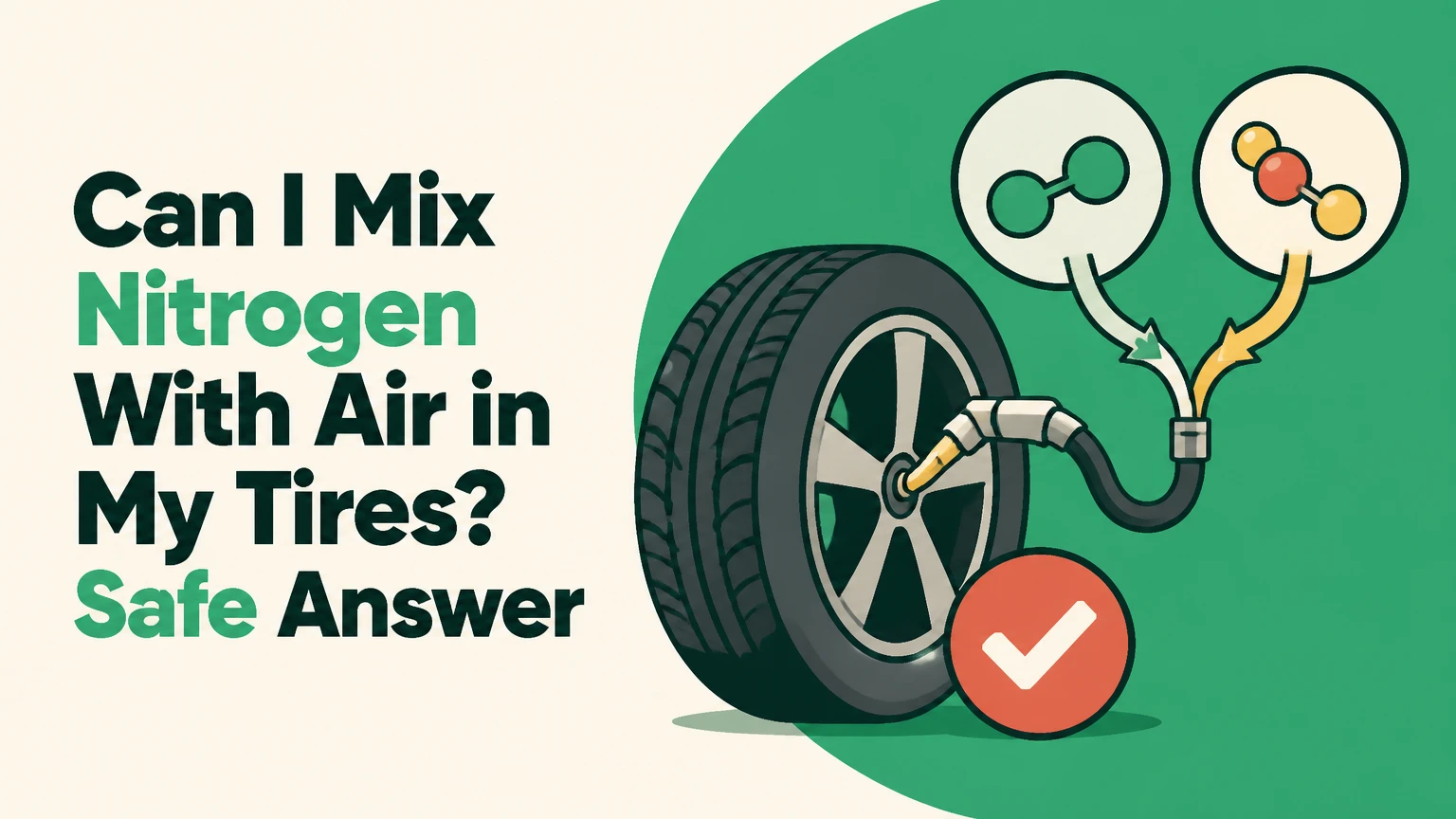
Yes, you can safely mix nitrogen with compressed air in your tires. Mixing does not create a chemical reaction, explosion, or special safety hazard because ordinary air is already approximately 78% nitrogen. If a tire is underinflated, add available air promptly; the correct tire pressure matters far more than preserving nitrogen purity.
Key facts at a glance
Ordinary compressed air contains approximately 78% nitrogen, 21% oxygen, and about 1% argon, carbon dioxide, and other gases.
Adding air reduces the concentration of nitrogen in a tire, but it does not make the tire unsafe.
Nitrogen does not eliminate pressure loss, punctures, valve leaks, temperature effects, or the need for monthly checks.
The correct inflation pressure is printed on the vehicle’s door-jamb placard or owner’s manual, not the maximum pressure molded into the tire sidewall.
Dry nitrogen can make pressure behavior more predictable in racing, aviation, and some commercial applications.
For most passenger cars, consistent pressure checks and prompt repairs provide more practical value than nitrogen purity.
Can I Mix Nitrogen With Air in My Tires?
You can mix nitrogen with air in a passenger-car, motorcycle, trailer, or truck tire without damaging the tire or wheel. A nitrogen-filled tire becomes a mixture of nitrogen, oxygen, argon, carbon dioxide, and water vapor after an air top-off, but those gases remain compatible under normal tire pressures and temperatures.
The immediate decision is simple: never leave a tire underinflated while searching for a nitrogen source. Underinflation increases sidewall flex, heat generation, stopping distance, rolling resistance, and the risk of tire failure. A normal air compressor is the appropriate emergency or routine solution when it is the only practical option.
Is mixing nitrogen and air dangerous?
Mixing nitrogen and air is not dangerous under normal vehicle operating conditions. Nitrogen is chemically inert at ordinary tire temperatures, while the oxygen in compressed air does not react explosively with nitrogen inside a sealed pneumatic tire.
The actual hazards involve pressure and tire condition. Overinflation, driving on a damaged tire, fitting the wrong tire, using a defective compressor, or ignoring a leak creates risk. The gas mixture itself does not.
What Happens to Nitrogen Purity After Mixing?
Adding compressed air lowers the nitrogen percentage, but the exact result depends on the amount of air added and the tire’s starting composition. A tire that begins at 95% nitrogen and receives a small top-off remains mostly nitrogen; a tire repeatedly filled with air eventually approaches atmospheric composition.
A simple example illustrates the dilution. If a tire contains 30 units of gas at 95% nitrogen and receives 5 units of ordinary air at 78% nitrogen, the resulting mixture contains about 92.6% nitrogen. The tire has not become hazardous. It simply no longer meets the original purity level.
| Starting condition | Added gas | Approximate resulting nitrogen |
|---|---|---|
| 95% nitrogen, 30 units | 5 units of 78% air | 92.6% |
| 95% nitrogen, 30 units | 15 units of 78% air | 89.3% |
| 99% nitrogen, 30 units | 10 units of 78% air | 93.8% |
| 78% atmospheric air, any volume | More 78% atmospheric air | 78% |
Green valve caps do not prove purity. They are commonly used as a visual marker, but a tire can retain green caps after someone has added ordinary air. Purity requires a calibrated gas analyzer, and purity testing is rarely useful for a normal road car.
Does one air top-off cancel the benefits of nitrogen?
One small air top-off does not suddenly cancel every possible nitrogen benefit. It reduces purity incrementally, and the practical effect depends on the tire’s volume, pressure, temperature, moisture content, and operating demands.
The most defensible nitrogen advantage is the use of dry gas, not a magical ability to hold pressure indefinitely. Dry gas can reduce moisture-related variability, while the slower diffusion of nitrogen compared with oxygen may reduce pressure loss over long periods. Those differences are usually modest for ordinary passenger vehicles.
How Do Nitrogen and Air Compare?
Nitrogen and compressed air deliver the same essential road-safety result when both are maintained at the vehicle manufacturer’s specified cold pressure. Nitrogen may provide a measurable maintenance or pressure-stability advantage, but regular air is cheaper, easier to obtain, and fully suitable for most road vehicles.
| Decision factor | Dry nitrogen, typically 93%-99% | Standard compressed air | Practical consequence |
|---|---|---|---|
| Main gas | 93%-99% nitrogen | About 78% nitrogen | Both inflate a tire safely |
| Oxygen content | Usually below 7% | About 21% | Less oxygen may slow oxidation over long periods |
| Moisture | Low when properly generated | Variable, depending on compressor and dryer | Dry nitrogen gives more repeatable behavior |
| Typical access | Tire shop, fleet depot, race facility | Service station, workshop, portable compressor | Air is easier for roadside use |
| Typical consumer cost | $0-$10 per tire, depending on provider | Free-$2 per fill, often free | Nitrogen has a convenience cost |
| Pressure maintenance | Still requires monthly checks | Still requires monthly checks | Neither replaces a gauge |
| Best use case | Track, aircraft, long-haul fleet | Daily driving and emergency top-offs | Application determines value |
A common technical error is to claim that oxygen molecules are smaller than nitrogen molecules. Molecular oxygen, O₂, has a molecular mass of about 32, while molecular nitrogen, N₂, has a molecular mass of about 28. Tire pressure loss through rubber depends on gas solubility, diffusion, temperature, rubber formulation, and partial pressure, not a simple “smaller molecule moves faster” rule.
Does nitrogen keep tires inflated longer?
Nitrogen can reduce pressure loss through tire rubber compared with ordinary air, but the reduction is not a dependable fixed value such as exactly 0.5 psi per month. Tire construction, ambient temperature, wheel condition, valve hardware, and punctures often matter more than the gas used.
The American Automobile Association, in its discussion of nitrogen-filled tires, notes that nitrogen still leaks and that regular pressure checks remain necessary. A slow loss from a tire often indicates a bead seal, valve core, wheel corrosion, or puncture problem rather than an unavoidable property of nitrogen.
Does Nitrogen Improve Fuel Economy or Safety?
Nitrogen does not create a direct, guaranteed fuel-economy or safety improvement when tire pressure is equal. Correct inflation improves handling, braking, tread wear, and rolling resistance regardless of whether the tire contains nitrogen, air, or a mixture.
The practical advantage of nitrogen is indirect. If a fleet or driver checks nitrogen-filled tires more consistently and maintains target pressure, the vehicle may preserve its intended rolling resistance for longer. A driver who ignores air-filled tires receives no comparable benefit, while a driver who checks ordinary air monthly can achieve the same pressure-dependent safety result.
| Claim | What is supported | What is overstated |
|---|---|---|
| Nitrogen leaks more slowly through rubber | Gas diffusion can be lower under comparable conditions | A universal monthly psi saving |
| Nitrogen improves fuel economy | Correct pressure reduces rolling resistance | A large gain from purity alone |
| Nitrogen stabilizes hot pressure | Dry gas reduces moisture-related uncertainty | No pressure change with temperature |
| Nitrogen protects wheels | Less moisture and oxygen can reduce corrosion conditions | “No corrosion risk” |
| Nitrogen improves safety | Stable, correct pressure supports safe operation | Purity compensates for underinflation |
Why does moisture matter inside a tire?
Moisture matters because water vapor can condense, evaporate, or freeze as tire temperature changes. Dry nitrogen limits that variable, which is useful when engineers need repeatable pressure behavior across repeated heat cycles.
The effect is often overstated for ordinary cars. A properly maintained passenger tire does not experience “significant pressure spikes” merely because it contains normal dry or moderately humid air. Internal pressure changes primarily follow temperature and tire load. Nitrogen still obeys the same gas laws as air.
What Should You Do When the TPMS Light Comes On?
When the Tire Pressure Monitoring System, or TPMS, warning light comes on, check and correct every tire as soon as practical, using ordinary air if nitrogen is unavailable. Inflate the tires to the cold pressure on the driver’s door-jamb label, then inspect for a puncture or persistent leak.
Do not wait for a nitrogen station. A tire that is 6 psi below specification can generate substantially more flex and heat, especially at highway speed or under heavy load. The gas composition is a secondary concern.
- Park safely and let the tires cool when possible.
- Measure all four tires and the spare if the vehicle monitors it.
- Compare readings with the door-jamb placard, not the sidewall maximum.
- Add air or nitrogen to the specified cold pressure.
- Inspect tread, sidewalls, valve stems, and wheel rims.
- Drive far enough for the TPMS system to update, following the owner’s manual.
- Obtain a professional inspection if pressure drops again.
A flashing TPMS light may indicate a sensor-system fault rather than low pressure. The vehicle manual identifies the warning-light behavior for that model.
How does temperature affect nitrogen tires?
Temperature changes affect nitrogen and air in broadly similar ways because both gases follow the same pressure-temperature relationship. As a practical rule, tire pressure changes by roughly 1 psi for each 10°F change in temperature, although tire construction, starting temperature, and measurement conditions alter the result.
Check pressure before driving, ideally after the vehicle has been parked for at least three hours. Do not bleed air from a hot tire to match its cold-pressure recommendation. A winter warning light usually requires adding pressure, not searching for a different gas.
How Can You Restore a Nitrogen Fill?
A shop can restore a high-purity nitrogen fill by evacuating the tire and performing one or more nitrogen purge cycles. Simply adding nitrogen on top of a mixed tire increases the nitrogen percentage, but it does not remove all oxygen, moisture, or other gases.
A typical service sequence is:
- Remove the valve core or deflate the tire using approved equipment.
- Fill the tire with dry nitrogen to a working pressure.
- Deflate the tire again to flush much of the original mixture.
- Refill to the vehicle’s specified cold pressure.
- Repeat the purge if a particular purity target is required.
- Replace the valve core, check for leaks, and fit the valve cap.
A tire technician should use a regulated nitrogen generator or cylinder, a calibrated gauge, and appropriate safety equipment. Purging a mounted tire does not make a damaged tire sound, and removing a tire from a wheel requires professional equipment.
Is a nitrogen purge worth doing?
A nitrogen purge is usually not worth paying for on a daily passenger car that receives regular pressure checks. The service makes more sense for race tires, aircraft tires, specialized industrial equipment, or commercial fleets where repeatable pressure and reduced moisture have operational value.
Purity targets such as 95% are service conventions, not a universal legal threshold for road-tire safety. A passenger car does not become unsafe at 90% nitrogen, and a 99% nitrogen tire still needs inspection.
How Much Does Nitrogen Tire Service Cost?
Nitrogen inflation commonly costs $0-$10 per tire, while a full purge and conversion typically costs about $20-$60 for four tires when offered as a standalone service. Prices vary by region, retailer, vehicle size, and whether the service is bundled with tire installation.
Some tire retailers provide free nitrogen top-offs to customers who bought tires there. Other shops charge a small service fee or do not offer nitrogen at all. A portable compressor and accurate gauge generally cost less than repeated trips to a specialty shop.
| Service or equipment | Typical price range | Typical time | Best financial fit |
|---|---|---|---|
| Free service-station air | $0-$2 | 5-10 minutes | Most passenger vehicles |
| Nitrogen top-off | $0-$5 per tire | 10-20 minutes | Existing nitrogen customers |
| Initial nitrogen fill | $5-$10 per tire | 10-20 minutes | Specialty applications |
| Four-tire purge and refill | $20-$60 | 20-45 minutes | Track or fleet use |
| Digital tire gauge | $10-$40 | 1-2 minutes | Every vehicle owner |
| Portable 12-volt compressor | $30-$100 | 5-15 minutes per tire | Emergency and home maintenance |
Who Benefits Most From Nitrogen?
Track drivers, aircraft operators, and some commercial fleets benefit most from dry nitrogen because they manage repeated heat cycles, high loads, or strict pressure targets. Everyday commuters generally gain more from an accurate gauge, monthly inspections, and prompt leak repair.
Aircraft use nitrogen for specialized operational reasons, including reduced moisture and fire-related risk in certain systems. Those requirements do not mean every passenger car needs aircraft-style tire servicing. Automotive decisions should follow the vehicle manufacturer’s instructions and the operating environment.
| Driver or equipment type | Nitrogen value | Recommended practice |
|---|---|---|
| Daily commuter, 8,000-15,000 miles annually | Low | Use air and check monthly |
| Track-day vehicle, repeated hot laps | Moderate to high | Use dry nitrogen if setup requires repeatability |
| Heavy-duty fleet, high annual mileage | Moderate | Track pressure, temperature, load, and downtime |
| RV or trailer stored for months | Moderate | Check pressure before every trip |
| Aircraft or specialized equipment | High or mandatory by specification | Follow maintenance regulations |
| Emergency roadside situation | None compared with safety | Use available air immediately |
Is nitrogen worthwhile for a daily driver?
Nitrogen is optional for a daily driver, not a requirement. The convenience of free, widely available compressed air usually outweighs the modest pressure-retention advantage unless the vehicle has unusual storage, mileage, load, or performance demands.
A driver who checks pressure once a month and before long trips can maintain safe operation with regular air. Nitrogen becomes a reasonable preference when the service is free, nearby, and included with tire maintenance.
Why Does a Nitrogen-Filled Tire Keep Losing Pressure?
A nitrogen-filled tire that loses pressure repeatedly may have a puncture, valve-core leak, bead leak, wheel corrosion, or temperature-related pressure change. Nitrogen reduces neither the need to diagnose physical leaks nor the possibility of damage from road hazards.
Use a consistent measurement method. Check the tire cold with the same gauge, record the reading, and repeat after several days. A loss greater than about 1-2 psi per month under stable conditions deserves inspection, while a rapid loss requires immediate service.
How can you find the leak?
A technician can remove the wheel, inspect the tread and inner liner, and apply a soap-and-water solution to the valve, bead, and suspected puncture. Continuous bubbles identify escaping gas, while a submerged wheel test can reveal slow leaks that are difficult to see externally.
Common repair decisions include:
- Repairing a tread puncture when its size, location, and angle meet tire-industry repair limits.
- Replacing a damaged valve stem or valve core.
- Cleaning or repairing a corroded wheel bead seat.
- Replacing a tire with sidewall or shoulder damage.
- Checking for a bent wheel after pothole impact.
A green cap does not change the diagnostic process. Pressure loss is a mechanical issue first.
Common Mistakes When Mixing Tire Gases
The most damaging mistakes involve underinflation, incorrect pressure references, and skipped inspections rather than mixing gases. These practitioner rules prevent the most common service failures.
- Driving to find nitrogen with a low tire: Add ordinary air first, then pursue nitrogen service later.
- Using the tire sidewall maximum: The sidewall value is a limit for the tire, not the vehicle’s recommended operating pressure.
- Bleeding a hot tire: Measure and adjust cold pressure unless the vehicle manufacturer gives another procedure.
- Treating green caps as proof: Confirm pressure and service history instead of trusting cap color.
- Assuming nitrogen prevents punctures: Nitrogen cannot seal tread damage or repair a leaking valve.
- Paying for a purge without a reason: Daily road use rarely justifies repeated conversion charges.
- Using an inaccurate gauge: A $10-$40 digital gauge can expose differences between service-station gauges and the vehicle specification.
An expert rule of thumb is to prioritize the maintenance chain in this order: correct cold pressure, intact tire, sound wheel and valve, then gas composition. Reversing that order creates an expensive but less safe result.
What About Motorcycles, Trailers, and Heavy Loads?
Motorcycles and trailers can safely receive ordinary air in nitrogen-filled tires, but pressure must match the manufacturer’s load and operating recommendation. Trailer tires deserve special attention because long storage periods, sun exposure, overload, and underinflation can combine to produce heat-related failures.
Check trailer tire pressure before every trip, including the spare. Confirm the load range, maximum cold pressure, wheel rating, and axle loading. Nitrogen may reduce moisture exposure during storage, but it cannot correct an overloaded trailer or aged rubber.
For towing, set pressure according to the vehicle, tire, and load instructions. Do not lower pressure to improve ride comfort when the tire is carrying a heavy trailer.
Frequently Asked Questions
Can I top off nitrogen tires with air at a gas station?
Yes, you can top off nitrogen tires with gas-station air. Inflate the tire to the specified cold pressure, because maintaining pressure protects the tire more effectively than preserving a high nitrogen percentage. The next air top-off will dilute the mixture further, but it will not create a safety problem.
Should I replace all the air with nitrogen after mixing?
You do not need to replace mixed gas in a normal passenger vehicle. A purge makes sense only when a fleet, race team, aircraft operator, or equipment manufacturer requires dry, high-purity nitrogen. Routine driving does not justify deflating a sound tire solely to remove ordinary air.
Can nitrogen tires be repaired after a puncture?
A nitrogen tire can be repaired using the same tire-industry criteria applied to an air-filled tire. The technician may lose some nitrogen during demounting or repair and can refill with nitrogen or air. Repairability depends on puncture location, size, angle, tire condition, and manufacturer guidance.
Does nitrogen stop tires from going flat in winter?
Nitrogen does not stop winter pressure loss. Nitrogen contracts as temperature falls, just like the gases in ordinary air, so cold weather can trigger the TPMS warning. Measure cold pressure and add gas to the door-jamb specification rather than ignoring the warning.
Are green valve caps required for nitrogen tires?
Green valve caps are not required to make a tire safe and do not verify nitrogen purity. They are a labeling convention used by many service providers. Check the actual pressure, service record, and tire condition instead of relying on cap color.
Is 100% nitrogen used in ordinary tire service?
Ordinary tire-service nitrogen is usually not literally 100% pure. Generators and service procedures commonly provide a stated purity range, often about 93%-99%, and residual air remains after a tire is mounted and filled. The percentage matters more in specialized applications than in ordinary commuting.
The Bottom Line
Can I mix nitrogen with air in my tires? Yes. Mixing is chemically safe, and adding ordinary air is the correct response when a nitrogen-filled tire is low and nitrogen is unavailable.
Nitrogen can offer lower moisture content and somewhat more predictable pressure behavior, especially in racing, aviation, long-haul fleets, or equipment with demanding heat cycles. For most passenger cars, the decisive variables are correct cold pressure, monthly measurement, proper load, tire condition, and prompt leak repair. Use air when it is available, maintain the manufacturer’s pressure, and treat nitrogen purity as an optional maintenance preference rather than a safety requirement.