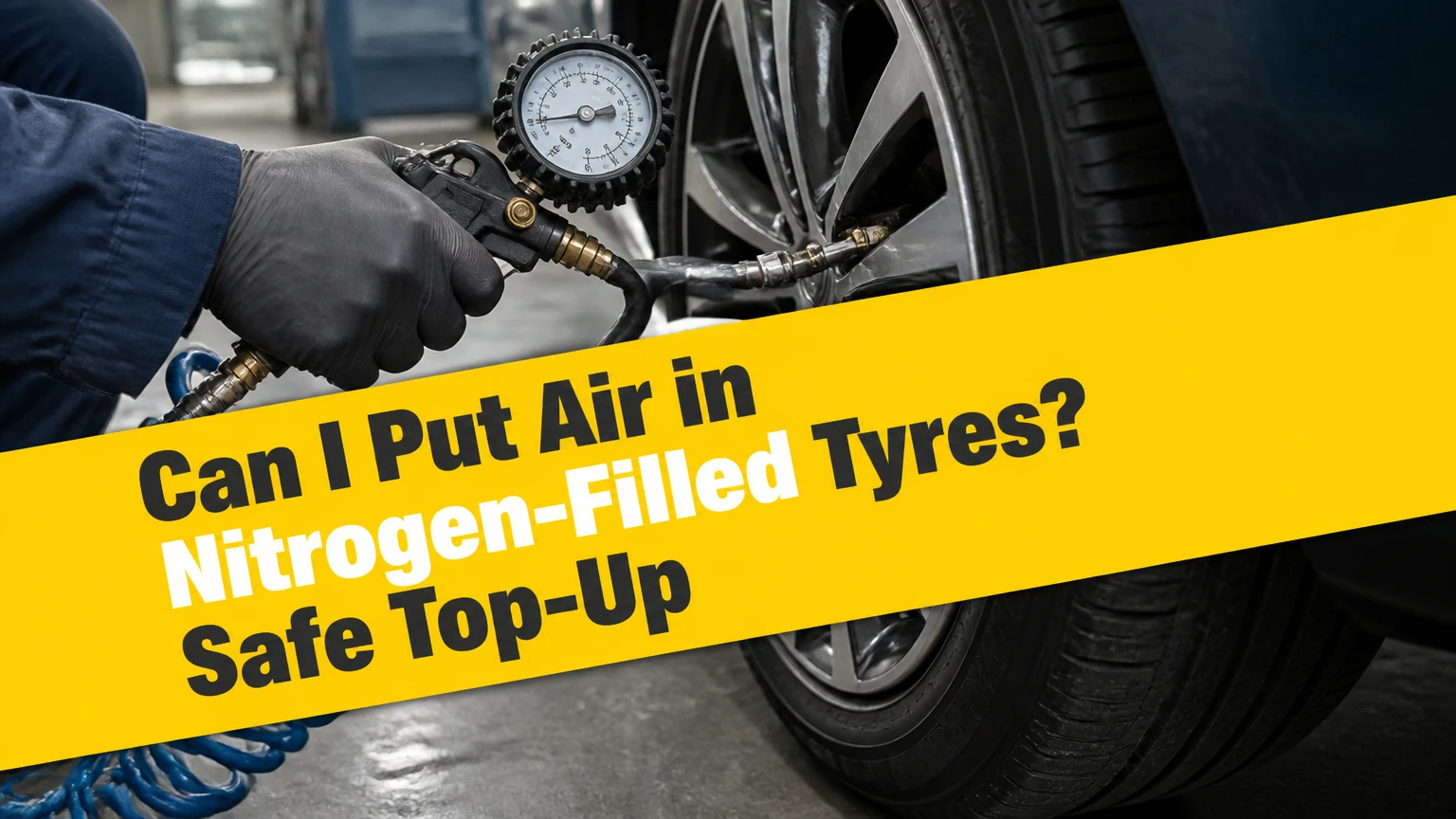
Yes, you can put regular compressed air in nitrogen-filled tyres safely. Air and nitrogen mix without a dangerous chemical reaction, and the tyre will operate normally when inflated to the vehicle manufacturer’s recommended cold pressure. Adding air reduces nitrogen purity, but correcting low pressure is more important than preserving the gas mixture.
Key Facts at a Glance
Regular atmospheric air contains approximately 78% nitrogen and 21% oxygen.
Nitrogen-filled tyres can be topped up with ordinary compressed air whenever necessary.
The correct target is the cold tyre pressure on the vehicle placard, not a nitrogen-specific pressure.
Nitrogen does not prevent punctures, valve leaks, bead leaks, or pressure loss from temperature changes.
Green valve caps may indicate a nitrogen service, but they do not prove the gas purity inside the tyre.
A nitrogen purge is optional for most passenger cars after an air top-up.
Can I Put Air in Nitrogen-Filled Tyres?
You can add compressed air to nitrogen-filled tyres without damaging the tyre, wheel, valve, TPMS sensor, or vehicle. The result is a mixture of gases, because ordinary air already contains mostly nitrogen; the practical change is lower nitrogen purity and potentially more moisture, not a safety hazard.
The immediate priority is pressure. A tyre that is 5 PSI below specification has a larger safety and wear problem than a tyre whose nitrogen concentration has fallen from 95% to a lower level. Underinflation increases sidewall flex, heat generation, braking distance, rolling resistance, and shoulder wear.
The U.S. Tire Manufacturers Association describes proper inflation as “the single most important thing you can do to prolong the life of your tires.” That maintenance principle applies whether the tyre contains air, nitrogen, or a mixture.
Does adding air damage a nitrogen-filled tyre?
No. Nitrogen and the gases in compressed air do not react in a way that damages rubber or creates an explosion inside a normal road tyre. The tyre’s operating pressure remains determined mainly by temperature, gas quantity, tyre volume, and load.
Compressed air can introduce more water vapour than a properly maintained nitrogen generator. That difference matters more in specialist applications, such as racing, aircraft systems, or industrial equipment, than in ordinary road use. A standard passenger-car tyre is designed to operate with compressed air.
What pressure should you use?
Use the cold inflation pressure on the driver’s door-jamb placard, fuel-filler label, or owner’s manual. Do not use the maximum pressure moulded into the tyre sidewall as the normal vehicle setting, because that figure describes the tyre’s permitted maximum load pressure rather than the vehicle’s recommended pressure.
| Information source | Typical location | Correct use |
|---|---|---|
| Vehicle placard | Driver’s door frame | Normal front and rear cold PSI |
| Owner’s manual | Vehicle handbook or app | Loaded, towing, and spare-tyre guidance |
| Tyre sidewall | Outer rubber sidewall | Maximum permitted tyre pressure, not usual target |
| TPMS display | Instrument cluster | Warning or live reading, subject to system accuracy |
| Handheld gauge | Valve stem | Independent pressure verification |
Check pressure when tyres are cold, ideally after the vehicle has been parked for at least three hours. Driving heats the casing and raises the displayed pressure, so adjusting a hot tyre to the cold placard number can leave it underinflated later.
Why Does Mixing Air and Nitrogen Matter?
Mixing compressed air with nitrogen matters because the gases have different moisture content and permeation behaviour, but the effect is gradual and usually modest for passenger vehicles. Adding air does not suddenly make a nitrogen-filled tyre unsafe or eliminate every benefit immediately.
Atmospheric air is approximately 78% nitrogen, 21% oxygen, and about 1% argon and other trace gases by volume. Nitrogen used for tyre inflation is normally generated or supplied at a higher purity and with lower moisture content than ordinary workshop air.
How does nitrogen leave a tyre?
Gas can permeate slowly through the rubber compound, while faster pressure loss usually comes from a puncture, valve problem, rim leak, or temperature change. Oxygen and nitrogen do not escape from a tyre at exactly the same rate, but the real-world difference depends on the tyre construction, liner, temperature, pressure, age, and moisture level.
Nitrogen’s useful property is consistency, not a magical ability to remain inside forever. Dry nitrogen can reduce oxidation and make pressure behaviour more predictable in demanding applications. The advantage is often too small to justify repeated charges for a private car that already receives monthly pressure checks.
Does nitrogen keep pressure three or four times longer?
A universal three-to-four-times pressure-retention claim is not reliable for every tyre and vehicle. Nitrogen may reduce permeation-related loss under controlled conditions, but a valve-core leak or a screw in the tread will overwhelm that benefit immediately.
A practical rule is more useful: if a road tyre loses noticeable pressure between monthly checks, investigate the leak instead of assuming the gas choice is the cause. Nitrogen cannot compensate for a damaged valve, corroded wheel, poor bead seal, or puncture.
Does ordinary air contain moisture?
Usually, yes. Workshop compressed air may contain water vapour unless the compressor system uses a functioning dryer, receiver drain, and filtration. Nitrogen service equipment also varies, so “nitrogen-filled” does not automatically mean laboratory-dry gas.
Moisture inside a tyre has limited significance for most passenger cars. It becomes more relevant when pressure must remain highly predictable through extreme heat, when wheels are vulnerable to corrosion, or when an operator manages a large commercial fleet with strict maintenance controls.
What Happens to Nitrogen Purity After an Air Top-Up?
Nitrogen purity falls in proportion to the amount of replacement gas added, but a tyre’s final concentration cannot be calculated from the top-up PSI alone unless the starting pressure, volume, temperature, and gas purity are known. A small top-up dilutes the original fill only slightly.
For an illustrative calculation, assume a tyre starts at 95% nitrogen and receives air containing 78% nitrogen. If the tyre’s original gas quantity is represented as 100 units, adding 10 units of air produces approximately 93.5% nitrogen:
[ (100 \times 0.95 + 10 \times 0.78) / 110 = 93.5% ]
Adding 50 units of air produces approximately 89.3% nitrogen. Those examples show why a minor correction does not instantly turn a nitrogen-filled tyre into ordinary air, while a complete deflation and refill changes the mixture far more substantially.
| Starting gas | Air added | Approximate final nitrogen concentration |
|---|---|---|
| 95% nitrogen | 10% of starting gas quantity | 93.5% |
| 95% nitrogen | 25% of starting gas quantity | 91.6% |
| 95% nitrogen | 50% of starting gas quantity | 89.3% |
| 95% nitrogen | Complete replacement with air | 78% |
These are illustrative values, not a vehicle-service measurement. A tyre technician cannot verify purity with a pressure gauge, and the nitrogen percentage is rarely important enough to measure on a normal road car.
How Do You Top Up a Nitrogen-Filled Tyre With Air?
Top up the tyre with a calibrated air pump in six steps, using the vehicle placard as the pressure target. The task normally takes 2-5 minutes per tyre, and the factor that matters most is setting the correct cold pressure rather than preserving gas purity.
Before You Start
| Requirement | Typical specification |
|---|---|
| Time | 10-20 minutes for four tyres |
| Difficulty | Low, provided the valve and tyre are accessible |
| Equipment | Tyre-pressure gauge, air pump, valve-cap tool if needed |
| Pressure target | Vehicle placard cold PSI, commonly 30-36 PSI on passenger cars |
| Best temperature | Cold tyres after at least three hours parked |
| Safety check | No sidewall bulge, exposed cord, or rapidly leaking valve |
Step 1: Read the cold pressure
Remove the valve cap and press the gauge firmly onto the valve stem. Record the pressure for each tyre, because a single low tyre often indicates a local fault rather than normal permeation.
You will know the reading is credible when the gauge seals without hissing and gives a stable value. A common mistake is measuring immediately after a motorway journey, when heat has raised the pressure.
Step 2: Inspect the tyre before inflating
Look for nails, screws, cuts, bulges, separated tread, and objects embedded in the shoulder. Do not drive on a tyre with a sidewall bulge, exposed internal cord, or rapid pressure loss.
You will know the tyre passes the basic visual check when the tread and sidewall have no visible structural damage. A common mistake is removing a nail before a technician can locate and repair the puncture, which can turn a slow leak into a rapid one.
Step 3: Set the pump to the placard pressure
Connect the air hose and add ordinary compressed air until the cold pressure reaches the manufacturer’s specified value. If the pump is inaccurate, use a separate gauge after disconnecting the hose.
You will know the tyre is correctly inflated when the independent gauge matches the placard target within the gauge’s practical accuracy, usually about 1 PSI. A common mistake is inflating all four tyres to the same number when the vehicle specifies different front and rear pressures.
Step 4: Check the valve and refit the cap
Listen for leakage after removing the nozzle, then tighten the valve cap. Apply a small amount of soapy water to the valve core if the pressure drops immediately or bubbles appear.
You will know the valve is likely sound when no bubbles form and the cap threads cleanly. A common mistake is treating the plastic cap as the primary seal; the valve core provides the pressure seal, while the cap mainly protects against dirt.
Step 5: Check the remaining tyres
Measure and adjust all tyres, including the spare if the vehicle has one. Tyres on the same axle should match the placard pressure unless the owner’s manual provides a special loaded or high-speed instruction.
You will know the check is complete when every tyre has a recorded cold reading. A common mistake is correcting only the tyre that triggered the TPMS warning while another tyre remains substantially underinflated.
Step 6: Confirm TPMS operation
Drive according to the owner’s manual after inflation. Direct TPMS vehicles measure pressure with sensors inside the wheel, while indirect systems estimate pressure from wheel-speed differences and may require a stored baseline reset.
You will know the warning has cleared when the dashboard indicator turns off after the vehicle completes its normal monitoring cycle. A common mistake is assuming every TPMS system resets after the same distance; some require a menu command, button, scan tool, or several minutes above a specified speed.
Does Adding Air Turn Off the TPMS Light?
Adding air to the correct cold pressure may turn off a TPMS light, but the reset method depends on the vehicle. A direct system may update automatically after driving, whereas an indirect system often needs a calibration command after all tyres are set correctly.
A flashing TPMS warning, rather than a steadily illuminated warning, commonly indicates a system fault on many vehicles. The exact interpretation varies by manufacturer, so the owner’s manual takes priority. Do not keep driving while guessing if the tyre is visibly damaged or loses pressure again.
| TPMS type | What measures pressure | Typical driver action after inflation |
|---|---|---|
| Direct TPMS | Valve-stem or wheel-mounted pressure sensor | Drive and allow sensor update; reset if manual requires it |
| Indirect TPMS | ABS wheel-speed data | Store or calibrate the new baseline |
| Hybrid system | Sensor plus vehicle-speed data | Follow the manufacturer’s reset sequence |
| Fault condition | Sensor, battery, wiring, or receiver fault | Diagnose system; inflation alone may not clear it |
Air Versus Nitrogen: Which Is Better for Your Tyres?
Regular compressed air is the better practical choice for most private passenger cars because it is available, inexpensive, and safe when used to maintain the specified pressure. Nitrogen is more defensible for racing, aircraft, specialised fleets, or vehicles where controlled moisture and pressure stability justify the service cost.
| Criterion | Ordinary compressed air | High-purity nitrogen | Mixed air and nitrogen |
|---|---|---|---|
| Nitrogen content | Approximately 78% | Commonly 93-99.9%, depending on service | Between starting and added-gas values |
| Moisture control | Depends on compressor dryer | Usually lower and more controlled | Depends on both sources |
| Availability | Nearly every fuel station or workshop | Selected tyre centres and dealers | Available wherever air is available |
| Typical top-up cost | Free to about £2 or $0-$2 | Free under some service plans, otherwise about £5-$15 per tyre | Usually air-pump price |
| Main maintenance need | Monthly pressure checks | Monthly pressure checks | Monthly pressure checks |
| Best application | Daily road driving | Racing, aviation, controlled fleets | Emergency or routine air correction |
How much does nitrogen inflation cost?
Nitrogen service commonly costs about $5-$15 or £5-£15 per tyre when sold separately, although some tyre retailers include it with a new-tyre purchase. Air top-ups are often free, coin-operated, or priced around $0-$2, depending on location and equipment.
A purge and refill takes roughly 15-30 minutes for a set, but the service process varies. A shop may simply deflate and refill, or it may use repeated evacuation cycles intended to reduce the remaining air. No ordinary tyre shop should claim a precise final purity without measuring it.
Is nitrogen worth paying for?
Nitrogen is usually not worth paying for solely to improve fuel economy on a private car. Any fuel or tread benefit depends first on maintaining correct pressure, and a driver who checks monthly can often capture the important benefit without locating a nitrogen supplier.
Nitrogen can make sense when a fleet has centralised maintenance, a race team needs repeatable hot-pressure behaviour, or a stored vehicle has wheels and operating conditions where moisture control matters. The business case must include service access, labour, refill charges, and the cost of missed maintenance.
What If a Nitrogen-Filled Tyre Keeps Losing Pressure?
A nitrogen-filled tyre that repeatedly loses pressure needs a leak inspection, because gas selection does not explain a rapid or localised pressure drop. Check the tread, valve core, bead seal, wheel, and temperature history before arranging another nitrogen fill.
| Symptom | Likely cause | Useful check | Appropriate action |
|---|---|---|---|
| One tyre loses 2 PSI in days | Puncture or valve leak | Soapy water and tread inspection | Repair or replace after inspection |
| Loss follows cold weather | Temperature change | Compare cold readings | Inflate to placard PSI |
| Bubbles at valve stem | Loose or damaged valve core | Soapy-water test | Replace or tighten valve core |
| Slow loss at rim edge | Bead leak or wheel corrosion | Submerge or inspect at shop | Break bead, clean, repair, or replace |
| TPMS warning returns after inflation | Ongoing leak or sensor issue | Recheck pressure next morning | Diagnose tyre and TPMS |
| Visible sidewall bulge | Structural damage | Visual inspection | Do not drive; replace tyre |
How much pressure change comes from temperature?
A commonly used rule of thumb is approximately 1 PSI for every 10°F, or 5.6°C, change in air temperature. The actual change varies with absolute pressure, tyre volume, gas temperature, sunlight, and measurement conditions, but nitrogen and air respond similarly to temperature changes.
| Ambient change | Approximate pressure effect | Practical response |
|---|---|---|
| 10°F decrease | About 1 PSI lower | Measure cold and inflate if needed |
| 20°F decrease | About 2 PSI lower | Check all tyres, not only one |
| 30°F decrease | About 3 PSI lower | Correct to placard pressure |
| 10°F increase | About 1 PSI higher | Do not bleed a hot tyre to cold target |
A temperature-related change affects every tyre in a similar way. If only one tyre falls substantially, suspect a leak instead of blaming the weather.
Can nitrogen hide a puncture?
No. Nitrogen does not seal tread punctures or prevent a tyre from losing pressure. A punctured tyre can lose nitrogen, air, or both at a rate determined by the hole, load, temperature, and object position.
A useful practitioner rule is to compare tyres on the same axle the next morning, before driving. A repeatable drop in one tyre deserves inspection even if the TPMS light has not appeared, because many systems warn only after pressure falls below a programmed threshold.
Should You Refill With Nitrogen After Adding Air?
You do not need to purge and refill a passenger-car tyre after a normal air top-up. Refill with nitrogen only when a specific operating requirement justifies restoring lower moisture content or higher gas purity, such as a documented motorsport, fleet, or specialist-equipment procedure.
A green valve cap is not a technical requirement and is not proof that a tyre contains 95% nitrogen. Valve caps are interchangeable, and many workshops use green caps as a service label. Base maintenance decisions on measured pressure, tyre condition, and the vehicle manufacturer’s instructions.
What are the alternatives to a nitrogen refill?
A dry workshop air line is a sensible middle option when moisture control matters but nitrogen access is limited. A portable 12-volt compressor can correct pressure at home or roadside, provided its gauge is checked against a known accurate gauge.
| Alternative | Typical purchase or service cost | Time to correct four tyres | Best use |
|---|---|---|---|
| Fuel-station air pump | $0-$2 per session | 10-20 minutes | Routine road-vehicle top-up |
| 12-volt compressor | $30-$150 one-time | 15-30 minutes | Home or roadside correction |
| Workshop dry air | $0-$10 | 10-20 minutes | Lower-moisture maintenance |
| Nitrogen purge | $20-$60 per vehicle set | 15-30 minutes | Specialist or controlled operation |
Which Drivers Should Use Air or Nitrogen?
Daily commuters should normally use compressed air and check pressure monthly. Track drivers, heavy commercial fleets, and some long-term storage operators may gain enough consistency from dry nitrogen to justify the additional process and cost.
Daily commuter
Choose regular air when the vehicle travels ordinary roads and receives routine maintenance. A monthly cold-pressure check, inspection after pothole impacts, and prompt puncture repair matter more than preserving a high nitrogen percentage.
Track or performance driver
Choose nitrogen when the team controls tyre temperatures, hot pressures, and repeated sessions. The benefit comes from predictable moisture content and repeatable setup data, not from greater grip on its own. Track regulations and tyre supplier instructions take priority.
Fleet operator
Choose nitrogen only after calculating the whole fleet cost. A centralised filling system, scheduled pressure audits, tyre-mileage records, and telematics can make a controlled gas programme useful, while paying retail prices for occasional top-ups may not.
RV or seasonal vehicle owner
Nitrogen may be convenient for a vehicle stored for months, but storage does not remove the need for pressure checks. Weight, tyre age, sun exposure, flat-spot risk, and the manufacturer’s storage instructions remain more important variables.
Common Mistakes When Topping Up Nitrogen Tyres
The most damaging mistake is delaying inflation because a nitrogen station is unavailable. A second mistake is treating a recurring pressure loss as evidence that the tyre needs more nitrogen rather than a leak diagnosis.
- Using the sidewall maximum: Set the placard PSI, not the maximum moulded into the tyre.
- Checking hot pressure: Measure cold, or record the conditions and recheck later.
- Ignoring a single low tyre: Repeated one-tyre loss usually requires a puncture or valve inspection.
- Assuming TPMS is a gauge: Confirm pressure manually because warning thresholds and sensor readings vary.
- Paying for an unlabeled service: Ask whether the technician is adding nitrogen, ordinary air, or performing a purge.
- Bleeding pressure after a drive: Hot pressure is not directly interchangeable with the cold placard value.
A tyre that is visibly damaged, rapidly deflating, or driven while severely underinflated should not be repaired through inflation alone. Stop in a safe place and arrange professional inspection or roadside assistance.
Frequently Asked Questions
Can I mix nitrogen and air in motorcycle tyres?
Yes, motorcycle tyres can generally be topped up with ordinary compressed air when nitrogen is unavailable. Use the motorcycle manufacturer’s cold pressure, inspect for punctures, and avoid riding if pressure drops rapidly. Two-wheeled vehicles are especially sensitive to pressure, because an underinflated tyre can affect steering, braking, heat, and cornering stability.
Can I put nitrogen in tyres that already contain air?
Yes, a tyre shop can add nitrogen to an air-filled tyre, but a simple top-up leaves a mixture rather than pure nitrogen. Higher purity requires deflation and a controlled purge and refill. For normal road use, maintaining the correct cold PSI usually provides more practical value than paying to remove every trace of air.
How often should nitrogen-filled tyres be checked?
Check nitrogen-filled tyres at least once a month and before long journeys, using a pressure gauge when the tyres are cold. Nitrogen reduces neither puncture risk nor valve failures. Check sooner after a pothole strike, kerb impact, seasonal temperature change, or any TPMS warning.
Is nitrogen safer than air in a car tyre?
Nitrogen is not inherently safer when both gases are maintained at the correct pressure. Nitrogen can reduce moisture and may slow permeation-related pressure loss, but ordinary compressed air is safe for road tyres and is often the better emergency choice when pressure is low.
Can a tyre shop tell whether my tyres contain nitrogen?
A pressure gauge cannot identify nitrogen concentration. A technician needs a suitable gas analyser to estimate composition, and many tyre shops do not measure purity during routine service. Green valve caps indicate a convention or service label, not verified gas content.
What should I do if the tyre is low right now?
Inflate the tyre to the vehicle placard’s cold pressure with ordinary air if nitrogen is unavailable. Inspect for visible damage and recheck the pressure after parking. If the tyre loses pressure again, the vehicle pulls, the sidewall is damaged, or the TPMS warning returns, stop driving and obtain a professional inspection.
The Bottom Line
You can put air in nitrogen-filled tyres safely, and the correct response to low pressure is to inflate the tyre promptly with whatever suitable compressed gas is available. The mixture will contain less high-purity nitrogen, but that change does not create mechanical damage or a dangerous reaction.
For most passenger cars, correct cold PSI, monthly checks, sound valves, proper bead seals, and timely puncture repairs outweigh the marginal advantage of maintaining nitrogen purity. If a specialist application requires dry nitrogen, arrange a purge later, but never leave a tyre underinflated while waiting for a nitrogen service.


