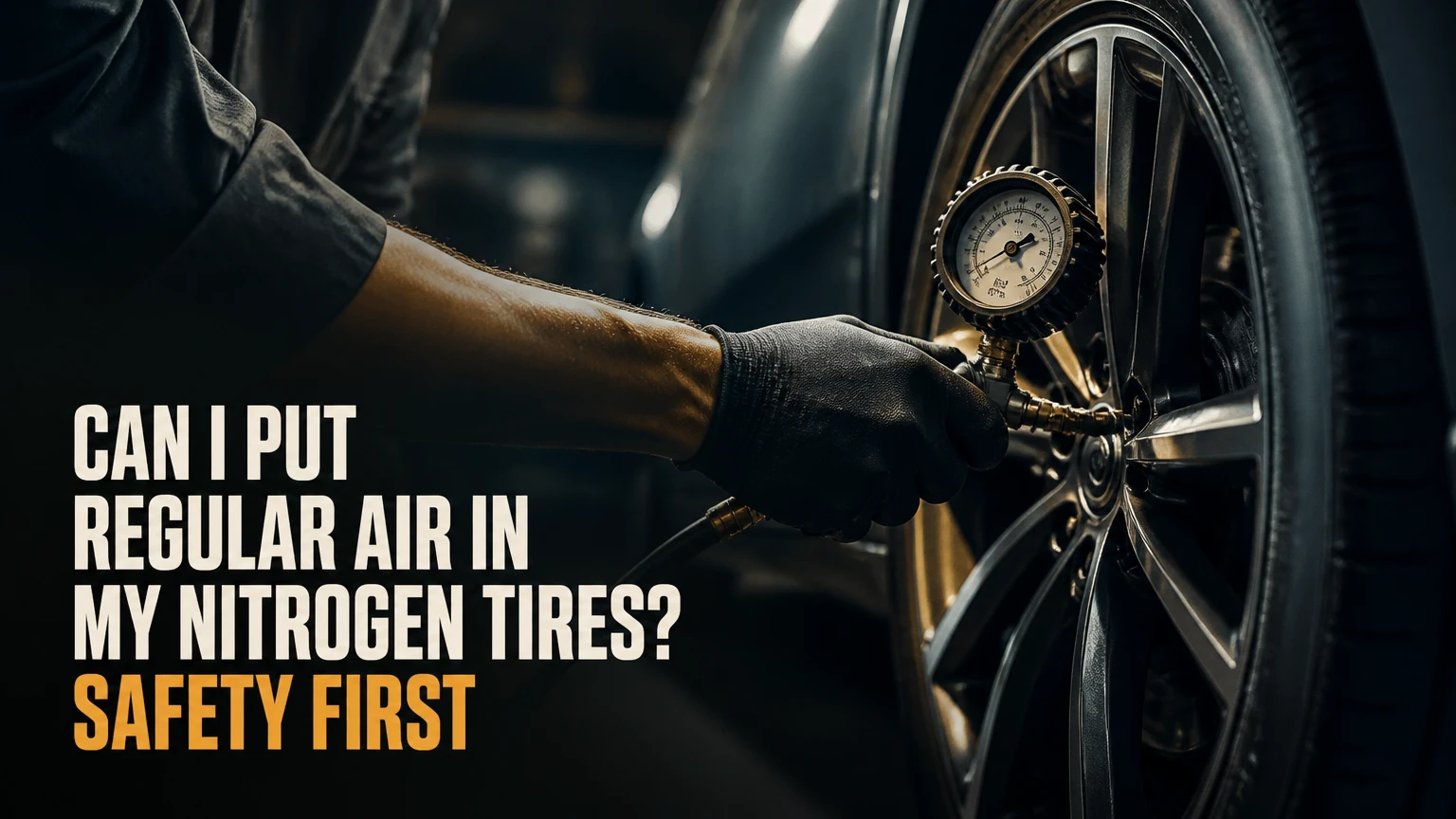
Yes, you can put regular compressed air in nitrogen-filled tires safely. Regular air and nitrogen do not react dangerously, damage the tire, or create a hazardous mixture. Inflate the tire to the vehicle manufacturer’s recommended cold pressure, because maintaining correct PSI matters far more for road safety than preserving a high nitrogen percentage.
Key Facts at a Glance
- Regular compressed air can safely mix with nitrogen inside a passenger-vehicle tire.
- The correct pressure appears on the driver’s door-jamb placard, not the tire sidewall.
- Adding air lowers the nitrogen concentration, but it does not make the tire unsafe.
- A TPMS warning or visibly low tire should be corrected immediately with the available safe air source.
- Nitrogen may slow pressure loss when the fill is very dry, but it does not make a tire leak-proof.
- Most daily drivers do not need a purge after an ordinary air top-off.
Can I Put Regular Air in My Nitrogen Tires?
Regular compressed air is the correct emergency and routine top-off option when nitrogen is unavailable. The tire will contain a mixture of nitrogen, oxygen, water vapor, and trace gases, but that mixture remains chemically compatible with the rubber, steel belts, wheel, valve, and TPMS sensor.
The practical priority is pressure. Underinflation increases sidewall flex, heat generation, tread-edge wear, rolling resistance, and the risk of tire failure. Waiting several miles or days for a nitrogen station creates a larger safety problem than diluting the original fill.
The U.S. Tire Manufacturers Association states that “Nitrogen is not a substitute for regular tire pressure maintenance.” That guidance captures the central rule: inspect pressure regularly and use nitrogen only when it is convenient or operationally justified.
A normal air compressor may add some moisture, depending on the compressor’s dryer, receiver tank, maintenance, and local humidity. That moisture does not create an immediate hazard in a passenger tire. The concern is long-term corrosion in unusual applications, such as large commercial tires, aircraft tires, or wheels exposed to severe service.
What happens when air mixes with nitrogen?
Mixing compressed air with nitrogen reduces the percentage of nitrogen in the tire without producing a new chemical compound. Because atmospheric air is approximately 78% nitrogen and 21% oxygen, a small air top-off still leaves the tire mostly nitrogen.
For example, a tire containing 30 psi of nearly pure nitrogen that receives 5 psi of atmospheric air will contain roughly 86% nitrogen before accounting for residual gases and gauge pressure calculations. A later 5 psi top-off changes the mixture further. The percentage is less important than the final pressure.
The tire does not suddenly switch from “nitrogen mode” to “air mode.” Pressure retention changes gradually as the gas mixture changes, and the difference is usually difficult to measure in ordinary driving.
Why Do People Use Nitrogen in Tires?
Nitrogen is used because a dry, controlled gas can reduce moisture and may reduce pressure loss through some tire materials. The benefit is incremental, not a replacement for checking pressure or repairing leaks.
Compressed air contains nitrogen already. A typical atmospheric-air mixture is about 78% nitrogen, 21% oxygen, and approximately 1% argon, carbon dioxide, water vapor, and other trace gases. Commercial nitrogen inflation commonly targets approximately 93-99% nitrogen, although the actual result depends on the equipment and whether the tire was purged first.
Is nitrogen more stable as temperatures change?
Nitrogen and oxygen both obey the same basic gas-pressure relationship inside a tire. At a fixed tire volume, pressure changes with absolute temperature, so a nitrogen tire still gains pressure when heated and loses pressure when cooled.
Dry nitrogen can produce more consistent readings because it contains less water vapor. Water vapor can condense or evaporate as temperature changes, adding variability. That advantage matters more in racing, aircraft, industrial equipment, and heavy fleets than in a typical commuter car.
The American Automobile Association and tire manufacturers consistently emphasize checking pressure when tires are cold. A cold reading means the vehicle has been parked for roughly three hours or driven less than one mile at low speed, unless the owner’s manual specifies another method.
Does nitrogen prevent leaks?
Nitrogen does not repair punctures, seal valve cores, stop bead leaks, or prevent a damaged wheel from losing pressure. A tire that repeatedly loses more than about 1 psi per month deserves inspection, particularly when the loss is concentrated in one tire.
Pressure loss can come from a screw or nail, a leaking valve core, a cracked alloy wheel, corrosion at the bead seat, or a damaged TPMS valve assembly. Gas diffusion through rubber is only one part of the pressure-loss picture.
A useful practitioner rule is simple: if one tire needs frequent top-offs and the other three do not, investigate the tire rather than changing the gas.
How Should You Inflate a Nitrogen-Filled Tire?
Inflate a nitrogen-filled tire with regular air whenever necessary, using the cold PSI printed on the vehicle placard. The process normally takes 3-10 minutes per vehicle, requires a pressure gauge and air source, and succeeds when all tires reach the specified pressure without a continuing leak.
Before you start
| Item | Typical requirement | Why it matters |
|---|---|---|
| Target pressure | 30-36 psi on many passenger cars | Use the door placard, not a generic number |
| Pressure gauge | Accuracy within approximately ±1 psi | Prevents over- or underinflation |
| Air source | Gas-station compressor or shop compressor | Availability matters during a warning |
| Inspection time | 2-5 minutes | Finds nails, bulges, cuts, and valve damage |
| Nitrogen purge | Optional for most road cars | Restores gas composition, not safety |
Step 1: Read the vehicle placard
Find the label on the driver’s door frame, door edge, fuel-door area, or owner’s manual. The placard may specify different front and rear pressures, a separate loaded-vehicle pressure, or a temporary-spare pressure.
Do not use the maximum pressure molded into the tire sidewall as the normal target. The sidewall number identifies the tire’s maximum rated inflation condition, while the placard matches the vehicle’s load, handling, braking, and suspension calibration.
Step 2: Check the tire and gauge
Measure pressure before driving, when the tire is cold. Remove the valve cap, press the gauge squarely onto the valve stem, and record the reading for each tire.
Inspect the tread and sidewall while working. A nail, screw, sidewall bulge, exposed cord, or cut requires professional evaluation rather than repeated inflation.
Step 3: Add regular compressed air
Attach the compressor chuck firmly and add air in short bursts. Pause every few seconds if the compressor lacks an automatic shutoff, then recheck the pressure with the same gauge.
A gas-station pump may display pressure in psi, kPa, or bar. One bar equals approximately 14.5 psi, and 36 psi equals approximately 248 kPa. Confirm the unit before setting the target.
Step 4: Match the recommended cold pressure
Set each tire to the placard value, including the spare if the vehicle manufacturer requires it. Do not reduce a hot tire to the cold placard number because the temporary reading includes heat from driving.
The air top-off dilutes the nitrogen. That result is acceptable. Correct pressure is the success checkpoint.
Step 5: Replace valve caps and inspect for leaks
Tighten the valve cap by hand and listen for escaping air. A small amount of household dish soap diluted with water can reveal bubbles around the valve core, stem, bead, or puncture, but a tire shop should handle any confirmed leak.
Step 6: Respond to the TPMS warning
Drive only as far as necessary to reach a safe inflation point when the TPMS light is on. If the warning flashes for about 60-90 seconds and then remains illuminated, the system may have a fault in addition to low pressure.
After inflation, some vehicles clear the warning automatically after several minutes of driving. Others require a TPMS reset procedure, relearn tool, or service scan. The owner’s manual determines the correct reset method.
Which Tire Pressure Is Correct?
The vehicle placard is the correct pressure reference for normal driving, usually expressed as cold PSI. The tire sidewall maximum is not the recommended operating pressure, and a nitrogen fill does not change the manufacturer’s pressure target.
| Marking or reading | Typical value | Correct use |
|---|---|---|
| Door-placard pressure | 32 psi | Normal cold setting for a specific vehicle |
| Tire sidewall maximum | 44-51 psi | Maximum rated condition, not routine target |
| TPMS warning threshold | Often 20-25% below target | Warning trigger varies by vehicle |
| Hot pressure after highway driving | 3-6 psi above cold value | Do not bleed down immediately |
| Temporary spare pressure | Often 60 psi | Follow the spare’s own instructions |
Seasonal temperature changes also affect readings. A common rule of thumb is approximately 1 psi for every 10 degrees Fahrenheit change, although the exact result depends on tire temperature, starting pressure, and measurement conditions.
Altitude changes pressure less dramatically than many drivers assume. The gauge measures pressure relative to local atmospheric pressure, while the tire’s absolute internal pressure changes with ambient conditions. A mountain trip rarely justifies changing the placard setting, but a cold-pressure check does.
Is Nitrogen Better Than Regular Air?
Nitrogen can be better for applications that require low moisture, reduced pressure variation from humidity, or long maintenance intervals. For ordinary passenger vehicles, the benefit is usually modest because regular air already contains about 78% nitrogen and tire pressure maintenance determines most real-world performance.
| Decision factor | Dry nitrogen fill | Standard compressed air |
|---|---|---|
| Typical gas composition | 93-99% nitrogen | About 78% nitrogen |
| Availability | Tire dealers, motorsport shops, some dealerships | Gas stations, repair shops, home compressors |
| Typical top-off price | $5-$20 per tire, market dependent | Free to about $2 at many locations |
| Moisture level | Low when properly generated | Depends on compressor and dryer |
| Passenger-car safety | Safe at placard pressure | Safe at placard pressure |
| Leak prevention | Does not stop punctures or valve leaks | Does not stop punctures or valve leaks |
| Best operating habit | Check pressure monthly | Check pressure monthly |
Published testing has not established a universal “three times slower” pressure-loss rate for all tires, wheels, temperatures, and compressors. Pressure retention depends on tire construction, seal quality, temperature, gas dryness, wheel condition, and the initial inflation process.
The fuel-economy argument also requires caution. The U.S. Department of Energy reports that properly inflated tires can improve fuel economy compared with significantly underinflated tires, but the improvement comes from maintaining pressure, not from nitrogen as a special fuel-saving gas.
Does nitrogen improve fuel economy?
Nitrogen can preserve the recommended pressure slightly longer in some conditions, and pressure at the recommended level reduces rolling resistance. A driver who checks air pressure monthly can capture most of that benefit without paying for nitrogen.
The largest avoidable fuel penalty comes from underinflation. A tire that is 5-10 psi below its placard setting has a much larger practical concern than whether its gas is 95% nitrogen or 78% nitrogen.
How Much Does a Nitrogen Refill Cost?
A nitrogen top-off typically costs $5-$20 per tire, while a full purge-and-refill commonly costs about $20-$80 for four tires, depending on location and whether the service is included with tire installation. Regular compressed air usually costs nothing or a small compressor-use fee.
Prices vary widely. Some dealerships include nitrogen with a new-tire package, some tire chains provide free top-offs to customers, and some fuel stations charge by time rather than by tire.
| Service | Typical price range | Typical duration | Practical result |
|---|---|---|---|
| Regular air top-off | $0-$2 | 3-10 minutes | Correct PSI, mixed gas |
| Nitrogen top-off | $5-$20 per tire | 5-15 minutes | Higher nitrogen percentage |
| Four-tire purge and refill | $20-$80 | 20-45 minutes | Replaces most existing gas |
| Leak diagnosis and repair | $20-$40 for a basic puncture | 30-90 minutes | Addresses pressure-loss cause |
| TPMS valve or sensor service | $50-$250 per wheel | 30-90 minutes | Depends on sensor and vehicle |
A nitrogen purge is economically difficult to justify for most family cars if the vehicle already holds pressure and the owner can check it monthly. The service becomes more defensible when a fleet loses measurable operating time from pressure variation or when a track operator needs repeatable hot-pressure behavior.
Do Mixed Tires Need a Nitrogen Purge?
Mixed nitrogen and air tires do not need a purge for safety. A shop can deflate and refill the tire if the owner wants a higher nitrogen concentration, but a vacuum purge is usually unnecessary for a normal road vehicle and can introduce service risk if performed poorly.
A basic bleed-and-fill cycle leaves residual gas in the casing. Repeating the cycle can raise nitrogen concentration, but the final percentage depends on the equipment, starting pressure, valve access, and whether the tire is fully deflated.
A shop should never remove a tire from the wheel simply to chase a purity number unless a qualified technician identifies a specific reason. Tire mounting and demounting can damage a bead or TPMS valve when done incorrectly.
Nitrogen purity is worth restoring when:
- A vehicle operates in a controlled motorsport program.
- A heavy-duty fleet has documented pressure-related operating costs.
- An aircraft, industrial tire, or manufacturer procedure specifies dry nitrogen.
- A tire manufacturer or vehicle warranty explicitly requires the service.
- A stored vehicle has an unusual corrosion-control requirement.
For a daily driver, refilling with nitrogen at the next scheduled tire service is optional. It is not a repair.
What Should You Do When TPMS Warns?
Inflate the tire immediately with regular air if nitrogen is unavailable, then inspect for a puncture or leak. A TPMS warning indicates that pressure may be below the vehicle’s safe operating threshold, while the warning itself does not identify whether the cause is temperature, a puncture, or a sensor fault.
Use a gauge because TPMS readings can lag and may not identify a gradual pressure loss accurately. If the tire is visibly damaged, nearly flat, or loses pressure again after inflation, use the spare or roadside assistance instead of continuing to drive.
A flashing TPMS lamp often indicates a system malfunction rather than simple low pressure. Common causes include a failed sensor battery, an unprogrammed replacement wheel, a relearn failure, or a sensor damaged during tire work.
The correct sequence is pressure first, diagnosis second, nitrogen purity last.
Who Benefits Most From Nitrogen?
Nitrogen is most useful for track cars, heavy commercial fleets, aircraft, and specialized equipment where moisture control or repeatable pressure behavior has measurable value. Most private passenger vehicles gain more from a reliable pressure-check routine than from paying for high-purity gas.
| Driver or vehicle | Nitrogen value | Better default decision |
|---|---|---|
| Daily commuter, 8,000-15,000 miles yearly | Small pressure-retention advantage | Use air and check monthly |
| Track vehicle, repeated hot laps | Repeatable dry-gas baseline | Use nitrogen if the program specifies it |
| Heavy truck fleet, 50,000+ miles per vehicle yearly | Possible maintenance and downtime benefit | Measure results across the fleet |
| RV or trailer stored for months | Limited benefit without pressure checks | Use placard PSI and inspect before travel |
| Classic car in climate-controlled storage | Gas choice secondary to age and humidity control | Maintain tires and storage environment |
The most valuable fleet practice is documented pressure inspection. A fleet that records pressures, tread depth, valve leaks, alignment, and load can determine whether nitrogen pays for itself instead of assuming it does.
Does Nitrogen Prevent Dry Rot?
Nitrogen does not prevent tire dry rot by itself. Tire aging is driven mainly by time, heat, ultraviolet exposure, ozone, flexing, chemical contamination, and storage conditions, while underinflation can accelerate heat damage and abnormal wear.
A stored vehicle benefits more from a cool, dry, shaded location and correct pressure than from a premium gas. Tires should be examined for cracking in the sidewall and between tread blocks, regardless of whether they contain air or nitrogen.
Tire age is identified by the DOT date code on the sidewall. The final four digits show the production week and year, such as 2322 for the 23rd week of 2022. Vehicle and tire manufacturers differ in replacement guidance, so the owner’s manual and tire maker’s recommendations control.
Nitrogen may reduce internal moisture exposure, but it cannot reverse oxidation, restore rubber flexibility, or make an aged tire roadworthy.
Common Mistakes With Nitrogen-Filled Tires
Waiting for a nitrogen station
A driver who postpones inflation while searching for nitrogen increases the risk created by low pressure. Use regular air first, then decide later whether a nitrogen service is worthwhile.
Using the sidewall maximum
The sidewall maximum is not the vehicle’s normal setting. Inflating every tire to 44 or 51 psi can reduce the intended contact patch and alter handling, especially on light vehicles.
Assuming nitrogen never needs checking
Nitrogen-filled tires still lose pressure through diffusion, valves, beads, punctures, and temperature changes. Check them at least monthly and before long trips.
Resetting TPMS without checking pressure
A reset can extinguish the warning while a tire remains underinflated. Measure every tire before performing a relearn or reset.
Replacing gas instead of repairing a leak
A nitrogen refill cannot fix a screw, cracked wheel, leaking valve core, or damaged bead. Repeated top-offs conceal the symptom and increase the chance of a roadside failure.
Bleeding a hot tire to cold pressure
Hot pressure is temporarily higher after driving. Record the value, let the tire cool, and adjust it to the placard pressure later.
FAQ
Can regular air damage a nitrogen tire?
Regular compressed air cannot damage a tire that was previously filled with nitrogen. Atmospheric air already contains mostly nitrogen, and the mixture is compatible with tire rubber, steel belts, wheels, valves, and TPMS components. Damage results from incorrect pressure, a puncture, overheating, age, or defective service, not from mixing the gases.
Can I put nitrogen in only two tires?
You can use nitrogen in only two tires, but all four tires may contain different gas mixtures without creating a safety issue. Set every tire to the vehicle placard pressure, then check pressures under the same cold conditions. Gas uniformity matters less than matching pressure, load requirements, tread condition, and axle placement.
How often should nitrogen tires be checked?
Check nitrogen-filled tires at least once each month and before long journeys. Temperature changes, valve seepage, punctures, wheel corrosion, and normal diffusion still reduce pressure. Check when the tires are cold, use a reliable gauge, and compare the readings with the driver’s door-placard specifications.
Is nitrogen worth paying for on a normal car?
Nitrogen is usually not worth paying a premium for a normal commuter car when free or inexpensive air is available and the driver checks pressure monthly. Nitrogen can be reasonable when a dealer includes it, a fleet measures a documented benefit, or a performance program requires dry, repeatable inflation conditions.
Can I use a portable air compressor on nitrogen tires?
A portable compressor is safe for nitrogen-filled tires when its hose and chuck fit the valve stem and the compressor is used within its rated duty cycle. Check pressure with a separate gauge, because inexpensive compressor displays can be inaccurate. Stop if the tire has a bulge, exposed cord, or rapid pressure loss.
Should I refill with nitrogen after using regular air?
You do not need to refill with nitrogen after using regular air unless a specific vehicle, fleet, motorsport, or equipment procedure requires it. A later nitrogen top-off gradually increases the nitrogen percentage, while a purge-and-refill replaces more of the mixture. Neither option compensates for an unresolved puncture or valve leak.
The Bottom Line
Yes, you can put regular air in your nitrogen tires, and doing so is safe. Inflate the tire to the manufacturer’s cold PSI immediately, especially when the TPMS warning is illuminated or the tire looks low. The air dilutes the nitrogen and may reduce a modest pressure-retention advantage, but correct pressure, leak inspection, tire age, and monthly maintenance matter more. For most road cars, a nitrogen purge is optional rather than necessary.