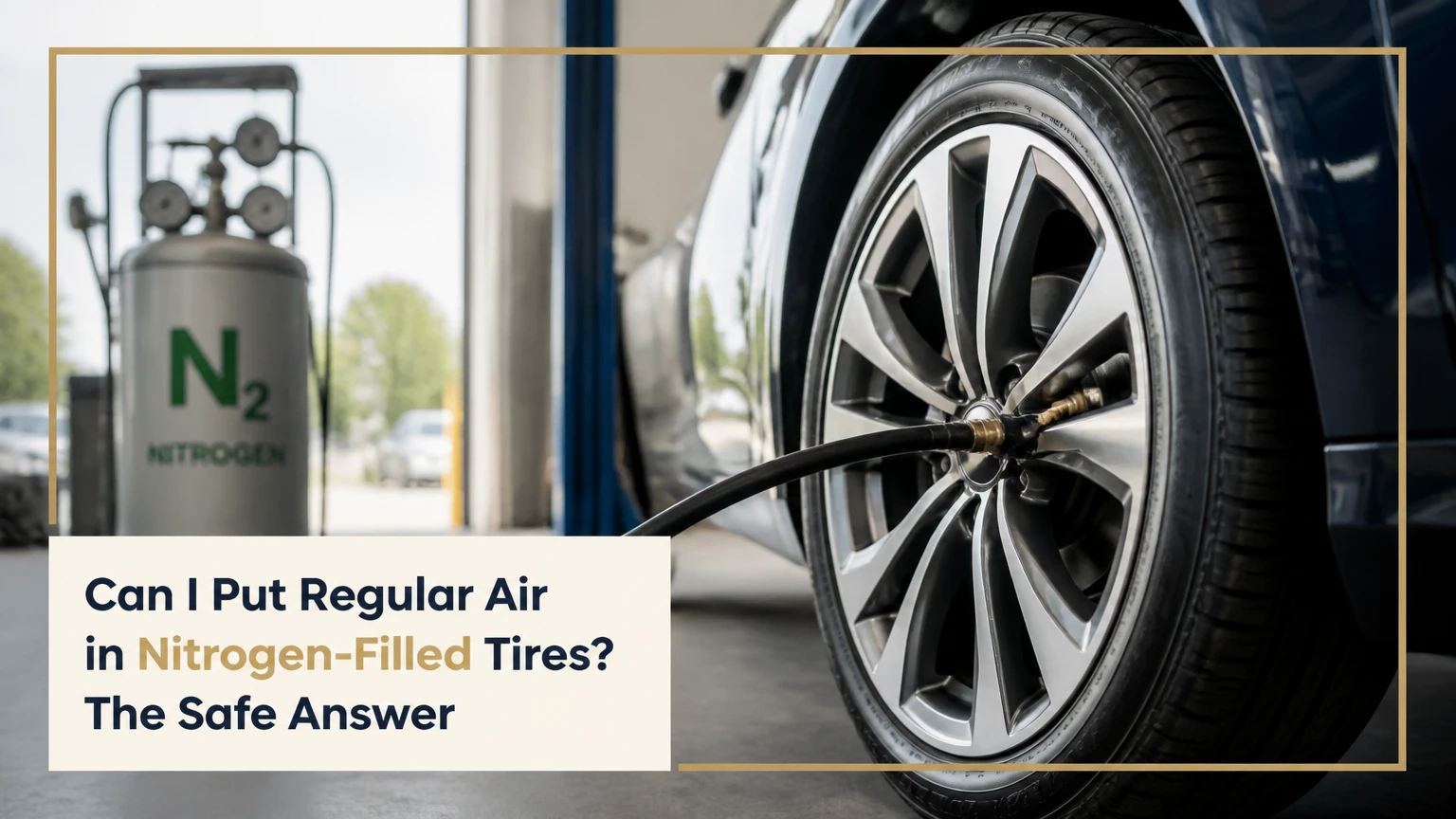
Yes, you can put regular air in nitrogen-filled tires. Compressed air and nitrogen mix safely, do not create an explosive reaction, and will not damage a compatible tire, wheel, valve, or TPMS sensor. Inflate the tire to the vehicle manufacturer’s recommended cold pressure immediately rather than driving while underinflated, even if adding air reduces nitrogen purity.
Key Facts at a Glance
- Regular compressed air is approximately 78% nitrogen, 21% oxygen, and about 1% argon, carbon dioxide, and water vapor, although humidity varies.
- Adding air changes the gas mixture but does not chemically damage the tire, rim, valve stem, or TPMS sensor.
- The correct inflation pressure is printed on the driver-side door-jamb placard, not on the tire sidewall.
- Nitrogen does not make tires maintenance-free. Punctures, valve leaks, bead leaks, and temperature changes still alter pressure.
- For most passenger vehicles, maintaining the correct pressure matters more than preserving a high nitrogen concentration.
- A full nitrogen purge is usually unnecessary after a small air top-up unless a manufacturer, racing team, or fleet procedure requires it.
Can I Put Regular Air in Nitrogen-Filled Tires?
Regular air is the correct emergency and maintenance choice when a nitrogen-filled tire is low and no nitrogen source is available. Adding ordinary compressed air dilutes the nitrogen mixture, but the resulting gas remains safe for normal road use and has no harmful reaction with tire rubber, steel belts, aluminum wheels, or TPMS hardware.
The practical priority is pressure, not purity. A tire at the recommended pressure has the designed contact patch, load capacity, steering response, and heat behavior; a tire below that pressure can flex excessively and overheat. The U.S. National Highway Traffic Safety Administration identifies underinflation as a major tire safety concern, while no road-safety authority requires ordinary passenger-car tires to contain pure nitrogen.
A small air top-up rarely creates a meaningful change in everyday driving. If the tire loses pressure again within days, the gas choice is not the problem. Inspect the tire and valve assembly for a puncture or leak.
Is Mixing Compressed Air and Nitrogen Safe?
Mixing compressed air and nitrogen is safe because both gases occupy the same tire chamber without producing a hazardous chemical reaction. Regular air already contains mostly nitrogen, so adding it does not create an explosive mixture or make the tire incompatible with its wheel.
What changes inside the tire?
The mixture contains more oxygen and potentially more moisture than a high-purity nitrogen fill. That difference can matter in specialized applications, especially racing, aircraft tires, long-term industrial storage, and operations where pressure consistency is tightly controlled. It is much less important for a road car driven at ordinary temperatures.
The AI Overview claim that nitrogen molecules are meaningfully larger than oxygen molecules oversimplifies the mechanism. Nitrogen, N₂, and oxygen, O₂, have similar molecular dimensions, and tire pressure loss depends on rubber formulation, liner construction, temperature, pressure, tire age, valve condition, and wheel sealing. Oxygen can permeate some rubber compounds faster, but the difference does not justify neglecting pressure checks.
What is in air compared with nitrogen?
| Inflation gas | Typical composition | Moisture level | Normal tire use |
|---|---|---|---|
| Ambient compressed air | 78% nitrogen, 21% oxygen, approximately 1% other gases | Variable, compressor-dependent | Standard passenger vehicles |
| Dry nitrogen | Usually 95% or higher nitrogen | Very low after drying | Fleets, racing, specialty service |
| Atmospheric air at high humidity | 78% nitrogen, 21% oxygen, up to several percent water vapor by volume | High and variable | Not preferred for precision applications |
| Nitrogen and air mixture | Often 80%-95% nitrogen after topping up | Variable | Safe for ordinary road use |
Nitrogen purity is not automatically 93% or 95% at every service outlet. The final concentration depends on the generator, filtration, purge method, initial gas, and how much air remains in the tire. A green cap does not prove a measured purity level.
Does Nitrogen Keep Tire Pressure More Stable?
Dry nitrogen can reduce pressure variation caused by moisture and may slow gas permeation modestly, but the pressure advantage for ordinary passenger vehicles is usually small. Temperature remains the dominant short-term influence because tire pressure changes as the gas warms or cools.
The ideal-gas relationship explains the main effect: at a fixed tire volume, pressure rises as absolute temperature rises. A tire that reads 35 psi at 20°C will not show the same gauge pressure after sitting overnight at 0°C or after highway driving heats the casing. Nitrogen and oxygen both follow this relationship.
Water vapor adds complexity because it can condense when cool and vaporize when hot. Dry nitrogen removes much of that moisture variability, which is useful for racing setups. It does not make a road tire immune to seasonal pressure changes.
How much pressure does a tire normally lose?
Published consumer figures vary because tire construction, climate, and leak conditions differ. A typical passenger tire may lose roughly 1 psi per month through normal permeation, with seasonal temperature changes adding or subtracting several psi. A sudden 2 psi loss in one week deserves inspection rather than repeated inflation.
| Condition | Typical pressure effect | Likely explanation | Recommended response |
|---|---|---|---|
| Overnight cold weather | 1-3 psi lower reading | Lower air temperature | Measure cold and adjust |
| Normal permeation | About 0.5-1.5 psi per month | Gas migration through rubber | Check monthly |
| Small tread puncture | More than 1 psi per week | Nail, screw, or embedded object | Tire-shop inspection |
| Valve or bead leak | Variable, often rapid | Damaged core, seal, or wheel | Soap-test and repair |
| Highway heat buildup | Temporary higher reading | Warmer casing and gas | Never bleed a hot tire to placard pressure |
A nitrogen-filled tire still requires routine measurement. TPMS is a warning system, not a precision maintenance gauge, and some systems do not warn until pressure has fallen substantially below the recommended value.
How Do You Add Air to a Nitrogen-Filled Tire?
Add regular air when the tire is low, using the vehicle placard pressure and a cold measurement. The job normally takes 2-5 minutes, requires no nitrogen-specific equipment, and should be completed before extended driving.
Step 1: Find the correct pressure
Read the driver-side door-jamb label or owner’s manual. Use the front and rear values shown for the vehicle, because axle loads and tire sizes can require different pressures. Do not use the maximum pressure molded into the tire sidewall as the normal target.
Step 2: Measure the tire cold
Check pressure before driving, or after the vehicle has been parked for approximately three hours. A tire warmed by highway travel can read several psi higher than its cold pressure.
Step 3: Inspect before inflating
Look for a nail, screw, sidewall bulge, cut, exposed cord, or valve-stem damage. Do not remove an embedded object, and do not inflate a visibly damaged tire for continued road use.
Step 4: Add compressed air
Connect the hose securely to the valve stem and inflate in short bursts. A gas-station inflator, workshop compressor, or portable 12-volt compressor can supply ordinary air; the equipment does not need a nitrogen setting.
Step 5: Verify the final pressure
Remove the hose, measure again with a reliable gauge, and replace the valve cap. Adjust to the placard value, not an estimate based on the tire’s appearance.
Step 6: Recheck the warning system
Drive according to the vehicle manual so the TPMS can update, if the system requires movement or a reset. A persistent warning after correct inflation indicates a sensor, relearn, or continuing leak issue.
Success checkpoint: The tire reaches the placard pressure while cold, the valve retains air, and no visible damage or warning condition remains.
Common mistake: Waiting for a nitrogen station while driving on a significantly underinflated tire. Pressure restoration is safer than preserving gas purity.
Should You Purge the Tire and Refill It With Nitrogen?
A purge and refill is optional after ordinary air has been added to a passenger-car tire. It becomes reasonable when a fleet specification, motorsport setup, specialty tire manufacturer, or storage protocol requires dry high-purity nitrogen and repeatable gas composition.
A proper conversion usually involves removing the valve core or evacuating the tire, replacing the gas, and repeating the process to reduce residual air. A shop may charge for the service and may not use a literal vacuum because tire-service equipment and procedures differ. A complete evacuation is not a routine requirement for safe road operation.
One air top-up does not permanently prevent future nitrogen use. The next scheduled service can refill the tire with nitrogen, although the final purity depends on the purge process and equipment.
| Service option | Typical cost per tire | Typical time | Best use |
|---|---|---|---|
| Self-service compressed air | $0-$2 | 2-5 minutes | Routine pressure correction |
| Shop air inflation | $0-$10 | 5-10 minutes | Inspection plus inflation |
| Nitrogen top-up | $0-$10 | 5-15 minutes | Existing nitrogen program |
| Nitrogen purge and refill | $20-$40 | 15-30 minutes | Specialty or controlled applications |
| Four-tire nitrogen conversion | $70-$100 or more | 30-60 minutes | Fleet or enthusiast preference |
Prices vary by region, tire shop, dealership policy, and whether inspection or tire removal is included. Many retailers provide nitrogen top-ups at no charge when they originally installed the tires.
Is Nitrogen Better Than Regular Air for Tires?
Nitrogen is potentially useful when pressure consistency, low moisture, or reduced maintenance across many vehicles has measurable operational value. Regular air is usually the better practical choice for private drivers because it is available everywhere, costs little, and delivers the same safety benefit when maintained at the correct pressure.
| Decision factor | Regular compressed air | High-purity nitrogen | Practical winner |
|---|---|---|---|
| Availability | Gas stations, workshops, portable pumps | Selected tire shops and dealerships | Air |
| Typical purchase price | $0-$2 per use | $5-$10 top-up or more | Air |
| Moisture control | Depends on compressor and dryer | Very low with suitable equipment | Nitrogen |
| Cold-pressure maintenance | Requires monthly checks | Still requires regular checks | Neither alone |
| Racing pressure repeatability | Adequate for many amateur uses | Better for controlled setups | Nitrogen |
| Roadside convenience | Immediate access | Limited locations | Air |
| Fuel economy benefit | Preserved when pressure is correct | Indirect, through pressure retention | Tie at equal pressure |
| Wheel corrosion consideration | Moisture may contribute over long periods | Dry gas reduces internal moisture | Nitrogen |
Which drivers benefit most from nitrogen?
Daily commuters: Use regular air and check pressure monthly. Nitrogen’s incremental benefit rarely offsets the inconvenience of locating a dedicated filling service.
Fleet operators: Consider nitrogen if centralized equipment, scheduled inspections, high annual mileage, and tire-cost data show a measurable return. Nitrogen does not replace a tire-pressure management program.
Track and autocross drivers: Dry nitrogen can improve repeatability during heat cycles, but the setup still requires temperature measurements, pressure logging, and driver testing. Nitrogen cannot compensate for an incorrect hot-pressure target.
Stored, classic, and exotic vehicles: Dry gas may reduce moisture exposure during long storage, but correct storage pressure, a dry garage, wheel inspection, and periodic movement are also important. Nitrogen will not prevent flat spots by itself.
Heavy trucks and buses: Fleet-scale benefits can be meaningful when pressure compliance is measured across hundreds of tires. The business case depends on labor, fuel consumption, tire wear, and equipment costs rather than nitrogen purity alone.
Does Nitrogen Prevent Rim Corrosion?
Dry nitrogen can reduce moisture inside a tire and therefore reduce one possible contributor to corrosion, but nitrogen does not guarantee that a wheel will remain corrosion-free. External road salt, damaged coatings, dissimilar-metal contact, bead-seat damage, and trapped water can corrode steel or alloy wheels independently of the inflation gas.
Wheel corrosion often causes a bead leak. A driver may interpret the resulting pressure loss as evidence that nitrogen “does not work,” when the actual defect is a damaged bead seat or corroded rim flange. A tire shop should demount the tire and inspect the sealing surfaces when repeated soap tests around the valve and tread show nothing.
Green valve caps are identification markers used by some service providers. They do not alter valve operation, seal the tire better, or convert ordinary air into nitrogen.
What Happens if a Nitrogen Tire Is Low or Has a Flat?
A low nitrogen-filled tire should be inflated with available compressed air before driving any significant distance. A flat, visibly damaged, or rapidly leaking tire should be replaced with the spare or handled by roadside assistance rather than repeatedly inflated.
Stop driving and obtain an inspection when:
- Pressure falls more than about 2 psi in one week.
- The TPMS warning returns soon after inflation.
- A nail, screw, sidewall cut, or bulge is visible.
- The valve stem leaks during a soap-water test.
- The wheel has a bent flange, crack, or severe corrosion.
- The tire was driven while substantially underinflated.
Apply soapy water to the tread, valve core, valve stem, and bead area. Bubbles identify escaping air, but the absence of bubbles during a brief test does not rule out a leak that appears only under load or after the tire warms.
A puncture in the repairable tread area may be repaired according to the tire manufacturer and Tire Industry Association procedures. Sidewall and shoulder damage generally requires replacement. Nitrogen does not change those repair rules.
Does Adding Air Affect TPMS or Tire Warranty?
Adding ordinary air does not normally affect a tire-pressure monitoring system or invalidate a tire warranty. TPMS sensors measure pressure, and some direct systems also measure temperature; they do not require the tire to contain pure nitrogen.
A TPMS warning can remain active after inflation if the vehicle needs a reset, relearn procedure, or short drive. Consult the owner’s manual because reset methods vary among Toyota, Ford, Honda, Tesla, BMW, and other manufacturers.
Warranty terms concern correct fitment, inflation, maintenance, road damage, and approved repairs. They generally do not make nitrogen purity a condition of ordinary tire use, but a commercial fleet or specialty vehicle may have a written operating specification. Follow that specification when one exists.
Common Mistakes With Nitrogen-Filled Tires
- Driving to find nitrogen: Underinflation increases flexing, heat, rolling resistance, and stopping distance. Add air first.
- Using the sidewall maximum: The sidewall figure is a tire limit, not the vehicle’s normal operating pressure.
- Checking only when the warning appears: TPMS is not a substitute for monthly gauge checks.
- Bleeding a hot tire: A hot reading includes heat-generated pressure. Set pressure cold unless the vehicle manufacturer gives a hot-pressure procedure.
- Assuming rapid loss is normal: A tire losing 2 psi weekly may have a puncture, valve-core leak, bead leak, or damaged wheel.
- Paying for repeated purges: Ordinary driving seldom justifies removing a safe mixed gas unless a documented specialty requirement exists.
A useful practitioner rule is simple: correct pressure beats preferred gas. A second rule is diagnostic: pressure-loss speed matters more than gas identity. A third rule applies to performance driving: log cold and hot pressures consistently, because nitrogen cannot correct an inconsistent measurement process.
When Is Nitrogen Worth the Cost?
Nitrogen is worth considering when the cost of pressure deviation exceeds the cost of nitrogen service. That calculation can favor nitrogen for a large commercial fleet, a race vehicle, or equipment exposed to controlled high-temperature cycles, while it usually favors ordinary air for a privately owned commuter car.
| Vehicle situation | Recommended inflation gas | Check interval | Reason |
|---|---|---|---|
| Compact car, 12,000 miles yearly | Regular air | Monthly | Easy access and low operating cost |
| Long-haul fleet, 100,000 miles yearly | Nitrogen or dry air program | Weekly to monthly | Centralized pressure control |
| Autocross car, repeated heat cycles | Dry nitrogen preferred | Before every event | More repeatable pressure behavior |
| Stored collector car, six-month storage | Nitrogen optional | Monthly during storage | Moisture reduction, not flat-spot prevention |
| RV or trailer with seasonal use | Either, with inspection | Before every trip | Load and temperature changes dominate |
No gas eliminates the need to inspect tread depth, rotation condition, alignment, valve hardware, wheel sealing, and tire age. Nitrogen is a maintenance aid, not a safety substitute.
FAQ
Can I use a gas-station air pump on nitrogen tires?
Yes. A gas-station compressor supplies ordinary compressed air, which is compatible with nitrogen-filled tires, wheels, valves, and TPMS sensors. Inflate to the cold pressure on the door placard, verify with a gauge, and arrange a nitrogen top-up later only if your vehicle or operating program specifically requires it.
Does regular air make a nitrogen tire explode?
No. Mixing regular air and nitrogen does not create an explosive reaction. Tire failure results from conditions such as severe underinflation, overloading, impact damage, excessive heat, or structural defects. Never exceed the vehicle’s recommended load and pressure limits, regardless of the inflation gas.
Is nitrogen better in winter?
Dry nitrogen may reduce moisture-related pressure variability, but winter temperature still lowers tire pressure because both nitrogen and air respond to temperature. Check pressure cold during seasonal changes and add gas as needed. Winter safety depends primarily on correct pressure, suitable tread, and appropriate cold-weather tires.
How often should nitrogen-filled tires be checked?
Check nitrogen-filled tires at least monthly and before long trips. Measure all four tires when cold, plus the spare if fitted with a monitoring system or intended for use. A tire that loses pressure quickly needs leak diagnosis, not a longer interval between nitrogen services.
Can a tire shop remove nitrogen after I add air?
Yes. A tire shop can reduce the mixed gas and refill the tire with nitrogen using its service equipment. Complete removal is normally optional for road vehicles, and the final purity depends on the number of purge cycles, equipment, and starting pressure rather than on the color of the valve cap.
Will nitrogen improve fuel economy?
Nitrogen may indirectly support fuel economy if it helps a driver or fleet maintain correct pressure, but nitrogen at the same pressure does not provide a dramatic independent fuel-saving effect. Underinflation increases rolling resistance, so regular air at the placard pressure can preserve the relevant efficiency benefit.
The Bottom Line
You can put regular air in nitrogen-filled tires safely. The exact keyword question, “can i put regular air in nitrogen filled tires,” has a practical answer: restore the manufacturer’s recommended cold pressure immediately, accept the lower nitrogen concentration, and inspect any tire that loses pressure repeatedly. For most road cars, correct pressure and timely leak repair matter more than maintaining high-purity nitrogen.