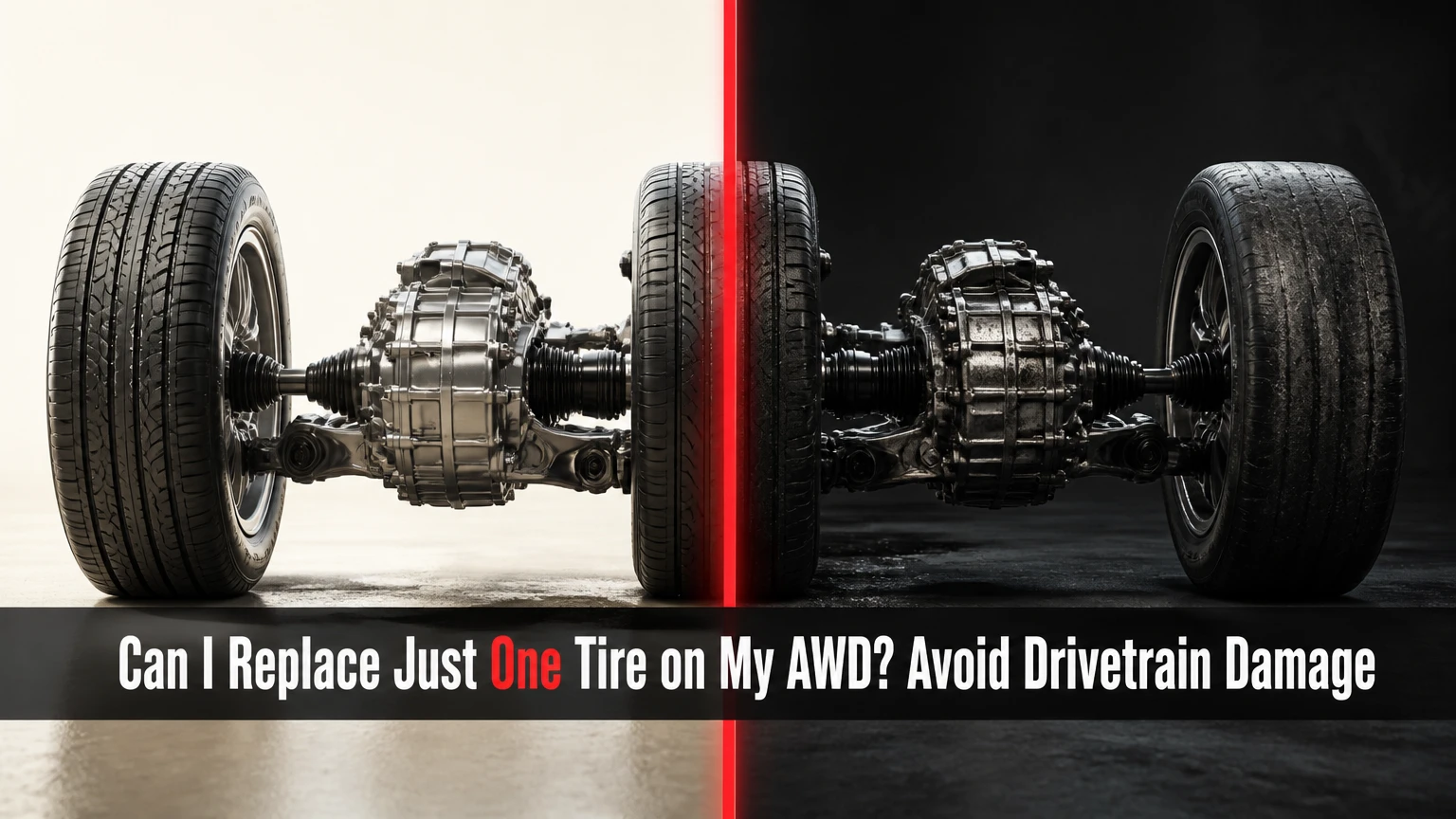
Yes, you can replace just one tire on an AWD vehicle when the replacement matches the other tires closely in rolling circumference, tread depth, size, load index, speed rating, and construction. If the remaining tires are substantially worn, install four tires, use a professionally shaved matching tire, or find an exact used match instead of fitting one full-depth new tire.
Key Facts at a Glance
AWD tire replacement is safe only when the vehicle manufacturer’s measured-difference limits are satisfied.
A general service rule is to keep all four tires within about 2/32 inch of tread depth, but the owner’s manual takes priority.
Matching sidewall size does not guarantee matching rolling circumference because tire models have different casings and tread profiles.
A new tire may measure approximately 10/32-12/32 inch, while a worn tire may measure 6/32 inch or less.
Tire shaving can reduce a new tire’s tread to match the other three, but the service must be performed by a qualified tire supplier.
A flashing AWD light, tight-turn shudder, or burning gear-oil odor requires prompt inspection rather than continued driving.
Can I Replace Just One Tire on My AWD?
A single replacement tire is usually acceptable when the other three tires are nearly new, the replacement is the exact same tire model, and the measured difference remains within the vehicle maker’s limit. A one-tire replacement is risky when the other tires have thousands of miles of wear, even if the sidewall size appears identical.
The safest decision begins with measurements, not appearance. Ask a tire shop to measure the three tires that remain, then compare those readings with the new tire’s published or actual tread depth. If the difference exceeds the manual’s limit, choose a shaved tire, a closely matched used tire, or a complete set.
A tire that failed because of a repairable tread puncture may not need replacement at all. A puncture in the repairable center area, with no sidewall or run-flat damage, can often be repaired according to the tire maker’s procedure. A sidewall bubble, belt separation, exposed cord, or puncture outside the repairable zone requires replacement.
Why Does AWD Care About Tire Diameter?
AWD systems care about rolling circumference because tires with different circumferences rotate at different speeds while traveling the same distance. A center differential, transfer case, viscous coupling, or electronically controlled clutch must absorb or manage that speed difference when the vehicle is traveling straight.
The mismatch becomes continuous rather than occasional. A normal differential allows wheel-speed differences during cornering, but a large front-to-rear difference can force clutch plates, gears, bearings, or fluid to work constantly. The resulting heat can accelerate wear and, in severe cases, damage the transfer case or differential.
A full-depth tire is not automatically a problem. The practical issue is the difference between that tire and the three installed tires, not the new tire’s tread depth in isolation. A 10/32-inch replacement beside three 9/32-inch tires may be acceptable, while the same tire beside three 5/32-inch tires may not be.
The common “2/32-inch rule” is a useful screening point, not a universal engineering specification. Tire Rack and Consumer Reports both discuss tire shaving for AWD and four-wheel-drive vehicles, while manufacturers such as Subaru publish vehicle-specific limits that can be stricter.
Which AWD Systems Are Most Sensitive?
Full-time mechanical AWD systems are generally the least tolerant of mismatched rolling circumferences because a mechanical center differential or transfer device remains connected during normal driving. Part-time systems may be less sensitive in two-wheel drive, but using four-wheel drive on high-traction pavement can still create driveline wind-up.
| AWD architecture | Typical mismatch concern | Components affected | Best replacement approach |
|---|---|---|---|
| Full-time mechanical AWD | High during every drive | Center differential, transfer case, viscous coupling | Match all four closely |
| Multi-plate clutch AWD | Moderate to high when engaged | Clutch pack, pump, control module | Follow manual limits |
| Part-time 4WD | Low in 2WD, high in locked 4WD | Transfer case, front axle | Match tires before 4WD use |
| Dual-motor electric AWD | Vehicle-specific | Motors, reduction gears, traction software | Follow EV maker’s axle and tire rules |
| Selectable electronic AWD | Variable by drive mode | Clutches, motors, wheel-speed controls | Match tire model and circumference |
Subaru Symmetrical AWD vehicles are a well-known example of a system that can be sensitive to tire circumference. Some Subaru manuals specify that the four tires must have the same circumference within 1/4 inch, but the exact requirement varies by model and year. That specification should be verified in the vehicle’s manual or through a Subaru dealer.
Electric AWD is not automatically exempt. A Tesla Dual Motor, Ford Mustang Mach-E, or another EV may use separate motors for each axle, reducing some mechanical front-to-rear coupling. Software still depends on reliable wheel-speed data, tire-load compatibility, and the manufacturer’s approved tire configuration, so EV owners must not generalize from one model to another.
How Much Tread Difference Is Safe?
The safe tread difference is the value in the owner’s manual or service information for the specific vehicle. If no vehicle-specific number is available, many tire professionals use approximately 2/32 inch as a conservative screening threshold, but tread depth alone cannot establish the exact rolling-circumference difference.
Measure the remaining three tires in the main grooves at several points. A tire with uneven wear may show 7/32 inch at one point and 5/32 inch at another, so using the highest reading can hide the actual mismatch. Compare the lowest representative reading and inspect for cupping, shoulder wear, and a different tire model.
Subaru’s 1/4-inch circumference example illustrates why a vehicle-specific measurement can matter more than a generic tread rule. Circumference depends on the tire’s casing, inflation, load, wear pattern, and actual molded dimensions. Two tires with equal tread readings can still have slightly different rolling radii.
| Remaining tire condition | Approximate tread reading | One-tire decision | Recommended action |
|---|---|---|---|
| Three tires nearly new | 9/32-11/32 inch | Usually acceptable | Install exact matching tire |
| Three tires moderately worn | 7/32-8/32 inch | Verify manual limit | Measure circumference or shave replacement |
| Three tires at 5/32-6/32 inch | 5/32-6/32 inch | Often unsuitable | Replace four or use matched shaved tire |
| Uneven or mixed models | 4/32-8/32 inch | Unsafe to judge visually | Inspect all tires and compare specifications |
A tread-depth gauge costs about $5-$15 and provides a better starting point than the penny test. The U.S. National Highway Traffic Safety Administration identifies 2/32 inch as a common replacement point for worn tread, but a tire can be unsuitable for AWD matching before it reaches the legal or safety-wear threshold.
What Must Match on a Replacement Tire?
The replacement should match the existing tires in brand, model, size, load index, speed rating, construction, and intended use. The same 235/55R19 marking on two tires does not make them interchangeable because internal belts, casing stiffness, tread profile, and inflated diameter can differ.
Check the complete sidewall marking. For example, 225/65R17 102H identifies size, load index, and speed rating, but it does not identify the tire model or whether the tire is a run-flat, reinforced, winter, all-season, or all-terrain design.
| Matching attribute | Example value | Why it matters | What to verify |
|---|---|---|---|
| Tire size | 235/55R19 | Controls nominal dimensions and clearance | Door-jamb label and manual |
| Load index | 105 | Sets rated carrying capacity | Equal or approved higher rating |
| Speed rating | V | Sets speed capability and construction | Manufacturer-approved rating |
| Tire model | Michelin CrossClimate2 | Defines casing and tread geometry | Exact model and generation |
| Construction | XL, run-flat, standard | Changes stiffness and loaded radius | Sidewall marking and manual |
| Season and traction type | All-season or winter | Changes compound and behavior | Match the vehicle’s intended set |
Do not combine a standard tire with a run-flat unless the manufacturer specifically permits it. Do not install one winter tire among all-season tires, even when the dimensions match. A tire with a different compound can change braking, cornering, hydroplaning, and electronic stability-control behavior.
How Do You Decide Between One, Two, or Four Tires?
Use tread measurements, tire age, damage type, and the manufacturer’s AWD limit to choose the replacement quantity. Replacing two tires on the same axle is not automatically safe because AWD still compares front and rear rolling speeds, and different axle diameters can load the center drivetrain.
| Replacement path | Typical installed cost | Typical time | Best use case | Main limitation |
|---|---|---|---|---|
| One exact new tire | $100-$300 | 1-2 hours | Other tires within tolerance | Full tread may mismatch |
| One professionally shaved tire | $125-$360 | 1-5 days | Three usable, worn matching tires | Shaving costs extra and removes tread |
| One exact used tire | $40-$150 | 1-7 days | Same model and measured tread available | History and age require inspection |
| Two new tires | $250-$700 | 1-2 hours | Manual permits axle replacement | Front-rear mismatch may remain |
| Four new tires | $500-$1,200 or more | 1-3 hours | Significant wear or mixed set | Highest immediate cost |
Prices are typical U.S. retail ranges for common passenger vehicles, excluding unusual performance, truck, and specialty EV tires. Regional labor, mounting, balancing, disposal, alignment, taxes, and road-hazard coverage can change the total.
The strongest cost-saving option is often one professionally shaved tire when the other three have even wear and substantial usable life. Tire Rack describes shaving as a way to match tread depth on AWD and four-wheel-drive vehicles, but the process may affect the tire warranty, and the service must be ordered from a supplier that supports the exact tire.
How Do You Measure the Other Three Tires?
Measure every remaining tire before purchasing a replacement, then compare the results with the owner’s manual and the replacement tire’s specifications. The process takes about 10-20 minutes and requires a tread-depth gauge, a flashlight, tire-pressure information, and the vehicle’s manual.
- Park on level ground and inspect all four tires. Look for bulges, sidewall cuts, exposed cords, belt separation, and severe shoulder wear. Do not measure a structurally damaged tire as if it were serviceable.
- Confirm cold inflation pressure. Check the door-jamb label, not the maximum pressure printed on the sidewall. Pressure changes the loaded radius and can also create handling problems.
- Measure each tire in three groove locations. Take readings on the inner, center, and outer portions of the main tread grooves, avoiding wear bars. Record the lowest consistent reading for each tire.
- Identify the complete tire specification. Photograph the sidewall and record brand, model, size, load index, speed rating, DOT date code, and run-flat or XL markings.
- Compare the readings with the manual. If the manual gives a circumference limit, have a shop measure circumference directly rather than estimating from tread depth.
- Inspect the replacement after installation. Confirm correct rotation direction, tire pressure, TPMS operation, wheel torque, and alignment if the original failure involved impact or uneven wear.
You will know the comparison is useful when each tire has a written tread measurement and a confirmed model identity. The common mistake is measuring only the center groove, which can miss shoulder wear that changes the tire’s effective rolling behavior.
Can a Tire Shop Shave a New Tire to Match?
A tire shop can shave a new tire to match the tread depth of the other three, provided the tire is an appropriate match and the shop has the equipment and expertise. Tire shaving removes tread rubber uniformly, allowing one new tire to approach the worn tire’s rolling circumference without replacing three serviceable tires.
A shaved tire is not the same as a used tire. The casing remains new, but the original tread depth and potentially the manufacturer’s warranty are changed. The shop should measure the installed set, confirm the target depth, and avoid shaving below a safe usable tread level.
Tire shaving is a poor choice when the remaining tires have uneven wear, age-related cracking, different models, or less than about 4/32 inch of usable tread. It is also unsuitable when the damaged tire failure reveals an alignment, suspension, or inflation problem that will quickly destroy the replacement.
Is a Used Matching Tire Safe?
A used tire can be safe for AWD when it is the exact same model and specification, has verified tread depth close to the other tires, and passes a professional inspection. A seller’s statement that the tire is “like new” is not a sufficient measurement.
Inspect the DOT date code, bead area, inner liner, sidewalls, repair history, and tread for plugs, patches, cupping, and irregular wear. Tire age matters because rubber and internal materials degrade even when tread remains; the tire manufacturer’s age guidance takes priority, and many manufacturers advise removal around six to ten years from manufacture.
A used tire is a poor bargain when its history is unknown, its date code is missing, or its tread depth is merely estimated. A $60 tire that causes a $1,000 transfer-case repair is not a cost-effective replacement.
Can You Drive With a Temporary Spare?
A temporary spare should be used only for the distance, speed, and drivetrain conditions stated in the owner’s manual. AWD vehicles may require disabling AWD, installing the temporary spare on a particular axle, or limiting travel to a short emergency trip.
Compact temporary spares have a smaller diameter and narrower tread than normal tires. Continuous use can create the same wheel-speed mismatch that makes a full-size mismatched tire dangerous, while a full-size spare may still differ in wear or model.
Do not use a compact spare for normal highway travel until the damaged tire is repaired or the correct replacement is installed. If the AWD warning light appears, follow the manual rather than assuming the light will reset after the spare is removed.
What Happens If Two AWD Tires Are Replaced?
Two tires may be replaced when the vehicle manufacturer permits axle-pair replacement and the new pair is matched to each other and sufficiently close to the other axle. Installing two new tires without checking front-to-rear circumference can still stress an AWD coupling.
Some manufacturers recommend placing the tires with greater tread on the rear axle for wet-road stability, but AWD, staggered fitments, directional tires, and vehicle-specific instructions can change that recommendation. The manual and tire shop’s fitment data should control placement.
Replacing two tires is especially complicated on vehicles with different front and rear sizes. A staggered setup may be factory-approved, while changing only one tire within a staggered axle can still create a side-to-side mismatch.
Which Common AWD Tire Mistakes Cause Trouble?
The most common mistake is treating the sidewall size as the complete fitment specification. A second mistake is accepting a generic 2/32-inch rule without checking the vehicle manual, because manufacturers calculate limits for particular drivetrains and tire configurations.
Avoid these errors:
- Eyeballing tread depth: A 2/32-inch difference is about 1.6 millimeters and is difficult to judge reliably without a gauge.
- Mixing tire models: Equal nominal size does not guarantee equal rolling radius.
- Replacing an axle pair automatically: Front-to-rear mismatch can still load an AWD coupling.
- Ignoring tire age: A matching but aged tire may have degraded rubber or hidden damage.
- Skipping alignment checks: A bent wheel or incorrect toe setting can rapidly create a new mismatch.
- Assuming electronic AWD has no limits: Wheel-speed sensors and traction software still require approved tire combinations.
A practitioner rule is simple: if the shop cannot document tread depth and tire identity for all four positions, the replacement decision is incomplete.
What Warning Signs Mean AWD Tires Do Not Match?
A flashing AWD or 4WD light, binding during tight turns, shuddering, hopping, unusual tire scrub, or a burning gear-oil smell can indicate a driveline or tire-mismatch problem. These symptoms also have other causes, so a technician should scan fault codes and inspect fluid, tire pressure, tire size, and drivetrain components.
Stop treating the vehicle as normal if the symptoms appear after a tire change. Avoid repeated tight circles, towing, high-speed travel, and extended driving until the mismatch is checked.
A warning light alone does not prove that one tire destroyed the drivetrain. Wheel-speed sensor faults, low pressure, damaged wiring, or a control-module issue can produce similar warnings. The correct diagnosis compares measured tire circumference and scan data rather than replacing parts based on the dashboard symbol.
Which AWD Tire Solution Fits Your Situation?
Nearly New Tires
Choose one exact new tire when the remaining three tires show minimal wear and the manual permits the measured difference. Confirm the same brand, model, size, load index, speed rating, and construction before installation.
Moderately Worn Tires
Choose a professionally shaved tire when all three remaining tires are structurally sound, evenly worn, and have enough tread to remain useful. This option preserves the existing set while controlling rolling-circumference variation.
One Damaged Tire and a Tight Budget
Consider an exact used tire only when the seller provides measured tread depth and a readable DOT date code. Have the tire inspected and balanced by a qualified shop before relying on it for AWD operation.
Several Worn or Mixed Tires
Replace all four when tread readings vary widely, models differ, tires are aged, or the vehicle has a strict circumference tolerance. The higher purchase price buys consistent traction and removes uncertainty from the drivetrain decision.
Frequently Asked Questions
Does replacing one AWD tire void my warranty?
Replacing one tire does not automatically void a vehicle warranty, but drivetrain coverage can be disputed if the tire configuration violates the owner’s manual or causes documented mismatch-related damage. Keep the invoice, tire specifications, tread measurements, and manufacturer guidance to show that the replacement met approved limits.
Should AWD tires have the same tread pattern?
AWD tires should normally have the same brand and model across all four positions, especially on full-time systems. Matching tread patterns also keeps compound, casing behavior, wet traction, and rolling circumference more consistent. A different model with the same size marking can still create a meaningful mismatch.
Can I repair a puncture instead of replacing the tire?
A puncture can often be repaired when it is in the central tread area, within the tire maker’s size limit, and the tire was not driven while severely deflated. Sidewall damage, shoulder punctures, belt separation, exposed cords, and many run-flat damage cases require replacement.
Do I need an alignment after replacing one tire?
An alignment is not automatically required after a normal tire replacement, but it is advisable when the old tire failed from uneven wear, impact, pulling, steering-wheel misalignment, or a pothole strike. Correct alignment prevents the replacement tire from developing a new circumference mismatch.
How long can I drive with one mismatched AWD tire?
There is no universal safe mileage for a mismatched AWD tire because drivetrain design, speed, load, temperature, and circumference difference vary. Drive only as needed to reach a tire professional, avoid high speed and tight turns, and stop immediately if binding, warning lights, or burning odor appears.
The Bottom Line
You can replace just one tire on an AWD vehicle only when the replacement remains within the manufacturer’s tire-difference limit and matches the other tires in model and specification. Measure the three existing tires, check the owner’s manual, and do not rely on visual tread comparison.
If the exact keyword question is can i replace just one tire on my awd, the practical answer is yes for a nearly new, precisely matched set, but no for a substantially worn or mixed set unless the replacement is professionally shaved or otherwise matched. When measurements are uncertain, replacing all four tires is safer than risking a transfer case, differential, clutch pack, or traction-control fault.


