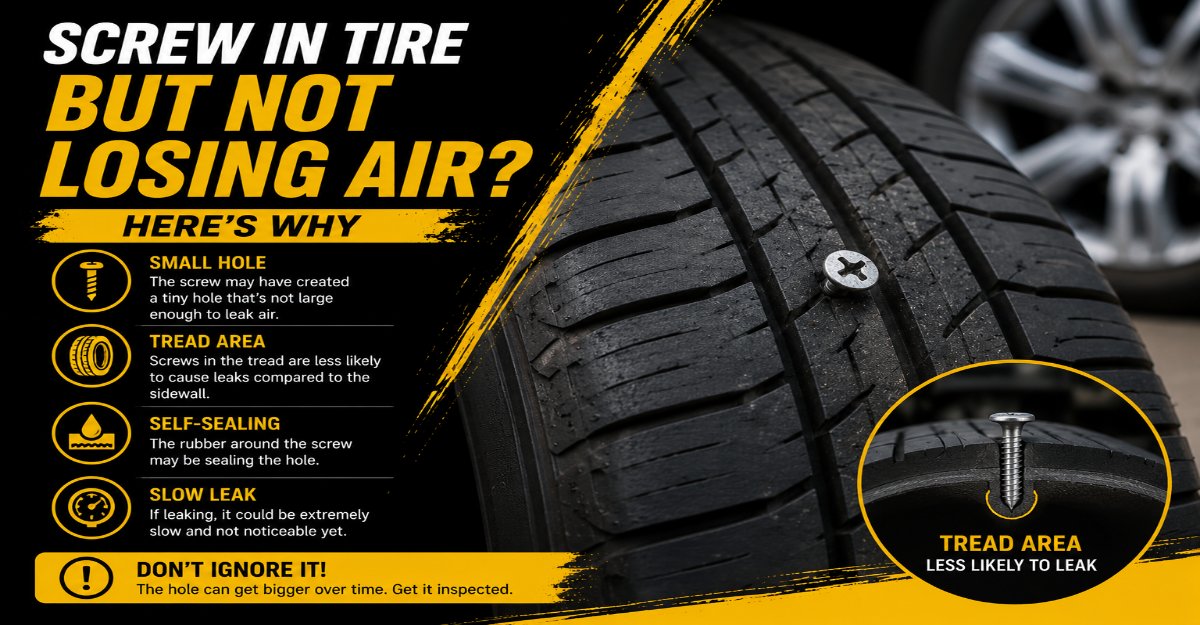
Finding a screw embedded in your vehicle tire while pressure remains stable indicates that the fastener has lodged within the thick exterior rubber tread block without fully breaching the airtight inner liner. This condition represents a temporary state of equilibrium where the metal shaft of the screw blocks the puncture channel tightly enough to prevent compressed air from escaping. However, structural integrity is compromised, and continuous flexing from road contact can push the screw deeper, necessitating immediate diagnosis, professional assessment, and proper repair according to industry safety standards.
Key Facts at a Glance
- Tread Depth: Passenger vehicle treads are typically 8/32 to 11/32 inches thick when manufactured brand new.
- Repairable Zone: Only the center 75 percent of the tread surface qualifies for standard professional repairs.
- Maximum Hole Limit: The U.S. Tire Manufacturers Association restricts repairs to punctures measuring 6mm (1/4 inch) or smaller.
- Repair Standard: A combination patch-plug unit represents the industry gold standard for permanent safety.
- Safety Rule: Never pull a foreign object out of a tire unless you possess an inflation source and a repair kit or spare tire nearby.
The Mechanical Physics of a Screw Lodged in a Tread Block
Modern pneumatic tires are complex composite structures built from multiple layers of synthetic rubber, steel wire cords, and textile plies. Understanding the internal architecture explains why certain punctures do not immediately deflate a tire.
- The Tread Block and Cap Ply: The outer rubber layer absorbs initial road impacts and provides traction. A short screw or a screw entering at a shallow oblique angle often terminates entirely within this non-structural rubber depth.
- The Steel Belts: Beneath the tread lies two or more high tensile steel cord belts designed to resist punctures and maintain a flat contact patch. If a screw encounters these steel cables, it may bend, wedge between the cords, or stall its forward progress.
- The Inner Liner: This innerhalation layer is a specialized halobutyl rubber compound engineered specifically to trap compressed air molecules. As long as this airtight membrane remains unpunctured, the tire pressure gauge will register zero loss.
- The Dynamic Risk: Vehicle weight, centrifugal force during rotation, and thermal expansion cause constant micro-movements of the embedded screw. Each rotation acts like a drill bit, gradually widening the channel and threatening the inner liner.
Immediate Action Protocol When You Discover a Screw
Discovering a metallic fastener in your tread requires a methodical approach to prevent a sudden roadside blowout. Follow these steps before operating the vehicle further.
- Leave the Screw Undisturbed: Pulling the fastener out on the roadside removes the temporary physical plug, instantly venting all internal pressure and stranding the vehicle.
- Inspect the Positioning: Measure or visually estimate the distance from the outer edge of the tread to determine if the object resides in the center repairable zone or the unrepairable shoulder and sidewall.
- Perform the Liquid Leak Test: Mix dish soap and water in a spray bottle or pour soapy water directly over the screw head. Active bubbling confirms that compressed air is escaping around the threads, even if the gauge has not dropped yet.
- Establish a Baseline Pressure: Connect a digital pressure gauge to the valve stem and record the exact PSI. Park the vehicle, wait two hours, and recheck the pressure to detect subtle slow leaks.
- Drive Conservatively to a Facility: If pressure is stable and no bubbles appear, drive under 50 miles per hour (80 kilometers per hour) directly to a certified tire service center.
Professional Repair Methods Compared
When a professional dismounts the tire from the wheel rim, they evaluate the internal damage and select one of three primary rehabilitation methods.
+--------------------------+------------------------+---------------------------------------+
| Repair Method            | Cost Estimate          | Safety & Longevity Rating             |
+--------------------------+------------------------+---------------------------------------+
| Combination Patch-Plug   | $20 to $45             | Industry Standard (Permanent)         |
+--------------------------+------------------------+---------------------------------------+
| Interior Patch Only      | $15 to $30             | Moderate (Vulnerable to belt rust)    |
+--------------------------+------------------------+---------------------------------------+
| External String Plug     | $5 to $15 (DIY kit)    | Emergency Temporary Only              |
+--------------------------+------------------------+---------------------------------------+
Combination Patch-Plug Units
The combination unit consists of a rubber stem coated with vulcanizing gum attached to a reinforced rubber patch. The stem fills and seals the puncture channel from the inside out, preventing moisture from reaching the internal steel belts, while the patch permanently seals the inner liner. This method satisfies all rigorous standards set by the USTMA.
Interior Flat Patches
An interior patch requires buffing the inner liner clean and applying chemical cement followed by a flat rubber patch. While this seals the air pressure effectively, it leaves the puncture tunnel open to environmental moisture. Water entering from the tread surface can oxidize the internal steel belts, leading to belt separation over time.
External String Plugs
External string plugs involve forcing a sticky, resin impregnated rubber cord into the hole using a manual insertion tool without removing the tire from the rim. This method serves exclusively as a roadside emergency measure to reach a repair shop. External plugs lack internal anchoring and can dislodge under high speed thermal stress.
Technical Boundaries: What Can and Cannot Be Repaired?
Tire service professionals adhere to strict legal and structural boundaries when deciding whether to repair or replace a punctured tire.
- The Sidewall and Shoulder Rule: Punctures located on the sidewall or within the outer shoulder zone cannot be repaired. These areas experience maximum flex, high heat generation, and extreme structural tension, making patches unstable.
- Puncture Angle Limits: A screw that enters at a severe diagonal angle can create a lengthy internal channel that exceeds safe drilling and filling parameters.
- Tread Depth Thresholds: Legally and safely, tires with remaining tread depth below 2/32 of an inch cannot be serviced. Investing in a repair on worn out rubber is economically unviable since replacement is imminent.
- Speed Rating Implications: High performance speed-rated tires carrying Z, W, or Y designations often lose their manufacturer certified speed rating permanently once punctured and repaired, requiring drivers to limit top speeds accordingly.
Troubleshooting Scenarios for Stabilized Punctures
Different tire reaction profiles require specific operational responses. Use this diagnostic matrix to determine your exact status.
- Scenario A: No Bubbles and Stable Pressure
- Diagnosis: The screw is lodged strictly in the tread rubber block without reaching the casing plies.
- Action: Have a tire technician extract the screw during your next routine oil change or tire rotation to inspect the base of the channel.
- Scenario B: Zero Pressure Loss, But Active Soapy Bubbles
- Diagnosis: A slow leak is underway. The screw threads are acting as a restrictive baffle, allowing air to bleed out microscopically over several hours.
- Action: Avoid long distance driving. Inflate the tire to specification and proceed immediately to a professional service center.
- Scenario C: Overnight PSI Drop of 4 to 6 PSI
- Diagnosis: The inner liner has been breached. The tire is classified as flat or compromised, and driving on it underinflated will destroy the internal sidewall structure.
- Action: Mount your spare tire or use a portable 12V air compressor to maintain pressure while driving slowly to the nearest repair shop.
Frequently Asked Questions
Can I drive long distances with a screw in my tire if the pressure is fine?
Driving long distances is strongly discouraged even if pressure remains stable. Centrifugal forces, road friction, and continuous tire flexing generate internal heat that can cause the embedded screw to migrate deeper into the carcass, transforming a minor blockage into a sudden blowout at highway speeds.
Will a screw puncture trigger my TPMS dashboard warning light?
The Tire Pressure Monitoring System only alerts you when internal pressure drops below the manufacturer recommended threshold, usually a 25 percent decrease. If the screw is sealing the hole completely and pressure is stable, the TPMS light will remain off despite the structural damage.
Are run-flat tires repairable after a screw puncture?
Most major tire manufacturers and industry associations prohibit the repair of run-flat tires if they have been operated in an underinflated state. If a run-flat tire maintained full pressure and the puncture meets standard size and location criteria, qualified technicians can repair it following specific internal inspection guidelines.
Can I use a can of tire sealant instead of getting a professional patch?
Aerosol tire sealant cans provide a temporary emergency fix by coating the interior with liquid latex. However, this sealant creates a messy residue that makes subsequent professional patch repairs difficult or impossible, often ruins TPMS sensors, and unbalances the wheel assembly.
How much should a professional tire repair cost?
A standard professional combination patch-plug service typically costs between twenty and forty-five dollars, which includes dismounting, inspecting, repairing, remounting, and rebalancing the wheel. Many nationwide tire retailers offer this service at zero cost to build long term customer loyalty.