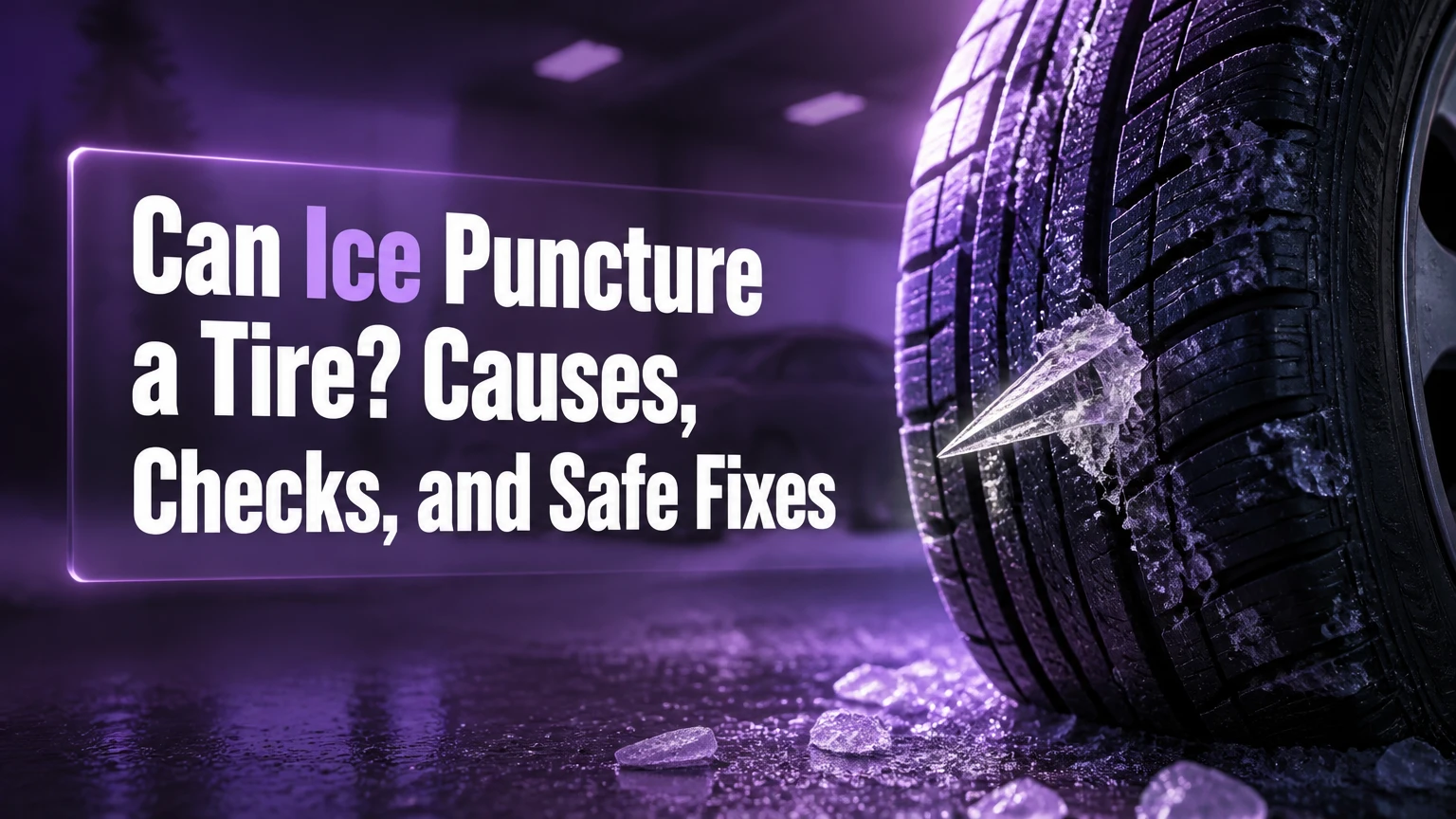
Yes, ice can puncture or damage a tire, but a smooth, flat sheet of ice rarely pierces tire rubber by itself. The greater risks are sharp frozen slush, ice-anchored debris, pothole edges, and impact damage caused by driving over uneven frozen surfaces. A tire that loses air afterward needs inspection before continued driving.
Key Facts at a Glance
- Smooth roadway ice normally causes loss of traction, not a puncture, because it lacks a concentrated sharp edge.
- Jagged frozen slush, exposed ice shards, and frozen debris can cut or penetrate the tread.
- Ice-covered potholes more commonly cause rim bends, sidewall pinches, and bead leaks than pure-ice punctures.
- A cold-weather pressure drop affects all tires similarly, while a puncture usually causes one tire to lose pressure faster.
- A puncture in the central tread may be repairable after internal inspection; sidewall and shoulder damage normally require replacement.
- Winter tires improve grip and cold-weather flexibility, but they do not make a vehicle immune to punctures or pothole damage.
Can Ice Puncture a Tire?
Ice can puncture a tire when the ice forms a sharp, rigid projection or holds another object in a position that concentrates force on a small area. Smooth black ice usually cannot pierce a tread because it presents a broad, slippery surface rather than a pointed cutting edge. Frozen road debris is the more common explanation when a driver finds damage after an icy trip.
A vehicle’s weight creates substantial contact force, but force alone does not puncture rubber. A sharp nail, broken metal edge, angular rock, or narrow ice ridge concentrates that force into a tiny contact area. Tire tread includes rubber, fabric, and steel reinforcement, yet the outer rubber can still be cut between tread blocks or penetrated by a pointed object.
Cold weather also changes the situation. Tire compounds become less flexible as temperature falls, although the exact transition depends on the compound, tire design, inflation pressure, and exposure time. The often-repeated claim that every tire becomes unsafe below 7°C (45°F) is too broad. That temperature is a useful rule for winter-tire traction, not a universal puncture threshold.
What is more likely, pure ice or hidden debris?
Hidden debris and pothole impact are generally more likely than a clean shard of ice piercing a tire. A frozen road surface can trap nails, screws, gravel, broken pavement, and metal fragments, leaving the object angled upward or concealed until the tire rolls over it.
The distinction matters during diagnosis. A small round hole in the tread with a nail still embedded indicates a conventional penetration, while a torn sidewall, bent rim, or bead leak points toward impact. A jagged cut across several tread blocks may involve frozen slush, but visual evidence is necessary before assigning the cause to ice.
Which Ice Hazards Actually Damage Tires?
Frozen slush ridges, concealed debris, pothole edges, and large refrozen chunks create different failure modes. Drivers should treat each hazard according to the type of force it applies, because reducing speed helps with impact damage but cannot remove a nail already lodged in the tread.
| Ice hazard | Typical tire effect | Most vulnerable area | Immediate response |
|---|---|---|---|
| Sharp frozen slush ridge | Cut or shallow tread gouge | Tread blocks and grooves | Slow down and inspect for air loss |
| Ice-covered pothole | Pinch flat, bent wheel, bead leak | Sidewall, rim, bead | Stop if steering or pressure changes |
| Debris frozen into roadway | Penetrating puncture | Central tread or shoulder | Do not remove embedded object roadside |
| Refrozen snowbank chunk | Impact bruise or sidewall tear | Sidewall and shoulder | Check for bulge, cut, or vibration |
| Ice packed near dual wheels | Abrasion during rotation | Inner sidewall | Remove buildup only when safely parked |
| Black-ice depression | Wheel strike and alignment damage | Rim, bead, suspension | Check steering pull and wheel vibration |
Frozen slush ruts and sharp ridges
Heavy traffic can compress wet snow into ruts that freeze into uneven ridges. These ridges can scrape tread rubber and force a tire sideways, but they are more likely to cause handling loss or impact damage than a clean puncture. A high ridge struck at speed can also load the sidewall and wheel abruptly.
Avoid crossing deep frozen ruts at an angle when traffic conditions permit. Reduce speed before the ridge, keep both hands on the steering wheel, and avoid sudden braking while the tire is climbing the frozen surface. A tire that feels normal immediately afterward can still develop a slow leak later.
Black ice, potholes, and wheel damage
Black ice itself is usually smooth and does not puncture a tire. The term describes a thin, transparent ice layer that hides pavement, and the associated danger is loss of control or an unseen pothole beneath the surface.
Freeze-thaw cycles can enlarge pavement cracks and potholes. The National Highway Traffic Safety Administration advises drivers to inspect tires after pothole impacts, particularly when a vehicle develops vibration, steering pull, or pressure loss. A sharp pothole lip can pinch the sidewall against the rim, producing a “snake bite” failure with two cuts or a single severe sidewall rupture.
Ice-anchored nails and rocks
A screw, nail, or metal fragment frozen into slush can stand at a penetrating angle. In that case, the ice provides temporary support, but the metal object performs the puncturing. Removing the object can turn a slow leak into a rapid leak, so leave it in place until the vehicle reaches a tire professional or roadside technician.
How Does Cold Weather Affect Tire Pressure and Rubber?
Cold weather reduces tire pressure because the air inside the tire contracts, while the tread compound becomes less flexible. The pressure change does not itself create a puncture, but low pressure increases sidewall flex, heat buildup, rim contact, and the likelihood of impact damage on frozen roads.
The commonly used approximation is a loss of about 1 psi for each 10°F (5.6°C) drop in ambient temperature. The exact reading depends on tire temperature, gauge accuracy, starting pressure, altitude, and whether the vehicle has been driven. Tire pressure should be checked when the tires are cold and adjusted to the vehicle manufacturer’s door-jamb specification, not the maximum pressure molded into the sidewall.
A cold morning can therefore illuminate the TPMS warning without any puncture. If all four tires fall by a similar amount, temperature is a likely contributor. If one tire loses 5-10 psi more than the others, suspect a leak, wheel damage, valve problem, or puncture.
How Can You Tell Cold Pressure Loss From a Puncture?
Compare all four cold-tire readings, inflate them to the placard specification, and recheck the readings after several hours or the next morning. Equal pressure loss across all tires suggests temperature-related contraction, while isolated or continuing loss from one tire suggests physical leakage.
| Finding | Likely cause | Verification |
|---|---|---|
| All four tires lose 1-3 psi overnight | Ambient temperature drop | Check again after equalizing pressures |
| One tire loses 5 psi in 24 hours | Tread puncture or valve leak | Soap test and professional inspection |
| Pressure drops immediately after impact | Pinch flat, rim damage, or cut | Remove wheel for internal inspection |
| TPMS warning disappears after inflation | Cold pressure change or slow leak | Monitor for 2-3 days |
| Visible sidewall bulge | Internal casing damage | Replace tire, do not patch |
| Tire holds air until loaded | Bead leak or structural damage | Inspect wheel and bead area |
How to Inspect a Suspected Ice Puncture
Inspect the tire in a safe location before driving farther. A pressure gauge, flashlight, soapy water solution, tread-depth gauge, and vehicle jack are useful, but a jack should not be used on an unstable icy shoulder.
- Check pressure with a gauge. Record all four readings and compare them with the door-jamb label. Do not rely on appearance, because radial tires can look inflated while dangerously underinflated.
- Look across the tread. Search for nails, screws, glass, metal, cuts, missing rubber, and an object lodged between tread blocks. Do not pull out an embedded object.
- Inspect both sidewalls. Look for bulges, bubbles, radial cuts, abrasion, or a section that appears compressed. Sidewall bulges indicate broken internal cords.
- Examine the rim and bead. A bent flange, cracked wheel, or wet bead area can cause air loss even when the tread is intact.
- Apply soapy water. Spray the tread, valve stem, bead, and suspicious cuts with dish soap diluted in water. Expanding bubbles identify escaping air.
- Measure again after cooling. A tire that loses pressure during the test or after inflation should not be used for normal-speed driving.
You will know the inspection found the leak when bubbles grow from a specific point or pressure falls measurably. Absence of visible bubbles does not prove the tire is safe; some leaks appear only when the tire flexes or when the wheel is submerged during a professional test.
Tread puncture versus sidewall damage
A central-tread puncture is potentially repairable when the hole is small, the tire has not been driven flat, and the damage lies within the manufacturer’s permitted repair zone. The Tire Industry Association and major tire manufacturers generally distinguish the repairable crown area from the shoulder and sidewall.
A sidewall cut is different. Sidewalls flex continuously, and a patch cannot restore the original casing strength after cords are damaged. A bulge means internal reinforcement has separated, so replacement is required even if the outer rubber appears intact.
Can an Ice-Damaged Tire Be Repaired?
An ice-related tire can be repaired only when the actual damage is a small puncture in the repairable tread area and the casing remains sound. A tire professional should remove the tire from the wheel, inspect the inner liner, measure the puncture, and use a combination plug-and-patch repair where the tire manufacturer allows it.
A roadside plug can temporarily stop air loss, but an exterior plug is not equivalent to a permanent internal repair. Do not repair a puncture near the shoulder, a sidewall cut, a hole larger than the manufacturer’s limit, or any tire driven while substantially flat. Run-flat tires also have specific distance and speed limits after pressure loss.
Typical repair and replacement costs
Prices vary by country, tire size, vehicle, shop labor, and whether a wheel or sensor is damaged. The following are typical North American retail ranges, not guaranteed quotes.
| Service | Typical price per tire | Typical time | Usual decision |
|---|---|---|---|
| Tire inspection and leak test | $0-$30 | 10-20 minutes | First step for unexplained loss |
| Internal plug-and-patch repair | $25-$60 | 30-60 minutes | Small central-tread puncture |
| Valve stem replacement | $15-$40 | 20-40 minutes | Valve leak or corrosion |
| Steel wheel replacement | $80-$250 | 45-90 minutes | Bent or cracked wheel |
| Passenger all-season tire | $100-$250 | 45-90 minutes | Replacement for ordinary damage |
| Winter or all-weather tire | $130-$350 | 45-90 minutes | Replacement in cold climates |
| Roadside tire change or tow | $75-$250 | 30-180 minutes | Unsafe shoulder or nonrepairable tire |
A shop may recommend replacing two tires on the same axle when the replacement has substantially greater tread depth than the existing tire. On all-wheel-drive vehicles, the vehicle manufacturer may specify a maximum tread-depth difference, so consult the owner’s manual before replacing only one tire.
Should You Drive After Ice Damages a Tire?
Do not drive at normal speed when a tire has rapid pressure loss, visible structural damage, or an embedded object with active bubbling. Inflate only if the tire is structurally intact and the vehicle can be moved a short distance to a safe location or tire shop, while following the tire and vehicle manufacturer’s instructions.
Driving on a severely underinflated tire can destroy the inner liner within a short distance. The damage may become invisible from the outside, eliminating the possibility of a safe repair. A tire with a sidewall bulge, exposed cords, large cut, or separated tread should be replaced rather than driven.
If the vehicle is on a highway shoulder, activate hazard lights, exit on the side away from traffic if possible, and move behind a barrier. Calling roadside assistance is safer than changing a tire beside fast-moving traffic, especially on an icy surface.
Do Winter Tires Reduce Ice-Related Damage?
Winter tires reduce the likelihood of loss-of-control events and some impact errors because their rubber remains more flexible in low temperatures and their tread patterns maintain traction on snow and ice. Winter tires do not guarantee puncture resistance, and their softer compounds can still be cut by debris or damaged by potholes.
The Rubber Association of Canada and tire manufacturers commonly recommend winter tires when temperatures regularly remain below approximately 7°C (45°F), because the objective is cold-weather grip rather than a special resistance to ice shards. Dedicated winter tires use high-silica compounds, dense sipes, and tread designs suited to cold surfaces. Studded designs add metal traction elements but cannot prevent sidewall cuts or wheel impact damage.
Winter, all-season, or all-weather tires?
| Tire category | Cold-weather design | Ice and snow traction | Puncture limitation | Best fit |
|---|---|---|---|---|
| All-season | Moderate flexibility | Limited below 7°C | No special ice protection | Mild winters and cleared roads |
| All-weather | Winter-certified compound | Better than all-season | Still vulnerable to debris | Variable climates and year-round use |
| Studless winter | Low-temperature compound | Strongest on packed snow and ice | Soft tread can still be cut | Frequent snow and temperatures below freezing |
| Studded winter | Winter compound plus metal studs | Strong ice acceleration and braking | Studs do not protect sidewalls | Severe ice, where legal |
| All-terrain | Reinforced casing varies by model | Uneven winter performance | Sidewall strength depends on construction | Mixed road and off-road use |
Look for the Three-Peak Mountain Snowflake symbol when winter certification matters. An all-season tire with aggressive-looking grooves is not automatically winter-rated. Conversely, winter tires should generally be removed when sustained warm temperatures increase wear and reduce dry-road handling.
How to Reduce the Risk in Winter
Preventive actions reduce both puncture exposure and impact severity. Tire selection helps, but correct pressure, slower speed over frozen irregularities, and regular inspection usually produce the largest practical safety benefit.
- Check cold pressure at least monthly and before long winter trips.
- Use the door-jamb specification, adding no extra pressure unless the vehicle or tire manufacturer explicitly requires it.
- Slow before frozen ruts and potholes rather than braking sharply on top of them.
- Avoid driving through snowbanks where frozen curb stones, rocks, and metal objects may be hidden.
- Remove packed ice from wheel wells and around dual wheels after parking safely.
- Keep a pressure gauge, inflator, flashlight, gloves, and correctly sized spare or repair kit in the vehicle.
- Inspect tread after driving through construction zones or roads treated with packed slush.
- Replace tires when tread reaches the manufacturer’s wear indicator or when casing damage appears.
Wheelspin and frozen surfaces
Wheelspin can remove tread rubber and overheat a tire, but it does not normally melt a tire and then refreeze it into a puncture. The practical hazard is repeated spinning against an immovable surface, which creates heat, abrades tread blocks, stresses the drivetrain, and may bury the vehicle deeper.
Use gentle throttle, traction-control settings recommended by the vehicle manufacturer, and traction aids suited to the surface. If the vehicle cannot move, stop spinning the wheels and clear snow around the tires or request recovery.
A practitioner rule about snowbanks
Treat every plowed snowbank as compacted material, not soft snow. Snow that looks loose at the surface can contain ice blocks, gravel, curb fragments, and road salt hardened into sharp masses. Entering a bank at speed is a common route to sidewall damage and bent wheels.
What Are the Main Failure Modes?
Ice-related tire problems often involve a combination of pressure, impact, and hidden damage rather than one isolated puncture mechanism. The correct response depends on where the damage occurred and whether the tire was driven while underinflated.
| Failure mode | Visible symptom | Hidden risk | Repair outlook |
|---|---|---|---|
| Crown puncture | Nail, screw, or small hole | Inner-liner damage after driving flat | Often repairable |
| Pinch flat | Two cuts on inner tube area of casing | Rim contact and casing bruise | Usually replacement |
| Sidewall cut | Slash or missing rubber | Cord exposure and sudden failure | Replace |
| Sidewall bulge | Bubble after impact | Broken internal cords | Replace |
| Bent rim | Vibration or bead leak | Repeated pressure loss | Wheel repair or replacement |
| Bead leak | Bubbles at rim edge | Corrosion or wheel deformation | Dismount and inspect |
| Tread chunking | Missing tread blocks | Imbalance and casing exposure | Replace if severe |
A delayed leak deserves attention. Ice can hide a small puncture until the tire warms, flexes, or encounters a second impact. Check pressure again after the vehicle has been parked for several hours, and do not dismiss a TPMS warning simply because the warning disappeared after inflation.
When Should You Replace the Tire Instead?
Replace the tire when damage reaches the sidewall or shoulder, the casing has a bulge, the inner liner is abraded, the puncture exceeds the permitted size, or the vehicle was driven a significant distance while nearly flat. Replacement is also appropriate when tread separation, exposed cords, or multiple overlapping repairs compromise the tire.
A tire shop should inspect the inside, not only the visible outer surface. The outside can show a small puncture while the inner liner contains a circumferential abrasion ring caused by driving underinflated. That internal damage cannot be judged safely with a plug inserted from the outside.
Insurance or roadside coverage may pay for towing, but ordinary puncture repair is often excluded unless the policy includes road-hazard coverage. Keep photographs of the tire, damaged wheel, and roadway if an identifiable pothole caused the loss, because local claims procedures may require documentation.
The Bottom Line
Can ice puncture a tire? Yes, but pure smooth ice is an uncommon direct puncture source. Sharp frozen formations can damage tread rubber, while ice-covered debris and potholes more often cause the pressure loss, sidewall tear, bent wheel, or bead leak discovered after winter driving.
Check pressure on all four tires, inspect for embedded objects and sidewall bulges, and use soapy water to locate a slow leak. Repair only a qualifying central-tread puncture after professional internal inspection. Replace any tire with sidewall damage, a bulge, severe impact damage, or evidence of being driven flat.
Frequently Asked Questions
Can a tire go flat from sitting on ice?
A tire does not normally go flat merely because it is parked on ice. Cold air can lower the gauge reading, while an existing puncture, valve leak, bead leak, or damaged wheel can continue releasing air. Measure all tires cold and compare the readings with the vehicle placard.
Can black ice damage a tire without puncturing it?
Black ice can damage a tire indirectly by causing a vehicle to slide into a curb, pothole, or snowbank. The smooth ice layer itself generally does not cut rubber. After a slide, inspect the sidewalls, wheels, steering behavior, and tire pressure for impact-related damage.
Can ice get inside a tire?
Ice cannot normally enter an intact pneumatic tire. Water or melted snow can reach the bead area, valve, or an existing cut, where freezing may worsen a seal leak. Ice packed around a wheel can also create vibration or rub against the sidewall, so remove buildup when safely parked.
Are run-flat tires safer after an ice puncture?
Run-flat tires may allow limited travel after pressure loss, but they are not immune to punctures, sidewall cuts, or wheel damage. Follow the vehicle manual’s speed and distance limits, commonly specified around 50 miles at no more than 50 mph, and have the tire inspected promptly.
Does tire sealant fix an ice puncture?
Tire sealant may temporarily close a small tread puncture, but it cannot safely restore a cut sidewall, bulge, bent wheel, or damaged inner liner. Sealant can also interfere with pressure sensors and professional inspection. Use it only as an emergency measure when the product and vehicle manufacturer permit it.