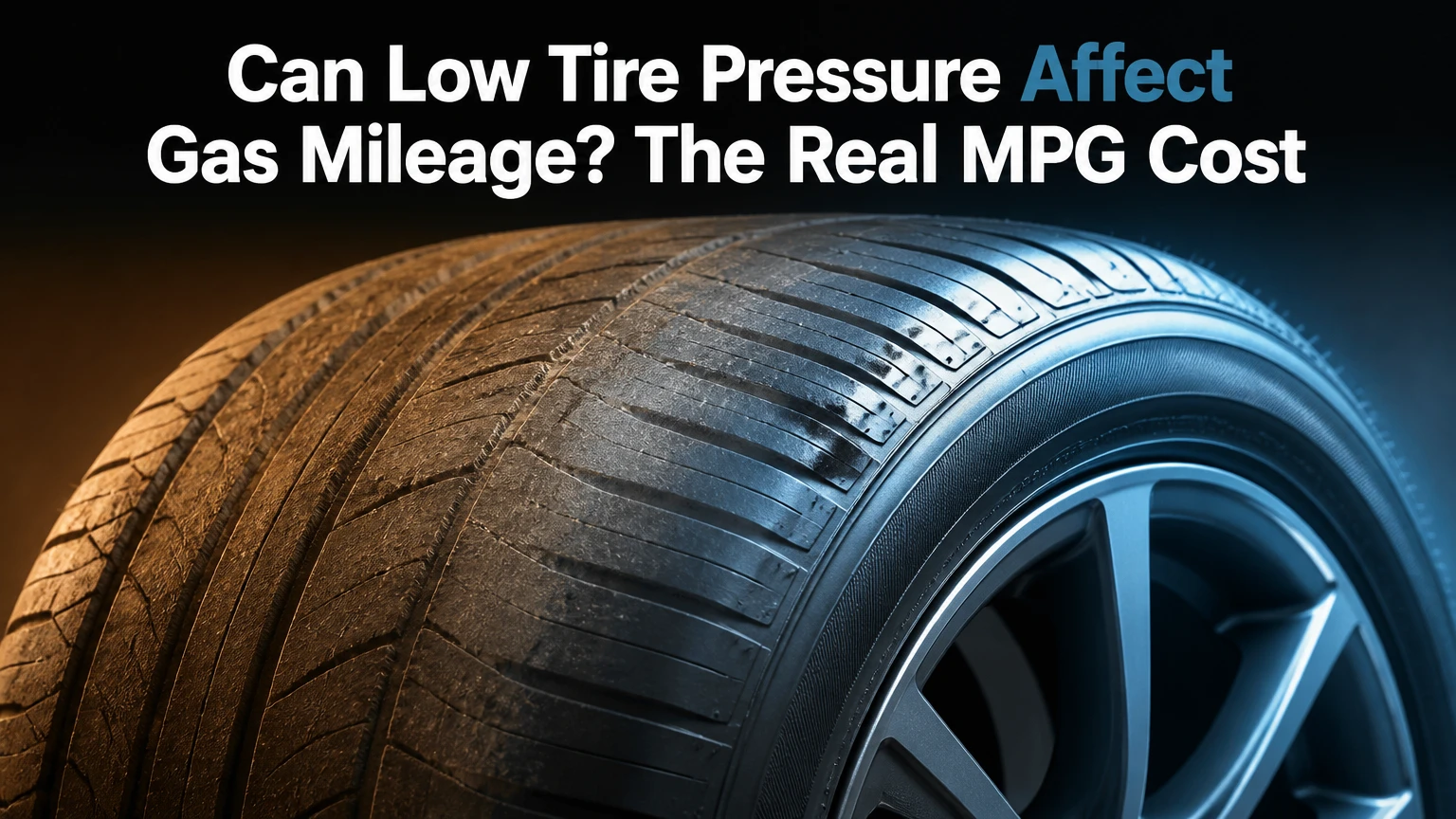
Yes, low tire pressure can reduce gas mileage because an underinflated tire flexes more and creates greater rolling resistance. The U.S. Department of Energy reports that properly inflated tires improve fuel economy by 0.6% on average and by up to 3%, while the exact loss depends on pressure deficit, speed, vehicle weight, tire design, and road conditions.
Key Facts at a Glance
- Low tire pressure increases rolling resistance, so the engine or electric motor needs more energy to maintain speed.
- The vehicle manufacturer’s recommended cold inflation pressure, not the tire sidewall maximum, is the correct operating target.
- The U.S. Department of Energy estimates that correct tire inflation improves gas mileage by 0.6% on average, with savings up to 3%.
- A 5% fuel-economy loss turns a car rated at 30 mpg into a vehicle returning about 28.5 mpg.
- Cold weather reduces tire pressure by approximately 1 PSI for each 10°F temperature decrease.
- TPMS warnings identify significant pressure loss on many vehicles, but the warning light does not replace regular gauge checks.
How Can Low Tire Pressure Affect Gas Mileage?
Low tire pressure affects gas mileage by increasing tire deformation and rolling resistance. As an underinflated tire rotates, its sidewalls and tread flex more at the contact patch, converting more of the vehicle’s forward energy into heat and forcing the powertrain to burn additional fuel.
A properly inflated tire still deforms, but its casing maintains the shape intended by the tire manufacturer. Lower pressure allows greater deflection under the vehicle’s weight. The rubber then requires more energy to bend and recover during every wheel rotation.
Rolling resistance is only one part of fuel consumption. Aerodynamics, acceleration, speed, temperature, payload, alignment, engine condition, and traffic often create larger short-term changes. Tire pressure becomes especially noticeable when all four tires are underinflated, when the vehicle travels long highway distances, or when the pressure loss is substantial.
The familiar estimate of approximately 0.2% lower fuel economy for every 1 PSI lost is useful as a rule of thumb, but it is not a universal test result for every vehicle. Tire construction and pressure range affect the relationship, and a small pressure change may be difficult to detect against normal driving variation.
How much fuel economy can low pressure reduce?
A modest pressure loss may reduce fuel economy by less than 1%, while significant underinflation can produce a loss approaching the U.S. Department of Energy’s upper estimate of 3%. A 3-5% penalty is possible in severe real-world cases, but it should not be presented as the expected result for every underinflated tire.
| Vehicle rating | 0.6% loss | 3% loss | Approximate fuel added per 1,000 miles |
|---|---|---|---|
| 25 mpg | 24.85 mpg | 24.25 mpg | 0.6-1.2 gallons |
| 30 mpg | 29.82 mpg | 29.10 mpg | 0.7-1.0 gallons |
| 40 mpg | 39.76 mpg | 38.80 mpg | 0.4-0.8 gallons |
| 50 mpg | 49.70 mpg | 48.50 mpg | 0.4-0.6 gallons |
The calculation uses the miles-per-gallon relationship rather than simply subtracting a percentage from the displayed MPG. For example, a vehicle that normally achieves 30 mpg uses 33.3 gallons over 1,000 miles. At 29.1 mpg, it uses about 34.4 gallons, a difference of approximately 1.1 gallons.
Fuel economy displays are not laboratory instruments. Compare several fill-ups over similar routes instead of judging the effect from one commute.
Why does underinflation increase rolling resistance?
Underinflation increases rolling resistance because the tire casing bends farther during each revolution. Internal rubber losses, called hysteresis, convert part of the energy used to deform the tire into heat rather than returning it to forward motion.
The pressure change also alters the contact patch, which is the section of tread touching the road. The footprint does not simply become wider in every tire; its shape depends on tire construction, tread pattern, load, wheel width, and how far pressure has fallen. Shoulder loading and excessive flexing are common symptoms, but visible tread shape alone cannot diagnose pressure accurately.
The powertrain responds to the added mechanical load. In a gasoline vehicle, the engine generally opens the throttle farther or maintains a higher load to preserve speed. The engine control module does not automatically create a “richer mixture” in every case, so that common explanation is too broad. Modern engines usually continue targeting an air-fuel ratio appropriate for emissions and operating conditions.
Electric vehicles and hybrids also lose efficiency from underinflated tires. Their motors avoid fuel combustion, but the battery must supply extra energy to overcome rolling resistance. Regenerative braking cannot recover all of that added tire deformation loss.
Which factors change the MPG effect?
Vehicle speed, tire temperature, axle load, alignment, tire compound, and the size of the pressure deficit change the fuel-economy result. A heavily loaded SUV with touring tires may respond differently from a compact hatchback with low-rolling-resistance tires at the same PSI loss.
| Factor | Typical effect on rolling resistance | Practical consequence |
|---|---|---|
| Pressure deficit | Greater deflection as PSI falls | 5 PSI low is more concerning than 1 PSI low |
| Vehicle load | More force on each contact patch | Towing and full cargo amplify tire stress |
| Speed | Higher casing cycles and aerodynamic demand | Highway trips expose inefficiency more clearly |
| Tire construction | Different casings lose energy differently | Replacement tires can change MPG |
| Alignment | Scrubbing adds resistance and wear | Correct pressure cannot fix toe misalignment |
| Temperature | Cold air lowers measured PSI | Check and adjust pressure before driving |
Where should drivers find the correct PSI?
The correct tire pressure is printed on the vehicle’s tire placard, usually inside the driver’s door jamb, fuel-filler door, glove box, or owner’s manual. The placard may specify different pressures for the front and rear axles or for normal and fully loaded conditions.
The number molded into the tire sidewall is the tire’s maximum rated cold inflation pressure, not the vehicle’s recommended setting. Inflating every tire to the sidewall maximum can reduce the intended contact behavior, produce a harsher ride, and accelerate center tread wear.
Vehicle manufacturers select placard pressure for a particular tire size, load rating, handling balance, braking performance, and suspension calibration. Replacement tires with a different load index or size may require professional confirmation before the pressure target changes.
Recommended pressure versus sidewall maximum
| Marking | Example value | What it means | Driver action |
|---|---|---|---|
| Vehicle placard, front | 35 PSI | Recommended cold pressure | Inflate front tires to 35 PSI |
| Vehicle placard, rear | 33 PSI | Recommended cold pressure | Inflate rear tires to 33 PSI |
| Tire sidewall maximum | 51 PSI | Tire’s maximum rated pressure | Do not use automatically |
| Temporary spare marking | 60 PSI | Special spare operating requirement | Follow spare-tire instructions |
How should you check and inflate tires?
Check tire pressure at least monthly and before long trips, using a reliable gauge when the tires are cold. A complete check takes about 5-10 minutes, requires no special skill, and usually costs nothing at home if you own a gauge and inflator.
Step 1: Read the vehicle placard
Record the recommended PSI for each axle. Confirm whether the vehicle has different specifications for normal driving, maximum occupants, or cargo.
Success checkpoint: You have a target for every tire, including the spare if the manufacturer requires it.
Common mistake: Using the number on the tire sidewall instead of the vehicle placard.
Step 2: Measure cold pressure
Measure before driving, after the vehicle has been parked for at least three hours, or when it has traveled less than one mile at low speed. Remove the valve cap, press the gauge firmly onto the valve stem, and record the reading.
Success checkpoint: The gauge stops hissing and gives a stable PSI value.
Common mistake: Checking immediately after highway driving. Warm tires often read several PSI higher than their cold pressure.
Step 3: Inflate or release air
Add air in short bursts, checking the gauge after each burst. If pressure is high, press the gauge’s release valve briefly and recheck until the reading matches the placard.
Success checkpoint: Each tire matches its specified cold PSI within about 1 PSI.
Common mistake: Adjusting only the tire that triggered a warning while ignoring the other three tires.
Step 4: Inspect the tire and valve
Look for nails, screws, sidewall cuts, bulges, cracked rubber, missing valve caps, and objects lodged between tread blocks. Do not drive on a tire with a sidewall bulge or visible structural damage.
Success checkpoint: No tire loses pressure during a repeat check over the next several days.
Common mistake: Treating repeated inflation as a repair.
Step 5: Reset or verify TPMS if required
Some vehicles relearn pressure automatically after driving; others require a reset procedure or sensor relearn. Follow the owner’s manual, and remember that the TPMS display may show pressure only after the vehicle moves.
Success checkpoint: The warning light turns off after the prescribed drive cycle or reset.
Common mistake: Assuming a cleared warning proves the tire has no leak.
Which inflation method is practical?
A digital gauge costing about $10-$20 and a portable 12-volt inflator costing about $30-$80 suit most private vehicles. Gas-station compressors are faster for occasional use, while a garage compressor makes sense for households maintaining several vehicles.
| Inflation option | Typical price | Typical time per tire | Best use | Limitation |
|---|---|---|---|---|
| Digital pocket gauge | $10-$20 | 30-60 seconds | Accurate home checks | Requires separate air source |
| Portable 12-volt inflator | $30-$80 | 3-8 minutes | Emergency and routine top-offs | Slower at large SUV tires |
| Gas-station compressor | Free-$3 | 1-3 minutes | Travel and quick correction | Gauge accuracy varies |
| Small shop compressor | $100-$300 | Under 1 minute | Multiple vehicles and tools | Bulky and noisy |
Why does tire pressure fall in cold weather?
Tire pressure falls in cold weather because the air inside the tire contracts as temperature decreases. A common field estimate is a 1 PSI change for each 10°F change in ambient temperature, although the exact result varies with initial temperature, tire volume, sunlight, and measurement conditions.
A cold snap can make all four tires read lower at the same time. That pattern usually indicates temperature change rather than four simultaneous punctures. Add air to the placard specification while the tires are cold, then recheck them after temperatures stabilize.
| Temperature change | Approximate pressure change | Example from 35 PSI |
|---|---|---|
| 10°F decrease | -1 PSI | 34 PSI |
| 20°F decrease | -2 PSI | 33 PSI |
| 30°F decrease | -3 PSI | 32 PSI |
| 20°F increase | +2 PSI | 37 PSI |
Temperature effects do not justify permanently overinflating tires in autumn. Inflate to the cold placard pressure, then let the reading vary naturally with operating temperature.
Do tires naturally lose 1-2 PSI per month?
Many tires lose roughly 1 PSI per month through normal air permeation and minor service-related losses, but 1-2 PSI every month is not a diagnosis. A tire losing more than 2 PSI in one week while the others remain stable deserves a leak inspection.
Common sources include punctures, loose valve cores, damaged valve stems, corrosion at the wheel bead, and a bent wheel. A tire shop can submerge the assembly or apply leak-detection solution to locate bubbles.
What does the TPMS warning light tell you?
The TPMS warning light indicates that one or more tires has fallen below a vehicle-specific warning threshold. On many passenger vehicles, the threshold is approximately 25% below the recommended cold pressure, but sensor strategy and warning behavior vary by vehicle.
TPMS is a safety backup, not a precision maintenance schedule. A tire can run below its placard pressure for days before the warning appears, and the system may not identify a slow leak early enough to prevent uneven wear.
Check pressure manually once a month and before long journeys. If the light flashes before remaining illuminated, the vehicle may have a TPMS system fault rather than only low pressure.
What other problems does underinflation cause?
Underinflated tires increase heat buildup, shoulder wear, steering effort, stopping distance, and the risk of losing control. The safety effect matters more than the modest fuel bill associated with a small pressure deficit.
At highway speed, repeated casing flexing creates heat faster than the tire can dissipate it. Severe underinflation can damage internal components even when the tread appears intact. A tire driven flat or nearly flat may require replacement rather than simple reinflation.
| Symptom | Likely pressure or vehicle issue | Recommended response |
|---|---|---|
| Both shoulders wear quickly | Underinflation or overload | Check cold PSI and vehicle load |
| Center tread wears quickly | Overinflation | Compare with placard PSI |
| One shoulder wears | Alignment or suspension problem | Request alignment inspection |
| Tire feels soft and wanders | Significant pressure loss | Stop safely and inspect immediately |
| Repeated TPMS warning | Leak, sensor issue, or bead leak | Test pressure and seek tire service |
Expert rule: a pressure gauge is more reliable than appearance. Radial tires can look normal while carrying substantially less air than specified, so a visual walk-around cannot replace measurement.
How do you find a slow leak?
Find a slow leak by comparing all four cold-pressure readings, then applying soapy water to the tread, valve stem, valve core, and wheel bead. Growing bubbles identify escaping air, although a puncture in the inner tread may require tire removal for safe repair.
Never remove a nail or screw before a tire professional evaluates it. Removing the object can turn a slow leak into a rapid loss, and puncture repair is generally limited to the repairable tread area under industry service rules.
A tire that loses pressure only after driving may have a heat-sensitive valve, bead leak, or wheel deformation. A tire that loses pressure while parked may have a puncture or valve leak. The pattern helps, but professional inspection confirms the cause.
Can higher pressure compensate for low gas mileage?
Higher pressure should not be used to compensate for poor gas mileage unless the vehicle manufacturer specifies a higher setting for a particular load. Overinflation can reduce rolling resistance slightly in some conditions, but the trade-off may include reduced ride compliance, less favorable contact behavior, and accelerated center wear.
The correct target is the placard pressure, not the lowest possible rolling resistance. Drivers seeking better MPG should first address speed, aggressive acceleration, roof cargo, alignment, maintenance, and tire selection.
A 5 PSI increase may appear to improve a short trip’s fuel reading because it coincides with warmer weather, a different route, or lighter cargo. That observation does not prove the higher pressure is safe or appropriate.
Does nitrogen preserve fuel economy?
Nitrogen can slow pressure loss modestly, but it does not create a meaningful fuel-economy advantage when drivers already check air pressure regularly. Ordinary compressed air is already about 78% nitrogen, and pressure still changes with temperature regardless of fill gas.
Nitrogen may suit fleets that want standardized service or applications with strict pressure stability requirements. For most drivers, a functioning valve, an accurate gauge, and monthly checks provide more practical value than paying $5-$10 per tire for nitrogen.
Nitrogen is not a repair for a puncture, wheel leak, or neglected pressure. A tire filled with regular air at the correct cold PSI is preferable to a nitrogen-filled tire operated below specification.
What changes for towing, hybrids, and off-road driving?
Towing and heavy cargo require the pressure listed for the vehicle’s loaded condition, while hybrids and electric vehicles benefit from the same careful inflation practices as gasoline cars. Off-road drivers may temporarily air down for traction, but they should reinflate before returning to paved roads.
A loaded vehicle places more force on each tire and increases heat generation when pressure is inadequate. Follow the placard and owner’s manual rather than copying a pressure number from another trailer or SUV.
Off-road airing down is a controlled exception, not an efficiency strategy. Driving at road speed with reduced pressure can damage the tire, wheel, and casing. Carry a compressor capable of restoring all four tires before reaching pavement.
Frequently Asked Questions
Can one low tire affect gas mileage?
Yes, one low tire can reduce fuel economy, although the effect is usually smaller than when all four tires are underinflated. A single low tire also creates an asymmetric handling problem, increases wear on that tire, and may indicate a puncture. Correct the pressure and investigate why it fell.
Does low tire pressure affect highway MPG more than city MPG?
Low tire pressure often has a clearer effect on highway MPG because long, steady driving exposes rolling resistance over many miles. City fuel economy varies heavily with idling, acceleration, traffic, and braking, which can hide the tire-related penalty. Underinflation remains harmful in both driving environments.
How often should tire pressure be checked?
Check tire pressure monthly and before long trips, after major temperature changes, and whenever the vehicle feels different. Commercial vehicles, rideshare cars, and vehicles carrying heavy loads benefit from weekly checks because mileage and heat cycles accumulate rapidly.
Can low tire pressure cause a check-engine light?
Low tire pressure normally triggers the TPMS warning light, not the check-engine light. A check-engine light indicates an emissions or powertrain fault, although reduced vehicle performance and tire drag may occur at the same time. Diagnose the two warning systems separately.
Is 28 PSI too low for a car tire?
Twenty-eight PSI is too low when the vehicle placard specifies a higher pressure, but it may be correct for a vehicle whose placard lists 28 PSI. Tire pressure has no universal safe number. Read the placard, measure the tire cold, and inspect any tire that repeatedly loses air.
The Bottom Line
Can low tire pressure affect gas mileage? Yes. Underinflated tires flex more, generate greater rolling resistance, waste energy as heat, and can reduce fuel economy by a measurable amount, with the U.S. Department of Energy reporting average savings of 0.6% and potential savings up to 3% from proper inflation.
Use the manufacturer’s cold-pressure specification, check all tires monthly, adjust them before driving, and treat recurring pressure loss as a leak investigation. Correct tire pressure will not fix every MPG problem, but it protects fuel economy, tire life, braking performance, and vehicle stability at the same time.