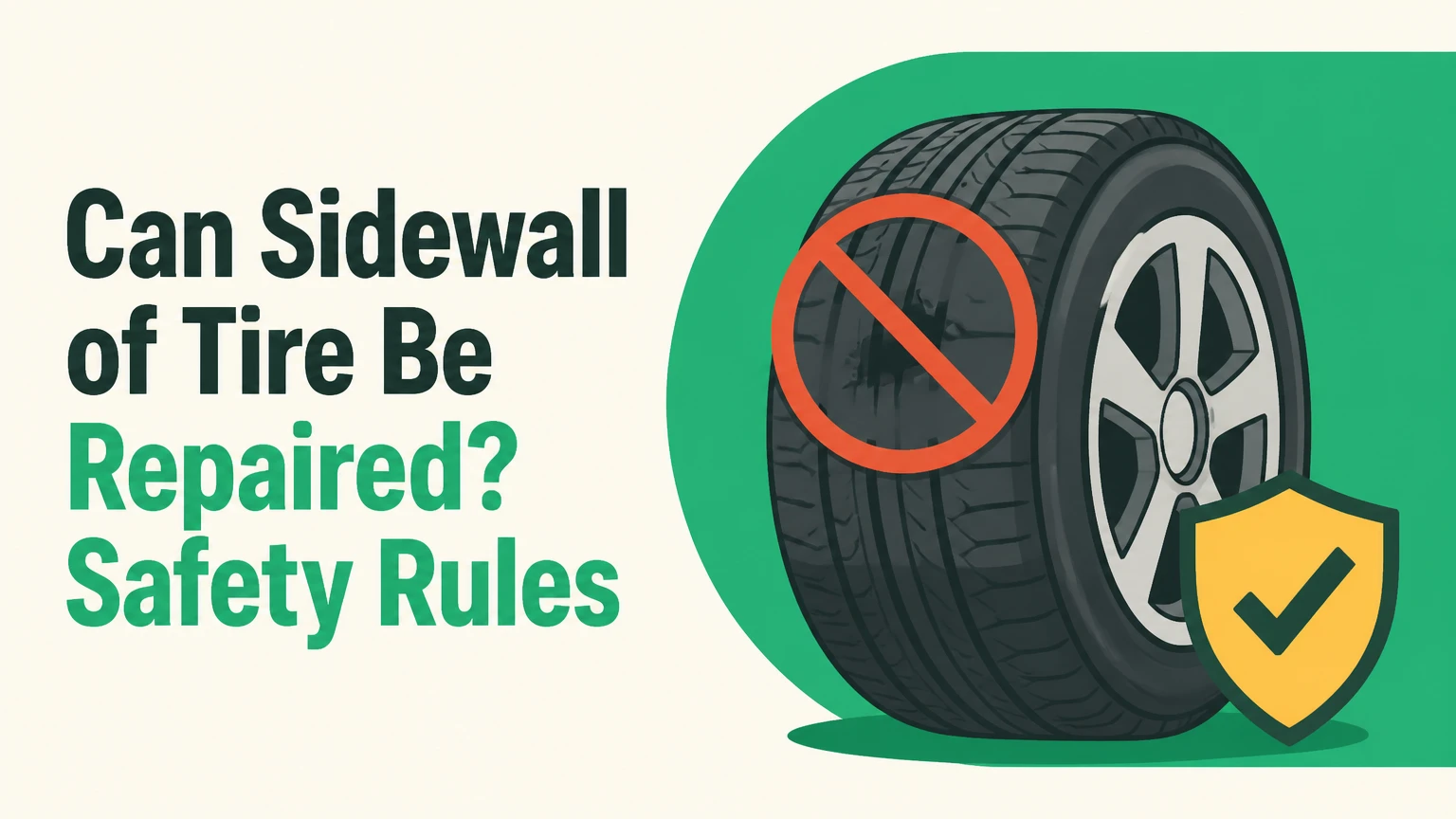
No, a damaged tire sidewall should not be repaired; the tire should be replaced. The U.S. Tire Manufacturers Association (USTMA), Tire Industry Association (TIA), and major manufacturers such as Michelin and Continental limit puncture repairs to the central tread area, because sidewall flex and internal structural damage can cause sudden air loss or a blowout.
Key Facts at a Glance
A sidewall cut, puncture, bulge, exposed cord, or deep crack makes the tire non-repairable.
A superficial curb scuff without exposed cords may be cosmetic, but a tire shop must confirm that condition.
Standard tire repairs apply only to suitable tread punctures, commonly no larger than 1/4 inch, or 6 millimeters.
A bulge or bubble indicates broken internal cords and requires immediate tire replacement.
Do not drive at highway speed on a tire with sidewall damage, visible cords, or a pressure loss.
AWD vehicles may require two, four, or one tread-matched replacement tire, depending on the vehicle manufacturer’s limit.
Can Sidewall of Tire Be Repaired?
A tire sidewall cannot be safely repaired with a plug, patch, rubber cement, vulcanizing compound, or external boot. Sidewall repairs may temporarily cover the visible injury, but they cannot reliably restore the casing’s original strength, flex characteristics, speed rating, or pressure-retention performance.
A reputable tire shop normally removes the damaged tire from service rather than attempting a structural repair. The replacement must match the vehicle’s required size, load index, speed rating, construction, and intended use. The shop should also inspect the wheel, because a pothole or curb impact can bend the rim while damaging the tire.
The important distinction is between repairing and temporarily moving a vehicle. A spare tire, tire transporter, or roadside technician may make short-distance movement possible. None of those actions repairs the damaged casing.
What Counts as the Sidewall?
The tire sidewall is the flexible rubber area between the tread shoulder and the bead that sits against the wheel rim. It contains branding, size markings, load and speed information, maximum inflation data, and safety markings.
The shoulder is the transition between tread and sidewall. A puncture near that transition may be outside the manufacturer’s permitted repair zone even when part of the injury appears to touch tread rubber. A technician must judge the location from the internal structure, not from the visible lettering alone.
| Tire area | Typical construction or function | Normal repair position |
|---|---|---|
| Center tread | Tread rubber over belts and casing plies | Often repairable if 1/4 inch or smaller |
| Outer tread | Tread blocks near the shoulder | Repairability decreases near shoulder |
| Shoulder transition | Curved high-flex zone | Usually excluded from repair |
| Sidewall | Flexible casing plies and protective rubber | Not safely repairable |
| Bead area | Steel bead bundle sealing to wheel | Not repairable by ordinary tire service |
Why Can’t a Sidewall Be Repaired?
A sidewall cannot be repaired because it repeatedly bends while carrying vehicle load, and a patch or plug cannot recreate the original casing structure. The tire’s internal cords transfer force around the casing; cutting, puncturing, or separating those cords can leave a hidden weakness even when the outer rubber looks sealed.
A tread puncture is different. In the permitted central tread area, the injury passes through a relatively stable section supported by belt packages. A proper repair uses a combination repair unit, commonly a rubber stem and inner patch installed after the tire is removed and inspected. A rope plug inserted from outside is not the same as a permanent industry repair.
Sidewalls also operate under inflation pressure. When internal cords break, air pressure pushes outward against the remaining rubber. That produces a bulge, which is a warning of casing failure rather than a surface defect.
USTMA’s consumer tire-repair guidance and TIA training materials restrict permanent puncture repairs to the repairable tread area. Exact limits vary by manufacturer and tire type, so a shop should follow the tire maker’s current instructions rather than a universal internet rule.
What Damage Does a Sidewall Bulge Indicate?
A sidewall bulge usually indicates broken or separated internal cords caused by an impact, underinflation, overloading, or a manufacturing-related casing problem. The rubber may remain intact on the outside, but the casing can no longer contain forces evenly.
A bulge can appear immediately after hitting a pothole or curb, or it can become visible after the tire loses pressure. A small bubble is not safer than a large bubble. Do not press, puncture, glue, or inflate a bulged tire to test it.
Which Damage Requires Immediate Replacement?
A tire requires immediate replacement when the sidewall has exposed cords, a cut deep enough to open the casing, a bulge, a puncture, or deep age cracks. Only a shallow, cosmetic abrasion with no cord exposure and no air loss may remain in service after professional inspection.
| Visible condition | What it may mean | Safe action |
|---|---|---|
| Gray or black surface scuff | Rubber transfer or superficial abrasion | Have a shop inspect; replacement may not be necessary |
| Cut with white, gray, or colored threads | Nylon, polyester, or casing cords exposed | Do not drive; install spare or call roadside service |
| Round bubble or lump | Broken internal casing cords | Replace immediately; do not inflate or patch |
| Nail or screw in sidewall | Casing puncture outside repair zone | Replace tire; do not use a plug |
| Fine shallow weather lines | Early surface aging | Check depth, age, pressure, and exposure |
| Deep cracks between ribs or through lettering | Dry rot and structural aging | Replace tire, especially before highway travel |
| Bead tear or rim-seal damage | Mounting or impact damage at wheel interface | Remove tire and inspect wheel and bead |
Is a Curb Scuff Safe to Drive On?
A curb scuff may be safe only when it removes a thin layer of rubber without exposing cords, creating a flap, producing a bulge, or causing air loss. A superficial scrape can look alarming while remaining cosmetic, but visual judgment becomes unreliable when the abrasion is deep or dirty.
Clean the area with mild soap and water, then inspect it under strong light. Do not cut away loose rubber or apply adhesive. If threads are visible, the surface is gouged, or the tire slowly loses pressure, treat the tire as structurally damaged.
Can You Drive on a Damaged Sidewall?
You should not drive normally on a tire with a sidewall cut, bulge, exposed cord, or active pressure loss. Driving increases heat and cyclic flexing, which can turn a visible defect into rapid casing separation or a blowout.
If the vehicle is already parked safely, leave the damaged tire in place and use a full-size spare, temporary spare, or roadside service. If you must move a vehicle out of immediate danger, travel only the shortest possible distance at very low speed, provided the tire is not flat, bulged, or shedding rubber. A flat or visibly deformed tire should not be driven even a few feet.
Keep passengers away from a damaged tire during inflation or removal. A severely damaged tire can fail while being handled, particularly if it has been driven underinflated.
What Should You Do After a Curb or Pothole Impact?
After a hard impact, check the tire sidewall on both sides, the wheel lip, the steering feel, and the TPMS warning. A new vibration, pull, repeated pressure loss, bent rim, or uneven steering wheel suggests that the impact affected more than the tire.
Use this sequence:
- Stop in a safe location and switch off the engine.
- Compare the suspect tire with the opposite tire.
- Look for a bulge, cut, bead separation, or exposed cord.
- Check pressure only when the tire has no obvious structural failure.
- Install the spare or request roadside assistance.
- Ask the shop to inspect the wheel, alignment, and suspension.
A TPMS warning does not identify the location or cause of damage. The sensor detects pressure, not broken casing cords.
Can a Plug, Patch, or Sealant Fix It?
A plug, inner patch, tire sealant, or sidewall boot cannot restore a damaged sidewall’s original structural capacity. Rope plugs can seal some tread punctures as an emergency measure, but they are inappropriate for a sidewall puncture because the casing continues to flex around the repair.
Tire sealant has a narrower role. Some products are approved for temporary use with specific tire and vehicle systems, while others can interfere with TPMS sensors, corrode components, or make internal inspection harder. Sealant cannot repair a cut, bulge, or cord separation.
A sidewall boot is used in some off-road or commercial emergency situations to help a vehicle leave a hazardous location. It is not a permanent highway repair and does not restore the tire’s speed rating. A shop that presents an adhesive patch as a permanent sidewall repair is giving unsafe advice.
| Proposed method | Typical use | Sidewall suitability | Main limitation |
|---|---|---|---|
| Combination tire repair unit | Permanent repair for approved tread punctures | No | Repair zone excludes sidewall |
| Rope plug | Temporary or improper external tread seal | No | Does not inspect internal damage |
| Liquid sealant | Temporary pressure retention in approved systems | No | Cannot rebuild casing cords |
| Internal boot patch | Emergency casing support in limited specialty settings | Not for ordinary passenger tires | Does not restore original rating |
| New replacement tire | Restores designed casing and tread assembly | Yes | Requires correct size and fitment |
How Should You Inspect a Suspect Tire?
Inspect a suspect tire without removing it from the wheel only for obvious external signs; a qualified technician must dismount the tire to inspect the inner liner, bead, and hidden impact damage. An external inspection cannot prove that a casing is undamaged.
Look at the inner and outer sidewalls, then examine the shoulder and wheel rim. Search for exposed fabric, a flap, localized swelling, abrasion through the rubber, sidewall lettering distortion, and fresh rubber dust. Compare the tire’s shape with the matching tire on the other side.
Do not run a bare hand over a sharp cut. Use a flashlight and keep fingers away from damaged areas. Do not use a tire pressure gauge or compressor on a tire with a pronounced bulge.
What Does a Professional Inspection Include?
A tire technician generally removes the wheel, releases air safely, and dismounts the tire to inspect the inner liner. The technician checks for abrasion rings, impact-induced wrinkles, bead damage, foreign objects, and evidence that the tire was driven while underinflated.
The technician should also inspect the wheel flange and valve stem, measure tread depth, verify the DOT date code, and compare the replacement requirement with the vehicle placard. A sidewall that looks acceptable externally can contain internal damage after a severe impact.
How Much Does Replacement Cost?
A typical sidewall-damaged tire replacement costs about $80-$350 or more for the tire, plus approximately $20-$60 for mounting, balancing, disposal, and related service. Run-flat, high-performance, large SUV, light-truck, and specialty electric-vehicle tires can exceed that range.
Prices vary by tire size, brand, load rating, region, and availability. Roadside mounting, emergency delivery, taxes, alignment, and a new TPMS valve or sensor can add separate charges.
| Replacement scenario | Typical tire price | Typical service time | Possible added cost |
|---|---|---|---|
| Compact passenger tire | $80-$150 | 20-45 minutes | $20-$45 mounting and balance |
| Crossover or SUV tire | $130-$250 | 30-60 minutes | $25-$60 service |
| Performance or run-flat tire | $180-$400+ | 45-90 minutes | $40-$100 specialized labor |
| Light-truck LT tire | $180-$350+ | 30-75 minutes | $25-$70 disposal and balance |
| Roadside replacement | $120-$350 tire | 30-90 minutes | $50-$150 call-out or delivery |
A used tire can reduce the purchase price, but it needs a careful inspection for age, repairs, uneven wear, sidewall cracking, mismatched specifications, and tread depth. A cheap tire with unknown history is not equivalent to a properly matched replacement.
How Many Tires Should You Replace?
Replace one tire only when the remaining tires are compatible in size, model, construction, tread pattern, and wear, and the vehicle manufacturer permits the resulting tread-depth difference. Replacing two tires on the same axle is common when one tire is damaged, while AWD systems often require tighter matching.
There is no universal 2/32-inch rule for every AWD vehicle. Some manufacturers specify a maximum circumference or tread-depth difference that is smaller, and some require four matching tires. The owner’s manual and tire manufacturer’s fitment guidance control.
| Drivetrain | Common replacement approach | Measurement that matters |
|---|---|---|
| FWD | Replace one if closely matched; otherwise replace axle pair | Tread depth and same-axle grip |
| RWD | Replace one if approved and matched; otherwise axle pair | Tread depth and traction balance |
| AWD | Often replace four or use approved tire shaving | Circumference, tread depth, and model |
| Full-time 4WD | Follow vehicle manual closely | Rolling radius across all tires |
| Performance vehicle | Match axle specifications and compound | Size, speed rating, compound, wear |
Tire shaving can reduce the tread depth of a new tire to match the remaining tires, but it must be performed by a qualified provider and approved for that vehicle. It is not a substitute for matching an incompatible tire model.
What Changes for AWD, FWD, and RWD?
AWD vehicles are more sensitive to rolling-circumference differences because the center differential, clutch pack, or electronically controlled coupling may compensate continuously for different tire sizes. That compensation can create heat and wear even when the vehicle drives normally.
FWD and RWD vehicles still need matched tires on the same axle. The deeper-tread pair is commonly installed on the rear axle for wet-road stability, but the shop should follow the tire maker’s and vehicle maker’s instructions.
What About Run-Flat Tires?
Run-flat tires do not make sidewall damage repairable. Some run-flat models permit a limited repair for a suitable tread puncture, while others prohibit repair entirely or require inspection after any pressure-loss event.
A run-flat tire driven while underinflated can suffer internal damage that is invisible from outside. Tell the technician how far and how fast the vehicle traveled after the pressure warning. The manufacturer’s run-flat inspection procedure determines whether the tire remains serviceable.
How Can You Prevent Sidewall Failure?
Prevent sidewall failure by maintaining the cold inflation pressure listed on the vehicle placard, avoiding curb contact, respecting the tire’s load index, and replacing aged or deeply cracked tires. Underinflation increases sidewall flex and heat, while overloading raises casing stress.
Check pressure monthly and before long trips, using a gauge when the tires are cold. Inspect after pothole impacts, rotate according to the vehicle schedule, and maintain alignment when the vehicle pulls or wears tires unevenly.
For frequent off-road use, LT-rated tires and a full-size matching spare can reduce inconvenience, but thicker or three-ply sidewalls do not make a cut repairable. They may resist certain impacts; they still require replacement after structural damage.
What Is a Tire Sidewall’s DOT Date Code?
The DOT date code identifies the week and year of manufacture, not the tire’s remaining safe life by itself. A code ending in 2422 means the tire was made in week 24 of 2022.
Age guidance varies by manufacturer and climate. Michelin advises regular inspection after five years of service and replacement by ten years from manufacture as a precaution, even when tread remains. Heat, sunlight, storage, load, and inflation history can shorten service life.
Common Mistakes That Increase Risk
- Using a rope plug in the sidewall: The plug may stop visible leakage while casing cords remain damaged.
- Driving to a repair shop on a bulge: Heat and flex can accelerate a sudden failure.
- Treating white threads as cosmetic fibers: Exposed casing cords indicate loss of protective rubber.
- Replacing one AWD tire without measuring: Rolling differences can stress drivetrain components.
- Inflating a damaged tire repeatedly: Additional pressure does not restore broken cords.
- Assuming a tire with tread is safe: Tread depth cannot compensate for a compromised casing.
- Accepting an unspecified sidewall patch: Ask the shop whether the repair follows the tire manufacturer’s written procedure. For ordinary passenger tires, the answer should be replacement.
An important practitioner rule is to photograph damage before removing the tire. The image helps document a road-hazard claim and shows whether the defect changed after the vehicle was moved.
Frequently Asked Questions
Can a small hole in the tire sidewall be fixed?
No. A small sidewall hole remains outside the normal permanent-repair zone because the sidewall flexes continuously and carries casing stress. Replace the tire instead of inserting a plug or patch. If the hole is near the shoulder, have a technician determine its exact location because the shoulder is also commonly excluded.
Is sidewall damage covered by a tire warranty?
A standard workmanship or materials warranty may cover a manufacturing defect, but curb, pothole, nail, overload, and road-hazard damage usually require separate road-hazard coverage. Photograph the tire, retain the purchase record, and ask the retailer to submit the tire for inspection before discarding it.
Can I repair a tire sidewall from the inside?
An internal patch or boot does not make a passenger-car sidewall safe for normal highway service. Some specialty commercial or off-road procedures may use temporary casing boots under written restrictions, but those procedures do not restore the original speed rating or provide a general consumer repair.
How long can I drive with a sidewall bubble?
Do not drive with a sidewall bubble. A bubble signals internal cord failure, and the tire can rupture without a predictable warning period. Install a spare or call roadside assistance; do not reduce speed, add sealant, or wait for the bubble to become larger.
Is a tire shoulder puncture repairable?
A shoulder puncture is usually not repairable because the shoulder sits in a high-flex transition zone. A puncture must be in the manufacturer-approved central tread area, commonly no larger than 1/4 inch, to qualify for professional repair. The technician must inspect the tire from the inside.
Should I replace the wheel after sidewall damage?
Replace the wheel only if inspection finds a bend, crack, deformation, or loss of the bead-sealing surface. A curb or pothole can damage both components, but a sidewall failure alone does not automatically condemn the wheel. Balancing and alignment checks can reveal impact-related problems.
The Bottom Line
Can sidewall of tire be repaired? No, not safely for normal passenger-vehicle use. Replace a tire with a sidewall cut, puncture, exposed cord, bulge, bead injury, or deep dry rot, then match the replacement to the vehicle’s size, load, speed, tread, and drivetrain requirements. A shallow scuff may be cosmetic, but only a qualified tire inspection can confirm that the casing remains intact.