Yes, a mobile tire service, roadside assistance provider, towing company, insurer, or vehicle manufacturer can send a technician to change a flat tire at your location. The technician can usually install a usable spare, inflate a low tire, or tow the vehicle when the wheel, tire, or vehicle cannot be safely repaired on-site.
Key Facts at a Glance
- Roadside assistance commonly installs a vehicle’s usable spare tire, but standard coverage often does not include the price of a new tire.
- A typical pay-per-use tire change costs about $75-$150 before a replacement tire, special equipment, mileage, or after-hours charges.
- A mobile tire shop may mount and balance a new tire on-site, with a typical total of $150-$350 or more.
- A highway shoulder is a high-risk work location; move away from traffic only when doing so is safe and legally permitted.
- A technician needs the vehicle’s exact location, make and model, tire problem, and spare-tire or wheel-lock-key status.
- A flat tire with a damaged wheel, no usable spare, seized hardware, or an unsafe location may require a tow rather than a tire swap.
Can Someone Come Out to Change a Tire?
A professional can come directly to a parked vehicle and change the tire without taking the car to a repair shop. The most common providers are roadside assistance clubs, automobile insurers, manufacturers, mobile tire shops, and local towing businesses.
The service usually means removing the damaged wheel and installing a spare tire that belongs to the vehicle. Some mobile tire companies carry replacement tires, tire changers, balancing equipment, compressors, and torque tools, although new-tire availability depends on the tire size and local inventory.
A roadside dispatcher should know whether the vehicle is at home, in a parking lot, or exposed on a highway. That distinction affects the equipment sent, the urgency assigned, and whether a tow truck is safer than a roadside repair van.
The National Highway Traffic Safety Administration describes tires as “the only thing connecting your vehicle to the road.” That connection is why a technician must verify tire pressure, wheel security, and compatibility before releasing the vehicle.
Who Can Come to Your Location?
Roadside clubs, insurance programs, automobile manufacturers, mobile tire companies, and towing operators can all dispatch help. Their capabilities and billing models differ, so the cheapest option is not always the fastest or most suitable.
| Provider | Typical price before a new tire | Typical arrival | Most suitable use |
|---|---|---|---|
| Roadside membership | $0 service fee, $60-$140 annual membership | 45-90 minutes | Covered drivers with an active plan |
| Auto insurer add-on | $0 at dispatch, policy premium varies | 45-90 minutes | Drivers confirming coverage first |
| Pay-per-use dispatch | $75-$125 | 30-60 minutes | One-time help without membership |
| Local towing company | $80-$150 | 35-60 minutes | Tire change or tow from a difficult location |
| Mobile tire shop | $50-$100 installation plus tire | 60-120 minutes | New tire, mounting, and possible balancing |
| Manufacturer program | Often included during warranty period | 45-90 minutes | New vehicles and eligible EVs |
Roadside memberships usually cover labor within a service limit, not unlimited assistance for every vehicle or every person. Some plans also impose a waiting period before benefits apply, which makes buying a membership after the flat an unreliable emergency strategy.
Which Service Should You Call?
Call an active roadside plan first when the vehicle is in a safe location and the plan covers the car. Use a pay-per-use dispatcher when you lack coverage, and call a mobile tire shop when you need a replacement tire rather than only a spare installed.
| Your situation | First call | Why | Main limitation |
|---|---|---|---|
| Active AAA or insurer plan | Covered roadside provider | Lowest immediate labor cost | Coverage limits and queue times |
| No membership, safe parking lot | Local towing operator or app | Simple flat-fee dispatch | Equipment varies by contractor |
| Tire shredded or missing | Mobile tire shop | May carry a matching tire | Correct size may require ordering |
| Highway shoulder with traffic | Roadside provider or emergency service | Better traffic-safety coordination | A tow may be safer than repair |
| EV with no conventional spare | Manufacturer roadside program | Vehicle-specific procedures | Tire damage may require towing |
| Luxury wheel or locking nuts | Dealer-affiliated or specialist provider | Better hardware and wheel protection | Higher price or longer wait |
Tell dispatch the vehicle’s year, make, model, trim if known, tire size, exact location, direction of travel, and whether the wheel is accessible. Say “flat tire,” “blowout,” “low pressure,” or “damaged wheel” accurately because each condition may require different equipment.
How Much Does an On-Site Tire Change Cost?
A professional on-site tire change typically costs $0 under qualifying roadside coverage, $75-$150 for pay-per-use labor, or $150-$350 or more when the technician supplies and installs a new tire. Night, distance, weather, commercial vehicles, and difficult access can increase the final bill.
A membership may have no separate dispatch charge, but the annual fee still represents the cost of coverage. A new tire is normally extra because roadside labor coverage does not automatically pay for parts.
| Cost component | Typical range | When it applies | What to confirm |
|---|---|---|---|
| Membership service call | $0 | Active eligible plan | Service-call limit and vehicle eligibility |
| Pay-per-use labor | $75-$125 | No active coverage | Flat fee, mileage, and tax |
| Towing-company tire change | $80-$150 | Local independent dispatch | Night and weekend surcharges |
| Mobile installation labor | $50-$100 | New tire supplied or delivered | Mounting, balancing, valve stem |
| Replacement tire | $80-$300+ | Tire cannot be reused | Brand, size, load and speed rating |
| Lock removal or special labor | $25-$100+ | Key missing or lug damaged | Removal method and replacement hardware |
| Tow after failed roadside repair | $100-$250+ | Unsafe or impossible tire change | Destination mileage and storage fees |
Ask for the estimated total before authorizing work. A quote should identify labor, service-call fee, mileage, replacement tire, mounting, balancing, disposal, taxes, and after-hours charges.
A very low advertised price can cover only the first few miles or a basic spare installation. It may not include a tire, wheel repair, tire-pressure inflation, or a tow to a shop.
How Long Does a Mobile Tire Change Take?
A technician typically arrives in 30-120 minutes, and the actual spare-tire installation often takes 20-45 minutes after arrival. Traffic, storms, rush-hour demand, rural distance, unsafe shoulders, missing equipment, and a difficult wheel can extend the total time substantially.
The dispatch estimate is not a guarantee. A provider may assign a contractor from another town, wait for a suitable truck, or pause roadside work when visibility and traffic make the location dangerous.
| Condition | Arrival estimate | Work estimate | Common delay |
|---|---|---|---|
| Urban parking lot, usable spare | 30-60 minutes | 20-35 minutes | Dispatch queue |
| Residential driveway | 45-90 minutes | 20-40 minutes | Access or appointment routing |
| Highway shoulder | 45-120 minutes | 25-45 minutes | Traffic-control precautions |
| Rural road | 60-180 minutes | 25-60 minutes | Long contractor distance |
| New tire required | 60-120 minutes | 45-90 minutes | Tire sourcing and balancing |
| Severe weather | 90 minutes or longer | Variable | Safety suspension or road closure |
Send a dropped pin and a visible landmark, then remain available by phone. If the vehicle is on a shoulder, give the direction of travel, nearest exit, mile marker, and whether the car is behind a guardrail.
What Does Roadside Tire Assistance Include?
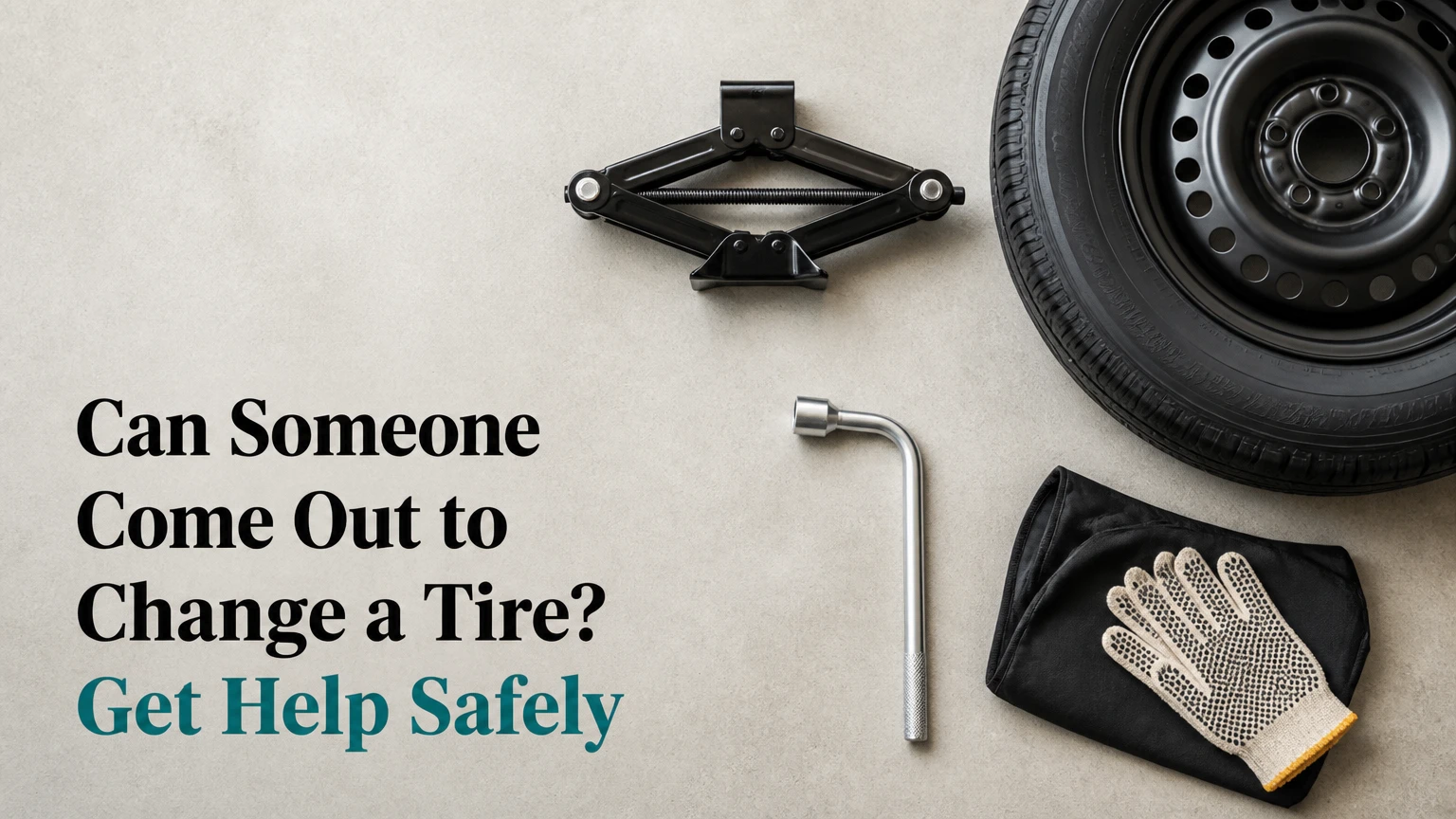
Basic roadside tire assistance usually includes a technician, jack, lug-nut tools, and installation of the vehicle’s usable spare. It generally does not include a new tire, wheel repair, permanent puncture repair, tire balancing, or a guarantee that a damaged wheel can be removed.
Before dispatch, ask these questions:
- Does the service install a compact temporary spare or only inflate the tire?
- Is the spare present, inflated, and the correct size?
- Does the provider handle locking lug nuts and damaged studs?
- Can the technician supply the tire’s correct size and load rating?
- Is tire mounting, balancing, valve replacement, and disposal included?
- What happens if the wheel is seized or the vehicle has no spare?
- Does the policy cover the specific vehicle, trailer, rental, or commercial van?
A temporary spare is an emergency solution, not a normal replacement. The vehicle owner’s manual specifies the maximum speed, distance, axle position, and pressure, and those instructions override generic advice.
How Does a Professional Change the Tire?
A professional changes a tire by securing the scene, stabilizing the vehicle, loosening the wheel hardware, lifting at an approved jack point, fitting the spare or replacement wheel, and torquing the lug nuts to the vehicle manufacturer’s specification. The final checks include tire pressure, wheel security, and safe stowage.
Step 1: Secure the Work Area
The technician activates hazard lights, positions the service vehicle to provide protection where possible, and uses warning equipment appropriate to the road. Passengers should exit toward the side away from traffic and wait behind a barrier or well beyond the travel lane.
A shoulder with fast-moving traffic may be too dangerous for a tire change. In that case, the correct outcome is a tow to a safer location.
Step 2: Inspect the Vehicle and Spare
The technician confirms the damaged tire, checks the wheel, identifies the factory jack point, and examines the spare for inflation and damage. A compact spare often requires substantially higher pressure than a normal passenger tire, so the sidewall and owner’s manual matter more than a generic pressure number.
Step 3: Remove the Wheel
The lug nuts are loosened before the vehicle is fully lifted, then the vehicle is raised with equipment placed at the manufacturer’s approved lift point. Wheel chocks or equivalent stabilization prevent movement, while the technician avoids placing any part of the body under a vehicle supported only by a jack.
Step 4: Install and Torque the Replacement
The replacement wheel is seated against the hub, the lug nuts are started by hand, and the nuts are tightened in a star or cross pattern. The final torque is applied with a calibrated torque wrench to the manufacturer’s specification, which may be 80-120 pound-feet but varies by vehicle.
Step 5: Check Pressure and Equipment
The technician measures the installed tire’s pressure, checks for obvious wheel or valve damage, and secures the removed wheel and jack in the vehicle. The driver should receive any speed restriction and should know whether the temporary spare requires immediate replacement.
A professional tire change does not make a severely damaged tire roadworthy. A bent rim, cracked wheel, exposed cord, damaged hub, or tire rubbing the suspension can still require towing.
What Should You Do on a Highway Shoulder?
Turn on hazard lights, stop as far from moving traffic as possible, apply the parking brake, and call roadside assistance from a safe position. Do not stand beside the vehicle, inspect the tire in the traffic lane, or attempt a tire change when vehicles are passing close by.
If the car can reach a nearby parking lot without driving on a completely flat tire, moving to that location may reduce risk. Do not drive farther merely to save a service fee when the tire has lost all pressure, the sidewall is damaged, or the wheel is scraping the road.
Keep occupants away from the traffic side. Children and pets should remain secured or move behind a barrier only when that can be done safely.
What If There Is No Usable Spare?
A vehicle with no usable spare needs a mobile tire company, a temporary tire solution, or a tow. Many newer cars, electric vehicles, sports cars, and compact vehicles use a tire mobility kit, run-flat tires, or sealant instead of a spare wheel.
| Vehicle condition | Possible roadside outcome | Drive-away limit |
|---|---|---|
| Small tread puncture, intact sidewall | Inflation or approved plug | Manufacturer and tire-maker limits |
| Inflated compact spare | Spare installation | Often 50 mph maximum |
| Run-flat tire with limited damage | Inflation or inspection | Commonly up to 50 miles at 50 mph, model-dependent |
| Torn sidewall or blowout | Tow or replacement tire | 0 miles |
| Bent or cracked wheel | Tow or wheel replacement | 0 miles |
| No spare, mobile tire unavailable | Tow to tire shop | 0 miles |
Run-flat specifications vary by brand, tire model, load, speed, and distance already driven without pressure. A tire sealant kit cannot safely repair a sidewall tear, large puncture, separated tread, or damaged wheel.
Can a Technician Install a New Tire?
A mobile tire shop can often install a new tire at the vehicle, but the provider must have the correct size, load index, speed rating, tread type, and wheel compatibility. Mounting and balancing require specialized equipment that basic roadside vans may not carry.
A replacement tire should match the vehicle’s requirements on the sidewall and placard. On all-wheel-drive vehicles, replacing one tire with a substantially different circumference can create drivetrain stress; the owner’s manual or a tire professional should determine whether one, two, or four tires are appropriate.
| Replacement factor | Example specification | Why it matters |
|---|---|---|
| Tire size | 225/55R17 | Must fit the wheel and suspension |
| Load index | 97 | Supports the vehicle’s required weight |
| Speed rating | V | Matches the vehicle requirement |
| Construction | Radial, tubeless | Matches wheel and vehicle design |
| Tread condition | Same axle pairing | Supports predictable handling |
| Tire age | DOT date code | Older stock may need evaluation |
A mobile installation may not provide alignment, suspension diagnosis, or a full road-force balance. Those services usually require a shop with a fixed lift and balancing machine.
What Problems Can Delay the Service?
Missing wheel-lock keys, seized wheels, rounded lug nuts, underinflated spares, damaged studs, and inaccessible vehicles are the most common complications. Tell the dispatcher about any known problem because a basic service van may not carry extractors, penetrating tools, replacement hardware, or a high-capacity jack.
Missing Wheel-Lock Key
Locking lug nuts require a matching adapter, commonly stored in the glovebox, center console, trunk, or spare-tire compartment. Without the key, removal may require an extractor and replacement lock, increasing labor and the risk of wheel damage.
Seized Wheel
Rust can bond the wheel to the hub after the lug nuts are removed. A technician may use controlled impact, penetrating lubricant, or a dead-blow mallet, but excessive striking can damage the wheel or nearby components.
Rounded Lug Nut or Damaged Stud
An over-tightened or rounded lug nut may require a special extractor. A broken wheel stud is not fixed by simply installing another lug nut, so the vehicle may need repair at a shop.
Flat or Incorrect Spare
A spare stored for years can lose pressure, and a compact spare may be the wrong size for a particular axle or drivetrain. Check the spare during routine maintenance, not after the primary tire fails.
TPMS Warning
The tire-pressure monitoring system may remain illuminated after a spare is installed because the spare lacks a sensor or has a different pressure threshold. The warning should be addressed according to the owner’s manual after the normal wheel is repaired or replaced.
Is Driving on the Flat Ever Safe?
Driving on a completely flat conventional tire is not safe because the sidewall can collapse, the wheel can be damaged, and steering or braking can deteriorate. Drive only far enough to reach a safer stopping place when the tire retains pressure and the owner’s manual or tire manufacturer permits it.
A tire with a slow tread puncture may be movable for a short distance at low speed, but that decision depends on pressure, traffic, distance, and the tire’s visible condition. A shredded tire, exposed cords, sidewall bulge, or metal-on-road contact means the vehicle should not be driven.
The cost of a tow is often lower than the cost of destroying a wheel, tire-pressure sensor, brake component, or suspension part. That is especially true for low-profile tires and alloy wheels.
Roadside Service Versus Changing the Tire Yourself
Professional roadside service is safer near traffic, for vehicles with heavy wheels, and for drivers without the correct jack or torque wrench. DIY installation is reasonable only in a stable, level, low-risk location when the owner has the correct equipment and understands the vehicle’s restrictions.
| Decision factor | Professional service | DIY change |
|---|---|---|
| Immediate labor cost | $0-$150 typical | $0 |
| Highway-shoulder exposure | Trained traffic precautions | Driver handles all exposure |
| Torque accuracy | Torque wrench normally available | Depends on driver’s tools |
| Special lug hardware | Extractors may be available | Often unavailable |
| New-tire installation | Possible with mobile tire shop | Requires tire machine |
| Time in a safe parking lot | 20-60 minutes after arrival | 20-45 minutes for an experienced driver |
The factory scissor jack is designed for emergency lifting, not prolonged support or workshop repairs. Never place any part of the body beneath a vehicle supported only by that jack.
An experienced technician also knows that “the lug nuts are off” does not prove the wheel is safe to remove. A seized hub, unstable shoulder, or damaged tire can make the apparent simple fix the wrong procedure.
How to Prepare Before the Technician Arrives
Give the dispatcher precise location and vehicle information, then make the vehicle accessible without standing in an unsafe traffic area. Preparation reduces repeat calls caused by an incorrect tire, missing wheel-lock key, or service truck with inadequate equipment.
Provide:
- Exact address, GPS pin, road direction, exit, mile marker, or parking-space number
- Vehicle year, make, model, trim, and license plate
- Flat, puncture, blowout, low pressure, damaged wheel, or unknown condition
- Tire size if visible on the sidewall or door-jamb placard
- Spare status, including whether it is present and inflated
- Wheel-lock-key location and any rounded or missing lug nuts
- Vehicle type, including EV, all-wheel drive, commercial van, rental, or trailer
- Safe contact method and a description of the vehicle
Do not remove the wheel-lock key or tools and leave them beside a highway. Tell the technician where they are, then retrieve them only from a safe location.
Special Situations That Change the Answer
Electric vehicles, all-wheel-drive cars, performance vehicles, rental cars, and trailers may require different equipment or a manufacturer-specific procedure. A standard roadside tire swap is not automatically suitable for every vehicle.
Electric Vehicles
Many EVs lack a spare tire because of underfloor battery packaging and weight targets. Request the manufacturer’s roadside program when possible, and tell the provider the vehicle is electric so the technician follows the approved lifting points.
All-Wheel-Drive Vehicles
AWD systems can be sensitive to differences in tire circumference. A temporary spare may be limited to a particular axle or prohibited for extended use, so follow the vehicle manual rather than assuming every spare is acceptable.
Performance and Luxury Vehicles
Low-profile tires and large alloy wheels are vulnerable to scratches and improper lifting. Ask whether the technician uses wheel-protection equipment, a manual torque wrench, and the correct jack pad.
Rental Cars and Trailers
Rental agreements may require the company’s roadside number, while trailers may have separate roadside coverage and different load-rated tires. Give dispatch the full vehicle combination rather than describing only the tow vehicle.
The Bottom Line
Can someone come out to change a tire? Yes. A roadside provider can usually install a usable spare, while a mobile tire shop may supply and mount a new tire; the typical price ranges from $0 with qualifying coverage to $350 or more with a replacement tire and specialized work.
Choose the provider based on the actual failure, location, and vehicle. Use roadside assistance for a normal spare installation, a mobile tire shop for a new tire, and a tow when traffic, wheel damage, missing equipment, or vehicle restrictions make an on-site tire change unsafe.
Frequently Asked Questions
Can I call roadside assistance without a membership?
Yes, many towing companies and dispatch platforms accept pay-per-use calls without a membership. Typical labor costs range from $75-$150, although mileage, night charges, taxes, and a replacement tire may be additional. Confirm the total price and expected arrival before authorizing dispatch.
Will roadside assistance repair a punctured tire?
A provider may inflate or temporarily repair a small tread puncture when the tire has no sidewall damage, but coverage and repair policy vary. A tire with a torn sidewall, exposed cords, separated tread, or a large puncture generally requires replacement or towing rather than a roadside patch.
Can someone change a tire in my driveway?
Yes, a mobile mechanic or towing company can usually work in a driveway if the vehicle is accessible and the surface is firm and reasonably level. Tell the provider about steep grades, narrow gates, low garage clearance, soft ground, or underground parking before dispatch.
Does roadside assistance bring a tire?
Basic roadside assistance usually does not bring a replacement tire. The technician normally installs the spare already in the vehicle, while a mobile tire shop may source and deliver a matching tire after confirming size, load rating, speed rating, and availability.
What if my wheel-lock key is missing?
Tell dispatch before the technician arrives. A provider equipped with locking-lug extractors may remove the lock, but the work can cost extra and may require replacement hardware. A basic roadside truck may instead recommend a tow to a shop with the correct removal equipment.
Should I wait inside the vehicle on a highway shoulder?
Remain in the vehicle with the seat belt fastened when leaving it would expose you to traffic, but follow local emergency guidance and move behind a barrier when that can be done safely. Never stand between the vehicle and passing traffic while waiting for a tire technician.