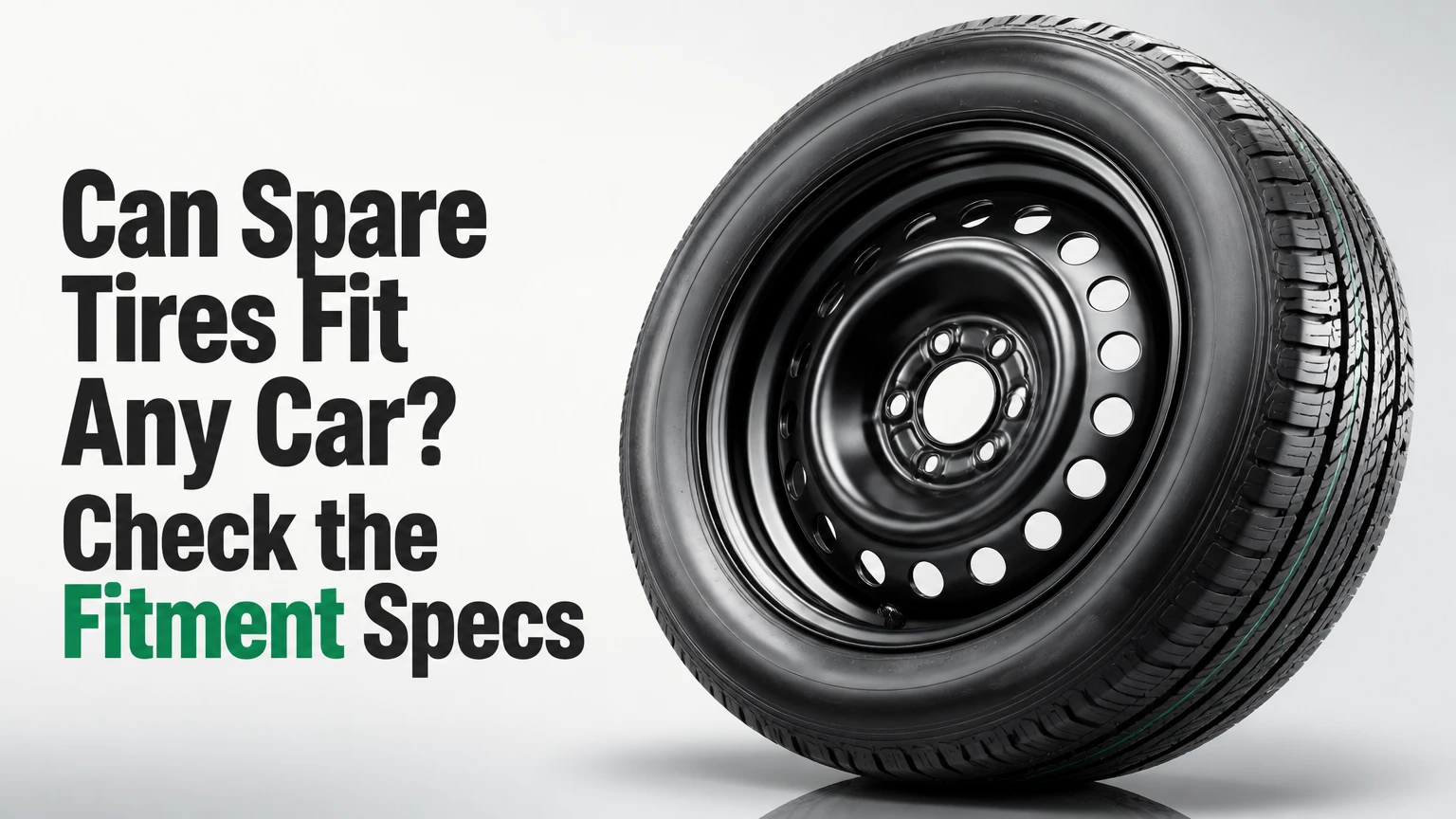
No, spare tires cannot fit any car. A spare wheel and tire must match the vehicle’s bolt pattern, center bore, brake clearance, offset, load capacity, and usable tire diameter. Even when a wheel mounts physically, the combination may be unsafe or may damage brakes, suspension, differentials, or electronic systems.
Key facts
A spare tire is vehicle-specific equipment, not a universal emergency wheel.
The bolt pattern, center bore, and lug-nut seat must match the vehicle hub.
The spare wheel must clear the largest brake caliper and suspension component.
A temporary donut commonly carries a 50 mph and approximately 50-mile limit, but the owner’s manual controls.
AWD and 4WD vehicles can require a closely matched rolling circumference on all four positions.
Tire pressure, tire age, load index, and TPMS status matter after physical fitment.
Can a donut spare fit any car?
A donut spare cannot fit any car because its wheel interface and tire dimensions are designed for a particular group of vehicles. A compact-car donut may have the wrong bolt circle, insufficient load capacity, inadequate brake clearance, or an incompatible lug-nut seat for an SUV or pickup.
A temporary spare is narrow to reduce storage space and weight. Its high inflation pressure, often about 60 psi, supports the vehicle only within the limits printed on the sidewall and in the owner’s manual. The spare may also be approved for one axle only.
The phrase “it fits” has two meanings. A wheel can slide over the studs and still be unsuitable because its offset causes rubbing, its tire is too small for an AWD system, or its load index is below the vehicle’s requirement. Physical mounting is only the first test.
Vehicle manufacturers commonly restrict temporary spares to 50 mph and about 50 miles. Those figures are typical, not universal. Ford, Toyota, Honda, General Motors, and other manufacturers publish model-specific restrictions that can differ by vehicle, wheel position, drivetrain, and spare design.
How does a spare wheel connect to a car?
A spare wheel connects through the vehicle’s hub, wheel studs or bolts, lug nuts, and machined center area. The lug holes establish the bolt pattern, the center bore locates around the hub, and the fasteners clamp the wheel against the hub face.
A correct connection requires the wheel to seat fully against a clean, flat mounting surface. Rust behind the wheel, an undersized center bore, or the wrong lug-nut seat can prevent proper clamping. A wheel that contacts only the lug nuts is not safely installed.
The tire itself transfers braking and cornering forces through the wheel. That makes the following details functional safety requirements rather than cosmetic wheel preferences:
- Bolt pattern: Number of fasteners and pitch-circle diameter, such as 5×114.3.
- Center bore: Diameter of the wheel’s central hole, measured in millimeters.
- Offset: Distance between the wheel’s mounting face and centerline.
- Wheel width and diameter: Dimensions that affect tire seating and brake clearance.
- Lug-seat type: Conical, spherical, or flat seat matched to the fastener.
- Load rating: Maximum weight supported by the wheel and tire.
Which specifications must match?
The spare wheel must match the vehicle’s bolt pattern, center bore, lug-seat geometry, brake clearance, offset range, and load capacity. The mounted tire must also provide an approved diameter, width, speed rating, and rolling circumference for the vehicle’s drivetrain.
| Fitment specification | Example value | What can go wrong if incorrect |
|---|---|---|
| Bolt pattern | 5×114.3 mm | Wheel will not align with studs |
| Center bore | 60.1 mm vehicle hub | Wheel bore may be too small or poorly centered |
| Offset | +35 to +45 mm | Caliper, strut, or fender contact |
| Wheel diameter | 17 inches | Brake or tire clearance failure |
| Tire load index | 91, 615 kg | Overloaded tire or wheel |
| Rolling diameter | Within manufacturer tolerance | ABS, traction-control, or differential problems |
Bolt pattern
A 5×114.3 wheel does not correctly replace a 5×112 wheel. Small apparent differences are not safe to overcome by forcing the wheel, enlarging holes, or tightening unevenly. Dual-drilled aftermarket wheels require separate verification because their design may alter seating strength and clearance.
Center bore
The wheel’s center bore must be large enough to pass over the vehicle’s hub lip. A smaller bore will not mount. A much larger bore may require a correctly sized hub-centric ring, although temporary spare applications should follow the manufacturer’s specifications rather than improvised adapters.
Offset and brake clearance
Offset changes the wheel’s position relative to the brake caliper, strut, control arm, and fender. A spare with the same diameter and bolt pattern can still fail because a large performance brake package occupies more space behind the wheel.
Load rating
The spare’s load index must support the axle load, not merely the average weight of the vehicle. A tire intended for a small sedan should not be transferred to a three-row SUV, cargo van, or pickup without written fitment approval.
Can a different wheel diameter fit?
A different wheel diameter can fit only when the complete wheel, tire, brake clearance, load rating, and vehicle approval are compatible. A 16-inch spare cannot be assumed safe on a car equipped with 17-inch wheels, because the smaller rim may contact the brake caliper even if the tire’s outside diameter appears similar.
Tire size is expressed through width, aspect ratio, and rim diameter. For example, a 215/55R17 tire has a nominal 215 mm width, a sidewall height equal to 55% of that width, and a 17-inch rim requirement. A 215/65R16 tire may have a similar outside diameter, but the 16-inch wheel still needs adequate brake clearance.
Low-profile performance brakes create the most common diameter exception. The owner’s manual, factory wheel chart, or manufacturer-approved spare kit is more reliable than comparing tire labels alone.
Are spare tires safe for AWD and 4WD vehicles?
A temporary spare is safe on an AWD or 4WD vehicle only when the manufacturer permits that specific spare and mounting position. A significantly smaller or larger rolling circumference can force the center differential, clutch pack, transfer case, or electronically controlled coupling to compensate continuously.
AWD systems vary. Some vehicles require the temporary spare on the rear axle, while others require it on the front or prohibit its use entirely. Some manuals instruct the driver to replace or deflate a tire temporarily so the circumference difference remains within a specified limit.
| Drivetrain situation | Main risk | Correct action |
|---|---|---|
| Front-wheel drive sedan | Reduced steering traction | Follow axle placement in manual |
| Rear-wheel drive pickup | Reduced rear traction under load | Use approved load-rated spare |
| Full-time AWD crossover | Differential or coupling wear | Confirm circumference tolerance |
| Part-time 4WD truck | Driveline wind-up on high traction surfaces | Do not engage 4H or 4L unless manual permits |
| Staggered-performance AWD car | Front and rear sizes differ | Use model-specific spare system |
Do not treat “AWD” as one standard design. The manufacturer’s instructions determine whether a donut can be used, where it goes, and how far the vehicle may travel.
What types of spare tires are available?
Vehicles use four main emergency-mobility arrangements: compact temporary spares, full-size matching spares, full-size non-matching spares, and no physical spare with run-flat or repair equipment. Each option balances cargo space, driving range, cost, handling, and recovery speed.
| Spare or alternative | Typical purchase cost | Typical restriction | Best use |
|---|---|---|---|
| Compact donut | $150-$300 | 50 mph, about 50 miles | Short trip to a tire shop |
| Full-size matching wheel | $200-$600+ | Manual may allow normal use | Remote travel and tire rotation |
| Full-size non-matching wheel | $120-$250 | Replace or repair promptly | Utility vehicles and older cars |
| Run-flat tire | $200-$450 per tire | Often 50 miles after pressure loss | Vehicles designed for run-flats |
| Sealant and compressor kit | $40-$80 | Tread punctures only | Small punctures away from sidewalls |
A full-size matching spare uses the same wheel and tire specification as the road tires. A full-size non-matching spare may use a steel wheel or different tread compound, so it remains an emergency measure even without the narrow donut appearance.
A repair kit is not a wheel substitute. Sealant generally cannot repair sidewall cuts, bead damage, large punctures, separated tread, or a tire that has been driven while flat.
How much does a compatible spare cost?
A compatible spare commonly costs $150-$600 or more, depending on whether the vehicle needs a compact wheel, a full-size alloy wheel, a tire-pressure sensor, and a jack kit. Used OEM assemblies can cost less, but shipping, tire age, corrosion, and missing hardware affect the actual value.
| Purchase route | Typical price | Verification requirement | Likely timeframe |
|---|---|---|---|
| New OEM donut assembly | $200-$450 | VIN and factory part number | 2-7 days |
| New aftermarket spare kit | $180-$400 | Model, year, brake package | 2-10 days |
| Used OEM wheel and tire | $75-$250 | Bolt pattern, bore, tire date | 1-7 days |
| Full-size tire and steel wheel | $150-$350 | Tire diameter and load index | 1-5 days |
| Dealer-supplied complete kit | $300-$700+ | Vehicle trim and options | 1-14 days |
The safest buying process starts with the owner’s manual and vehicle identification number. Confirm the spare part number with a dealer or reputable wheel supplier, then ask whether the assembly clears the largest factory brake package.
Can a spare from another car work?
A spare from another car can work only when every relevant specification matches and the vehicle manufacturer or a qualified wheel specialist confirms clearance. Matching bolt holes alone do not establish compatibility between vehicles.
For example, two cars may share a 5×114.3 bolt pattern but use different center bores, offsets, lug-seat shapes, brake packages, and load requirements. Honda, Toyota, Ford, Hyundai, and Nissan models can also change wheel specifications between generations or trims.
Before using an interchangeable spare, verify:
- The bolt pattern and fastener thread match.
- The center bore passes over the hub.
- The lug nuts match the wheel seat and thread.
- The wheel clears the brake caliper by a safe margin.
- The tire load index meets the vehicle requirement.
- The rolling diameter is approved for the drivetrain.
- The spare’s speed, distance, and axle restrictions are understood.
Never rely on a seller’s phrase “fits many vehicles” without a written application list.
How do you install a spare tire safely?
Installing a spare tire usually takes 20-30 minutes on level ground, assuming the jack, wrench, and locking-key adapter are present. The most important success factor is correct vehicle support, because a compatible wheel cannot compensate for a jack placed under the wrong structure.
Step 1: Secure the vehicle
Move away from traffic, select Park or first gear, apply the parking brake, and switch on hazard lights. Chock the wheel diagonally opposite the flat when conditions allow.
You will know the vehicle is secure when it cannot roll during gentle hand pressure. Do not change a tire on a soft shoulder, steep slope, or unstable surface unless remaining in the vehicle is more dangerous.
Step 2: Check the spare and tools
Inspect the sidewall, tread, wheel, valve stem, and pressure label. Confirm that the jack, lug wrench, locking-wheel-nut key, and towing or roadside-assistance information are available.
A donut at 20 psi may appear intact but cannot provide its designed support. Inflate it to the pressure specified on the spare sidewall or in the manual, not the pressure listed on the driver-door placard for normal tires.
Step 3: Loosen the lug nuts
Remove the wheel cover if necessary, then loosen each lug nut about half a turn while the flat tire remains on the ground. Turn counterclockwise and keep the wrench fully engaged.
The checkpoint is movement without lifting the vehicle. A common mistake is removing the nuts before loosening the wheel, which can allow the wheel to rotate or shift on the jack.
Step 4: Lift at the approved jack point
Place the jack under the designated pinch weld or frame point shown in the owner’s manual. Raise the vehicle until the flat tire clears the ground by roughly 2-6 inches, depending on the vehicle and jack design.
The checkpoint is stable contact between jack, vehicle, and ground. Stop if the jack tilts, sinks, or contacts plastic trim. A broad, solid board can distribute pressure on soft ground, but never use an unstable object or crawl under a vehicle supported only by a jack.
Step 5: Mount the spare
Remove the loosened nuts, pull the flat wheel straight outward, and place it aside. Clean loose rust from the hub face with a brush, then slide the spare fully onto the hub.
The checkpoint is a wheel that sits flush without force. If the spare stops before contacting the hub face, do not tighten it into position. Check center-bore corrosion, brake-caliper interference, and wheel orientation.
Step 6: Tighten and torque
Install the correct lug nuts by hand, then tighten them in a star pattern while the tire is slightly off the ground. Lower the vehicle completely and torque the fasteners to the manufacturer’s specification, often roughly 80-100 lb-ft for passenger cars but not universally.
The checkpoint is even seating with no wobble. Recheck torque after driving the distance specified by the vehicle manufacturer or tire shop.
What limits apply after fitting a spare?
A temporary spare normally requires reduced speed, reduced distance, gentle cornering, and prompt repair of the original tire. The exact limits appear on the spare sidewall and in the vehicle manual, with 50 mph and approximately 50 miles representing common but non-universal figures.
Avoid cruise control, hard braking, abrupt steering, towing, and heavy cargo unless the manual permits them. A narrow spare changes braking balance and cornering response, especially on wet pavement.
| Condition after installation | Typical temporary-spare response |
|---|---|
| Maximum speed | 50 mph, unless a lower limit is printed |
| Intended distance | About 50 miles, only as a typical limit |
| Highway travel | Minimize; use the nearest safe repair facility |
| Wet or icy roads | Reduce speed substantially |
| Original tire repair | Arrange immediately, usually the same day |
| Spare storage | Restore pressure and inspect after removal |
Some vehicles may illuminate ABS, traction-control, AWD, or tire-pressure warning lights after a spare is installed. Warning lights can result from different wheel speed or missing TPMS data, but they should not be ignored if braking or steering feels abnormal.
What common fitment problems occur?
The most common spare-tire failures involve incorrect specifications, insufficient pressure, wrong fasteners, and overlooked vehicle-specific restrictions. The correct response is to stop rather than force the assembly into service.
| Symptom | Likely cause | Safe response |
|---|---|---|
| Wheel will not slide on | Small center bore or rust | Remove, inspect, and clean the hub |
| Lug nuts tighten unevenly | Wrong seat or damaged studs | Stop and obtain correct hardware |
| Tire rubs at full lock | Incorrect offset or width | Do not drive; verify wheel clearance |
| Vehicle pulls strongly | Different diameter or pressure | Stop and inspect installation |
| TPMS warning appears | Sensor missing or unrecognized | Check pressure manually and follow manual |
| Donut is soft | Normal pressure loss over time | Inflate before use to labeled pressure |
A wrong lug nut is especially dangerous with aftermarket wheels. Conical lug nuts, spherical lug nuts, and flat-seat hardware are not interchangeable merely because their threads match.
A spare tire also has an age limit. Rubber compounds harden with time, and a tire stored under a vehicle can suffer heat, moisture, and road contamination. Inspect the date code and replace an old or cracked spare even if the tread is unused.
What should EV owners do?
EV owners should carry the vehicle’s approved mobility equipment and a compatible inflator, while recognizing that many electric vehicles lack a spare-tire well because battery packaging occupies the underfloor area. A sealant kit cannot address every puncture, so long-distance drivers may prefer a model-specific compact spare kit.
EVs add two fitment concerns: higher curb weight and sensitive wheel-speed systems. A low-load passenger-car donut may not support an electric crossover, and a tire with a substantially different circumference can affect ABS, traction control, and AWD operation.
Check whether the EV manufacturer permits:
- Tire sealant with the installed TPMS sensor.
- A particular lifting point and jack capacity.
- A spare wheel near the battery enclosure.
- Towing or flatbed transport after a tire failure.
- Temporary driving with an illuminated drivetrain warning.
What can you use instead of a physical spare?
Run-flat tires, tire sealant, a 12V compressor, roadside assistance, and a standalone spare kit can replace or supplement a physical spare. The correct alternative depends on puncture type, road access, vehicle design, and the manufacturer’s equipment instructions.
| Alternative | Handles tread puncture | Handles sidewall damage | Main limitation |
|---|---|---|---|
| Tire sealant | Yes, usually small holes | No | Temporary chemical repair |
| 12V compressor | No repair by itself | No | Re-inflates only a repairable tire |
| Run-flat tire | Yes, within design limits | Limited | Must be vehicle-approved |
| Roadside assistance | Technician response | Yes, through recovery | Requires coverage and signal |
| Standalone spare kit | Yes, after wheel change | Yes, if tire is replaced | Adds weight and storage demand |
The National Highway Traffic Safety Administration advises drivers to inspect tires and maintain correct inflation, while the Rubber Manufacturers Association, now part of the U.S. Tire Manufacturers Association, has long emphasized that underinflation increases heat buildup and failure risk. A repair alternative still requires regular pressure checks.
A manufacturer-approved repair kit may include sealant that must be replaced after use. Some sealants can contaminate or damage TPMS components, so tell the tire technician which product entered the tire.
Which spare solution fits each situation?
A compact donut suits a city commuter with nearby tire service, while a full-size matching spare suits remote travel, heavy vehicles, and repeated off-pavement driving. Run-flats suit vehicles engineered around them, and a repair kit suits drivers who accept limited puncture coverage.
City commuter
Choose the factory donut when trunk space matters and repair shops are typically within 10-30 miles. Check pressure every six months and after large temperature changes, because a small spare can lose enough pressure to become unusable.
Long-distance traveler
Choose a full-size matching spare when a tire failure may occur far from service. The wheel can preserve normal ground clearance and handling, although its additional 40-70 pounds and cargo-space demand are practical costs.
Pickup or off-road driver
Choose the manufacturer-approved full-size spare with an adequate load rating. A donut can reduce ground clearance and sidewall protection, making it unsuitable for gravel, mud, rocks, or a loaded truck.
AWD performance-car owner
Use only the factory-approved temporary system. Staggered tire sizes, large brake calipers, and tight circumference tolerances make generic spare wheels particularly risky.
EV owner
Carry the approved repair kit, inflator, and roadside plan. Add a standalone spare only after confirming lifting points, battery clearance, wheel load rating, storage, and electronic-system compatibility.
FAQ
Can I put a 16-inch spare on a 17-inch car?
A 16-inch spare can be used on a 17-inch car only if the wheel clears the brakes and the mounted tire has an approved outside diameter, load index, and drivetrain compatibility. The rim diameter alone does not determine fitment. Factory spare kits and the owner’s manual provide the reliable answer.
Do spare tires expire if they are never used?
Spare tires age even when stored in a trunk or under the vehicle. Inspect the DOT date code, sidewalls, tread, valve stem, and wheel corrosion, and replace the tire when cracking, hardening, or manufacturer age guidance indicates deterioration. Unused tread does not prove that the rubber remains safe.
Does a spare tire need a TPMS sensor?
A spare tire may need a TPMS sensor for the vehicle to monitor pressure, although some temporary spares are supplied without one. The vehicle may display a warning when the spare lacks a recognized sensor. Check pressure manually and follow the owner’s manual rather than treating the warning as a fitment approval.
Can I use a spare on the front axle?
You can use a spare on the front axle only when the vehicle manufacturer permits that position. A front-mounted donut can alter steering, braking, and drive-wheel traction, while some vehicles require moving a full-size rear wheel to the front and placing the spare on the rear.
Can tire sealant fix a nail puncture?
Tire sealant can often close a small tread puncture, commonly up to about 6 mm or one-quarter inch, when the tire remains mounted and structurally sound. Sealant cannot safely repair sidewall cuts, bead leaks, large punctures, separated tread, or damage caused by driving while flat.
Should I buy a used OEM spare?
A used OEM spare can be a sensible low-cost purchase when its part number, bolt pattern, center bore, brake clearance, load rating, tire date, pressure, and condition are verified. Reject assemblies with cracks, bent rims, severe corrosion, damaged lugs, sidewall cracking, or an unknown fitment history.
The Bottom Line
Can spare tires fit any car? No. A safe spare tire assembly must match the vehicle’s hub interface, brake clearance, load capacity, tire diameter, lug hardware, and drivetrain requirements. Confirm the VIN-specific owner’s manual and spare part number before purchase, then maintain the pressure and respect every speed, distance, and axle-position restriction.


