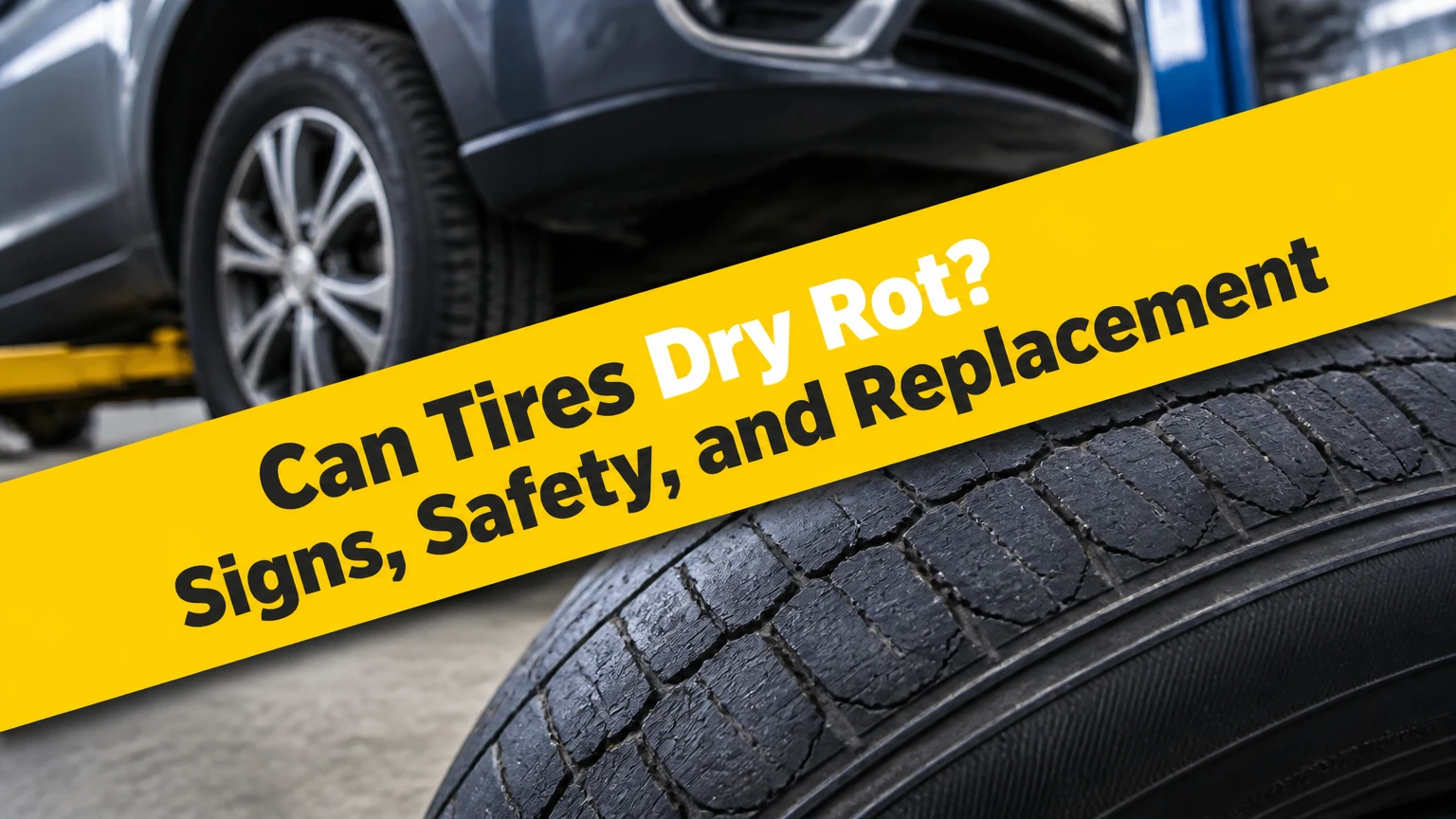
Yes, tires can dry rot. Tire dry rot, also called sidewall cracking, weather checking, or ozone cracking, is age-related deterioration of rubber caused by ozone, ultraviolet light, heat, oxygen, and time. A tire with visible structural cracks, exposed cords, bulges, or tread separation should be professionally inspected and generally replaced, even when tread depth remains acceptable.
Key Facts at a Glance
- Tire dry rot is chemical and environmental aging, not fungal decay and not ordinary tread wear.
- A tire’s four-digit DOT date code identifies its manufacture week and year, not its installation date.
- Good tread depth does not prove that the casing, sidewall, or belt package remains safe.
- Visible cracks in grooves or sidewalls require assessment; deep cracks, cords, bulges, and separation require removal from service.
- Tire manufacturers commonly advise annual inspection after five years of service and replacement by ten years from manufacture, although vehicle use and tire condition can require earlier replacement.
- Tire dressings cannot repair aged rubber, and regular driving cannot reverse existing cracking.
What Is Tire Dry Rot?
Tire dry rot is the visible result of rubber degradation that makes a tire harder, less elastic, and prone to cracking. The term is informal because tires do not rot biologically like wood; technicians may instead call the condition weather checking, ozone cracking, aging cracks, or sidewall cracking.
A modern tire contains natural and synthetic rubber, carbon black, silica, oils, resins, sulfur compounds, steel belts, textile cords, and protective chemicals. Antioxidants and antiozonants slow damage by moving toward the rubber surface, where they help intercept ozone and oxygen. Heat, sunlight, washing, storage conditions, and elapsed time affect how well that protection remains available.
A small amount of superficial checking can occur on an older tire without immediate casing failure. The difficulty is that a vehicle owner cannot reliably determine crack depth, belt condition, or internal separation from a driveway inspection alone. Tire manufacturers and trained tire technicians therefore consider age, location, pattern, inflation history, load, climate, and visible damage together.
Why Do Tires Dry Rot?
Ozone attacks exposed rubber through a chemical reaction that produces fine cracks, while ultraviolet radiation and heat accelerate oxidation and loss of flexibility. Tires parked outdoors, exposed to hot climates, or stored near ozone-producing electrical equipment can age faster than tires kept in a cool, shaded, ventilated area.
In practical terms, the process usually develops like this:
- Protective compounds migrate through the rubber and gradually become depleted at the surface.
- Ozone, oxygen, ultraviolet light, and heat attack vulnerable rubber molecules.
- Small cracks appear, often first in sidewall lettering, shoulder grooves, or tread channels.
- Repeated flexing, underinflation, impacts, and temperature changes enlarge the cracks.
- Severe damage can reach reinforcing cords or accompany belt separation.
The supplied overview describes polymerization loss as a discrete stage. That wording is too absolute for a driveway diagnosis. Tire aging involves oxidation, chain scission, cross-link changes, plasticizer migration, and mechanical fatigue; the exact chemistry varies by compound and tire design.
What Does Dry Rot Look Like?
Tire dry rot commonly appears as fine radial lines on the sidewall, branching cracks in tread grooves, a gray or chalky surface, hardened rubber, small flakes, or cracking around raised lettering. Surface color alone cannot establish that a tire is unsafe, because dirt, cleaning residue, and normal weathering can produce similar appearance.
Inspect all visible surfaces with the wheels turned fully left and right, and use a flashlight to examine the inner sidewalls. Look for patterns rather than one isolated mark. Sidewall cracks that run circumferentially, cracks between tread blocks, exposed fabric, a bulge, or a raised tread edge deserve prompt professional evaluation.
| Finding | Typical location | Likely meaning | Recommended action |
|---|---|---|---|
| Fine shallow lines | Raised sidewall lettering | Early surface weathering possible | Photograph and inspect monthly |
| Multiple branching cracks | Sidewall or shoulder | Advanced weather checking possible | Arrange tire-shop inspection |
| Cracks between tread blocks | Main grooves | Rubber aging or stress damage | Avoid assuming tread depth makes it safe |
| Cord or fabric visible | Sidewall or tread | Structural reinforcement exposed | Do not drive; replace tire |
| Bulge or bubble | Sidewall | Impact or casing separation | Do not drive; replace tire |
| Tread lifting or belt edge | Tread shoulder | Possible belt separation | Stop using tire and seek service |
Can a Fingernail Test Prove a Tire Is Unsafe?
A fingernail catching in a crack or rubber flaking under light contact indicates deterioration, but the fingernail test cannot prove that a tire is safe or establish a universal crack-depth limit. There is no broadly applicable rule that every crack under 1 millimeter is safe or every crack over 2 millimeters is automatically the same type of failure.
Do not cut, widen, probe, or scrape the crack. A technician can inspect the whole tire, measure tread and pressure, check for bulges, assess bead and inner-liner condition, and compare the damage with the tire’s age and service history.
Can a Tire Have Good Tread and Still Be Unsafe?
A tire can have substantial tread and still be unsafe because tread depth measures remaining groove rubber, not the condition of the sidewall, carcass, bead, belts, or inner liner. Low-mileage vehicles, collector cars, trailers, and rarely used spare tires are especially likely to have age-related damage before tread wear becomes significant.
NHTSA consumer guidance states, “Tires are the only part of your vehicle that make contact with the road.” That contact depends on more than tread. A tire must retain sufficient flexibility, contain inflation pressure, maintain its belt structure, and tolerate heat and load cycles without separating.
| Tire condition | Tread-depth implication | Safety interpretation | Decision |
|---|---|---|---|
| 8/32 inch, no cracks, 3 years old | Ample tread | Age and appearance favorable | Continue inspections |
| 7/32 inch, sidewall branching cracks, 7 years old | Ample tread | Aging damage outweighs tread | Replace after inspection |
| 4/32 inch, no visible cracks, 5 years old | Usable but reduced | Wet traction may be declining | Plan replacement |
| 10/32 inch, bulge after impact | Nearly new tread | Casing may be damaged | Do not drive |
| 6/32 inch, exposed cord | Adequate groove depth irrelevant | Structural failure risk | Replace immediately |
How Does the DOT Date Code Affect Replacement?
The DOT Tire Identification Number ends with four digits that show the week and year of manufacture. A code of 2224 means the tire was made during the 22nd week of 2024. The code identifies manufacture, not purchase, mounting, or the date when the tire first touched the road.
The complete code may appear on only one sidewall, so the visible outside of a mounted tire may not show the date. The letters “DOT” can be followed by plant and size information before the final four digits. Do not confuse the DOT date code with the tire’s load index, speed symbol, or molded maximum inflation pressure.
Michelin advises inspection by a tire professional every year after five years of service and recommends replacement at ten years from manufacture as a precaution, regardless of external appearance. Bridgestone similarly advises replacement after ten years from manufacture and recommends annual professional inspection after five years. Other manufacturers or fleet policies may specify shorter limits.
Age is not a guaranteed pass-fail test. Replace sooner when cracking, vibration, repeated air loss, impact damage, irregular wear, overheating, or separation is present.
Is It Safe to Drive on a Tire With Cracks?
Driving may be reasonable for a tire with faint, superficial weather checking only when a qualified technician has inspected it, the tire is within the manufacturer’s service guidance, and no bulge, cord exposure, air loss, vibration, or separation exists. A driver should not make a safety decision from a single photograph or a tread-depth reading.
Do not drive on a tire with exposed cords, a sidewall bubble, an expanding split, tread separation, a severe cut, sudden pressure loss, or a vibration that began after damage. Fit the vehicle’s spare if it is serviceable, or arrange roadside assistance. A temporary spare has its own speed and distance restrictions printed on the sidewall.
Before a long trip, inspect cold pressures using the vehicle placard, check all four tires and the spare, and look for foreign objects and uneven wear. The correct inflation target is normally on the driver-door placard or owner’s manual, not the maximum pressure molded into the tire sidewall.
Can Driving Regularly Prevent Dry Rot?
Regular driving may reduce some storage-related problems because the tire flexes and protective compounds can redistribute toward the surface, but driving does not stop aging or restore cracked rubber. Ozone, heat, ultraviolet exposure, inflation pressure, load, and calendar age continue to matter on a moving vehicle.
A daily-driven sedan stored under cover can outlast a lightly used vehicle parked in full sun, but mileage is not a reliable lifespan predictor. A tire that sits for months may develop flat spotting, pressure loss, and localized stress, while a tire driven underinflated experiences excessive heat and sidewall flexing.
A practical maintenance routine includes checking cold pressure at least monthly, rotating according to the vehicle manufacturer’s schedule, washing with mild soap and water, and inspecting sidewalls during every pressure check. Tire dressing is optional and cosmetic. No dressing can reverse ozone cracking.
How Should You Store Tires?
Store tires clean and fully dry in a cool, dark, dry location away from direct sunlight, heat sources, solvents, fuels, and ozone-producing electrical equipment. A garage is usually preferable to an outdoor driveway, but a hot, poorly ventilated garage beside a running compressor is not an ideal environment.
For loose tires, place them upright and rotate them periodically, unless the tire or vehicle manufacturer gives different instructions. For mounted wheels, keep assemblies off damp ground and maintain the vehicle maker’s storage-pressure guidance. Do not automatically inflate to the tire sidewall maximum, because that number is the tire’s maximum rated pressure and may exceed the vehicle’s approved operating pressure.
Opaque tire covers reduce ultraviolet exposure, but covers do not make old tires safe or prevent heat and age from acting. Do not seal wet tires in plastic. For seasonal tires, clean and dry them completely, place each tire in a suitable storage bag if recommended by the tire-storage provider, and avoid trapping moisture inside.
| Storage environment | Main exposure | Practical advantage | Main limitation |
|---|---|---|---|
| Shaded indoor garage | Low UV, variable temperature | No direct sunlight or rain | Heat and ozone may remain |
| Climate-controlled room | Low UV, stable temperature | Best control of heat and humidity | Cost and space requirements |
| Outdoor driveway | UV, rain, heat cycles | Convenient and free | Fastest environmental exposure |
| Covered outdoor parking | Reduced UV, outdoor temperature | Better than uncovered parking | Heat, ozone, and humidity remain |
| Tire shop storage | Controlled handling, seasonal rotation | Professional inspection possible | Storage fees and access schedule |
What About Spare Tires, RVs, and Trailers?
Spare tires, RV tires, boat-trailer tires, and classic-car tires often age out because they accumulate calendar time with limited movement. Trailer tires also experience long periods of loading, sun exposure, and inflation loss, while RV tires may carry high loads after months of storage.
Inspect the spare’s date code and sidewall before relying on it. Check RV and trailer tires before every trip, including the inner sidewalls where access permits, and use load and inflation values supplied by the vehicle or trailer manufacturer. Tire covers help with sunlight, but they do not replace pressure checks or age-based inspection.
Support stored vehicles according to the owner’s manual if long-term storage procedures call for it. Avoid parking on sharp debris or standing water. Plastic, plywood, or specialized pads can separate tires from contaminated surfaces, but ordinary concrete does not normally “draw” oils out of tire rubber in the way some storage claims suggest.
Which Conditions Age Tires Fastest?
Direct sunlight, high temperatures, ozone exposure, chronic underinflation, heavy loading, and long storage periods all increase tire-aging risk, but no reliable universal percentage applies to every climate or tire. Claims that outdoor parking accelerates dry rot by exactly 300 percent are not a sound general rule without a defined test method.
Ozone-producing equipment includes some electric motors, welders, and high-voltage devices, although the concentration and ventilation determine actual exposure. Store tires away from such equipment rather than treating every garage motor as an automatic hazard.
Petroleum solvents, aggressive degreasers, and some silicone or solvent-heavy dressings can damage rubber or interfere with surface protection. Use the tire manufacturer’s cleaning instructions. Mild soap and water are the conservative choice.
Can Dry Rot Be Repaired?
Dry rot cannot be repaired with a sealant, conditioner, tire shine, patch, plug, or surface coating because the damage involves the rubber compound and may extend below the visible surface. A puncture repair addresses a localized penetration; it does not restore an aged sidewall or weakened belt package.
A tire professional may approve continued use when marks are superficial and the tire passes inspection. Replacement is the appropriate remedy when cracks are deep or widespread, cords are visible, rubber is shedding, the tread is separating, the tire repeatedly loses pressure, or the tire has exceeded the manufacturer’s age guidance.
Replace tires in axle pairs when possible so left and right tires have closely matched tread and handling characteristics. On all-wheel-drive vehicles, consult the owner’s manual before replacing fewer than four tires, because circumference differences can stress the drivetrain.
How Much Does Replacing Dry-Rotted Tires Cost?
Replacing dry-rotted tires typically costs about $400-$1,200 for four passenger-car tires, including common mounting and balancing charges, while premium SUV, truck, run-flat, specialty, and RV sets can cost substantially more. Local labor, tire size, brand, taxes, disposal fees, alignment needs, and seasonal demand determine the final invoice.
| Replacement scenario | Typical tire price | Typical installed total | Common extra |
|---|---|---|---|
| Compact passenger car, four tires | $75-$160 each | $380-$800 | Disposal and balancing |
| Crossover or SUV, four tires | $120-$260 each | $600-$1,250 | Alignment, if needed |
| Run-flat set, four tires | $180-$400 each | $850-$1,800 | Specialized mounting |
| Light-truck set, four tires | $150-$350 each | $750-$1,600 | Valve stems or TPMS service |
| RV or trailer set, four tires | $150-$450 each | $800-$2,000 | Load-range and access charges |
These figures are typical consumer ranges, not a fixed market price. Ask for the tire’s manufacture date, road-hazard terms, mounting fee, balancing fee, valve or TPMS service, disposal charge, and alignment recommendation before approving work.
What Should You Do Before a Road Trip?
Use this five-minute screening process before a long drive:
- Find the DOT date code on every tire and record the four-digit week-year number.
- Set cold pressure to the vehicle placard specification, including the spare.
- Turn the steering wheel to inspect both front sidewalls and use a flashlight.
- Look for branching cracks, bulges, exposed cords, tread lifting, uneven wear, and objects.
- Postpone the trip for any tire with structural symptoms, persistent pressure loss, or uncertain damage.
A tire shop can usually perform a visual and pressure inspection in about 15-30 minutes, although a replacement appointment may take 45-90 minutes for four tires. Alignment, seized wheel hardware, TPMS faults, or difficult RV access can extend that time.
When Should You Replace Rather Than Monitor?
Replace a tire rather than monitor it when a technician confirms structural cracking, when cracks extend into the tread grooves or carcass, or when age combines with visible deterioration. Monitoring is limited to tires with minor surface weathering that have passed a professional inspection and remain within the manufacturer’s service recommendations.
Use this decision framework:
- No visible damage and recent date code: Maintain pressure and inspect monthly.
- Faint surface lines only: Photograph, schedule an inspection, and monitor the pattern.
- Branching cracks, flaking, or widespread checking: Plan immediate replacement.
- Bulge, exposed cord, tread separation, sudden loss of pressure, or severe vibration: Do not drive.
- Older than the manufacturer’s service limit: Replace, even if appearance and tread seem acceptable.
The most common mistake is treating a visual home inspection as a structural test. A tire can look acceptable externally while suffering internal belt, bead, or liner deterioration.
Frequently Asked Questions
Does dry rot mean a tire is flat?
No. Dry rot describes rubber aging and cracking, while a flat tire describes loss of inflation pressure. A dry-rotted tire may hold air until a crack, puncture, bead problem, or structural failure causes leakage, so normal pressure does not prove that aged rubber is safe.
Can tire dry rot happen in a garage?
Yes. A garage reduces ultraviolet exposure and rain but does not stop age-related oxidation. Heat, ozone-producing equipment, poor ventilation, seasonal temperature changes, underinflation, and long storage can still contribute to cracking. A cool, shaded, dry garage is generally better than an uncovered driveway.
Are used tires with good tread worth buying?
Used tires with good tread are worth considering only when the buyer can verify the DOT date code, inspect the full sidewall and tread, confirm matching size and load rating, and obtain a professional inspection. A low price is poor value if the tire is already near its age limit or shows weather checking.
Does tire pressure affect dry rot?
Tire pressure does not cause chemical aging by itself, but underinflation increases flexing, heat, and sidewall stress, which can enlarge existing cracks and accelerate mechanical damage. Check pressure cold at least monthly and before heavy loads, using the vehicle placard rather than the tire’s maximum molded pressure.
Should all four tires be replaced together?
Replacing all four tires together gives the most consistent tread depth and handling, but the correct decision depends on wear, drivetrain requirements, and the manufacturer’s guidance. Replace tires on the same axle as a minimum where practical, and ask an all-wheel-drive manufacturer about allowable circumference differences.
Does tire shine prevent dry rot?
Tire shine does not prevent or reverse dry rot. Some products may be compatible with tire rubber, while solvent-heavy or petroleum-based products can damage surfaces or remove protective materials. Mild soap, water, shade, correct inflation, and professional age inspection provide safer maintenance than relying on a cosmetic dressing.
The Bottom Line
Can tires dry rot? Yes. Tire dry rot is age and environment-related rubber degradation that can produce sidewall cracking, tread-groove checking, hardening, flaking, and eventual structural failure. Check the DOT date code, inspect every tire including the inner sidewall and spare, maintain the vehicle’s specified pressure, and replace any tire with structural symptoms or age beyond manufacturer guidance. Good tread alone is not a safety certificate.


