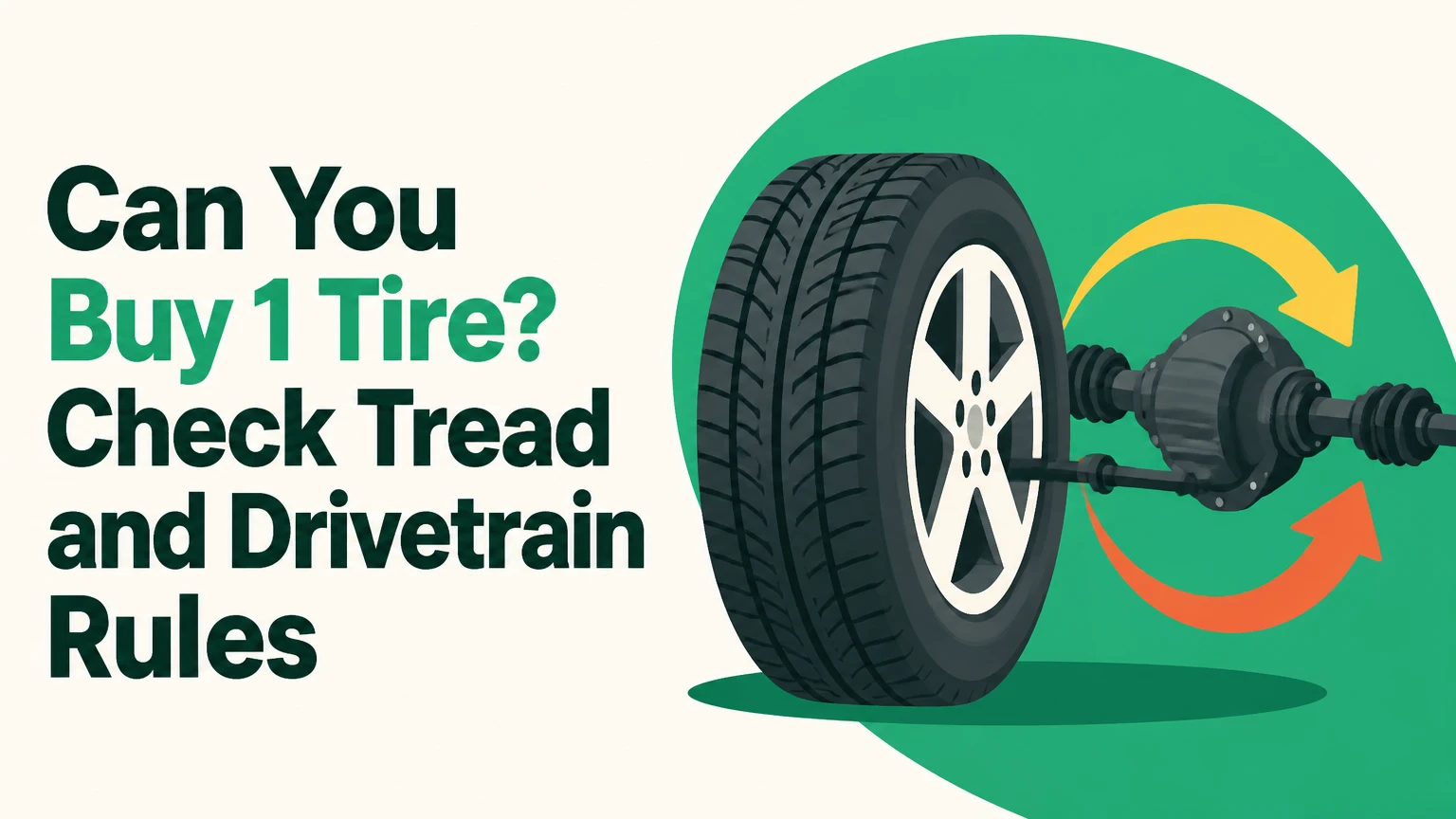
Yes, you can buy one tire, but installing it safely depends on the other tires’ tread depth, exact specifications, vehicle drivetrain, and owner’s-manual limits. One replacement tire is usually reasonable when the remaining tires are nearly new and closely matched. AWD vehicles and vehicles with substantially worn tires often require a shaved tire, a pair, or four replacements instead.
Key Facts
A single tire should match the existing tires in size, construction, season, speed rating, load index, and tread pattern whenever possible.
The legal minimum tread depth in much of the United States is 2/32 inch, but legal tread is not the same as safe or mechanically compatible tread.
AWD systems can be sensitive to tire circumference differences, but there is no universal 2/32-inch tolerance for every AWD vehicle.
New tires are generally placed on the rear axle when replacing fewer than four, because greater rear wet traction reduces oversteer risk.
A tire shop should measure all four tires, inspect for internal damage, verify the vehicle manual, and reset or relearn TPMS when required.
A punctured tire may be repairable, making replacement unnecessary, if the damage is within the repairable tread area and the tire was not driven flat.
Can You Buy 1 Tire for a Car?
You can buy one tire for a car, and a tire dealer can mount and balance it individually. The important question is whether one new tire will work with the three tires already installed. A single replacement is most defensible when the other tires have similar tread depth, are the same tire model, and have no age, damage, or uneven-wear problems.
Tire manufacturers and vehicle makers treat tire matching as a handling and mechanical issue, not merely a purchasing preference. The United States Tire Manufacturers Association advises that, when only two tires are replaced, “the new tires should be installed on the rear axle.” That guidance addresses wet-road stability, but it does not mean every isolated replacement can simply be moved to the rear.
The replacement tire must also fit the wheel and vehicle. A tire with the correct width but a different load index, speed rating, winter compound, run-flat construction, or overall diameter can change braking, steering, noise, and electronic-system behavior.
When Is One Tire a Reasonable Replacement?
One tire is usually reasonable when the matching tire on its axle has nearly the same tread depth and the other three tires are in good condition. For example, replacing a damaged 8/32-inch tire with the same model at 10/32 inch may be acceptable after a professional inspection, particularly on a two-wheel-drive vehicle.
A single tire is a poor choice when the other tires are halfway worn, have irregular wear, belong to different seasonal categories, or have mismatched circumferences. Replacing one tire also makes little sense if the remaining tires are old enough to require replacement soon, because the installation fee will be repeated shortly.
Tire Rack, Consumer Reports, and vehicle manufacturers commonly emphasize matching tires by axle and preserving the vehicle’s approved size and service ratings. The exact decision belongs to the vehicle manufacturer’s tolerance, not a generic internet number.
How Does Tread Depth Affect One New Tire?
A new passenger tire commonly measures about 10/32 to 12/32 inch of tread, while a worn tire may measure 5/32, 4/32, or less. Removing tread reduces the tire’s rolling radius, so a new tire can rotate slightly fewer times per mile than a worn tire. The difference matters most when the vehicle continuously couples all four wheels.
Tread depth is not a perfect measurement of circumference. Tire construction, inflation pressure, rim width, load, wear pattern, and the manufacturer’s molded diameter also affect rolling radius. Two tires with equal tread measurements can still have slightly different circumferences, while two different models with similar tread depth may behave differently.
A 2/32-inch measurement is widely used as a legal replacement threshold in the United States, and Michelin identifies 2/32 inch as the point at which a tire should be replaced. That number does not establish a safe mismatch limit. Wet braking can deteriorate before the legal limit, and AWD compatibility depends on the vehicle’s engineering.
How Do You Measure the Existing Tires?
Measure the main grooves of all four tires with a calibrated tread-depth gauge, recording each tire in 32nds of an inch. Take several readings across the tread because shoulder wear, cupping, and alignment problems can make the center reading misleading.
Use this inspection sequence:
- Record tread depth at the inner, center, and outer grooves.
- Compare the tire on the same axle first.
- Check the DOT date code on every sidewall.
- Measure inflation pressure when the tires are cold.
- Inspect bulges, exposed cords, cuts, puncture repairs, and cracking.
- Compare the molded tire model and size markings.
- Ask the vehicle manufacturer or dealer for the permitted circumference difference.
A digital gauge costing roughly $10-$30 is adequate for a preliminary measurement, but a gauge cannot identify internal belt damage. A tire that was driven while flat may need replacement even if its visible tread looks normal.
Is One Tire Safe on FWD, RWD, or AWD?
One tire is most feasible on FWD or RWD vehicles when the replacement matches the existing tires and the tread difference is small. AWD vehicles deserve stricter scrutiny because their center differential, clutch pack, transfer case, or electronically controlled coupling may compensate continuously for different wheel speeds.
| Drivetrain | One-tire feasibility | Main technical concern | Sensible default |
|---|---|---|---|
| FWD | Moderate to high | Front axle traction and steering mismatch | Match the axle, then follow rear-placement guidance if practical |
| RWD | Moderate to high | Rear traction and differential speed | Replace one only with close tread and specification matching |
| Full-time AWD | Low to moderate | Continuous circumference mismatch | Check the manual and measure all four before buying |
| On-demand AWD | Vehicle-specific | Clutch-pack engagement and wheel-speed inputs | Follow the manufacturer’s tire-diameter tolerance |
| 4WD with selectable modes | Vehicle-specific | Driveline wind-up in locked 4WD | Do not use mismatched tires in locked 4WD |
The terms AWD and 4WD do not identify one standardized mechanical design. Subaru, Audi quattro, BMW xDrive, Honda Real Time AWD, Toyota Dynamic Torque Control AWD, and Ford systems can impose different requirements. Some manuals specify a maximum circumference difference; others specify tread-depth limits or require replacement of all four tires.
Does AWD Always Require Four New Tires?
AWD does not always require four new tires, but many AWD manufacturers recommend replacing all four when tread wear differs materially. A manufacturer may permit one replacement if the tire is shaved to the correct circumference, if the remaining tires are nearly new, or if the measured difference falls within its published tolerance.
The often-repeated “2/32-inch maximum for AWD” is not a universal engineering rule. Some vehicles allow less, some specify circumference rather than tread depth, and some tire manufacturers publish their own recommendations. The owner’s manual and the exact drivetrain design control the decision.
A tire shop should not promise that a generic AWD threshold applies to every vehicle. Ask for the manufacturer’s documented limit in inches, millimeters, percentage circumference, or tread depth.
Which Tire Specifications Must Match?
The safest single replacement matches the existing tire’s complete service description, not just its visible size. Compare the sidewall markings and vehicle placard before ordering.
| Specification | Example | Why the match matters | Acceptable variation |
|---|---|---|---|
| Tire size | 225/55R17 | Controls diameter, width, and fit | Use only vehicle-approved sizes |
| Load index | 97 | Sets rated carrying capacity | Equal or higher only if approved |
| Speed rating | V | Sets certified speed capability | Equal or higher, subject to manual |
| Construction | Radial, run-flat | Changes stiffness and handling | Match vehicle requirements |
| Season category | All-season or winter | Changes grip and compound behavior | Do not mix categories on an axle |
| Tread model | Michelin Defender2 | Changes circumference and handling | Same model is preferred |
| Inflation specification | 35 psi cold | Controls contact patch and wear | Follow vehicle placard, not sidewall maximum |
The sidewall’s maximum pressure is not the normal operating pressure. Use the driver-door placard or owner’s manual. The vehicle placard also identifies the approved tire size and load requirements.
A different brand can sometimes be used safely when its size, load index, speed rating, construction, category, and actual dimensions are appropriate. However, a different model may have a different tread design and rolling circumference even when the sidewall numbers match.
What If the Original Tire Model Is Discontinued?
If the original tire is discontinued, first ask the manufacturer or a qualified tire retailer for a current replacement with closely matching dimensions and performance characteristics. A same-brand successor is not automatically identical. Compare published specifications and measure the installed tires when the vehicle has sensitive AWD hardware.
If no suitable match exists, replacing the axle pair often produces a more predictable result than mixing one new tire with three older models. Replacing all four may be the correct economical choice when the existing set has significant wear or uneven handling.
Should the New Tire Go on the Front or Rear?
When replacing two tires, the new tires generally belong on the rear axle, regardless of whether the vehicle is FWD or RWD. Deeper rear tread helps the rear tires resist hydroplaning and maintain lateral grip, reducing the possibility of sudden oversteer. Tire Industry Association and USTMA consumer guidance use this rear-axle principle.
A single new tire cannot always follow that rule because the replacement location must preserve axle matching and the vehicle’s approved configuration. If the new tire is installed on the rear while the other rear tire is much more worn, the rear axle may become mismatched. A technician may need to replace the pair, shave the new tire, or use a closely matched tire on the opposite axle.
Do not move tires between axles without checking directional tread, staggered sizing, rotation restrictions, and the owner’s manual. Performance vehicles often use different front and rear sizes, making ordinary rotation impossible.
What Are the Replacement Options?
The practical options are one identical tire, one shaved tire, two tires, four tires, or a used tire. The best option depends on tread measurements, drivetrain, tire age, damage type, and the vehicle’s replacement instructions.
| Replacement option | Typical tire cost | Typical service cost | Best fit | Main limitation |
|---|---|---|---|---|
| One identical new tire | $60-$450+ | $25-$70 | Nearly new remaining tires | New tread may not match circumference |
| One shaved new tire | $90-$500+ | $25-$75 shaving plus installation | AWD or precise tread matching | Availability and warranty vary |
| Two new tires | $120-$900+ | $50-$140 | One axle is worn or damaged | Remaining pair must still be safe |
| Four new tires | $240-$1,800+ | $100-$280 | AWD, worn set, or mixed tires | Highest immediate expense |
| Used matching tire | $25-$150 | $25-$70 | Temporary budget or lease situation | Hidden damage, age, and uncertain history |
| Repairable puncture | $20-$45 | Usually included | Tread-area puncture under repair limits | Not suitable for sidewall or shoulder damage |
Prices are typical US retail ranges and vary by size, region, tire category, disposal fees, taxes, and vehicle. Premium 21-inch performance tires can exceed the table’s upper range.
Is a Used Tire a Good Alternative?
A used tire can work when its exact size, model, service rating, age, and tread depth closely match the vehicle’s other tires. A reputable dealer should inspect the inside and outside, verify air retention, disclose the DOT date, and reject tires with exposed cords, sidewall repairs, bead damage, or severe cracking.
Used tires are not a reliable substitute for a new tire on a sensitive AWD system unless the measured circumference is appropriate. They also carry uncertain heat-cycle history, impact exposure, and storage conditions. For a temporary repair, a used tire may be financially sensible; for long-term highway use, a matched new tire or pair is usually easier to document and warranty.
How Much Does One Tire Cost?
One tire typically costs $50-$100 for an economy model, $110-$220 for a mid-range model, and $230-$450 or more for a premium, high-performance, run-flat, or oversized tire. Mounting and balancing commonly add $20-$45 per wheel, with disposal, valve, TPMS, taxes, and mobile-service fees sometimes adding another $5-$35.
| Cost item | Typical range | What changes the price | Planning note |
|---|---|---|---|
| Economy tire | $50-$100 | 14-16-inch size and basic compound | Often limited model availability |
| Mid-range tire | $110-$220 | 16-19-inch size and warranty | Common commuter category |
| Premium tire | $230-$450+ | Performance, EV, run-flat, or 20-inch size | Exact model may require ordering |
| Mount and balance | $20-$45 | Wheel diameter and retailer | Per wheel, before disposal |
| Tire shaving | $25-$50 | Provider and tread-removal amount | Confirm warranty before ordering |
| Alignment check | $0-$150 | Shop policy and adjustment needs | Needed when wear is uneven |
| TPMS service | $0-$25 | Sensor type and relearn process | Some vehicles relearn automatically |
An in-stock local replacement commonly takes 45-90 minutes. A special-order or shaved tire may take 2-5 business days, although emergency inventory and shipping can change that estimate.
Can a Punctured Tire Be Repaired Instead?
A punctured tire may be repaired when the hole is in the central tread area, is no larger than the manufacturer’s repair limit, and the tire has not been driven underinflated. A proper repair requires removing the tire, inspecting the inside, and using a combination plug-and-patch repair approved by the tire industry.
A sidewall, shoulder, bead, belt separation, bulge, or puncture from driving flat generally requires replacement. A rope plug installed from outside may stop air loss temporarily, but it is not the same as a permanent internal repair.
The National Highway Traffic Safety Administration advises drivers to inspect tires regularly and respond to pressure loss promptly. TPMS warns about pressure; it does not certify that a tire is structurally safe.
What Problems Can One Mismatched Tire Cause?
A mismatched tire can alter braking balance, steering response, hydroplaning resistance, rolling resistance, and wheel-speed data. On AWD vehicles, continuous speed differences can increase heat and wear in the center coupling or differential, although the severity depends on the system and the magnitude of the mismatch.
Common symptoms include:
- ABS, traction-control, or stability-control warnings
- Steering pull under acceleration or braking
- New vibration or uneven ride height
- Scrubbing or binding during tight turns
- Faster wear on one axle
- Reduced wet-road stability
- Tire-pressure warnings after a wheel change
A warning light does not prove that tire mismatch caused the problem. Low pressure, a damaged wheel-speed sensor, incorrect tire pressure, or a failed ABS component can produce similar symptoms. Scan the vehicle and verify tire pressures before assuming the new tire is at fault.
What Should You Do If the Car Pulls?
Check cold inflation pressure against the door placard, then inspect the tire model, size, tread depth, and directional orientation. If the vehicle still pulls, have the shop check conicity, wheel alignment, brake drag, suspension wear, and wheel-speed sensors.
Do not compensate for a tire mismatch by changing pressure beyond the manufacturer’s specification. Excessive pressure reduces the contact patch, while insufficient pressure increases heat and shoulder wear.
What Mistakes Should You Avoid?
The most common mistake is buying a tire based only on the 225/55R17 size. That choice can ignore load index, speed rating, run-flat construction, season category, tread model, and drivetrain requirements.
Avoid these errors:
- Using a universal AWD threshold. Confirm the vehicle-specific circumference or tread limit.
- Installing a winter tire beside all-season tires. Compound and grip differences can be large even at the same tread depth.
- Ignoring tire age. NHTSA and tire manufacturers recommend regular inspection of older tires; cracking and storage damage can make tread depth irrelevant.
- Assuming the rear rule solves every single-tire case. Rear placement is primarily guidance for replacing a pair and maintaining wet stability.
- Skipping the internal inspection after a flat. A tire driven without pressure may have hidden sidewall and bead damage.
- Mixing run-flat and standard tires without approval. Sidewall stiffness changes steering and suspension behavior.
- Forgetting a staggered setup. Front and rear tire sizes may differ, preventing normal rotation or relocation.
- Replacing only the visibly damaged tire. Uneven wear on the opposite tire may make a pair the safer minimum.
What Is the Practitioner Rule of Thumb?
Use one tire only when the other tires are nearly new, closely matched, and mechanically compatible. Use two when the axle pair is worn or the opposite tire has substantial damage. Use four when the set is broadly worn, the AWD manufacturer requires it, or mixing models would create a measurable handling problem.
This rule is a screening method, not a substitute for the manual. A 2WD vehicle with 8/32-inch tires may accept one replacement, while an AWD vehicle with 7/32-inch tires may require a specific circumference match.
Which Replacement Should You Choose?
Choose one identical new tire when the other three tires are within the vehicle’s permitted wear difference and the damaged tire is the only problem. Choose a shaved new tire when the vehicle maker permits shaving and precise circumference matching is necessary. Choose two when one axle has clearly uneven wear, and choose four when the set is worn or the AWD system demands uniformity.
| Driver situation | Recommended option | Typical decision trigger | Avoid |
|---|---|---|---|
| Nearly new FWD commuter set | One identical tire | Other tires measure within about 1/32-2/32 inch, subject to manual | Different tire category |
| RWD vehicle with worn axle pair | Two tires | Same axle has materially different tread | One tire on the worn axle |
| AWD crossover | Four or approved shaved tire | Manual requires close circumference matching | Generic 2/32-inch assumption |
| Lease return with one damaged tire | Matching used or new tire | Exact model and tread can be documented | Unknown-age marketplace tire |
| Performance car with staggered sizes | Vehicle-approved replacement | Front and rear sizes cannot interchange | Rotating tires across axles |
| Winter tire setup | Matching seasonal tire | Same axle has identical winter construction | One winter tire with all-season tire |
The lowest purchase price is not always the lowest ownership cost. A cheap mismatched tire can create premature wear, repeated installation, warning lights, or drivetrain repairs.
How Do You Buy and Install One Tire Safely?
Follow a documented inspection process before ordering. The process usually takes 30-60 minutes for measurement and 45-90 minutes for an in-stock installation, while AWD research or tire shaving can extend the job to several days.
- Read the vehicle placard and manual. Record approved size, load index, speed rating, pressure, rotation limits, and AWD replacement instructions.
- Identify the existing tires. Photograph every sidewall and record brand, model, size, DOT date, load index, and speed rating.
- Measure all four tires. Use a tread gauge at multiple points and note uneven wear.
- Check for repairability. Ask for an internal inspection if the tire lost pressure or was driven flat.
- Call a qualified retailer. Provide the vehicle identification, drivetrain, tire measurements, and exact tire model.
- Choose the replacement path. Select one, a shaved tire, a pair, four tires, or a repair based on measured compatibility.
- Confirm placement. Follow the manual, axle-matching requirements, directional markings, and rear-axle safety guidance.
- Mount and balance the tire. Install a correct valve or TPMS service kit and torque lug nuts to the vehicle specification.
- Set pressure and calibrate systems. Inflate cold tires to placard pressure and complete TPMS or AWD relearn procedures.
- Perform a post-install inspection. Verify no leaks, vibrations, warning lights, pulling, or abnormal noises during a controlled test drive.
You will know the installation is successful when the tire holds pressure, the wheel is vibration-free at highway speed, the steering remains centered, and no ABS, TPMS, or stability warning appears. Stop driving and return to the shop if any warning persists.
Frequently Asked Questions
Can I buy one tire if the other three are half-worn?
You can purchase one tire, but installing it beside three half-worn tires is often a poor choice. The new tire may differ substantially in circumference and wet grip. Measure all four tires first; replacing the axle pair is commonly more predictable on 2WD vehicles, while AWD vehicles may require four or a manufacturer-approved shaved replacement.
Can I mix tire brands on the same car?
Different tire brands can sometimes coexist on a vehicle when size, load index, speed rating, construction, season, and actual circumference are compatible. Mixing different models on the same axle is less desirable because tread behavior and steering response can differ. Never mix winter and all-season tires casually.
Does a new tire need TPMS programming?
A new tire itself does not contain the TPMS sensor, but the wheel may use a sensor that needs inspection, replacement, cloning, or relearning. Some vehicles relearn automatically after driving, while others require a scan tool or a manual procedure. Ask the installer to verify the system before leaving.
Can I drive temporarily on a different tire?
Drive only far enough to reach a tire professional, at reduced speed and with correct pressure, if the replacement is an emergency measure. A temporary mismatch is especially risky on AWD vehicles, wet roads, and high-speed trips. Do not treat a temporary spare or unknown used tire as a permanent replacement.
How long can a single new tire last?
A single new tire can last roughly 30,000-70,000 miles depending on compound, vehicle weight, alignment, inflation, climate, and driving style. Its practical replacement life is also limited by the other tires: if the set becomes mismatched or the older tires reach the wear limit, the newer tire may need to be replaced early.
Should I replace all four tires if one has a flat?
Replace all four only when tread wear, drivetrain requirements, tire age, or vehicle instructions justify it. A repairable puncture needs no replacement, and a nearly new matched set may need only one tire. AWD manufacturers often prefer uniform circumference, so check the manual before authorizing a four-tire purchase.
The Bottom Line
You can buy 1 tire, but safe installation requires more than matching the sidewall size. Measure tread depth and circumference-related wear, verify the exact tire specifications, inspect the other tires, and follow the vehicle manufacturer’s drivetrain guidance. One identical tire suits a nearly new 2WD set; a worn set, AWD vehicle, or discontinued model may justify a shaved tire, a pair, or four tires.