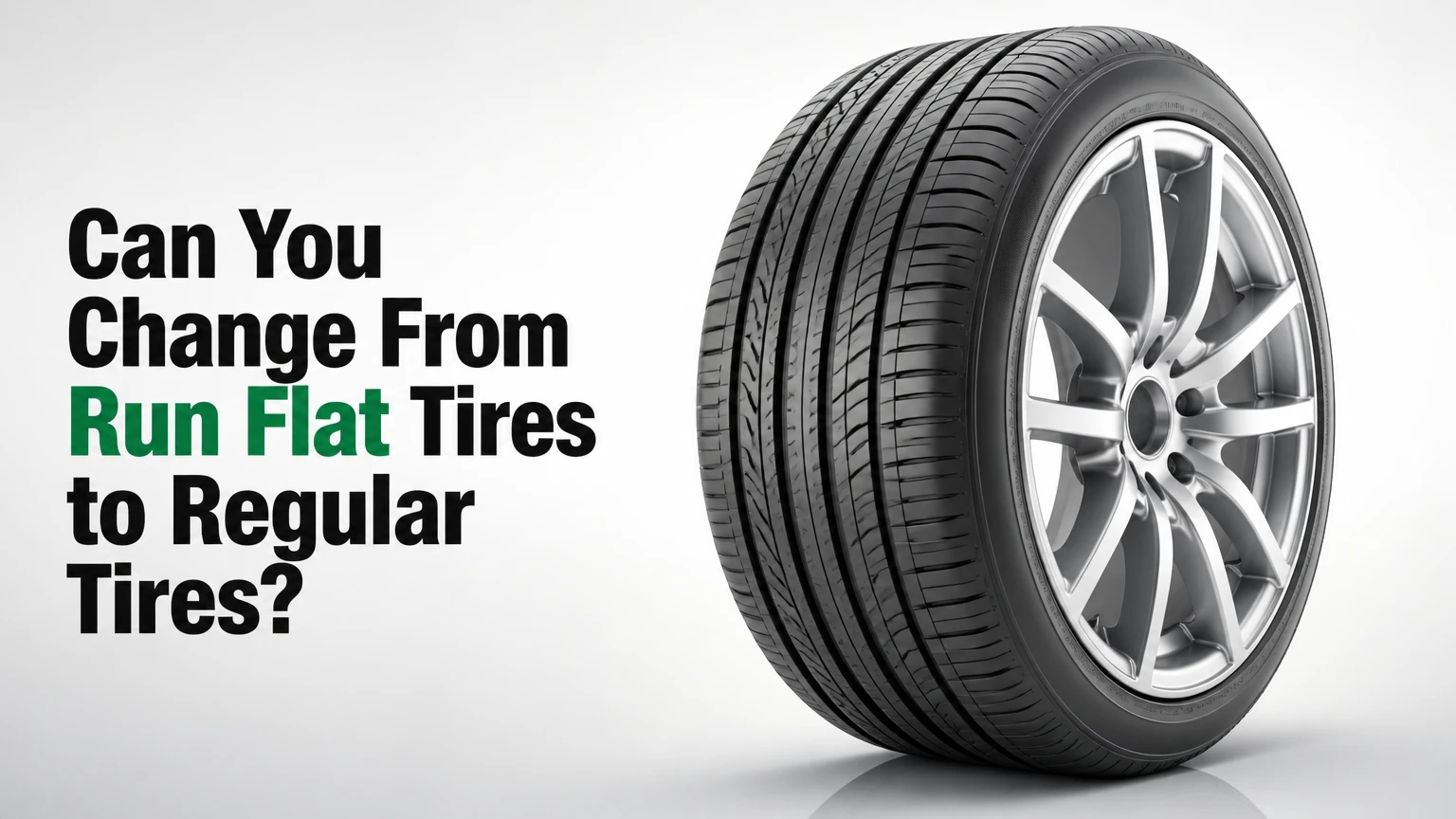
Yes, you can change from run-flat tires to regular tires if the replacement tires match the vehicle’s approved size, load index, speed rating, and wheel fitment. The conversion usually improves ride comfort and lowers tire cost, but it removes limited-distance mobility after a puncture, so the vehicle needs a spare, inflator, repair plan, or roadside-assistance coverage.
Key Facts at a Glance
- Standard tires can generally mount on wheels originally supplied with run-flat tires.
- A regular tire cannot safely be driven after losing pressure; stop promptly and inspect the tire and wheel.
- Use the driver-door placard, not the old tire sidewall, for pressure and minimum load requirements.
- Do not mix run-flat and standard tires on the same axle, and avoid mixing them across the vehicle unless the vehicle manufacturer specifically permits it.
- A tire plug kit and compressor cannot repair every puncture, especially a shredded sidewall or damaged bead.
- The conversion commonly takes 45-90 minutes and costs about $400-$1,200 for four standard tires in the United States, before optional spare equipment.
Can You Change From Run-Flat Tires to Regular Tires?
Run-flat tires can be replaced with conventional pneumatic tires on most passenger cars, crossovers, and SUVs, provided the tire and wheel specifications remain correct. The vehicle does not usually require a new wheel, because standard tires are designed to seat on ordinary rims and on most original-equipment run-flat rims.
The important change is the vehicle’s response to air loss. A run-flat tire has reinforced sidewalls or an internal support ring that can carry the vehicle for a limited distance. A standard tire depends on air pressure to carry the load, so its useful driving range after a puncture is effectively zero.
A conversion is less suitable when the vehicle has no practical spare-tire solution, uses a highly specialized staggered setup, has an electronically controlled suspension calibrated for a specific tire construction, or is covered by a manufacturer requirement for run-flat tires. The owner’s manual and tire placard control the final decision.
What Safety Capability Do You Give Up?
A run-flat tire provides temporary mobility, not unlimited puncture protection. Michelin describes many zero-pressure run-flat systems as allowing up to 80 kilometers, or 50 miles, at a maximum of 80 km/h, or 50 mph, after a pressure loss, but the exact distance and speed depend on the tire and vehicle.
That limit assumes suitable conditions. Excess speed, heavy loading, repeated cornering, low temperature, or an unknown puncture history can reduce the safe distance. A regular tire provides better normal ride compliance but offers no comparable zero-pressure capability.
The National Highway Traffic Safety Administration states, “TPMS is not a substitute for proper tire maintenance.” That principle matters more after conversion because a pressure warning requires immediate action rather than a planned drive to a tire shop.
What Changes When You Replace Run-Flats?
Replacing run-flats changes sidewall stiffness, emergency mobility, ride response, and sometimes the vehicle’s handling balance. The powertrain, brakes, wheels, TPMS sensors, and tire-pressure warning system normally remain unchanged, although the sensors must be serviced correctly during mounting.
Run-flat sidewalls are heavier and stiffer because they must support the vehicle when the air chamber is empty. Standard tires use more flexible sidewalls, which usually absorb sharp impacts more effectively. That difference explains why a vehicle can feel quieter and less brittle immediately after conversion.
The result is not automatically better in every category. A soft touring tire can reduce steering precision on a sports sedan, while a low-profile UHP tire can remain firm despite being non-run-flat. Tire category, aspect ratio, construction, pressure, alignment, and suspension condition all affect the result.
Will Regular Tires Fit Run-Flat Wheels?
Regular tires usually fit run-flat wheels when the wheel diameter, width, bolt pattern, offset, and bead-seat dimensions match the vehicle. A run-flat marking on the wheel does not by itself prevent installation of a conventional tire, but a tire shop should inspect the rim for cracks, bends, corrosion, and bead damage before mounting.
Some run-flat-compatible wheels use an extended hump identified by markings such as EH2 or EH2+. The hump helps retain a deflated run-flat bead during low-pressure operation. A conventional tire can generally seat on that wheel, but the wheel marking is not a substitute for checking the complete wheel and tire specification.
The reverse situation requires more caution. A run-flat tire may require a compatible extended-hump rim, and a standard wheel may not provide the bead retention or fitment required by the tire manufacturer. Never infer compatibility from diameter alone.
How Do You Verify Wheel Compatibility?
Use this sequence before ordering tires:
- Read the wheel size stamped or cast inside the rim, such as 18 x 8J.
- Confirm the replacement tire’s approved rim-width range.
- Check the wheel for EH2 or EH2+ markings if the vehicle originally used run-flats.
- Compare bolt pattern, offset, center bore, and brake-clearance requirements if changing wheels.
- Ask the installer to inspect both beads and the TPMS valve stem during mounting.
A 225/45R18 tire, for example, still needs a compatible 18-inch wheel with an appropriate width range. A tire that fits the diameter but exceeds the wheel-width or load requirements is not a safe replacement.
How Do You Choose the Correct Standard Tire?
Choose a conventional tire that matches or exceeds the vehicle’s original size, load index, and speed rating, then select the tread category for the climate and driving style. The driver-side door placard gives the manufacturer’s approved cold-inflation pressure and often lists front and rear values separately.
The sidewall code contains several separate specifications. In 245/40R19 98Y, “245” is section width in millimeters, “40” is aspect ratio, “R” identifies radial construction, “19” is wheel diameter in inches, “98” is load index, and “Y” is speed rating.
Do not automatically choose the highest available rating. A higher-rated tire can have a stiffer casing, shorter tread life, higher cost, or poorer cold-weather traction. Select a reputable tire with the correct rating and a performance level appropriate for the vehicle.
| Driving situation | Suitable tire category | Typical benefit | Important limitation |
|---|---|---|---|
| Urban commuting, 10,000-15,000 miles yearly | Grand touring all-season | Lower noise and 50,000-70,000-mile warranty range | Reduced response during aggressive cornering |
| Warm climate and performance driving | UHP summer | Dry braking and steering precision at temperatures above 45°F | Poor choice for freezing weather or snow |
| Mixed weather with occasional snow | All-weather, 3PMSF-marked | Better winter traction than standard all-season tires | More noise and rolling resistance than touring tires |
| Frequent heavy snow and ice | Dedicated winter tire | Improved cold-temperature grip below 45°F | Requires seasonal storage or a second wheel set |
| Heavy SUV or loaded crossover use | XL or reinforced standard tire, if placard permits | Higher load capacity at the correct pressure | Firmer ride and potentially higher replacement cost |
Do You Need the Same Original-Equipment Tire?
You do not always need the same brand or run-flat designation, but the replacement must meet the vehicle’s approved dimensional and performance requirements. Some vehicles have OE-specific tuning, such as BMW star-marked tires or Mercedes MO approvals, and the owner’s manual may recommend retaining that specification.
A conventional tire with an identical size can still behave differently from the original run-flat. Compare wet braking, tread warranty, load index, speed rating, rolling resistance, and rim-protection features rather than relying on size alone.
Are Regular Tires More Comfortable and Cheaper?
Regular tires are usually more comfortable and less expensive than comparable run-flats, although the exact difference depends on tire category, wheel diameter, brand, local labor rates, and warranty. The largest comfort improvement usually occurs when a stiff run-flat is replaced with a conventional grand touring tire on the same wheel.
Typical United States retail ranges are shown below. Prices exclude tax, disposal fees, alignment, and unusual TPMS repairs.
| Cost item | Standard tire conversion | Run-flat replacement | Typical quantity or time |
|---|---|---|---|
| Economy or touring tire | $100-$300 each | $180-$450 each | 4 tires |
| Premium UHP tire | $180-$350 each | $250-$500+ each | 4 tires |
| Mounting and balancing | $20-$45 per tire | $20-$50 per tire | 45-90 minutes |
| Four-tire installed subtotal | $480-$1,380 | $800-$2,200+ | 1 appointment |
| Full-size spare and carrier kit | $150-$400 | Often unavailable as OE equipment | 1 kit |
| Compressor and sealant kit | $40-$120 | Optional | 1 kit |
Standard tires often have broader local availability, which can reduce waiting time during a puncture or replacement. Cost savings are not guaranteed if the vehicle requires an uncommon size, a premium XL casing, a dedicated winter set, or a new spare-tire assembly.
Which Tire Type Wins for Daily Driving?
A conventional grand touring all-season tire usually wins for daily commuting because its flexible casing reduces impact harshness and its tread compounds prioritize noise, wet grip, and tread life. A premium standard tire can also cost less per set than an equivalent run-flat, but the savings should fund emergency mobility equipment.
A standard tire is not automatically longer-lasting. A 30,000-mile UHP tire can wear sooner than a 40,000-mile run-flat, while a 70,000-mile touring tire may outlast both. Tread warranty, alignment, inflation, rotation, driving style, and vehicle torque determine actual wear.
Can You Mix Run-Flat and Regular Tires?
Do not mix run-flat and standard tires on the same axle because different sidewall stiffness can alter steering response, braking balance, and cornering behavior. Replacing all four tires is the cleanest solution, while a temporary two-tire replacement should place matching construction and similar tread depth on the same axle.
Mixing becomes more sensitive on all-wheel-drive vehicles. Some AWD systems can be damaged or forced to work continuously when tire rolling circumferences differ, even if the tires share the same nominal size. Subaru, Audi, BMW, Mercedes-Benz, and other manufacturers publish different allowable tread-depth or circumference limits.
Follow the vehicle manufacturer’s instructions rather than a universal percentage. If one tire is damaged and the remaining tires have substantial wear, ask whether the vehicle permits one replacement, requires two, or needs four tires.
| Replacement situation | Recommended action | Risk if ignored | Typical decision |
|---|---|---|---|
| Four worn run-flats replaced | Install four matching standard tires | Lowest construction mismatch | Preferred conversion |
| One damaged tire, front-wheel drive | Replace axle pair if tread difference is excessive | Uneven braking and steering | Check manufacturer limit |
| One damaged tire, AWD | Measure all tire circumferences or tread depths | Driveline stress and warning lights | Often replace four |
| Temporary mixed construction | Keep matching tires on each axle and drive only to repair | Unpredictable handling | Emergency-only measure |
| Staggered performance vehicle | Preserve front and rear sizes | ABS, traction-control, and handling errors | Use placard sizes exactly |
What Backup Equipment Do You Need?
A vehicle converted to standard tires should carry a functioning spare or a clearly understood roadside plan. The most reliable setup is a vehicle-approved compact spare with a jack, lug wrench, wheel chock, and storage solution; an inflator and sealant provide less coverage but weigh less.
Sealant only addresses certain tread punctures. It cannot repair a sidewall cut, a separated tread, a bent wheel, a puncture larger than the product rating, or a tire driven while severely underinflated. Many sealants also contaminate the TPMS sensor and require prompt professional cleaning or replacement.
A compressor alone does not make a flat tire driveable. It can restore pressure after a slow leak if the tire remains structurally sound, but driving on a visibly damaged or unseated tire can destroy the casing and wheel within a short distance.
What Should a Contingency Kit Contain?
Carry equipment suited to the vehicle rather than buying the smallest universal pouch.
- Vehicle-approved compact spare tire
- Jack rated for the vehicle’s gross weight
- Lug wrench matching the wheel fasteners
- 12-volt compressor with a pressure gauge
- Plug kit for eligible tread punctures
- Manufacturer-approved sealant
- Reflective warning device and gloves
- Roadside-assistance telephone and policy details
A spare is especially valuable for remote travel, nighttime driving, extreme weather, towing limitations, or areas with limited cellular coverage. Run-flats remain a rational choice for drivers who prioritize temporary mobility and do not want to store a spare.
What Happens to TPMS After the Conversion?
The tire-pressure monitoring system continues to work after switching to standard tires because TPMS measures pressure, not run-flat construction. The sensors must remain installed, the valve stems must be undamaged, and the system may require a relearn procedure after installation.
Set cold pressure to the door-placard value. Do not reduce pressure because conventional sidewalls look or feel softer, and do not add 1-2 PSI merely to compensate for a floaty ride unless a qualified technician and the manufacturer’s specifications support that adjustment.
A pressure warning does not identify every possible tire failure. TPMS may respond only after pressure drops below a programmed threshold, and indirect systems can require driving to calculate a change. Check pressures manually at least monthly and before long trips.
Can a Regular Tire Be Driven Flat?
A regular tire should not be driven after it loses functional air pressure. Slow immediately, avoid abrupt steering, stop in a safe location, and inspect the tire only when traffic and road conditions permit.
Driving flat can damage the sidewall internally, bend the wheel, separate the tread, and make an otherwise repairable puncture unsafe to repair. A run-flat’s reinforced casing changes that emergency capability; the distinction is structural, not a marketing label.
Does the Suspension Need Recalibration?
Most vehicles do not require suspension recalibration after installing correctly specified conventional tires, but ride and steering characteristics can change. Run-flat-equipped vehicles may use firmer dampers, bushings, or spring rates to control stiff sidewalls, so a soft replacement tire can feel less precise.
If the vehicle feels unstable, first verify cold pressure, tire size, load rating, wheel balance, alignment, and tire condition. Do not mask a handling problem by adding pressure above the placard without checking the manufacturer’s limits.
What Are the Common Conversion Mistakes?
The most consequential mistakes occur during specification and emergency planning.
- Using the old tire’s pressure as the target: The door placard controls normal pressure, including different front and rear values.
- Choosing a lower load index: A cheaper tire with insufficient load capacity can overheat under passenger or cargo loads.
- Assuming all all-season tires work in snow: Standard all-season tires lack the severe-snow-service symbol used on 3PMSF tires.
- Ignoring alignment: Toe misalignment can destroy a new tire’s shoulder tread within thousands of miles.
- Installing only one tire on an AWD vehicle: Rolling-diameter differences can stress the drivetrain.
- Treating sealant as a spare: Sealant cannot solve sidewall, bead, or wheel damage.
An experienced tire installer should record tread depth, cold pressure, torque specifications, TPMS condition, and alignment symptoms at the conversion appointment. Those details make later diagnosis much easier.
Which Drivers Should Switch?
The best decision depends on how the vehicle is used, not only on the purchase price. A commuter who can reach a tire shop quickly may value comfort, while a rural traveler may place greater value on continued mobility after a puncture.
City Commuter
Choose a conventional grand touring all-season tire with the placard load and speed ratings, then add a compressor and a roadside-assistance plan. This combination addresses the usual objectives, lower impact harshness, broader tire availability, and lower replacement cost.
Do not rely on tire sealant alone if daily travel includes uncontrolled-access highways or long distances between services.
Performance Driver
Choose a standard premium UHP tire when steering feel and dry or wet grip matter more than zero-pressure mobility. Keep the original size, load index, speed rating, and staggered fitment, and compare independent wet-braking and tread-wear data before purchase.
A non-run-flat tire can feel sharper because it weighs less, but a soft touring tire can reduce response. The category matters as much as the run-flat designation.
Snow-Belt Driver
Choose a dedicated winter tire for frequent snow, ice, or temperatures below approximately 45°F, or choose a 3PMSF-marked all-weather tire for mixed conditions and one-set convenience. Standard all-season tires remain acceptable in mild climates but cannot match winter compounds on ice.
Retain the correct TPMS sensors and confirm whether a second wheel set fits the vehicle’s brakes and tire-pressure system.
Remote or Highway Traveler
Keep run-flats or install conventional tires together with a vehicle-approved spare. A spare offers a more complete solution than sealant when the tire suffers a sidewall cut, tread separation, or wheel impact.
The physical space, jack points, and spare speed limits must be checked before travel. A compact spare is an emergency mobility device, not a replacement for a full-size tire.
How Much Does the Conversion Cost and How Long Does It Take?
A four-tire conversion typically costs $480-$1,380 for standard tires, mounting, and balancing in the United States, and professional installation commonly takes 45-90 minutes. Adding a compact spare, jack, and carrier can raise the total by another $150-$400.
An alignment may add $90-$180 when tire wear or steering symptoms indicate a problem. TPMS valve-stem service can add $5-$25 per wheel, while a damaged sensor may cost approximately $50-$150 per sensor depending on the vehicle.
Budget for ownership, not only installation. A lower purchase price loses its value if the vehicle has no recovery plan, requires frequent towing, or uses an expensive uncommon tire size.
A Practical Conversion Checklist
Before authorizing the installation, confirm each item:
- Vehicle owner’s manual permits conventional replacements.
- Tire size matches every front and rear placard position.
- Load index equals or exceeds the placard requirement.
- Speed rating meets the manufacturer’s minimum.
- Replacement tire fits the wheel-width range.
- AWD tread-depth or circumference limits are satisfied.
- Tire category matches climate and driving style.
- TPMS sensors and valve stems remain serviceable.
- Cold pressures are recorded from the door placard.
- Spare, compressor, sealant, or roadside coverage is available.
- Wheel fasteners will be torqued to the vehicle specification.
- Alignment will be checked if existing tires show uneven wear.
The installation is complete when the TPMS warning is cleared or relearned, all four tires hold pressure, the wheels are balanced, and the vehicle tracks straight on a safe road test.
Frequently Asked Questions
Can I put regular tires on only the rear?
You can install standard tires on the rear only when the vehicle manufacturer and tire professional approve the axle combination, but mixing construction can change handling. Matching all four tires is safer. If replacing two tires, install the pair with greater wet-grip capability on the rear axle unless the manufacturer gives different instructions.
Will changing run-flats void my warranty?
Changing tire construction does not automatically void a vehicle warranty, but the replacement must meet the vehicle’s approved specifications. A manufacturer or lease company may require an OE tire designation, and an aftermarket tire that causes a failure could complicate a claim. Check the owner’s manual and lease terms.
Can I repair a regular tire after a nail puncture?
A regular tire can often be repaired when the puncture is in the repairable tread area, the hole is within the repair product’s size limit, and the tire was not driven underinflated. A professional should remove the tire for internal inspection. Sidewall and shoulder damage generally require replacement.
Do run-flat tires make a car safer?
Run-flat tires improve mobility after certain punctures because their reinforced structure can support the vehicle for a limited distance. They do not eliminate blowout risk, prevent all crashes, or remove the need for pressure checks. Standard tires can provide excellent normal traction, but they require an immediate stop after major air loss.
Should I replace run-flats with all-season tires?
All-season tires are a sensible replacement for many daily-driven vehicles in mild climates, especially when lower noise and lower cost are priorities. Choose all-weather or dedicated winter tires when severe snow, ice, or sustained freezing temperatures exceed the capability of ordinary all-season compounds.
Can I switch back to run-flats later?
You can usually switch back if the wheels, tire dimensions, load index, and vehicle specifications remain compatible. The tire shop should verify whether the selected wheel has the required bead-retention features and whether the replacement run-flat has the correct manufacturer approval. Relearning TPMS may be necessary after installation.
The Bottom Line
You can change from run flat tires to regular tires when the replacement meets the vehicle’s size, load, speed, wheel, and climate requirements. The conversion commonly delivers a softer ride, wider product choice, and lower purchase cost, but it removes run-flat mobility after a puncture. Choose the tire category carefully, maintain placard pressure, match tires across axles, and carry a spare or dependable roadside plan.