Yes, you can check tire pressure on the dashboard if your vehicle has a direct Tire Pressure Monitoring System, or TPMS, that reports individual readings. Some vehicles use indirect TPMS and show only a warning light, so a handheld gauge remains necessary. The driver’s-door placard, not the tire sidewall, provides the correct cold-pressure specification.
Key Facts at a Glance
- Direct TPMS uses pressure sensors in the wheels and may display individual PSI or bar values.
- Indirect TPMS uses ABS wheel-speed data and usually cannot display actual tire pressure.
- U.S. vehicles generally trigger a TPMS warning at about 25% below the manufacturer’s specified cold pressure, although warning behavior varies by vehicle.
- Tire pressure should be measured when tires are cold, ideally before driving or after at least three hours parked.
- The correct pressure appears on the driver’s-door or door-jamb placard, not as the maximum pressure molded into the tire sidewall.
- A flashing TPMS light usually indicates a system fault, while a steady light usually indicates low pressure.
Can You Check Tire Pressure on the Dashboard?
You can check tire pressure on the dashboard when the vehicle provides a TPMS pressure display, but the dashboard cannot always measure or show a usable PSI value. Direct TPMS-equipped cars may show four individual readings in the instrument cluster or infotainment screen. Indirect systems normally provide only a low-pressure warning.
Turn on the ignition and open the vehicle-information menu with the steering-wheel controls or touchscreen. Look for labels such as Tire Pressure, Tire Information, Vehicle Status, Maintenance, or Service. If the display shows four wheel positions with PSI, kPa, or bar values, the vehicle is reporting sensor data.
Some dashboards show dashes until the car moves. A short drive, often at more than 15 mph, can wake the sensors or allow the control module to update. Exact menu names, refresh speeds, and displayed tolerances depend on the make, model, year, trim, and market.
What Do the TPMS Symbols Mean?
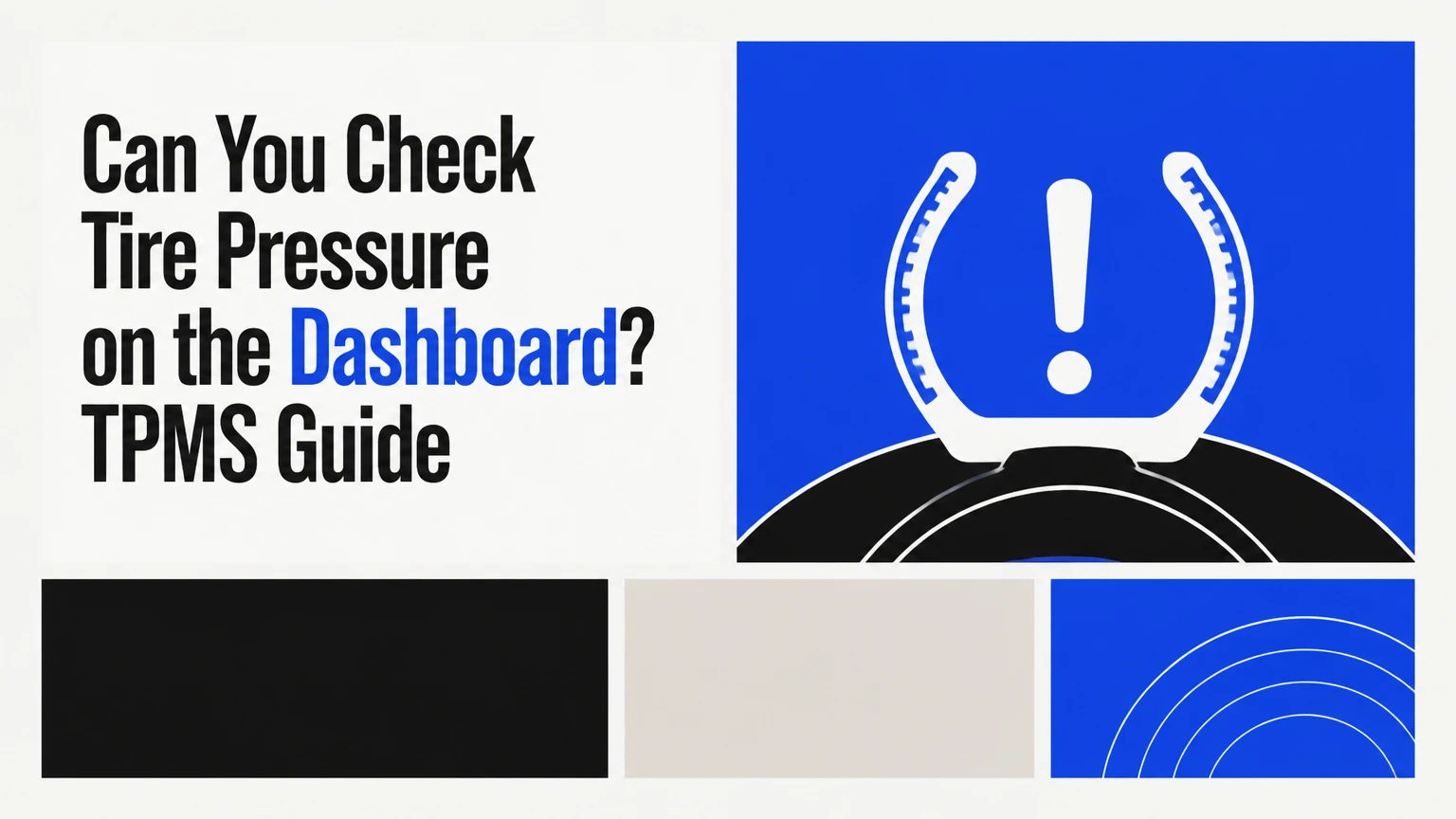
A steady horseshoe-shaped symbol with an exclamation point usually means one or more tires have pressure below the monitored threshold. A TPMS symbol that flashes for roughly 60-90 seconds after startup and then remains illuminated usually indicates a malfunction in the monitoring system.
| Dashboard indication | Typical meaning | Immediate action | Common cause |
|---|---|---|---|
| Solid amber TPMS symbol | Low pressure detected | Stop safely and measure all tires | Leak, cold weather, underinflation |
| Flashing symbol, then solid | TPMS system fault | Check pressures manually and arrange diagnosis | Dead sensor, wiring, module fault |
| Four numeric PSI readings | Direct sensor data available | Compare each value with the door placard | Normal monitoring mode |
| Dashes or blank readings | Data unavailable or not refreshed | Drive briefly, then use a gauge | Sensor sleep, relearn issue, fault |
| “Tire pressure sensor fault” message | Sensor communication problem | Inspect pressures before driving far | Missing, damaged, or unprogrammed sensor |
The warning light is a safety alert, not a precision gauge. The National Highway Traffic Safety Administration describes TPMS as a system that warns drivers about significantly underinflated tires, and its consumer guidance states that TPMS is “not a substitute for manually checking tire pressure.”
How Does Dashboard Tire Pressure Monitoring Work?
Dashboard tire-pressure monitoring works through either direct pressure sensors or indirect wheel-speed calculations. Direct TPMS measures air pressure inside each wheel assembly, while indirect TPMS estimates an abnormal tire condition from how quickly the wheels rotate relative to one another.
Direct TPMS Measures Pressure at the Wheel
Direct TPMS places a radio-equipped pressure sensor inside each tire, commonly attached to the valve stem. Each sensor transmits pressure and sometimes temperature data to a receiver or TPMS control module. The vehicle then assigns readings to front-left, front-right, rear-left, and rear-right positions.
Direct sensors provide the most useful dashboard information, but they have limitations. A sensor may transmit slowly while the vehicle is parked, fail after its internal battery reaches the end of its life, or require relearning after tire rotation. A display can also show a warm-tire value that differs from the cold specification.
Typical direct-sensor battery life is five to ten years. Many original sensors use sealed batteries, so replacement involves changing the complete sensor, installing a service kit, programming or relearning it, and sometimes balancing the wheel.
Indirect TPMS Estimates Pressure Through Wheel Speed
Indirect TPMS uses ABS or electronic stability-control wheel-speed sensors rather than an air-pressure sensor in each wheel. An underinflated tire has a smaller effective rolling radius, so it rotates slightly faster than the other tires at the same road speed. The system compares those patterns and generates a warning.
Indirect TPMS usually cannot tell the driver that a tire contains 29 PSI. It can identify a rolling difference after the system has learned a baseline. Tire wear, mismatched tire sizes, snow chains, slippery roads, and uneven loading can affect the calculation.
Resetting an indirect TPMS system establishes a new reference. The reset does not add air, inspect the tire, or measure actual pressure.
Which TPMS Type Does Your Car Have?
A vehicle has direct TPMS if its dashboard displays separate PSI, kPa, or bar readings for individual wheels. A vehicle has indirect TPMS if it offers only a warning symbol or requires a calibration procedure after inflation without showing actual pressure numbers.
| TPMS type | Sensor location | Dashboard information | Main maintenance issue |
|---|---|---|---|
| Direct, valve-stem sensor | Inside each wheel | Individual PSI, kPa, or bar | Sensor battery and valve-seal replacement |
| Direct, band-mounted sensor | Inside each tire on the rim | Individual pressure readings | Tire removal required for service |
| Indirect, ABS-based | No pressure sensor in tire | Warning symbol or message | Calibration after pressure adjustment |
| Aftermarket external monitor | Valve caps or valve stems | Separate screen or phone app | Exposed sensors, battery replacement |
The fastest practical test is the instrument cluster menu. Numeric readings identify a direct system, but the absence of numbers does not prove the car is indirect because some direct systems show only a warning by design. The owner’s manual or manufacturer service information provides the definitive answer.
What Pressure Should You Set?
Set tires to the cold inflation pressure printed on the driver’s-door placard, door frame, fuel-door label, or owner’s manual. The placard may list different front and rear pressures, a higher pressure for heavy loads, and a separate specification for a temporary spare.
Common passenger-car recommendations fall around 30-36 PSI, but that range is only a typical example. Tire sidewalls state the tire’s maximum allowable inflation pressure or a related manufacturing specification; they do not necessarily state the vehicle’s recommended operating pressure.
| Vehicle situation | Where to find the specification | Typical pressure pattern | Correct response |
|---|---|---|---|
| Normal load, passenger car | Driver’s-door placard | Often 30-36 PSI cold | Use the exact placard value |
| Full passengers or cargo | Door placard or owner’s manual | Rear pressure may increase | Follow the listed load condition |
| Temporary spare | Spare-tire label or manual | Often 60 PSI or higher | Use the spare’s own specification |
| Tire replacement with different size | Vehicle manufacturer or tire engineer | May differ from original setup | Confirm fitment and pressure advice |
For example, a tire marked “maximum 51 PSI” does not mean the vehicle should be driven at 51 PSI. Overinflation can reduce the contact patch and change handling, while underinflation increases flexing, heat, rolling resistance, and tread-edge wear.
How Do You Check Tire Pressure on the Dashboard?
Use the dashboard menu first, then verify the readings with a gauge if a warning is active or the values look abnormal. The complete check usually takes two to five minutes after startup, although some vehicles need a short drive before fresh sensor data appears.
- Park safely and switch on the ignition. Put the transmission in Park, apply the parking brake, and turn the ignition to the accessory or run position.
- Open the vehicle-information menu. Use steering-wheel arrows, instrument-panel buttons, or the central touchscreen.
- Select the tire-pressure screen. Search for Tire Pressure, Tire Information, Vehicle Status, Service, or Maintenance.
- Read each wheel position. Record PSI, kPa, or bar for all displayed tires, and note whether the values are marked cold or warm.
- Refresh stale data if required. Drive on ordinary roads for approximately 5-15 minutes, following the owner’s manual, then check the screen again.
- Compare the values with the placard. Treat a meaningful difference from the specified cold pressure as a reason to measure manually.
- Inspect and measure if the warning remains. A dashboard reading cannot reveal a nail in the tread, sidewall damage, or a valve leak.
You will know the dashboard check worked when each displayed wheel has a current value and the vehicle reports no unresolved TPMS fault. The common mistake is assuming that a number is current simply because it appears on screen.
Why Can the Dashboard Show Different Tire Pressures?
Dashboard readings can differ because tires heat at different rates, sensors have measurement tolerances, and the vehicle may display the last transmitted value. A difference of 1-2 PSI between tires can arise from temperature or sensor tolerance, but a steadily falling reading suggests a leak.
Do not bleed air from a warm tire merely to match the cold placard number. Heat from driving raises pressure temporarily. Measure all tires under the same conditions, preferably before driving, and adjust them after they cool.
How Do You Check Pressure Without a Dashboard PSI Display?
Use a calibrated tire-pressure gauge and an air compressor when the vehicle shows only a TPMS warning or an indirect system. The manual procedure takes about five minutes for four tires and remains the correct validation method for every TPMS type.
- Check pressure before driving, or wait at least three hours after driving.
- Remove the valve cap and press the gauge squarely onto the valve stem.
- Compare the reading with the driver’s-door placard.
- Add air in short bursts, checking again after each adjustment.
- Inspect the tread, sidewall, valve stem, and wheel lip for damage or leakage.
- Replace the valve cap and repeat the process on every tire, including the spare if it has a monitor.
- Drive only after correcting a significantly underinflated tire.
A digital gauge costing roughly $10-$30 is adequate for household use when checked against a known accurate gauge. Service-station gauges can be damaged, poorly maintained, or difficult to use accurately, so carrying a personal gauge reduces uncertainty.
What Is the Difference Between Cold and Hot Pressure?
Cold pressure is measured before driving or after the tire has cooled for several hours. A tire that has been driven may read several PSI higher because friction and flexing warm the air inside it.
| Measurement condition | Typical timing | What the reading is useful for | Adjustment rule |
|---|---|---|---|
| Fully cold | Before driving | Setting placard pressure | Adjust to placard value |
| Warm after city driving | 10-30 minutes after use | Finding a severe low tire | Do not bleed to cold value |
| Warm after highway driving | Immediately after travel | Detecting major imbalance | Recheck when cold |
| Cold after overnight parking | 8-12 hours parked | Best routine maintenance check | Set all tires to specification |
The often-used rule is approximately 1 PSI for every 10°F change in ambient temperature, although tire construction, starting temperature, and measurement conditions affect the result. A cold snap can illuminate the warning without causing a puncture, but the tire still needs measurement and correction.
How Do You Reset the TPMS Warning?
Reset TPMS only after measuring and setting every tire to the manufacturer’s specified cold pressure. Direct systems may relearn automatically, while indirect systems usually require a dashboard calibration command followed by a drive.
Typical reset sequence:
- Correct all tire pressures with a gauge.
- Turn on the ignition without starting the engine, if the vehicle allows that procedure.
- Open Settings, Vehicle, Tire Pressure, TPMS, Calibration, or Initialize.
- Confirm the reset and wait for the confirmation message.
- Drive for approximately 10-20 minutes at normal road speed.
- Recheck the warning light and dashboard readings.
Some vehicles use a physical TPMS button, while others require a scan tool or sensor-position relearn. A tire rotation may also require position identification on direct systems.
Resetting before inflation is unsafe because an indirect system can memorize an underinflated condition as its new normal. The reset button clears a reference, not a mechanical problem.
Why Is the TPMS Light Still On?
A TPMS light that remains on after inflation usually means the system has not completed its relearn cycle, a tire is still below specification, or a slow leak is continuing. Measure every tire manually instead of repeatedly resetting the warning.
| Symptom | Most likely explanation | Safe diagnostic action | Typical repair |
|---|---|---|---|
| Light appears after cold morning | Pressure fell with temperature | Measure cold pressure | Inflate to placard value |
| Light returns within one day | Slow puncture or valve leak | Compare readings morning and evening | Tire repair or valve service |
| Light flashes at startup | TPMS fault | Check pressure, then scan system | Sensor or module diagnosis |
| One tire displays no value | Sensor not transmitting | Inspect sensor history and wheel | Sensor replacement or relearn |
| Warning follows wheel change | Missing or incompatible sensor | Verify replacement-wheel compatibility | Program correct sensor |
| Light remains after reset | Calibration incomplete or fault present | Follow manual drive procedure | Diagnostic scan |
A flashing light is more serious than a solid light because it indicates loss of monitoring capability. Driving may still be possible after confirming correct pressure, but the vehicle no longer provides reliable automatic warning protection.
Can Cold Weather Trigger the Warning?
Cold weather can trigger a TPMS warning because air pressure decreases as ambient temperature falls. A typical change of about 10°F can produce roughly a 1 PSI change, so a tire already near the warning threshold may trigger the system on a cold morning.
Check pressure while cold and inflate to the placard value. Do not compensate by exceeding the placard specification during summer, because seasonal changes do not justify permanent overinflation.
Can a Spare Tire Cause the Warning?
A spare tire can trigger a warning if it lacks a compatible sensor, has low pressure, or replaces a monitored wheel. Many temporary spares have different sensor arrangements, and some vehicles do not monitor the spare until it is installed.
Check the spare’s pressure according to its own label. A compact spare often requires substantially more pressure than the road tires, and using the road-tire specification can leave it dangerously underinflated.
What Does TPMS Maintenance Cost?
Typical TPMS costs range from $10-$30 for a personal pressure gauge to approximately $80-$200 for a complete installed sensor, depending on vehicle, sensor type, labor, programming, and local prices. A warning caused by ordinary low pressure costs nothing beyond air; a failed sensor requires tire-service work.
| Service or equipment | Typical cost | Typical time | What the price includes |
|---|---|---|---|
| Digital pressure gauge | $10-$30 | 2-5 minutes | Manual measurement tool |
| TPMS diagnostic scan | $20-$80 | 15-30 minutes | Fault-code and sensor check |
| One replacement sensor | $50-$200 installed | 30-90 minutes | Sensor, tire removal, relearn |
| Four replacement sensors | $200-$600 installed | 1-3 hours | Sensors, service parts, programming |
| Valve-stem service kit | $5-$20 per wheel | During tire service | Seal, core, nut, cap |
| Indirect-system calibration | $0-$100 | 10-20 minutes | Owner reset or shop procedure |
Prices vary substantially between original-equipment and programmable aftermarket sensors. When a tire is already removed, replacing an aging sensor and its rubber service components can cost less than paying for a second tire-removal appointment later.
A sensor battery is often sealed into the housing and cannot be economically replaced separately. Confirm the design before purchasing a sensor, because some heavy-duty or specialty systems use different service arrangements.
Can an OBD Scanner or Phone App Check Tire Pressure?
An OBD scanner can diagnose TPMS codes and sometimes display sensor identifiers, but a basic OBD-II reader cannot automatically measure tire pressure on every vehicle. A phone app needs compatible external valve sensors or a vehicle-specific data connection, so it is not a universal replacement for the dashboard or a gauge.
Aftermarket external TPMS kits attach sensors to valve stems and transmit pressure to a dedicated display or smartphone. They can monitor vehicles without a factory numeric display, including trailers and some recreational vehicles, but exposed sensors can be stolen or damaged and require batteries.
Use an OBD-compatible TPMS tool when performing sensor relearns or diagnosing communication faults. Use a physical gauge when deciding whether a tire is safe to drive. The tools answer different questions.
When Should You Stop Driving?
Stop driving and arrange assistance when a tire is visibly damaged, rapidly losing pressure, severely underinflated, hot with an unusual odor, or showing sidewall bulging. A dashboard warning alone does not reveal whether the tire has enough structural integrity for continued travel.
Use this decision process:
- If the light is on and a tire is more than a few PSI below specification, inflate it before continuing.
- If the tire drops again quickly, do not keep adding air and driving; locate the puncture or fit the correct spare.
- If the sidewall is cut, crushed, bulging, or separated, do not repair or drive on it.
- If all readings are correct but the light flashes, arrange TPMS diagnosis.
- If the display reports a very low value while the tire looks normal, verify with a gauge before driving at speed.
A tire can lose internal structure after being driven flat, even if it later holds air. Visual appearance is not a reliable substitute for measurement and inspection.
Expert Rules for Reliable TPMS Checks
Rule 1: Treat dashboard PSI as a trend, not laboratory measurement. A direct sensor is excellent for identifying which tire is changing, but a handheld gauge is better for setting exact cold pressure.
Rule 2: Inspect the valve area after every tire service. Valve cores, seals, retaining nuts, and caps can leak after a sensor or tire installation. A slow valve leak often looks like a mysterious puncture that appears several days after service.
Rule 3: Do not diagnose a flashing light by adding air repeatedly. Flashing generally identifies a monitoring-system fault, so repeated inflation may leave the actual problem untouched while creating overinflation in unaffected tires.
Rule 4: Compare pressure by axle and temperature. Front and rear specifications may differ, and one tire measured warm can appear higher than three tires measured cold. Consistent conditions make small changes meaningful.
FAQ
Does every modern car show tire pressure numbers?
No. Many modern cars have TPMS, but only direct systems with a driver-facing pressure display show individual PSI or bar values. Other vehicles use direct sensors only for warning purposes, while indirect systems infer pressure loss from ABS wheel speed and show no actual pressure number.
How often should tire pressure be checked?
Check tire pressure at least once a month and before long trips, with the tires cold. Check sooner after hitting a pothole, installing a tire, noticing handling changes, or seeing a TPMS warning. Dashboard monitoring helps identify changes but should not replace scheduled manual checks.
Is 35 PSI too high for a tire?
35 PSI is appropriate only when it matches the vehicle’s cold-pressure placard or the specified load condition. Tire size, vehicle weight, axle load, and suspension design determine the correct value. The maximum PSI molded into the sidewall is not the normal vehicle setting.
Why does one tire lose pressure faster than the others?
One tire that repeatedly loses pressure may have a puncture, leaking valve core, damaged bead seal, cracked wheel, or sensor service-seal problem. Temperature affects all tires, so an isolated recurring loss points more strongly to a physical leak than to weather.
Can I drive after the TPMS light comes on?
Drive only far enough to reach a safe stopping place, then measure all tires. Continue only if pressures meet specification and no tire shows damage or rapid loss. A flashing light requires system diagnosis, while a solid light requires pressure verification before normal-speed travel.
The Bottom Line
Can you check tire pressure on the dashboard? Yes, when the vehicle provides direct TPMS readings, but the display is not universal and does not replace a gauge. Use the driver’s-door placard for the correct cold pressure, measure manually when a warning appears, reset only after inflation, and stop driving when damage or rapid pressure loss is present.