No, you should not drive a standard tire on a flat tire, even for a short distance, except to move the vehicle the minimum distance required to escape immediate danger. A fully deflated tire can damage its sidewall, wheel rim, and suspension within hundreds of yards, while a run-flat tire may travel farther only under its manufacturer’s stated limits.
Key facts at a glance
A standard pneumatic tire has no dependable load-carrying structure after it loses most of its air pressure.
A safe driving distance for a conventional flat tire does not exist; the only acceptable movement is a slow roll to a nearby safe stopping point.
A typical run-flat limit is up to 50 miles at no more than 50 mph, but the vehicle manual and tire sidewall instructions control.
A self-sealing tire can seal some tread punctures, but it cannot safely compensate for a split sidewall, damaged bead, or major air loss.
Driving on a flat tire can turn a repairable puncture into a tire and wheel replacement.
If the vehicle cannot reach a safe place within a few yards, use roadside assistance or emergency services instead of driving farther.
Can You Drive a Short Distance on a Flat Tire?
You can move a vehicle on a conventional flat tire only as an emergency maneuver to clear a traffic lane, reach a broad shoulder, or leave another immediate hazard. Driving one or two miles to a tire shop is not a safe exception because the tire may fail before the destination, especially at higher speed or under heavy vehicle load.
A “short distance” has no fixed legal or mechanical meaning. A few feet across a parking space is materially different from several hundred yards on asphalt, and a tire with 8 psi is different from one whose sidewall is already collapsing onto the rim. Treat both the warning and the handling as urgent.
Michelin’s tire-safety guidance gives the correct practical rule: “Never drive on a flat tire.” The emergency exception is about personal safety, not tire preservation. If stopping where you are would expose occupants to fast traffic, move only far enough to reduce that danger, using the procedure below.
What counts as a flat tire?
A flat tire has lost all or nearly all inflation pressure, so the wheel and tire no longer maintain their designed shape. A tire can be unsafe before it looks completely collapsed: a TPMS warning, strong steering pull, rhythmic thumping, or a visibly low sidewall may indicate pressure loss that requires immediate checking.
The correct cold inflation pressure is printed on the driver-door placard, not on the maximum-pressure marking molded into the tire sidewall. A conventional tire that is 25% below its recommended pressure is already dangerously underinflated according to National Highway Traffic Safety Administration guidance, although the exact damage threshold varies with speed, load, temperature, and tire construction.
How Far Can You Drive on a Flat Tire?
A conventional flat tire should travel 0 miles as a planned trip and only a few yards as an emergency relocation. At 5-10 mph, a driver may sometimes reach a safe shoulder or parking area, but even that movement can destroy the casing, bend the rim, or make a later tire repair impossible.
| Situation | Recommended movement | Typical speed | Immediate action |
|---|---|---|---|
| Flat tire in a traffic lane | 10-100 yards to clear danger | 3-10 mph | Hazards on, steer smoothly, stop at the first safe area |
| Flat tire on a wide shoulder | 0 yards | 0 mph | Park, secure the vehicle, call roadside assistance |
| Tire with visible sidewall tear | 0 yards | 0 mph | Do not inflate or drive; request a tow or mobile tire service |
| Slow leak with measurable pressure | Shop distance only after inflation and inspection | Road-legal speed | Inflate to placard pressure and monitor continuously |
| Run-flat tire with active TPMS | Manufacturer limit, commonly 50 miles | Manufacturer limit, commonly 50 mph | Drive directly to service without exceeding either limit |
The table provides practical boundaries, not a guarantee. A pothole, sharp road edge, overloaded vehicle, or damaged wheel can reduce the usable distance to zero. “Hundreds of yards” is a damage-risk warning, not a permission to drive that far.
Why is there no universal safe distance?
Tire damage depends on variables that a driver cannot reliably judge from the roadside. A 19-inch low-profile tire has less sidewall flex than a tall 15-inch tire, while a heavily loaded SUV places more force through the deflated casing than a lightly loaded compact car.
Road surface changes the result as well. Smooth, dry pavement at low speed is less destructive than gravel, a curb strike, standing water, or a shoulder with a sharp drop-off. Heat builds rapidly when rubber folds against the road, so distance and time cannot be separated.
Why Does a Flat Tire Become Damaged So Quickly?
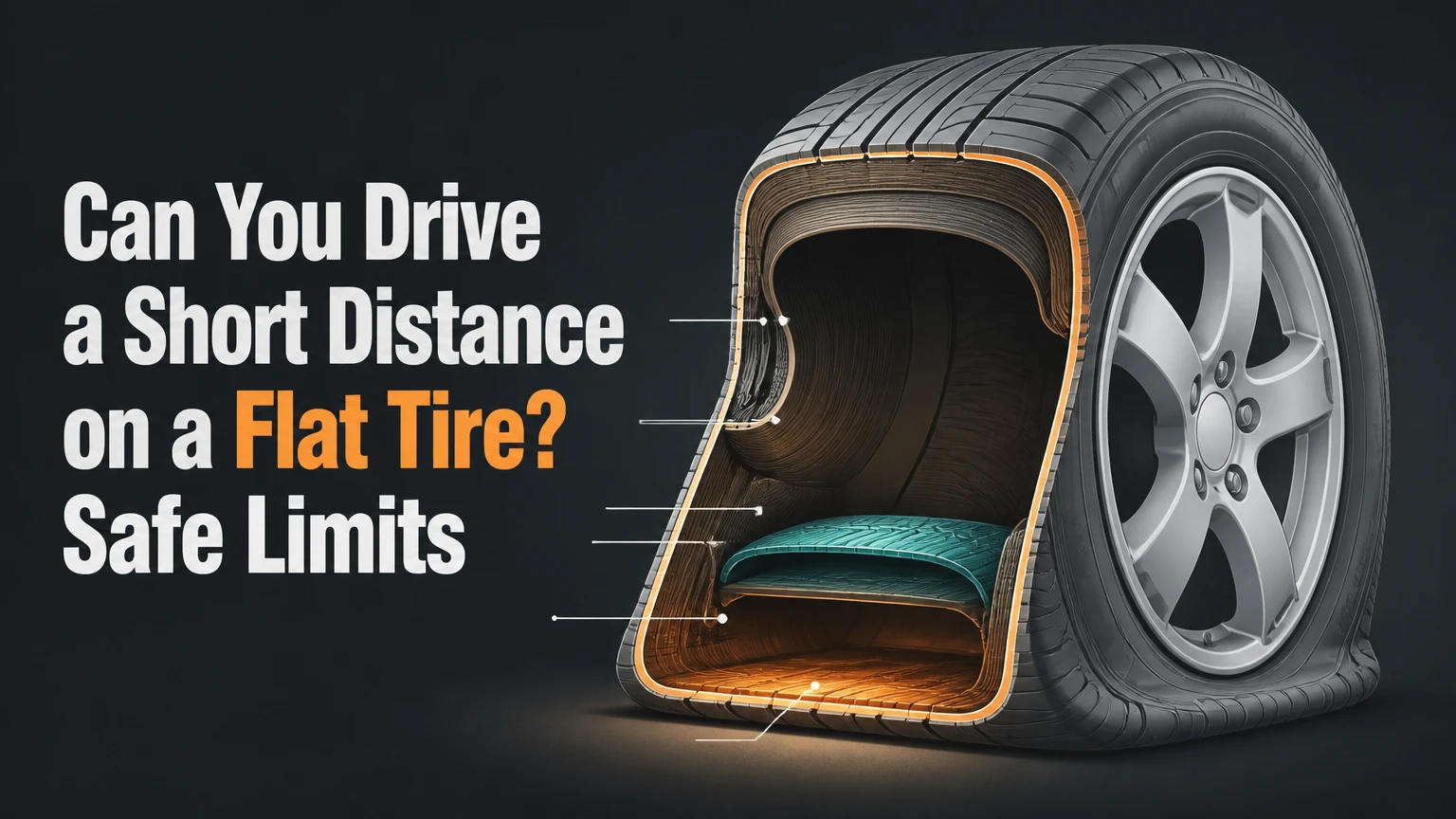
A flat tire loses the compressed-air support that normally carries much of the vehicle’s load, causing the sidewall to fold under the wheel. The folded rubber is pinched between the road and rim, which creates heat, tears internal cords, and can expose the wheel to direct impact.
The usual failure sequence is:
- Load transfer: The rim pushes downward into a tire that no longer holds its designed shape.
- Sidewall flexing: The unsupported sidewall bends sharply with every wheel rotation.
- Internal friction: Rubber layers and steel or textile cords rub and deform, generating heat.
- Casing separation: Internal components can shred or separate even when the exterior still appears intact.
- Rim contact: The wheel lip strikes the road, risking bends, cracks, and air-sealing damage.
- Vehicle instability: Steering response changes, particularly when the failed tire is on the front axle.
A tire can therefore be unsafe to repair after a short drive while appearing repairable from the outside. Tire technicians inspect the inner liner and sidewall after demounting the tire. A plug inserted from the outside cannot reveal internal run-flat damage.
What damage can driving cause?
| Component | Typical damage | Observable symptom | Usual consequence |
|---|---|---|---|
| Tire sidewall | Chafing, folding, cord separation | Gray or black abrasion dust | Tire replacement |
| Inner liner | Heat cracking or rubber granulation | Powder inside the casing | Tire replacement |
| Steel belts | Separation or distortion | Bulge, vibration, uneven tread | Tire replacement |
| Alloy wheel | Bent flange or crack | Slow leak, wobble, visible deformation | Wheel repair or replacement |
| Suspension | Overloaded bushing or impact damage | Pulling, clunking, uneven alignment | Inspection and possible repair |
| TPMS sensor | Impact or valve-stem damage | Missing or inaccurate pressure reading | Sensor or valve replacement |
What Should You Do When a Tire Goes Flat While Driving?
When a tire loses pressure in motion, keep the vehicle stable, reduce speed gradually, and stop at the first genuinely safe location. Hazard lights, gentle throttle release, and firm steering are safer than hard braking or a sudden lane change.
- Hold the steering wheel with both hands. Keep the vehicle pointed straight and expect heavier steering if a front tire failed.
- Switch on the hazard lights. Signal your reduced speed to traffic behind you.
- Release the accelerator gradually. Do not accelerate to reach a distant exit or use abrupt steering corrections.
- Avoid sudden braking. Brake gently only when necessary, because a failed tire can alter the vehicle’s braking balance.
- Choose the safest nearby refuge. A wide shoulder, parking lot, service road, or emergency pull-off is preferable to stopping beside fast traffic.
- Move only as far as necessary. Keep speed near walking pace, generally 5-10 mph, and avoid curbs or potholes.
- Secure the vehicle. Select park or first gear, apply the parking brake, turn on additional warning devices if available, and keep occupants away from traffic.
- Inspect without entering traffic. Look for a spare, compressor, or roadside-assistance contact, but do not crawl under a vehicle on an uncontrolled shoulder.
If the tire is flapping, the wheel is scraping, the car is difficult to control, or the shoulder is too narrow, do not drive to a safer location. Call emergency services if the vehicle creates an immediate collision hazard.
Should you stop immediately on a highway?
Stop at the first safe point, but do not choose an unsafe stopping position merely to avoid tire damage. A broad shoulder beyond a guardrail is usually safer than remaining in a live travel lane, while a narrow shoulder beside fast traffic may require emergency assistance to manage the scene.
The safest action varies by road design. Keep your seat belt fastened, remain inside with doors locked when leaving the vehicle would expose you to traffic, and follow local emergency guidance. Never stand between the disabled vehicle and moving traffic.
Which Tire Types Can Move After Pressure Loss?
Only tires specifically designed or equipped for pressure-loss operation should be driven beyond the minimum distance needed for safety. Run-flat tires use reinforced sidewalls or an internal support ring, while self-sealing tires use a sealant layer that addresses particular punctures rather than total structural failure.
| Tire type | Pressure-loss design | Typical operating limit | Main restriction | Service outcome |
|---|---|---|---|---|
| Standard pneumatic | Compressed air only | 0 planned miles | No safe extended travel when flat | Inspect before repair or replacement |
| Run-flat, reinforced sidewall | Self-supporting sidewall | 50 mph and 50 miles typical | Confirm vehicle and tire maker limits | Replace or inspect according to manufacturer |
| Run-flat, support ring | Internal mechanical support | Vehicle-specific | Requires compatible wheel system | Specialist inspection required |
| Self-sealing pneumatic | Sealant layer in tread area | Normal speed if pressure remains correct | Small tread punctures only | Check pressure and repair puncture |
| Temporary compact spare | Reduced-size pneumatic tire | Often 50 mph maximum | Limited distance and handling | Replace with full-size tire promptly |
Can you drive on run-flat tires?
A run-flat tire can usually be driven after a puncture, commonly for up to 50 miles at a maximum of 50 mph, but only when the tire manufacturer and vehicle manufacturer permit those limits. A driver must reduce speed, avoid hard cornering, and go directly to a qualified tire shop.
Run-flat performance depends on continued structural integrity. A severe pothole strike, sidewall split, overloaded vehicle, or extended driving beyond the warning limit can make the tire unsafe. Some vehicles require a functioning TPMS because the reinforced tire may feel almost normal while pressure is absent.
The 50-mile and 50-mph figures are common industry limits, not universal specifications. Bridgestone, Continental, Goodyear, Michelin, and vehicle manufacturers publish model-specific restrictions. Check the sidewall, owner’s manual, and dashboard warning before relying on any run-flat distance.
Is a self-sealing tire safe when it loses air?
A self-sealing tire is safe to continue driving only when the puncture has sealed and the tire retains the vehicle maker’s required pressure. The internal polymer layer commonly addresses small tread punctures, often around 3-5 millimeters, but it does not repair a sidewall cut, bead leak, valve failure, or large impact break.
Check the pressure with a gauge rather than trusting appearance. If pressure continues falling, inflate only if the tire has no visible structural damage and drive directly to service. A self-sealing layer does not turn a completely deflated conventional tire into a run-flat tire.
Can Adding Air Make a Flat Tire Drivable?
Adding air can make a tire temporarily drivable only when the tire has a slow tread puncture, no visible damage, and enough pressure to remain inflated after inspection. Air does not restore a tire that has been driven flat, has a torn sidewall, has separated belts, or has a damaged wheel.
Use this decision process:
- Visible nail in the tread, no bulge, pressure holds: Inflate to the door-placard pressure and drive directly to a tire shop.
- Sidewall cut, bulge, exposed cord, or torn bead: Do not inflate or drive; arrange towing or mobile service.
- Valve-stem leak: Inflate only for a controlled move if the valve holds pressure, then replace the valve or sensor.
- Pressure falls within minutes: Do not attempt a shop journey; the tire can collapse again in traffic.
- Tire was driven while completely flat: Request internal inspection after removal from the wheel.
A portable 12-volt compressor is useful for a low tire, not a substitute for a spare or tow service. Compressor operation also requires a safe location and a pressure gauge, because many inflators display approximate rather than calibrated readings.
What Does Flat-Tire Damage Cost?
Typical US consumer costs range from about $20 for a puncture repair to more than $1,000 for multiple tires, a wheel, and roadside recovery. Exact prices depend on tire size, vehicle class, region, run-flat construction, wheel material, and whether the damage occurred at night or on a highway.
| Service or part | Typical price range | Typical time | Main price variable |
|---|---|---|---|
| Tread puncture repair | $20-$40 | 20-45 minutes | Local shop policy and tire condition |
| Standard passenger tire | $100-$250 | 30-60 minutes | Size, brand, load and speed rating |
| Run-flat tire | $180-$450 | 45-90 minutes | Reinforced construction and size |
| Alloy wheel replacement | $250-$900 | 1-3 hours | OEM versus aftermarket wheel |
| Emergency tow | $75-$200 base | 30-120 minutes | Distance, location, and time of day |
| Mobile tire service | $100-$300 service fee | 30-90 minutes | Travel distance and after-hours coverage |
| Four-tire replacement | $500-$1,800 | 1-3 hours | Vehicle class and tire specification |
These are typical planning ranges, not a quote. Tire shops may refuse to repair a casing that traveled flat because internal damage cannot be confirmed safely without demounting and inspection.
Is a flat tire repairable after driving on it?
A puncture may be repairable if the tire retained enough pressure and the damage lies within the repairable tread area. A tire driven while flat is often replaced because sidewall flexing can damage internal cords and inner-liner rubber beyond what an exterior inspection reveals.
The Tire Industry Association’s accepted repair practice generally limits permanent repairs to the tread area and requires removal, internal inspection, and a combination patch-plug repair. An outside plug alone is not an adequate repair for many punctures, and no conventional repair restores a cut sidewall.
Can You Drive on a Temporary Spare?
A compact temporary spare can be driven only within its printed speed and distance limits, commonly 50 mph and roughly 50-70 miles. Temporary spares have different diameter, tread, load capacity, and handling characteristics, so they are intended to reach a repair facility rather than become a permanent wheel.
| Spare configuration | Common speed limit | Typical distance limit | Important limitation |
|---|---|---|---|
| Compact donut spare | 50 mph | 50-70 miles | Reduced grip and braking performance |
| Full-size matching spare | Vehicle speed limit | Manufacturer-specific | Check age, pressure, and tread |
| Full-size temporary spare | 50-70 mph | 50-200 miles | May differ in diameter or load rating |
| AWD compact spare | 50 mph | Manufacturer-specific | Drivetrain may require immediate service |
Check the spare’s sidewall for the actual limit. A compact spare on one axle can create a diameter mismatch that stresses an all-wheel-drive system, so consult the owner’s manual before fitting it. Inflate the spare to its specified pressure, which may be much higher than the normal tire’s pressure.
What If the Vehicle Has No Spare Tire?
A vehicle without a spare tire should be left stationary after a flat unless an undamaged tire can be safely reinflated and monitored. The practical alternatives are a roadside-assistance plan, manufacturer assistance, a compatible compressor and plug kit for permitted tread punctures, or a mobile tire technician.
Electric vehicles often omit spare tires to reduce mass and preserve cargo space, but EV weight makes correct load-rated replacement tires especially important. Do not fit a tire with an inadequate load index, and do not assume an EV’s sealant-and-compressor kit can handle sidewall damage.
Before a trip, verify four items:
- The roadside-assistance telephone number and coverage distance.
- The compressor’s power connector, operating time, and pressure range.
- The sealant kit’s expiration date and compatibility with the TPMS sensor.
- The tire shop or mobile service capable of supplying the vehicle’s exact size and load rating.
What Mistakes Make a Flat Tire Worse?
The most expensive mistake is treating a flat tire as a minor inconvenience rather than a structural failure. The following errors commonly convert a tire repair into a tire, rim, and suspension bill.
- Driving to a distant repair shop: A one-mile trip can destroy the casing and bend a low-profile alloy wheel.
- Following the TPMS light without checking pressure: A solid warning requires immediate measurement; a flashing warning can indicate a TPMS system fault, but the tire still needs inspection.
- Using aerosol sealant on a sidewall: Sealant products are designed for limited tread punctures and cannot repair cuts or bead damage.
- Braking hard during a blowout: Sudden braking can shift vehicle balance; controlled deceleration preserves steering authority.
- Ignoring a steering pull: A severe pull may indicate a front-tire failure, wheel damage, or suspension problem.
- Installing one mismatched tire on an AWD vehicle: Circumference differences can stress differentials and manufacturer-monitored drivetrains.
- Placing a jack on an unstable shoulder: A jack can sink or tip, creating a crush hazard before the tire is removed.
A tire that looks inflated after using sealant still requires professional inspection. Sealant can interfere with pressure sensors and may conceal continuing air loss.
How Do You Decide Between Repair, Replacement, and Towing?
Choose repair only for an eligible tread puncture that has not been driven flat; choose replacement for structural damage or run-flat abuse; choose towing whenever the vehicle cannot reach a safe area without extended movement. The correct decision depends more on casing condition and wheel safety than on the puncture’s visible size.
| Finding after pressure loss | Drive farther? | Likely service | Inspection requirement |
|---|---|---|---|
| Nail in central tread, pressure stable | Directly to shop after inflation | Internal patch-plug repair | Remove tire and inspect liner |
| Nail near shoulder, pressure falling | No | Tire replacement likely | Measure puncture location and casing damage |
| Sidewall slash or bulge | No | Tire replacement | Inspect wheel and suspension |
| Run-flat driven within limits | Directly to approved shop | Manufacturer-directed inspection | Confirm mileage, speed, load, and heat exposure |
| Bent alloy rim with intact tire | No | Wheel repair or replacement | Check bead seat and alignment |
| Tire driven fully deflated | No planned travel | Replacement commonly required | Demount and inspect internal layers |
Do not let a shop repair a tire solely because the puncture can be plugged from outside. Ask whether the tire was driven underinflated, whether the inner liner was examined, and whether the proposed repair meets the shop’s tire-industry procedure.
What Should You Check After Installing a Replacement?
After a tire change, confirm inflation, wheel-fastener torque, TPMS operation, and vehicle tracking before returning to normal speed. A flat-tire event can damage a wheel or alignment component even when the replacement tire fits correctly.
Check the following:
- Set cold pressure to the driver-door placard specification.
- Tighten wheel nuts to the vehicle manufacturer’s torque value.
- Confirm the TPMS warning clears after the required relearn procedure.
- Inspect the removed wheel for cracks, bends, and damaged valve hardware.
- Drive slowly in a controlled area and check for vibration or steering pull.
- Recheck pressure after the tire cools and again the next morning.
- Replace a temporary spare with the correct full-size tire promptly.
A vibration above approximately 40-50 mph, a new pull, or repeated pressure loss requires another inspection. Wheel imbalance, bent rims, alignment changes, and suspension damage can appear only after the flat tire has been replaced.
FAQ
Can a car sit overnight with a flat tire?
A car can sit overnight on a flat tire without automatically damaging its suspension, but the tire sidewall and wheel remain vulnerable to additional load and movement. Park on stable, level ground, avoid driving the vehicle even a few feet, and arrange repair or towing. Inflate only after checking for cuts, bulges, and bead damage.
Can I drive after inflating a tire with a nail?
You may drive directly to a tire shop after inflating a tire with a nail when the puncture is in the central tread, the tire has no bulge or sidewall damage, and pressure remains stable. Do not remove the nail before service. Check pressure again before moving and stop if the tire loses air.
Should I replace one tire or two?
Replace one tire only when the remaining tire on that axle has comparable tread depth, specification, and age, and the vehicle manufacturer permits that arrangement. Replace two tires when tread wear differs materially, mounting the new pair on the rear axle in most vehicles unless manufacturer guidance says otherwise.
Can an AWD vehicle use one new tire?
An AWD vehicle may use one new tire only when its manufacturer allows the resulting circumference difference. Some AWD systems specify a very small tread-depth variation, such as 2/32 inch, while others require a matched set. Ask a dealer or tire specialist to measure all four tires before ordering one replacement.
Is a blinking TPMS light more serious than a solid light?
A solid TPMS light usually indicates low pressure in at least one tire, while a blinking light for about 60-90 seconds followed by a steady warning often indicates a sensor or system fault. Neither pattern proves the tire is safe. Measure every tire with a gauge and inspect for physical damage.
Can I use Fix-a-Flat on a completely flat tire?
Fix-a-Flat and similar aerosol products are not reliable repairs for a completely flat tire, sidewall damage, bead leaks, or a large puncture. The product may temporarily inflate or seal a small tread puncture, but the tire still needs professional inspection, and the product may affect TPMS servicing.