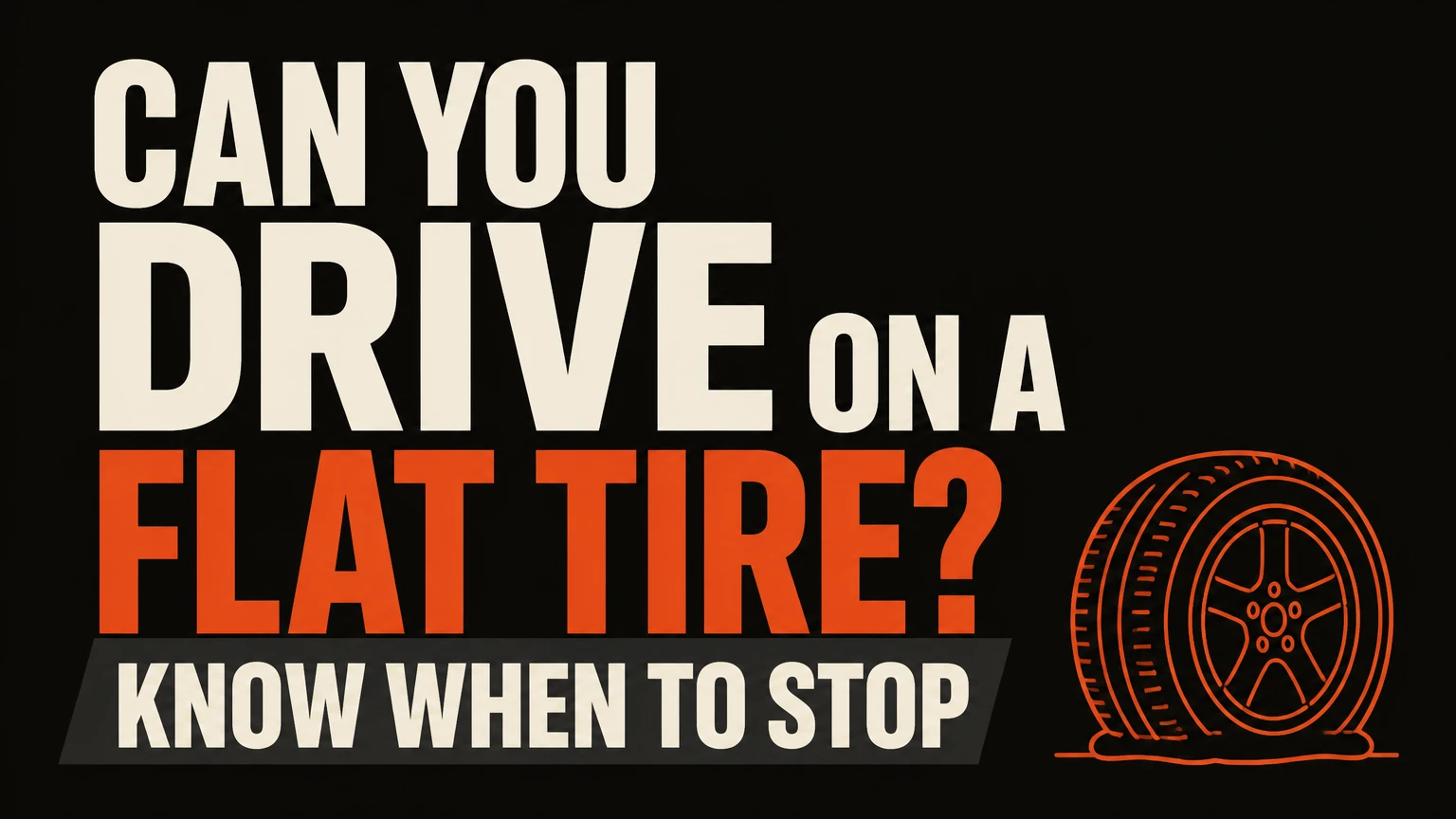
You should not drive on a flat tire except for the few meters needed to escape an immediate traffic hazard. A standard flat tire can lose its sidewall, internal belts, and bead support within a short distance, while the exposed wheel can damage the rim and suspension. Stop safely, switch to a spare, inflate and inspect the tire, or call roadside assistance.
Key Facts at a Glance
- A standard tire with little or no air should not be driven to a repair shop.
- A slow leak may permit a short trip only after inflation and a pressure check.
- Driving on a flat tire can destroy a repairable puncture and bend or crack the wheel.
- A run-flat tire may travel under restricted conditions, but its limit is manufacturer-specific.
- A tire sealant kit works only for certain small tread punctures and cannot repair sidewall damage.
- If the vehicle is stopped in a live traffic lane, moving to safety can be safer than remaining stationary.
What Counts as a Flat Tire?
A flat tire is a pneumatic tire that has lost enough air pressure to collapse or stop supporting the vehicle correctly. A tire can be technically flat at 0 psi, visibly collapsed at very low pressure, or dangerously underinflated while still appearing normal from outside.
A low-pressure tire and a fully flat tire are related but require different decisions. A tire at 24 psi when the door-jamb label specifies 35 psi may have a slow leak and could be reinflated for inspection. A tire with a visibly folded sidewall, exposed rim, severe pull, or repeated pressure loss should not be driven.
| Condition | Typical pressure state | Visible or driving symptom | Correct next action |
|---|---|---|---|
| Correct inflation | 30-40 psi on many passenger cars | Normal steering and tread shape | Continue driving and check monthly |
| Low pressure | 20-29 psi | TPMS warning, softer steering, uneven wear | Inflate to the door-label pressure and inspect |
| Severe underinflation | 5-19 psi | Heavy steering, tire bulge, heat risk | Stop driving and arrange inspection |
| Fully flat | 0-4 psi | Collapsed sidewall, rim close to pavement | Do not drive except to escape danger |
| Blowout | Rapid pressure loss | Bang, pull, flapping rubber, debris | Control vehicle, slow gradually, stop safely |
The correct reference pressure appears on the driver’s door placard or vehicle handbook, not on the maximum-pressure marking molded into the tire sidewall. Tire pressure should be checked with a gauge when the tire is cold, because driving heat raises the reading.
Why Is Driving on a Flat Tire Dangerous?
Driving on a flat tire removes the air cushion that carries the vehicle’s load. The sidewalls then flex sharply between the wheel rim and road, producing heat and mechanical damage while reducing the tire’s ability to transmit steering and braking forces.
A conventional passenger tire is designed to operate with its specified internal pressure. When pressure disappears, the sidewall folds and the rim compresses the lower section of the casing. The internal liner can tear, steel or textile cords can separate, and the bead can unseat from the wheel.
Heat makes the failure faster. Repeated flexing creates friction inside the sidewall, so a tire that looks repairable from the outside may contain hidden rubber dust, cord damage, or belt separation. A tire technician must inspect the inside after any meaningful distance driven underinflated.
Handling also changes. A front flat often creates steering pull and heavier steering effort; a rear flat may feel like fishtailing or instability during lane changes. Electronic stability control can reduce some vehicle motion, but it cannot restore the tire’s lost structure or grip.
How Much Damage Can a Flat Tire Cause?
A flat tire can suffer irreversible internal damage before a driver reaches a nearby workshop. No universal safe mileage exists because vehicle load, speed, tire construction, road temperature, wheel size, and the remaining pressure all change the outcome.
A slow roll of several meters may leave the tire usable, but even that movement is a risk if the sidewall is already crushed. A claim that a flat tire is safe for a fixed distance, such as 200 meters, is not a general engineering limit. That distance may be an emergency relocation guideline, not a tire-preservation allowance.
The wheel can also become damaged. A bent lip may cause continuing air loss, while a cracked alloy wheel can create a sudden failure later. Driving over potholes on a flat tire increases the chance of damage to the wheel, wheel bearing, brake components, and suspension.
Can You Drive on a Flat Tire to a Shop?
You should not drive a standard flat tire to a shop, even if the shop is nearby. Inflate the tire only if the damage appears minor and the tire holds pressure, then drive directly for inspection; otherwise use a spare tire or roadside recovery.
The practical exception is a dangerous stopping position. If the car is partly in a traffic lane, on a narrow motorway shoulder, or near a blind bend, moving a very short distance at walking speed may reduce immediate collision risk. Use hazard lights, keep both hands on the wheel, avoid sudden braking, and stop at the first safer location.
Do not treat the emergency movement as permission to continue several kilometers. If the tire makes a flapping, grinding, or rhythmic thumping sound, stop immediately because the casing may be disintegrating.
What Should You Do on a Highway?
A highway flat tire requires traffic protection before tire repair. The safest sequence is:
- Hold the steering wheel firmly and keep the vehicle pointed straight.
- Release the accelerator gradually rather than making a sudden steering correction.
- Avoid hard braking while the vehicle is unstable.
- Turn on hazard lights and signal toward the shoulder.
- Move only far enough to reach a wide, visible, firm stopping area.
- Stop, apply the parking brake, select Park, and switch off the engine.
- Exit on the side away from traffic only when that movement is safer.
- Call roadside recovery and provide the highway direction, lane, exit, and vehicle location.
Passengers should remain behind a barrier when a safe barrier exists. Do not stand beside the vehicle, place yourself between the car and traffic, or attempt a wheel change in a narrow live shoulder.
What Are the Immediate Steps After a Flat?
The immediate response to a flat tire is to stabilize the vehicle, confirm the hazard, and prevent further movement. The required tools are a safe stopping area, warning lights, a pressure gauge or TPMS reading, and either a serviceable spare or roadside assistance.
Step 1: Confirm the Tire Problem
Look for a collapsed sidewall, visible puncture, loose rubber, or a wheel sitting unusually low. A TPMS warning confirms abnormal pressure in many vehicles, but it does not reveal whether the cause is a nail, valve failure, sidewall tear, or wheel damage.
Do not pull a penetrating object from the tread before inspection. Removing a nail can turn a slow leak into a rapid leak.
Step 2: Secure the Vehicle
Park on firm, level ground where possible. Apply the parking brake, select Park in an automatic vehicle, and select first or reverse gear in a manual vehicle.
A jack is not a substitute for a stable surface. Gravel, soft soil, grass, and sloped shoulders can allow a jack to slip or sink, causing vehicle damage or serious injury.
Step 3: Choose a Recovery Method
Use the spare tire when the location is safe and the vehicle manufacturer permits the change. A temporary “donut” spare commonly carries a lower speed limit, often 80 km/h, and a restricted distance that must be confirmed on its sidewall or in the handbook.
Use an inflator only when the tire has a slow leak and no visible structural damage. Inflation can restore temporary support, but it does not repair a cut sidewall or a separated belt.
Step 4: Recheck Before Moving
After installing or inflating a tire, verify pressure with a gauge and check that the wheel nuts are seated. If a spare is fitted, drive directly to a tire professional and avoid heavy loads, high speed, and extended travel.
You will know the vehicle is ready for a cautious trip only when the tire holds the specified pressure, the wheel is secure, and steering feels normal. Any vibration, pull, or continuing pressure loss requires another stop.
Which Tire Types Can Move Without Air?
Only tires specifically engineered for limited zero-pressure operation can normally move without air. Standard tires, reinforced tires that are not run-flats, and temporary spares do not gain run-flat capability merely because their sidewalls look stiff.
| Tire type | Structural support without air | Typical restricted limit | Repair position | Main limitation |
|---|---|---|---|---|
| Standard radial tire | Air pressure only | 0 km at normal road speed | Tread puncture may be repairable | Sidewall damage occurs rapidly |
| Run-flat tire | Reinforced sidewall or support ring | Up to 80 km at up to 80 km/h on many models | Manufacturer and inspection dependent | Heat and distance limits vary |
| Self-sealing tire | Sealant layer inside tread | Normal driving only while seal holds | Professional inspection required | Larger or sidewall cuts remain unsafe |
| Temporary spare | Reduced-size casing and air pressure | Often 80 km/h maximum | Not a permanent repair | Limited distance and handling |
| Full-size spare | Normal tire structure | Vehicle and tire specification | Replace or repair removed tire | Must be inflated and compatible |
Run-flat limits are not universal. Bridgestone, Michelin, Continental, and vehicle manufacturers publish different restrictions by tire model, load, ambient temperature, and damage type. The owner’s manual and tire sidewall take priority over a generic 80 km or 80 km/h rule.
How Do Run-Flat Tires Work?
Run-flat tires use reinforced sidewalls or an internal support system to carry the vehicle after pressure loss. The design preserves limited mobility, but it does not preserve ordinary handling, braking, tire life, or unlimited distance.
A functioning TPMS is particularly important because a run-flat may look acceptable while operating at zero pressure. Drivers should reduce speed, avoid abrupt maneuvers, and travel directly to an approved tire facility within the published limit.
A run-flat that has been driven while deflated may require replacement even when no external damage is visible. Some manufacturers permit repair after a controlled pressure loss; others prohibit repair after any zero-pressure operation.
Standard Tires Versus Run-Flats: Which Is Safer?
Run-flat tires provide a safety advantage during a puncture because they can carry the vehicle to a safer stopping place. Standard tires usually cost less and can offer a more compliant ride, but they require an immediate stop after a serious pressure loss.
| Decision factor | Standard tire | Run-flat tire | Practical winner |
|---|---|---|---|
| Zero-pressure mobility | 0 km recommended | Often 80 km maximum | Run-flat |
| Maximum restricted speed | Normal pressure required | Often 80 km/h | Run-flat |
| Replacement cost | Typical baseline | Often 20-50% higher | Standard |
| Ride comfort | Softer sidewall response | Firmer response | Standard |
| Puncture repair | Tread puncture often repairable | Model-dependent | Standard |
| Spare-tire dependence | Usually higher | Often lower | Run-flat |
| TPMS importance | Helpful | Essential for timely warning | Standard for simplicity |
| Wheel protection after pressure loss | Low | Better, within limits | Run-flat |
Run-flats are not ideal for every driver. A driver who prioritizes low replacement cost and comfortable ride quality may prefer standard tires with a full-size spare. A driver who frequently travels isolated roads or fast highways may value limited mobility to reach safety.
Can a Flat Tire Be Repaired?
A flat tire may be repaired when the damage is a small puncture in the central tread, the casing has not been driven severely underinflated, and the tire meets the manufacturer’s repair criteria. Sidewall, shoulder, bead, belt, and large puncture damage generally require replacement.
The U.S. Tire Manufacturers Association describes permanent repair as a process that combines an interior patch with a rubber stem or plug-patch after the tire is removed for inspection. An external rope plug alone is a temporary roadside measure, not an equivalent permanent repair.
| Damage type | Typical size or location | Repair likelihood | Required service |
|---|---|---|---|
| Nail in center tread | About 6 mm or less | Often repairable | Remove tire, inspect, patch-plug |
| Screw near shoulder | Within shoulder ribs | Usually not repairable | Replace tire |
| Sidewall cut | Any visible cord exposure | Not repairable | Replace tire |
| Bead leak | Wheel-to-tire sealing edge | Depends on wheel and bead | Dismount, clean, inspect |
| Belt separation | Bulge or vibration | Not repairable | Replace tire and inspect wheel |
| Run-flat driven flat | Distance varies by model | Manufacturer-dependent | Specialized inspection |
A tire shop should inspect the inside, measure puncture size and location, examine the wheel, and check the remaining tread. Replacing one tire can create tread-depth differences, which matter on some all-wheel-drive vehicles.
How Much Does Flat-Tire Recovery Cost?
Typical flat-tire costs range from about $20-$60 for a simple puncture repair in many markets, while replacement, mobile service, towing, and wheel damage can raise the total substantially. Local labor rates, tire size, vehicle type, taxes, and after-hours fees determine the final price.
The figures below are planning ranges rather than universal prices. A specialty performance tire, a large SUV tire, or a remote motorway call can cost more.
| Service or part | Typical price range | Typical time | Main cost variable |
|---|---|---|---|
| Pressure check and inflation | $0-$15 | 5-10 minutes | Shop policy |
| Tread puncture repair | $20-$60 | 30-45 minutes | Tire removal and local labor |
| Standard replacement tire | $80-$300 | 45-90 minutes | Size, brand, load rating |
| Run-flat replacement | $150-$500 | 45-90 minutes | Model and fitment |
| Mobile roadside fitting | $50-$150 plus parts | 30-90 minutes | Distance and time of day |
| Towing or recovery | $75-$250 | 30-120 minutes | Location and mileage |
| Alloy wheel repair | $100-$250 | 1-3 hours | Crack, bend, and wheel material |
Replacing a tire may be cheaper than repairing secondary damage. Continuing on a flat can convert a $30 puncture repair into a replacement tire, wheel repair, and recovery bill.
Are Tire Sealant and Air Compressors Safe Alternatives?
Tire sealant and a 12-volt compressor are useful for limited emergencies, not substitutes for a spare or professional inspection. Sealant generally suits small tread punctures, while a compressor can restore pressure only if the tire remains structurally intact.
Read the vehicle handbook before using sealant. Some products can interfere with TPMS sensors, have an expiration date, and require a maximum driving speed or distance printed on the container.
Do not use sealant for a sidewall cut, a separated tread, a bead failure, or a tire that has been driven while collapsed. Tell the tire technician that sealant was used because residue can affect inspection and cleaning.
What Mistakes Make a Flat Tire Worse?
The most expensive mistake is driving farther after the vehicle has reached a safe stopping place. A driver may save a few minutes but destroy the casing, bend the wheel, and make a repair impossible.
Avoid these failure modes:
- Driving on the shoulder to a service station: Use the shoulder only to reach the nearest safe stopping area, then call recovery.
- Relying on the TPMS light alone: Check pressure with a gauge because warning thresholds vary and sensors do not identify structural damage.
- Inflating a visibly damaged tire: Do not add air to a tire with a cut sidewall, exposed cord, bulge, or loose tread.
- Changing a tire beside fast traffic: Wait for professional recovery if the shoulder is narrow, dark, sloped, or unsafe.
- Using the wrong jack point: Follow the vehicle handbook because pinch welds and reinforced lift points differ by model.
- Leaving a temporary spare installed for weeks: Replace it with the correct tire promptly and check its pressure monthly.
One counterintuitive rule matters: a tire that holds air after a flat is not automatically safe. Internal damage from driving underinflated can remain invisible until heat and speed trigger a later failure.
How Can You Prevent a Flat-Tire Emergency?
Monthly pressure checks reduce the chance of unnoticed underinflation, and a cold pressure check before long trips catches slow leaks before they become roadside failures. The vehicle door placard provides the correct pressure for the installed load and tire configuration.
Keep the spare inflated, inspect its age and tread, and confirm that the jack, wrench, locking-nut key, and towing eye are present. A practical roadside kit includes a pressure gauge, 12-volt compressor, reflective vest, warning triangle, gloves, flashlight, and phone charger.
Inspect tires for embedded objects, cracks, bulges, uneven wear, and tread below the legal or manufacturer limit. Rotate tires according to the vehicle schedule, and have persistent pressure loss checked at the valve, bead, wheel, and tread rather than repeatedly adding air.
FAQ
Can I drive one mile on a flat tire?
Driving one mile on a standard flat tire is not considered safe. The distance can destroy the sidewall and damage the wheel, even at low speed. Move only far enough to escape immediate danger, then use a spare, mobile tire service, or towing.
Can I drive with a nail in my tire?
You may be able to drive a short distance to a tire shop if the nail is in the central tread, pressure remains near specification, and the tire has not collapsed. Do not remove the nail before inspection, and stop if pressure falls or handling changes.
Is it safe to leave a flat tire overnight?
Leaving a vehicle parked overnight with a flat tire is safer than driving it, provided the vehicle is in a secure legal parking position. Avoid moving the car later until the tire is inflated and inspected, because the rim may be supporting the vehicle’s weight.
Can I drive with a flat tire on an all-wheel-drive vehicle?
Do not drive a standard flat tire on an all-wheel-drive vehicle. AWD systems can be sensitive to tire circumference differences, and driving may damage the tire, wheel, or drivetrain. Use the specified spare procedure and ask the manufacturer about tread-depth matching.
Does a flat tire always need replacement?
A flat tire does not always need replacement. A small central-tread puncture can often receive a permanent internal patch-plug after inspection, but sidewall damage, belt separation, bead damage, and severe underinflation usually make replacement necessary.
What if the tire is flat but the rim is not touching the ground?
Do not assume clearance makes driving safe. A partially supported tire can still have damaged cords and unstable handling. Inflate only if there is no visible structural damage, confirm that pressure holds, and drive directly to inspection rather than continuing normally.
The Bottom Line
Can you drive on a flat tire? With a standard tire, no, except for the minimal distance required to leave an immediate traffic hazard. Stop safely, protect passengers from traffic, and choose a spare, controlled inflation followed by inspection, mobile tire repair, or roadside recovery. A run-flat tire is the only common exception, and its speed and distance limits come from the tire and vehicle manufacturer.