Yes, you can drive on a spare tire, but a compact spare is an emergency replacement designed for a short, slow trip to a tire shop. Follow the spare’s sidewall limit and your owner’s manual, commonly no more than 50 mph and approximately 50 miles. A full-size matching spare may be used longer, but it still requires correct pressure, tread, and vehicle compatibility.
Key Facts at a Glance
- A donut spare commonly carries a maximum speed of 50 mph, or 80 km/h, and a typical distance guideline of about 50 miles, or 80 km.
- The spare-tire sidewall and vehicle owner’s manual control when their limits differ from general guidance.
- A compact spare can reduce braking, cornering, wet-weather grip, and emergency-maneuver capability.
- AWD and four-wheel-drive vehicles may require closely matched tire diameters, not merely a wheel that fits the hub.
- Never drive on a spare with zero pressure, visible damage, a cracked sidewall, or a loose wheel.
- Replace or repair the damaged tire as soon as practical, preferably the same day.
Can You Drive on a Spare Tire?
You can drive on a spare tire only as a temporary measure, and the safest destination is the nearest suitable tire repair or replacement facility. A compact spare restores basic mobility, but its smaller tread, different construction, and altered rolling diameter can change vehicle handling and stress the differential.
The 50-mph and 50-mile figures are common operating limits, not universal permissions. Some vehicles specify a lower speed, a shorter distance, a particular axle, or no compact-spare use on AWD systems. The yellow or red warning label on the spare and the owner’s manual take priority over generic advice.
A spare tire is not equivalent to the original tire. It may have less tread width, a higher inflation pressure, a lighter carcass, and a different speed rating. Those differences matter most during hard braking, abrupt lane changes, standing water, gravel, snow, and high-speed motorway travel.
How does a compact spare affect the drivetrain?
A compact spare usually has a smaller rolling circumference, so that wheel rotates more times per mile than the full-size tires. On a driven axle, the differential absorbs the speed difference; on AWD vehicles, the center coupling or transfer case may also respond to the mismatch.
The risk is not identical for every car. A small difference over a short distance may fall within the manufacturer’s tolerance, while a larger mismatch or extended driving can create heat and wear. Tire manufacturers and vehicle makers therefore publish model-specific restrictions rather than one safe universal distance.
How Far and How Fast Can You Drive?
A compact spare commonly permits up to 50 mph and about 50 miles, but the precise limit comes from the sidewall and owner’s manual. Treat those numbers as an outer emergency boundary, not a target: drive only far enough to reach a safe repair location.
| Spare situation | Typical maximum speed | Typical distance guidance | Correct action |
|---|---|---|---|
| Compact temporary spare | 50 mph / 80 km/h | About 50 miles / 80 km | Drive directly to a tire shop |
| Manual specifies lower limit | 40-45 mph / 64-72 km/h | 25-50 miles / 40-80 km | Follow the manual exactly |
| Full-size matching spare | Vehicle-rated speed | No temporary-distance limit | Inspect and use as a normal tire if approved |
| Full-size non-matching spare | Manufacturer-specific | Manufacturer-specific | Confirm diameter, axle, and drivetrain rules |
| Zero-pressure or damaged spare | 0 mph | 0 miles | Tow the vehicle or replace the spare |
Speed amplifies heat and handling problems. A donut that feels manageable at 35 mph can become unstable during a 55-mph merge, especially when the road is wet or the vehicle is heavily loaded.
Distance also includes the route to the shop, not merely highway mileage. A 20-mile trip involving steep grades, snow, or a heavily loaded SUV may be more demanding than 45 miles on a dry, level road at moderate speed.
What changes the safe distance?
Road temperature, vehicle load, tire pressure, drivetrain layout, and the spare’s age all change the practical risk. A compact spare stored for eight years may have acceptable pressure but degraded rubber, while an underinflated spare can overheat before reaching the printed distance.
Avoid towing a trailer, carrying unusually heavy cargo, or making unnecessary stops and detours. If the tire shop is beyond the stated limit, arrange roadside assistance or a flatbed tow rather than treating the limit as negotiable.
Which Spare Tire Type Do You Have?
The spare type determines whether the tire is an emergency mobility device or a potentially normal replacement. Identify the wheel by reading its sidewall, checking the tread width and diameter, and consulting the vehicle’s equipment list.
| Spare type | Construction and use | Main limit | Best practical use |
|---|---|---|---|
| Compact donut | Narrow temporary radial tire | Usually 50 mph and 50 miles | Short trip to repair facility |
| Full-size matching | Same diameter, size, tread, and load rating | Vehicle-specific | Normal driving after pressure check |
| Full-size non-matching | Full-diameter tire with different tread or specification | Axle and drivetrain restrictions | Temporary use after manual confirmation |
| Run-flat | Reinforced sidewall supports vehicle after pressure loss | Commonly 50 mph and 50 miles | Reach a tire facility without changing wheels |
| Tire sealant kit | Liquid sealant and compressor, no replacement wheel | Puncture and product restrictions | Small tread puncture, not sidewall damage |
Is a full-size spare always safe for unlimited driving?
A full-size spare is suitable for normal use only when its size, load index, speed rating, tread condition, and wheel specification match the vehicle’s requirements. A full-size tire with a different circumference can still damage an AWD system or create handling imbalance.
The tire’s age also matters. The National Highway Traffic Safety Administration recommends checking tire age and following the vehicle and tire manufacturer’s replacement guidance; many manufacturers recommend replacement around six to ten years from manufacture, even when tread remains.
Find the DOT code on the sidewall. The final four digits identify the production week and year, so “2319” means the 23rd week of 2019. A stored spare also needs inspection for cracking, bulges, corrosion around the bead, and pressure loss.
Are run-flat tires the same as spare tires?
Run-flat tires are not spare tires, although they provide a similar emergency-mobility function. Bridgestone, Michelin, and other manufacturers commonly limit a damaged run-flat to approximately 50 mph and 50 miles, with exact limits varying by tire and vehicle.
Run-flats require a functioning tire-pressure monitoring system because the reinforced sidewall can hide the normal feel of a deflated tire. A run-flat may be unrepairable after driving without pressure, depending on its internal damage and the manufacturer’s policy.
How Should You Drive on a Donut?
Drive a compact spare below its printed maximum, use gentle steering and braking, and travel directly to a tire facility. Leave extra following distance, avoid standing water, and do not use cruise control when changing speed or road conditions could require a sudden maneuver.
Use the right lane where practical, but do not create a dangerous speed differential on a high-speed road. Turn smoothly, accelerate gradually, and avoid potholes because the temporary tire’s narrow tread and limited sidewall capability reduce control margins.
The most important rule is to reduce exposure. A donut is for reaching help, not for completing a holiday, commuting for a week, or testing how long it will last.
Can you drive on a spare tire in rain or snow?
You can sometimes drive a short distance in light rain, but a compact spare has reduced wet grip and should be driven more slowly than the sidewall maximum. Snow, ice, flooding, and heavy rain can make towing safer because the spare may not provide balanced traction.
Avoid sudden braking on a slippery surface. Electronic stability control and ABS can help, but they cannot create tread grip where the temporary tire has little contact area or a different compound.
Can you drive on a spare tire overnight?
You can drive overnight only when the route is short, the road is dry and safe, the spare is correctly inflated, and the vehicle manual permits that use. Darkness adds visibility risk, while remote roads, wildlife, unlit shoulders, and long distances favor roadside assistance or towing.
If the nearest open tire shop is closed, park safely and arrange service for the next available period. Do not convert a temporary spare into a multi-day solution merely because the vehicle still moves.
How Do You Install a Spare Tire Safely?
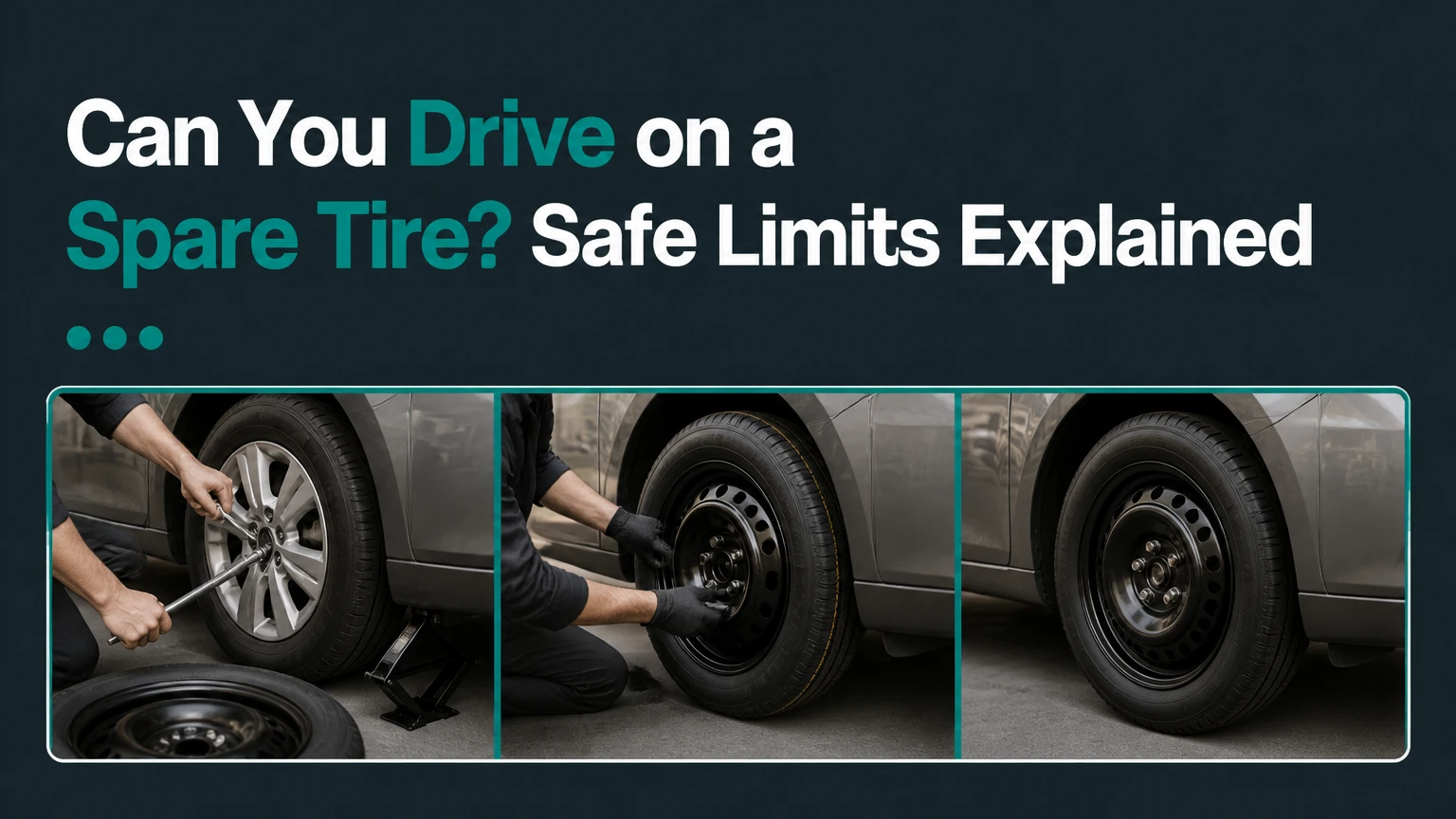
Install the spare on level ground away from traffic, then verify its pressure and wheel torque before driving. The complete process commonly takes 20-30 minutes, but roadside safety matters more than speed.
What to check before lifting the vehicle
- Move passengers away from traffic and switch on hazard lights.
- Apply the parking brake and select Park or first gear.
- Use wheel chocks if available, placing them on the opposite side from the flat.
- Confirm the jack’s lift point in the owner’s manual.
- Keep the spare, jack, wrench, and locking-wheel-nut key accessible.
- Do not work on soft soil, a live traffic lane, or a slope.
Step 1: Loosen the wheel nuts
Loosen each lug nut about one-half turn while the flat tire remains on the ground. Do not remove the nuts yet, because the tire’s contact with the surface prevents the wheel from rotating.
Step 2: Raise the vehicle at the approved point
Position the jack under the manufacturer-designated lift point and raise the vehicle until the flat tire clears the ground by roughly 1-2 inches. Never place any part of your body under a vehicle supported only by the emergency jack.
Step 3: Mount the spare
Remove the loosened nuts, pull the damaged wheel straight off, and place the spare on the hub. Hand-thread every nut before using the wrench, since cross-threaded studs can require expensive repair.
Step 4: Tighten and lower the vehicle
Snug the nuts in a star or crisscross sequence, lower the vehicle until the tire contacts the ground, and tighten them again in the same sequence. Use a torque wrench when available and apply the torque specified by the vehicle manufacturer, often approximately 80-110 lb-ft for passenger cars but not universally.
Step 5: Check pressure, warnings, and clearance
Measure the spare with a reliable gauge before driving. Compact spares often require roughly 60 psi, far higher than the door-jamb pressure for ordinary tires, but the sidewall value controls.
After installation, confirm that the wheel is not rubbing the brake caliper, suspension, or body. Drive a few yards, stop in a safe location, and recheck for looseness, vibration, or unusual pulling.
Where Should the Spare Go?
The correct spare position depends on vehicle configuration and manufacturer instructions, but many manufacturers prefer the temporary spare on the rear axle when possible. A front-mounted donut can reduce steering and braking performance, especially on a front-wheel-drive vehicle.
If the flat is on the front and the vehicle manual permits it, a common procedure is to move a full-size rear tire to the front and install the donut on the rear. This adds work and is not appropriate for every wheel, brake, or drivetrain design, so the manual must be checked first.
| Vehicle configuration | Typical concern | Common manufacturer approach | Do not assume |
|---|---|---|---|
| Front-wheel drive | Front steering and drive traction | Place compact spare on rear if permitted | Every front tire can accept a donut |
| Rear-wheel drive | Rear propulsion and stability | Follow axle and speed instructions | Rear placement is always harmless |
| AWD | Circumference mismatch | Use matching tire or tow if restricted | A full-size tire automatically matches |
| 4WD with selectable modes | Transfer-case stress | Follow 2WD and 4WD manual rules | Driving mode cancels tire mismatch |
| Performance vehicle | Brake clearance and handling | Use approved wheel and tire only | Any same-diameter wheel fits |
AWD owners should measure tread depth and compare rolling circumference when the manual provides a tolerance. Discount Tire notes that AWD systems can require closely matched tire circumferences, but the acceptable difference is vehicle-specific rather than a universal percentage.
What Problems Can a Spare Tire Cause?
A temporary spare can cause longer stopping distances, steering pull, wheel-speed warnings, drivetrain heat, uneven handling, or tire failure when driven beyond its design limits. The most serious risks arise when drivers combine excessive speed, low pressure, heavy load, and a mismatched driven wheel.
| Symptom after installation | Likely cause | Immediate response | Can you continue? |
|---|---|---|---|
| Vehicle pulls strongly | Different tire grip or pressure | Slow down and stop safely | Only after pressure and fit check |
| Steering wheel vibration | Loose nuts, bent wheel, imbalance | Stop and inspect torque | No if vibration persists |
| ABS or traction warning | Wheel-speed mismatch | Drive cautiously if manual allows | Stop if braking feels abnormal |
| Grinding or rubbing | Incorrect wheel or brake clearance | Stop immediately | No |
| Tire-pressure warning | Low spare pressure or TPMS mismatch | Measure with gauge | No if pressure is low |
| Spare loses air | Puncture, valve leak, old rubber | Stop before rim damage | No |
An ABS or traction-control warning can occur because the compact spare rotates at a different speed, but the warning is not automatically harmless. If the brake pedal feels different, the car pulls violently, or multiple warning lights appear, stop and request professional assistance.
What if the spare tire is flat?
Do not drive on a flat spare, even for a short distance. A deflated tire can unseat from the rim, destroy the wheel, damage the tire-pressure sensor, and reduce steering control almost immediately.
Use a pressure gauge rather than judging by appearance. Compact spares can look inflated while losing enough pressure to become unsafe, and many require inflation pressures far above ordinary passenger tires.
What if the original tire has sidewall damage?
Sidewall cuts, bulges, punctures near the shoulder, and tire separation generally require replacement rather than a plug or patch. The U.S. Tire Manufacturers Association describes repairable punctures as limited to the tread repair area and stresses that the tire must be removed for internal inspection.
A small tread puncture may be repairable after professional inspection. Do not use sealant as a repair for sidewall damage, a large cut, a damaged valve, or a tire that has been driven while severely underinflated.
What Does a Spare Tire Replacement Cost?
A typical compact spare costs approximately $100-$300, while a full-size replacement wheel and tire may cost $150-$500 or more. Roadside assistance, towing, mounting, balancing, and vehicle-specific AWD requirements can add to the final bill.
| Service or replacement | Typical price range | Typical time | Main cost variable |
|---|---|---|---|
| Compact spare tire only | $100-$300 | Same day if stocked | Size, brand, wheel requirement |
| Full-size tire replacement | $100-$350 | 30-90 minutes | Tire size and performance rating |
| Mount and balance | $20-$60 per tire | 20-40 minutes | Shop and wheel diameter |
| Flat repair | $20-$45 | 20-45 minutes | Puncture location and inspection |
| Local tow | $75-$200 | 30-90 minutes | Distance, time, vehicle type |
| AWD tire replacement set | $400-$1,500+ | 1-3 hours | Tread matching and tire count |
Prices are typical U.S. consumer ranges, not guaranteed quotes. A vehicle using staggered tire sizes, run-flats, specialty wheels, or an AWD system may require a higher-cost solution than a conventional compact sedan.
A tire shop should inspect the remaining tires before replacing only one. If the replacement tire has substantially different tread depth or diameter, the shop may recommend shaving the new tire, replacing an axle pair, or replacing all four tires.
Should You Drive or Call a Tow Truck?
Drive slowly to a nearby tire facility only when the spare is correctly inflated, undamaged, properly installed, and within the manual’s speed and distance limits. Choose a flatbed tow when the spare is flat, the vehicle is AWD with a prohibited mismatch, the route requires high-speed travel, or the vehicle has unstable handling.
Use this decision rule:
- Safe shoulder and approved spare: Install it and drive directly to the nearest shop.
- No safe place to change the tire: Call roadside assistance.
- Flat, cracked, old, or wrong-size spare: Do not install it; request a tow.
- AWD or 4WD restriction: Read the manual before moving the vehicle.
- Severe weather or a distant shop: Tow instead of extending the emergency trip.
- Pulling, grinding, vibration, or brake changes: Stop and call for help.
Roadside assistance is usually cheaper than wheel, transmission, differential, or suspension damage. More importantly, towing removes the handling risk created by a temporary tire on a vehicle that was engineered around four matching tires.
Common Mistakes to Avoid
Ignoring spare-tire pressure
Many compact spares require around 60 psi, so a standard tire gauge and a monthly inspection are useful. The pressure printed on the spare sidewall may be a maximum, while the vehicle label or manual may provide the operating specification.
Treating 50 miles as a warranty
The common 50-mile figure does not guarantee safety on every vehicle or road. It is a temporary-use guideline that assumes correct inflation, moderate load, sound installation, and suitable conditions.
Driving at the maximum speed
The sidewall speed limit is an upper boundary, not the recommended cruising speed. Lower speed reduces heat generation and leaves more time to respond to a pull, pothole, or wet surface.
Installing the spare on the wrong axle
A front-wheel-drive car may have reduced steering and drive traction with a front donut. Follow the vehicle’s axle-placement instructions, even when moving the full-size tire requires an additional wheel change.
Leaving the damaged tire unrepaired
A spare should trigger a repair appointment, not end the process. Replace or repair the original tire promptly, then restore the spare to its carrier at the correct pressure.
Frequently Asked Questions
Can you drive 100 miles on a spare tire?
Driving 100 miles on a compact spare is generally outside the common 50-mile guideline and should not be attempted unless the vehicle manufacturer specifically permits it. Arrange a tire delivery, roadside service, or tow when the nearest suitable facility exceeds the stated distance.
Can you drive on a spare tire on the highway?
Highway driving on a compact spare is possible only for a short, necessary trip when the manual allows it and the route can be completed within the speed limit. Avoid high-speed traffic when possible because merging, wet pavement, and emergency braking reduce the spare’s safety margin.
Can you drive with a spare tire for a week?
A compact spare should not remain in service for a week. Arrange repair or replacement as soon as possible, because repeated trips increase exposure to heat, potholes, tread loss, and drivetrain mismatch.
Can a spare tire damage an AWD car?
A spare tire can damage an AWD car when its rolling circumference differs beyond the vehicle’s permitted tolerance or when the manual prohibits that spare position. Some AWD vehicles allow limited compact-spare use, while others require a matching tire or flatbed tow.
Why is the TPMS light still on after installing the spare?
The TPMS light can remain on because the temporary wheel lacks a pressure sensor, uses a sensor the vehicle has not recognized, or has incorrect pressure. Measure the tire manually, then follow the vehicle’s reset or relearn procedure after the normal tire is restored.
How long can a spare tire sit unused?
A spare tire can sit unused for years, but storage does not stop rubber aging or pressure loss. Inspect the DOT manufacturing date, tread, sidewalls, valve, wheel, and inflation pressure at least monthly and before every emergency trip.
The Bottom Line
Can you drive on a spare tire? Yes, when the spare is approved for the vehicle, correctly inflated, properly installed, and used only to reach a repair facility. Keep a compact spare below its printed speed limit, plan for roughly 50 miles or less unless the manual says otherwise, and tow the vehicle when the spare is flat, incompatible, damaged, or unsuitable for the route.
A full-size matching spare offers more capability, but it still needs safe pressure, adequate tread, compatible dimensions, and acceptable age. AWD and 4WD vehicles deserve special caution because a mismatched rolling circumference can create drivetrain stress even when the wheel physically fits. Repair or replace the damaged tire promptly, then return the spare to service-ready condition.