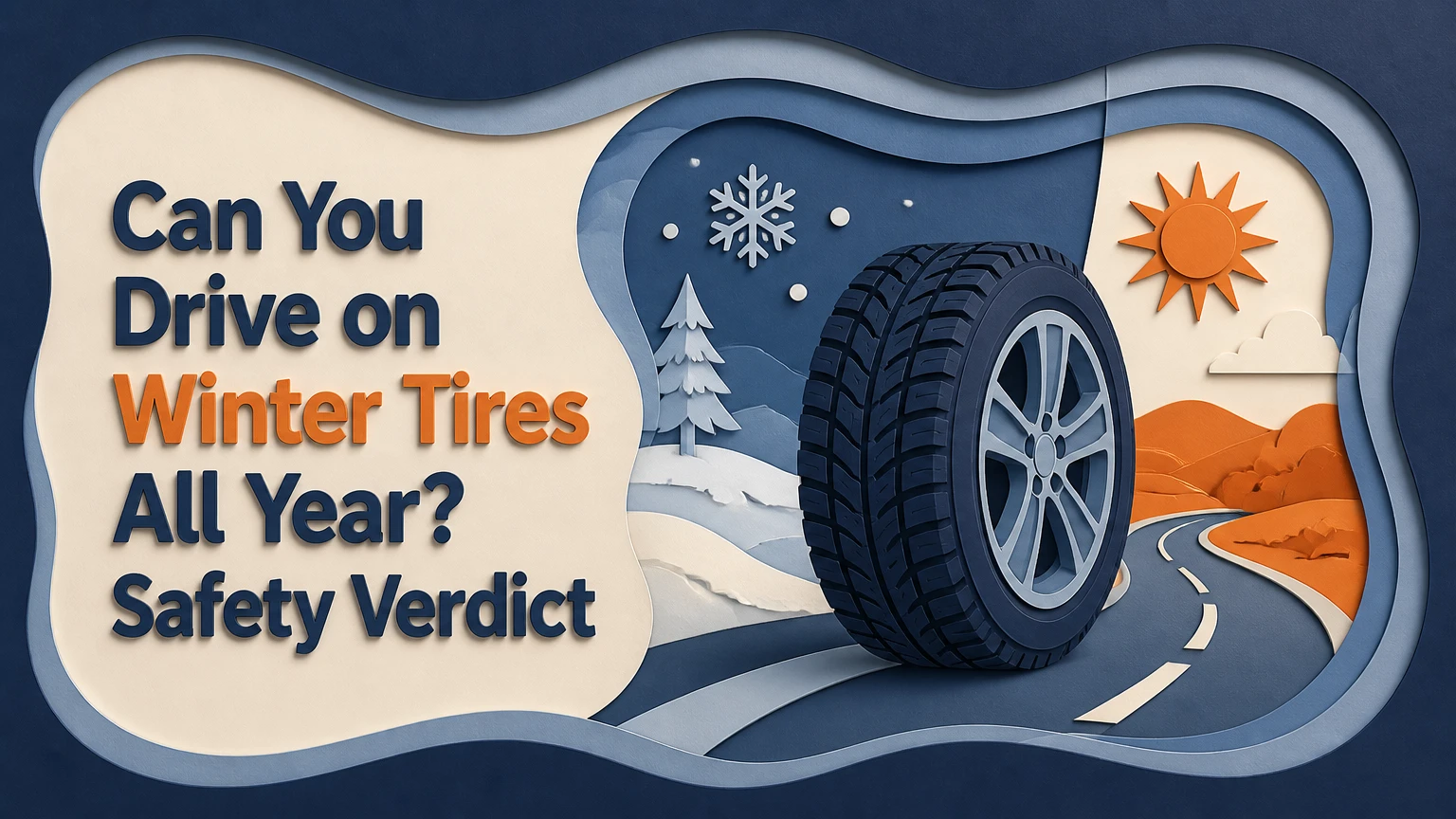
Yes, you can drive on winter tires all year in many places, but winter tires are a poor and potentially unsafe summer choice. Their soft cold-weather compound wears quickly on warm pavement, while flexible tread blocks reduce steering precision, dry braking performance, and fuel economy. Studded tires may also be restricted by local law.
Key Facts at a Glance
- Winter tires are generally designed for cold conditions near or below 7°C (45°F), although actual performance depends on the tire and road surface.
- Warm, dry pavement can wear a winter tire’s soft tread substantially faster than cold-weather driving.
- Winter tires can remain physically intact in summer, but increased tread flex can reduce cornering precision and braking performance.
- The 3PMSF symbol identifies a tire that meets a severe-snow traction test; it does not mean the tire is equally effective on ice or in summer.
- All-weather tires are usually the most practical one-set option for drivers with moderate winters and warm summers.
- AWD and 4WD improve propulsion, but they do not replace four tires with appropriate cold-weather grip.
Can You Drive on Winter Tires All Year?
You can legally drive on non-studded winter tires all year in many jurisdictions, but legality does not make year-round use advisable. Winter tires are optimized for cold pavement, snow, and ice, so keeping them through hot weather usually sacrifices tread life, steering response, dry-road braking, and operating cost.
The legal answer varies by location. Studded-tire dates, winter-tire mandates, minimum tread rules, and insurance conditions differ between states, provinces, and countries. For example, a jurisdiction can permit a studless winter tire in July while restricting studded tires to a defined winter period.
The practical rule is simple: use dedicated winter tires when sustained cold and snow justify them, then change to summer, all-season, or all-weather tires when warm conditions become normal. CAA-Quebec describes driving on winter tires in summer as “a risky venture,” because heat and dry pavement accelerate wear and degrade handling.
A single warm afternoon is not an emergency. Seasonal patterns matter more than one temperature reading. Drivers should also follow the tire manufacturer’s specifications, vehicle load requirements, and local regulations.
Why Do Winter Tires Handle Poorly in Warm Weather?
Winter tires handle poorly in warm weather because their rubber compound remains softer and their tread blocks move more under steering, braking, and acceleration loads. The same flexibility that helps a tire conform to icy irregularities can make the tread feel vague on warm asphalt.
Continental, Bridgestone, Pirelli, and Michelin each describe winter tires as products intended for low-temperature operation, commonly using 7°C (45°F) as a practical dividing point. The threshold is not a physical switch. A tire does not suddenly fail at 7.1°C, and it does not become ideal at 6.9°C.
What Does the Winter Tire Compound Do?
A winter tire uses a rubber formulation designed to retain flexibility in cold conditions. As temperature rises, the compound becomes less suitable for high-load dry-road driving because the tread can deform more readily.
The relevant material property is the glass-transition temperature, or Tg. Below and near that transition, rubber behavior changes significantly. Manufacturers tune winter compounds to stay pliable in freezing conditions, while summer tires use compounds that retain better stability at higher temperatures.
Tread design adds another effect. Deep grooves and numerous sipes create edges that can grip snow and evacuate slush, but those small tread elements can move independently on dry pavement. The driver may notice delayed steering response, extra noise, or a soft feeling during lane changes.
Does the 7°C Rule Apply to Every Tire?
The 7°C rule is a useful seasonal guideline, not a universal engineering limit. Tire construction, road temperature, sunlight, speed, vehicle weight, inflation pressure, and the specific compound all affect performance.
A shaded road at 8°C can produce a different result from sun-heated asphalt at 25°C. A winter tire driven gently for a short urban trip faces less heat stress than the same tire used for a heavily loaded, high-speed highway journey.
Use the threshold as a changeover signal when temperatures remain consistently above it. Do not treat the threshold as permission to ignore an unexpected cold snap, overnight frost, or local winter-tire requirements.
What Happens to Winter Tires in Summer?
Summer driving accelerates tread wear and can make the vehicle feel less precise, especially during hard braking, fast cornering, and highway lane changes. The severity depends on mileage, pavement temperature, tire age, vehicle alignment, inflation, and driving style.
Typical practitioner observations show that a winter tire used through a hot summer can lose much more tread than it would during a normal cold-weather season. Some tires may lose several millimeters over one summer, particularly under aggressive driving or high annual mileage. A precise percentage cannot be guaranteed across brands.
| Summer effect | Typical symptom | Main cause | Safety consequence |
|---|---|---|---|
| Rapid tread wear | Visible shoulder or center wear | Soft compound and hot asphalt | Reduced future snow traction |
| Tread squirm | Delayed steering response | Flexible blocks and deep grooves | Less precise lane changes |
| Higher rolling resistance | Fuel use rises about 3-7% typically | Sticky compound and aggressive tread | Higher operating cost |
| Heat cycling | Rubber ages faster | Repeated heating and cooling | Earlier loss of winter performance |
| Noise and vibration | Humming or block noise | Open tread pattern | Driver fatigue and reduced refinement |
Winter tires do not normally explode merely because summer arrives. That claim overstates the risk. The more common problem is progressive performance loss, which can be difficult to notice until an emergency maneuver exposes it.
How Much Braking Performance Can Winter Tires Lose?
Warm-weather braking performance can be worse with winter tires, but no universal extra distance applies to every vehicle or test. Published comparisons vary by tire model, pavement temperature, speed, wetness, tread depth, anti-lock braking calibration, and test method.
A claim such as “all winter tires need 5-8 meters more at 100 km/h” should be treated as a scenario-specific estimate, not a guaranteed result. Drivers should understand the direction of the effect without treating one number as a promise.
A tire’s contact patch still grips the road through rubber friction and tread interaction. When flexible blocks deform under braking, part of the tread movement becomes heat and delay rather than useful longitudinal grip. Low remaining tread can further reduce wet-road water evacuation.
Does Dry Pavement Make Winter Tires Safe?
Dry pavement removes snow and ice, but it does not eliminate the disadvantages of a soft winter compound. Warm, dry asphalt can produce less accurate steering and longer stopping performance than a tire designed for that temperature range.
The effect is most important during sudden braking, an evasive swerve, a downhill stop, or a heavily loaded trip. Gentle driving can hide the difference. Hidden limitations still matter because emergency maneuvers are not planned.
Correct inflation remains essential. Underinflation increases heat generation and shoulder wear, while overinflation reduces the contact patch and can worsen uneven wear. Check pressure when the tires are cold and use the vehicle placard, not the maximum pressure molded into the sidewall.
Are Studded Winter Tires Different?
Studded winter tires are different because metal studs add traction on some icy surfaces, while also increasing road wear, noise, and legal restrictions. Studs do not make a tire suitable for summer; dry pavement can loosen or wear the studs and damage the road surface.
| Tire category | Severe-snow mark | Best temperature range | Strongest surface | Main warm-weather limitation |
|---|---|---|---|---|
| Studless winter | 3PMSF | Below about 7°C | Snow and mixed ice | Soft tread and fast wear |
| Studded winter | 3PMSF | Below about 7°C | Certain hard ice | Noise, road wear, legal dates |
| All-weather | Usually 3PMSF | Cold to warm seasons | Mixed conditions | Less ice grip than a dedicated winter |
| All-season | Usually M+S, model dependent | Moderate temperatures | Dry and wet roads | Limited severe-snow traction |
| Summer | No 3PMSF | Warm conditions | Dry and wet warm pavement | Poor cold and snow performance |
Stud regulations can specify installation and removal dates, permitted roads, vehicle classes, or weather conditions. Check the relevant transport authority before fitting or retaining studded tires.
Are All-Weather Tires Better for Year-Round Driving?
All-weather tires are usually better than winter tires for year-round driving when a driver wants one set that can handle occasional snow and normal summer temperatures. Many all-weather models carry the Three-Peak Mountain Snowflake, or 3PMSF, symbol and use a more temperature-balanced compound.
All-weather does not mean all conditions perform equally. A 3PMSF tire must meet a severe-snow traction standard, but the symbol does not certify maximum ice braking, deep-snow performance, hot-weather handling, or equal performance to a dedicated summer tire.
| Driving situation | Dedicated winter | All-weather 3PMSF | All-season | Summer |
|---|---|---|---|---|
| Frequent packed snow | Strongest choice | Acceptable to strong | Limited | Unsuitable |
| Glare ice | Best with proper design | Moderate | Weak | Very weak |
| Warm highway trips | Poor fit | Good compromise | Good | Strongest |
| Occasional frost | Strong | Strong | Moderate | Weak |
| Severe mountain winter | Strongest choice | May be insufficient | Insufficient | Unsafe |
| One-set ownership | High compromise | Best compromise | Best only in mild winters | Seasonal use |
Choose a dedicated winter set if snow, ice, or freezing temperatures are routine and driving cannot be postponed. Choose all-weather tires if winter precipitation is intermittent and the convenience of one set matters more than peak snow and ice performance.
Are All-Season Tires Safe in Snow?
All-season tires can be acceptable in light snow and mild climates, but many do not meet the 3PMSF severe-snow standard. The term all-season describes intended use across several seasons, not guaranteed winter capability.
Check the sidewall. The M+S marking indicates mud and snow design characteristics, but it is not equivalent to the 3PMSF certification. A tire with 3PMSF has passed a standardized severe-snow acceleration test, although that test does not measure every winter condition.
All-season tires can make sense where winter temperatures are moderate, snowfall is rare, roads are promptly cleared, and the driver can avoid travel during storms. They are a weak choice for regular ice, steep untreated roads, rural travel, or regions with mandatory winter equipment.
Does AWD Remove the Need for Winter Tires?
AWD does not remove the need for winter tires because all-wheel drive helps transmit engine power but does not create additional tire-road friction during braking. A vehicle with AWD can accelerate confidently and still struggle to stop or turn on ice.
The same principle applies to 4WD. Drivetrain traction helps the driven wheels overcome wheelspin, while every tire remains responsible for steering and braking. Four appropriate winter tires provide a more balanced result than two winter tires on a two-wheel-drive vehicle.
Never mix winter and non-winter tires on a vehicle unless the manufacturer specifically permits the arrangement. Differences in circumference, grip, and handling can destabilize the vehicle and interfere with electronic stability systems.
When Should Winter Tires Come Off?
Winter tires should usually come off when temperatures remain consistently above about 7°C (45°F), severe snow is no longer expected, and local winter-tire rules no longer require them. Use overnight lows and the driver’s actual travel conditions, not only afternoon forecasts.
A driver in a northern continental climate may change in April or May. A coastal driver may change earlier, while a mountain driver may need winter capability into late spring. Tire shops often experience seasonal demand, so booking 1-3 weeks ahead can reduce delays.
What Should You Check Before Removal?
Inspect the tires before storing them. Measure tread depth, look for cracks or bulges, record their position, and check whether uneven wear suggests alignment or suspension trouble.
A commonly used winter-service benchmark is approximately 4/32 inch, or about 3.2 millimeters, although legal minimums differ and some manufacturers specify different replacement guidance. Winter traction can decline before the legal minimum is reached.
Replace a tire with a bulge, exposed cord, deep cut, severe cracking, irregular structural damage, or an unrepairable puncture. Tread depth alone cannot prove that an old winter tire remains safe.
How Much Does Year-Round Tire Ownership Cost?
A two-set system commonly costs more at purchase but can reduce tire replacement frequency because each set accumulates mileage during only one season. A one-set all-weather system costs less to manage but may deliver less peak winter traction than dedicated winter tires.
Typical North American costs vary by vehicle size, brand, wheel diameter, and region. The following figures are planning ranges, not universal prices.
| Ownership item | Typical low range | Typical high range | Usual timing |
|---|---|---|---|
| Four winter tires | $400 | $1,000 or more | Every 3-6 seasons, condition dependent |
| Four all-weather tires | $500 | $1,200 or more | Every 3-6 seasons, condition dependent |
| Seasonal wheel swap | $60 | $120 | Twice yearly |
| Mount and balance | $80 | $180 | When tires share wheels |
| Basic steel wheel | $60 | $150 each | One-time purchase |
| Indoor storage service | $40 | $120 per season | Twice yearly |
The cheapest-looking option is not always the cheapest over five years. A driver who destroys a winter set during summer may pay for new winter tires sooner, lose the value of the original tread, and still pay changeover costs.
| Five-year setup | Initial equipment | Seasonal service | Main replacement risk | Best fit |
|---|---|---|---|---|
| Winter plus all-season sets | $900-$2,200 | $600-$1,200 | Two aging sets | Snowbelt commuter |
| Winter plus summer sets | $1,200-$2,800 | $600-$1,200 | Higher seasonal specialization | Warm, performance-focused driver |
| One all-weather set | $500-$1,200 | $0-$300 | Faster total mileage wear | Moderate winter climate |
| Winter tires all year | $400-$1,000 | $0-$600 | Rapid summer wear | No recommended normal use |
The proper comparison uses total mileage, not calendar age alone. Low-mileage drivers may replace tires because of age, while high-mileage drivers may wear out tread before rubber aging becomes the limiting factor.
What If You Cannot Change the Tires Immediately?
If an immediate tire change is impossible, reduce speed, avoid long highway trips, check cold inflation, remove unnecessary loads, and arrange professional replacement as soon as practical. A short temporary drive is less damaging than months of summer use.
Do not use worn winter tires for a final summer season if they show structural damage, severe cracking, exposed wear bars, or less than the manufacturer’s recommended winter tread. Do not assume low annual mileage makes heat harmless, because time and pavement temperature still affect the compound.
Avoid towing, aggressive cornering, hard acceleration, and emergency-style testing. If steering feels delayed, the vehicle wanders, vibration develops, or stopping feels abnormal, stop driving and have the tires inspected.
A tire professional can also check alignment, balance, suspension components, and pressure. Uneven summer wear may indicate a mechanical fault rather than a tire-only problem.
How Should Winter Tires Be Stored?
Winter tires should be cleaned, dried, labeled, protected from sunlight, and stored in a cool, dry area away from ozone-producing equipment. Tires mounted on wheels can be stacked or hung according to manufacturer guidance, while unmounted tires are commonly stored upright and rotated periodically.
Storage Checklist
- Wash salt and road grime from the tread and sidewalls using mild soap and water.
- Dry the tires completely before covering them.
- Mark each tire’s former position, such as front-left or rear-right.
- Inspect for cuts, bulges, embedded objects, and uneven wear.
- Store tires away from direct sunlight, heaters, solvents, fuel, and electric motors.
- Keep tires in airtight storage bags if the manufacturer or storage provider recommends them.
- Follow the manufacturer’s pressure guidance when storing mounted assemblies.
- Recheck pressure, tread, age, and sidewall condition before reinstalling.
Do not store tires outdoors under a tarp for an entire summer. Rain, ultraviolet exposure, ozone, temperature swings, and ground moisture accelerate deterioration even when tread remains visible.
How Do You Identify the Right Replacement Tire?
Identify the correct replacement using the vehicle placard, owner’s manual, tire sidewall, load index, speed rating, and seasonal certification. Tire width and wheel diameter alone are insufficient because load capacity and construction also affect safety.
A sidewall such as P215/60R16 95H contains several specifications: P indicates passenger use, 215 is width in millimeters, 60 is aspect ratio, R identifies radial construction, 16 is wheel diameter, 95 is load index, and H is speed rating.
Check these details:
- Original or approved tire size
- Load index equal to or above vehicle requirements
- Speed rating appropriate for the vehicle
- 3PMSF symbol for severe-snow service
- Manufacturing date and tire age
- Correct TPMS compatibility where applicable
- Matching tires across the axle and preferably all four positions
A higher price does not guarantee the best fit. A tire with the correct size but an unsuitable load index, seasonal design, or speed rating is not an appropriate substitute.
What Are the Most Common Year-Round Mistakes?
The most common mistake is treating legal use as evidence of good performance. Legal standards usually establish minimum requirements, while tire manufacturers design products for particular temperature and surface conditions.
Mistake 1: Waiting for visible damage
Summer wear may reduce future snow traction before the sidewall shows cracking or the tread reaches a legal limit. Measure tread and inspect the compound rather than relying on appearance.
Mistake 2: Installing only two winter tires
Two winter tires create an imbalance in front-to-rear grip. The vehicle can oversteer or understeer unpredictably, particularly during braking or a wet corner.
Mistake 3: Assuming 3PMSF means winter perfection
The severe-snow symbol is valuable, but it does not mean an all-weather tire matches a dedicated winter tire on glare ice. Match the tire to the worst conditions you regularly face.
Mistake 4: Ignoring inflation after seasonal changes
Temperature changes alter pressure. Check all four tires cold after installation, reset the TPMS if required, and recheck pressure after several days.
Mistake 5: Keeping old tires because tread looks adequate
Rubber ages through time, ultraviolet exposure, heat cycles, and storage conditions. Replace tires when age, cracking, damage, or manufacturer guidance indicates, even if tread appears deep.
Which Tire Setup Fits Your Driving?
A snowbelt commuter who drives daily on untreated roads should use dedicated winter tires plus a summer or all-season set. Peak snow and ice grip outweigh the cost and inconvenience of seasonal changes.
A mild-climate urban driver who sees occasional frost and light snow should consider a 3PMSF all-weather tire. The one-set arrangement avoids storage and swap appointments, but the driver should still avoid severe storms when possible.
A performance-oriented driver should use summer tires during warm months and dedicated winters during cold months. Summer tires generally provide more precise warm-weather steering and braking than either all-season or winter designs.
A low-mileage driver should not automatically choose year-round winter tires. Low mileage limits wear from distance, but it does not eliminate heat exposure, aging, or reduced emergency performance.
A budget-constrained driver should compare a one-set all-weather purchase with a two-set system over five years. Running winter tires in summer usually saves less than expected because accelerated wear consumes expensive winter capability.
FAQ
Can Winter Tires Overheat and Blow Out in Summer?
Winter tires do not normally overheat and fail solely because outdoor temperatures rise. Heat increases tread flex, rolling resistance, and wear, while underinflation, overloading, high speed, damage, or an aged casing can raise failure risk much further. Correct pressure and prompt replacement reduce the risk, but they do not make summer use ideal.
Can You Drive on Winter Tires in Rain?
You can drive on winter tires in rain, but wet-weather performance depends on tread condition, speed, water depth, and tire design. A winter tire with deep grooves may evacuate water effectively, yet its soft warm-weather compound can provide less precise braking and steering than a summer or all-season tire on warm wet pavement.
How Long Do Winter Tires Last?
Dedicated winter tires commonly last about three to six seasons when used only in cold months and maintained correctly. Mileage, storage, alignment, pressure, tread depth, driving style, and tire age determine the actual service life. Year-round use can consume several seasons of usable winter tread much sooner.
Are Winter Tires Worth the Cost?
Winter tires are usually worth the cost for drivers who regularly encounter snow, ice, freezing temperatures, or untreated roads. They are less compelling in climates with rare snow and mild winters, where a 3PMSF all-weather tire may provide a better convenience-to-performance balance. The decision depends on exposure to severe conditions, not vehicle price.
Can Winter Tires Be Stored Outside?
Winter tires can be stored outside temporarily only with substantial protection, but indoor storage is safer. Ultraviolet light, ozone, moisture, and temperature swings accelerate rubber aging. Keep tires clean, dry, covered, and away from chemicals and electric motors, then inspect them carefully before the next installation.
Should You Replace Winter Tires at 4/32 Inch?
Replace winter tires at or before the manufacturer’s recommended winter limit, and treat 4/32 inch, approximately 3.2 millimeters, as a practical inspection point rather than a universal legal rule. Snow traction declines as grooves become shallower. Structural damage, cracking, age, and uneven wear can require replacement earlier.
The Bottom Line
Can you drive on winter tires all year? In many regions, yes, but doing so is usually a poor safety and cost decision. Warm pavement softens the winter compound, increases tread wear and rolling resistance, and can reduce steering and braking precision without producing obvious visible damage.
Use dedicated winter tires when cold-weather traction is a regular requirement. Use summer or all-season tires for appropriate warm-weather conditions, or choose a 3PMSF all-weather tire when one-set convenience is more important than maximum winter performance. Check local law, the tire manufacturer’s guidance, tread depth, tire age, inflation pressure, and the conditions you actually drive in before deciding.