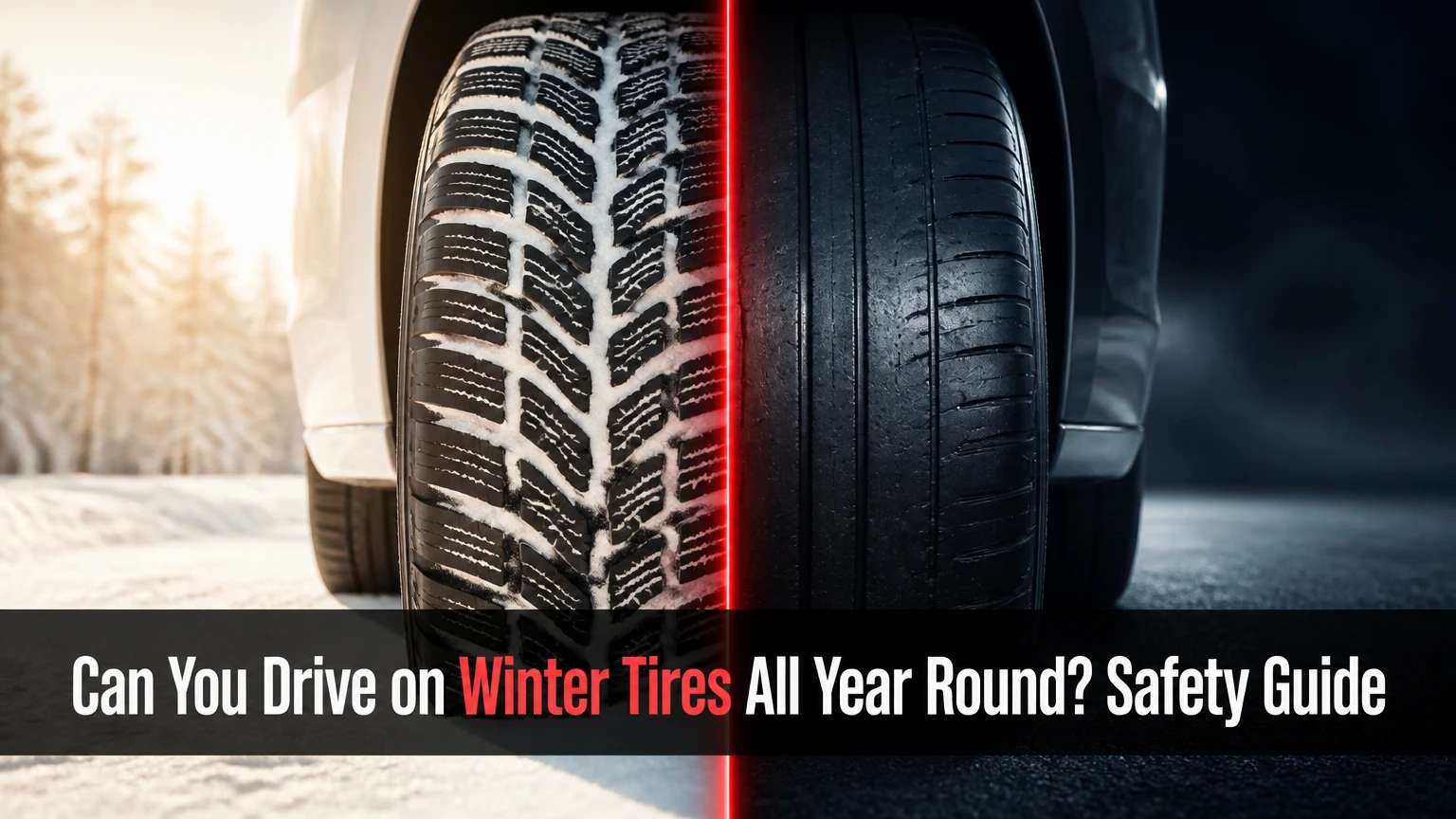
Yes, you can usually drive on winter tires all year round, but doing so is unsafe and uneconomical in warm weather. Winter tires use soft compounds, flexible tread blocks, and dense siping for cold pavement, snow, and ice; above roughly 7°C (45°F), they generally wear faster, steer less precisely, and may require longer emergency stops.
Key Facts at a Glance
- Winter tires are optimized for cold conditions, not hot summer pavement.
- The 7°C (45°F) changeover point is a practical guideline, not an instant legal or performance cutoff.
- Warm weather can make winter tread blocks flex excessively, reducing steering precision and dry-road grip.
- Summer use can consume winter tread substantially faster, shortening the number of safe winters remaining.
- Tire laws and insurance consequences vary by country, state, province, road, and vehicle category.
- A 3PMSF all-weather tire is usually a better year-round compromise than a dedicated winter tire.
Can You Drive on Winter Tires All Year Round?
You can drive on winter tires year-round in many jurisdictions, but the decision is advisable only for limited, low-speed use in a cool climate. Drivers should verify local rules first, because some jurisdictions regulate winter tire periods, studded tires, minimum tread depth, or approved winter markings rather than banning summer use.
“Winter tires are designed to provide better traction in snow and ice,” according to Transport Canada’s winter-driving guidance. That design advantage does not continue unchanged on warm, dry pavement. A winter tire may remain roadworthy in summer, but roadworthy does not mean optimal, economical, or equally safe.
The practical question is not simply whether winter tires are legal. It is whether the tire will retain enough braking, cornering, heat resistance, and tread depth for the conditions you actually drive. A driver covering 3,000 km in a cool coastal summer faces a different risk from a driver covering 25,000 km on hot motorways.
Is 7°C a strict temperature limit?
No. Seven degrees Celsius is a useful seasonal-change guideline, not a point at which winter tires suddenly fail. Pavement temperature, sunlight, tire model, vehicle load, speed, rain, and tire pressure all affect performance.
Winter tires begin offering their strongest advantages as temperatures remain near or below 7°C. Drivers should consider sustained daytime and overnight temperatures rather than changing tires for one unusually warm afternoon.
Why Do Winter Tires Perform Poorly in Warm Weather?
Winter tires perform poorly in heat because their rubber remains softer and their tread design allows more movement than a summer or conventional all-season tire. The combination increases tread squirm, rolling resistance, steering delay, and heat generation on warm asphalt.
Dedicated winter compounds contain silica and other formulation features that preserve flexibility in cold conditions. Flexibility helps the tread conform to irregular ice and maintain contact on packed snow, but the same flexibility can make the tread blocks deform during rapid cornering on hot pavement.
Winter tread also contains many sipes, which are narrow cuts across the tread blocks. Sipes create biting edges for snow and ice. On dry summer roads, a high sipe count can reduce block stability, producing a vague steering response and uneven stress across the tread.
Deep grooves and larger voids help clear snow and slush. They do not automatically reduce traction on dry roads, but they can reduce block stiffness and the proportion of stable rubber supporting aggressive cornering.
What happens inside the tread?
A winter tire on hot asphalt can experience four linked effects:
- Tread squirm: Flexible blocks move under steering and braking force.
- Heat buildup: Repeated flexing converts more mechanical energy into heat.
- Compound wear: Soft rubber abrades more rapidly against warm, coarse pavement.
- Contact instability: The tread footprint changes shape under load.
The result is usually gradual performance loss, not an immediate blowout. A blowout risk depends on tire age, damage, inflation, load, speed, and construction. It is inaccurate to claim that every winter tire used in summer will catastrophically fail.
How Much Do Winter Tires Affect Braking and Handling?
Winter tires can lengthen dry-road braking and reduce cornering precision in warm conditions, but no single percentage applies to every vehicle or tire. The difference depends on pavement temperature, tire model, tread depth, road surface, vehicle electronics, inflation pressure, and whether the comparison uses summer or all-season tires.
A soft winter tread can move under hard braking, delaying the tire’s ability to transmit force consistently. A driver may notice the effect first as a less immediate pedal response or a car that feels less settled during lane changes.
Wet summer roads create another complication. A winter tire may still evacuate water effectively, yet its flexible blocks and worn edges can produce less stable braking than a warm-weather tire. Drivers should increase following distance rather than rely on a generic stopping-distance multiplier.
| Condition | Likely winter-tire behavior | Main consequence | Practical response |
|---|---|---|---|
| 0-7°C dry pavement | Strong cold-weather flexibility | Good cold grip, moderate block movement | Continue using winter tires |
| 15-25°C dry pavement | Softer tread response | Less precise steering and faster wear | Plan seasonal change |
| Above 25°C highway travel | Greater heat and flexing | Higher wear and vague handling | Avoid prolonged use |
| Warm wet pavement | Soft blocks and reduced stability | Potentially longer emergency braking | Increase following distance |
| Snow or ice below 7°C | Flexible compound and dense siping | Strongest winter performance | Use properly matched winter tires |
Professional tire tests often demonstrate measurable differences between tire categories, but test results are model-specific. A premium winter tire, a worn winter tire, and a performance all-season tire will not produce the same stopping distance.
Does all-wheel drive solve the problem?
No. All-wheel drive can help a vehicle accelerate on snow, but it cannot eliminate tire-compound or braking limitations. Every vehicle still depends on the four contact patches for steering and stopping.
This is a common practitioner rule: traction at the driven wheels helps you move, while tire grip at all four corners determines how consistently you turn and stop. All-wheel drive does not make a winter tire suitable for hot-weather performance.
How Quickly Do Winter Tires Wear in Summer?
Winter tires can wear dramatically faster in summer, with some tire-industry guidance reporting wear rates up to about 60% higher in warm conditions. The actual rate varies with asphalt texture, temperature, mileage, alignment, inflation, acceleration, braking, vehicle weight, and tread depth.
A single hot season may remove a large portion of the tread needed for future snow performance. The financial loss is greater than the visible rubber loss because winter tires are valuable mainly for their cold-weather capability.
Winter tires should generally be replaced for snow service when usable tread approaches 4 mm, although local regulations and manufacturer guidance control the legal minimum. A tire can remain above the legal wear bar while delivering noticeably weaker snow and slush performance.
| Tread condition | Winter usefulness | Summer implication | Recommended action |
|---|---|---|---|
| New, 8-10 mm typical | Strong snow and ice capability | Highest heat-related waste | Remove for warm season |
| 6-7 mm | Good if evenly worn | Still soft and inefficient | Store for next winter |
| About 4 mm | Reduced snow performance | Little reason to preserve for winter | Seek replacement advice |
| Wear bars at 1.6 mm | Legally worn in many markets | Unsafe in rain and winter | Replace immediately |
| Cracks, bulges, or damage | Unsafe regardless of tread | Elevated failure risk | Remove from service |
Should you burn off old winter tires in summer?
Using old winter tires through summer can make economic sense only when the tires are already unsuitable for another winter and a professional inspection confirms they are safe. It is not a safe method for tires with sidewall damage, cracking, uneven wear, low pressure history, or excessive age.
“Burning them off” does not restore grip. Heat can accelerate degradation, and a tire with shallow winter tread may still have a soft compound that handles poorly in summer.
Do Winter Tires Use More Fuel?
Winter tires often use more fuel than low-rolling-resistance summer or all-season tires because their compounds and tread patterns flex more. A typical increase may fall around 3-5 percent, but vehicle type, speed, inflation, temperature, and tire model can produce a smaller or larger result.
Underinflation magnifies the effect. Transport Canada and tire manufacturers consistently advise checking pressure regularly, especially when temperatures change, because cold weather reduces measured inflation pressure and low pressure increases rolling resistance.
A 4 percent fuel penalty on a vehicle consuming 8 L/100 km over 15,000 km equals approximately 48 extra litres of fuel. At a fuel price of $1.60 per litre, that represents about $77, before accounting for accelerated tread replacement.
Fuel cost is rarely the largest reason to remove winter tires. Braking and tread preservation matter more.
How Do Winter, All-Season, and All-Weather Tires Compare?
Dedicated winter tires deliver the strongest snow and ice performance, standard all-season tires offer moderate year-round compromise performance, and 3PMSF all-weather tires provide stronger certified snow capability without seasonal swaps. None is best in every climate.
The Three-Peak Mountain Snowflake, or 3PMSF, symbol indicates that a tire passed a standardized severe-snow traction test. The marking does not mean the tire equals a dedicated winter tire on glare ice, deep snow, or extreme cold.
| Tire category | Cold and snow behavior | Warm-weather behavior | Best operating situation |
|---|---|---|---|
| Dedicated winter | Strongest snow and ice traction | Rapid wear and soft handling | Frequent snow, ice, and temperatures below 7°C |
| Standard all-season | Moderate cold and wet performance | Stable year-round use | Mild winters with occasional light snow |
| All-weather, 3PMSF | Better snow traction than standard all-season | More stable than winter tires in heat | Mixed climate with moderate winter conditions |
| Summer performance | Strongest warm dry and wet grip | Poor near-freezing and snow performance | Warm climate with no winter snow |
A standard all-season tire is not automatically an all-weather tire. Buyers should inspect the sidewall for the 3PMSF symbol rather than relying on product names.
What does a second set of wheels change?
A second wheel set reduces changeover time and mounting stress because the complete wheel and tire assembly can be installed directly. It also lowers the risk of bead damage from repeated tire mounting, although correct equipment and trained technicians make rubber-only seasonal changes routine.
Typical North American costs vary by vehicle and market:
| Ownership setup | Typical initial cost | Typical annual service | Storage requirement |
|---|---|---|---|
| Winter tires on existing wheels | $450-$850 | $100-$200 for two changes | 4 mounted or unmounted tires |
| Winter tires plus steel wheels | $750-$1,400 | $40-$120 for two changes | 4 complete assemblies |
| Standard all-season only | $400-$750 | $0-$80 for rotations | No seasonal set |
| 3PMSF all-weather only | $500-$950 | $0-$80 for rotations | No seasonal set |
Prices are typical ranges for 16-18-inch passenger-car and compact-SUV applications in North America. Premium sizes, run-flat construction, sensors, storage, and local labor can change the total substantially.
Which Tire Strategy Fits Your Climate and Mileage?
Drivers in severe winter climates should use dedicated winter tires seasonally. Drivers in mild climates with occasional snow may prefer 3PMSF all-weather tires, while low-mileage drivers in cool regions can sometimes accept year-round winter use if they understand the handling and replacement trade-offs.
| Driver situation | Recommended setup | Reason | Main limitation |
|---|---|---|---|
| Frequent snow and ice, 12,000+ km/year | Dedicated winter plus summer or all-season | Maximizes seasonal grip | Swap and storage cost |
| Mild winter, occasional snow, under 12,000 km/year | 3PMSF all-weather | Avoids swaps while improving snow traction | Less ice grip than winter |
| Warm climate with no snow | Summer or all-season | Winter capability is unnecessary | Winter tires waste tread |
| Under 5,000 km/year, cool climate | Seasonal winter or carefully monitored year-round use | Low mileage limits wear | Summer braking compromise remains |
| Frequent highway travel | Seasonal setup or all-weather | Heat and speed increase wear | More expensive than one set |
| Leased or heavily loaded SUV | Follow vehicle and tire load specifications | Load affects heat and stability | Incorrect fitment can void coverage |
The lowest purchase price is not always the lowest ownership cost. A single winter set used year-round may need replacement before its second or third winter, while two sets divide mileage and preserve each compound for its intended season.
When Should You Switch Away From Winter Tires?
Switch from winter tires when cold conditions have ended and temperatures remain consistently above approximately 7°C, subject to local weather and the tire manufacturer’s guidance. In many temperate regions, that means late March through May, but calendar dates are less reliable than sustained temperatures.
Switch back before regular cold weather arrives, especially if overnight temperatures begin staying near 7°C or lower. Waiting for the first snow creates appointment shortages and leaves summer tires exposed to unnecessarily cold conditions if the change is delayed.
Inspect each tire during the change:
- Measure tread depth at several points.
- Check for cracking, bulges, punctures, and sidewall damage.
- Record uneven wear across inner, center, and outer tread.
- Confirm the tire’s age from the DOT date code where applicable.
- Reset and verify TPMS after installation.
- Torque wheel nuts to the vehicle manufacturer’s specification.
A tire with good tread can still require replacement because of age, ozone cracking, impact damage, or repeated underinflation. Tire age recommendations differ by manufacturer, so consult the tire brand and vehicle manual.
Can You Mix Winter Tires With Other Tires?
You should not mix winter tires with summer, all-season, or all-weather tires unless the vehicle manufacturer and a qualified tire professional specifically approve the arrangement. Four matching tires provide predictable handling; two winter tires on one axle can create a major grip imbalance between axles.
Installing winter tires only on the front of a front-wheel-drive vehicle may improve acceleration and steering while leaving the rear axle with less lateral grip. In a wet corner, the rear can lose traction first, producing oversteer. Installing them only at the rear can create front-axle understeer and weaker steering response.
Replace tires in pairs on the same axle when possible, and keep the better-matched pair on the rear when a temporary mismatch is unavoidable. Follow the vehicle manual, tire retailer guidance, and local requirements.
Do speed ratings matter in summer?
Yes. A tire’s speed rating describes its tested capability under specified conditions, while the load index describes the maximum supported load. Winter tires may have lower ratings than the vehicle’s original summer tires, so drivers must obey the lower applicable rating and the vehicle manufacturer’s requirements.
Lower speed rating alone does not make summer use illegal or guarantee overheating. Excessive speed, overloading, low pressure, damaged casings, and hot pavement create the greater thermal risk. Check the sidewall and vehicle placard before sustained highway travel.
What Should You Do if Winter Tires Stayed on Too Long?
If winter tires remained installed into warm weather, check pressure, inspect damage, measure tread, and schedule a change before prolonged highway driving. Drive conservatively until the tires are removed, because heat and flexible tread can reduce steering precision and increase wear.
Use the following triage process:
- Check inflation cold: Adjust all four tires to the vehicle placard pressure.
- Inspect the tread: Look for chunking, feathering, cupping, exposed cords, or cracking.
- Measure depth: Record the shallowest point, not the average.
- Assess the route: Avoid unnecessary high-speed driving in high heat.
- Arrange service: Replace damaged tires rather than trying to preserve them.
- Recheck alignment: Uneven wear can indicate toe, camber, suspension, or wheel-balance problems.
Screeching during ordinary cornering, floating steering, or rapid shoulder wear indicates that the tire deserves immediate inspection. These symptoms do not prove a tire will blow out, but they show that the vehicle is operating outside its intended performance range.
Is Year-Round Winter-Tire Use Ever Reasonable?
Year-round winter-tire use can be defensible for a very low-mileage driver in a consistently cool region when avoiding a second set is more important than maximizing warm-weather performance. The arrangement is not appropriate for frequent highway travel, hot summers, heavy loads, emergency-response driving, or vehicles that cover substantial annual mileage.
The safety trade-off remains even when annual mileage is low. A single emergency stop in July can matter more than the money saved on a seasonal change, particularly when passengers, motorcycles, pedestrians, or dense traffic are present.
An all-weather 3PMSF tire usually provides a better one-set solution. It sacrifices some extreme ice and deep-snow performance but uses a tread and compound designed for a wider temperature range.
FAQ
Can winter tires be damaged by hot weather?
Hot weather can accelerate tread wear and increase heat cycling, especially during high-speed travel, hard cornering, low-pressure operation, or heavy loading. Heat does not automatically destroy every winter tire, but repeated warm-weather use can reduce the tread and age the compound before the next winter.
Are winter tires noisier in summer?
Winter tires can sound louder on warm, coarse pavement because their aggressive tread pattern and flexible blocks create more vibration. The perceived noise varies by tire design, vehicle insulation, road surface, and tread wear, so noise alone is not a reliable safety diagnostic.
Are all-season tires safe in snow?
Standard all-season tires can be adequate in light, occasional snow when driven cautiously, but they do not provide the cold-weather grip of dedicated winter tires. For regular snow, choose a tire carrying the 3PMSF severe-snow symbol or use dedicated winter tires.
Do winter tires last longer if stored properly?
Yes. Storing winter tires clean, dry, away from sunlight, ozone sources, solvents, and heat helps preserve rubber and casing condition. Keep tires inflated, protect them from moisture, and follow the manufacturer’s storage position guidance for mounted and unmounted assemblies.
Can tire pressure prevent summer winter-tire wear?
Correct pressure helps control wear, heat, and handling, but it cannot convert a winter compound into a summer compound. Inflate tires to the vehicle placard specification when cold, then inspect pressure at least monthly and before long trips.
Should electric vehicles use winter tires year-round?
Electric vehicles can use winter tires seasonally, but their higher curb weight and instant torque may increase tread wear when winter tires remain on during warm weather. EV drivers should also verify load index, rolling resistance, wheel compatibility, and the manufacturer’s approved tire sizes.
The Bottom Line
Can you drive on winter tires all year round? Usually, yes, but most drivers should not. Dedicated winter tires belong on cold-weather roads, while summer or all-season tires belong on warm roads; a 3PMSF all-weather tire is the more balanced single-set alternative. Seasonal use protects braking performance, preserves winter tread, and often lowers long-term ownership cost.