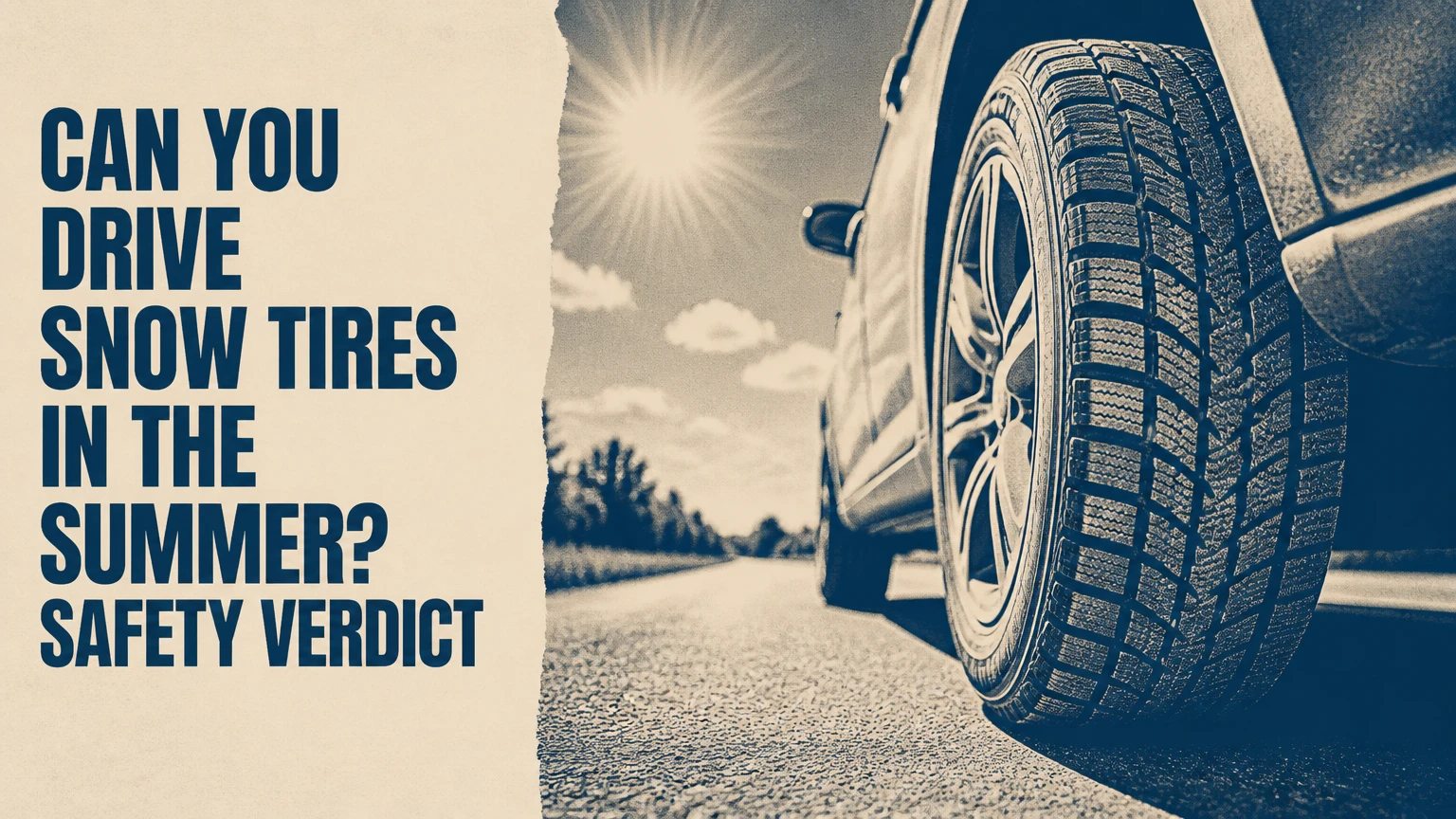
Yes, you can usually drive snow tires in the summer from a legal standpoint, but winter tires are a poor and potentially unsafe summer choice. Their soft cold-weather compound, flexible tread blocks, and dense siping can increase dry-road braking distance, reduce steering precision, accelerate wear, and raise operating costs when temperatures remain above about 7°C (45°F).
Key Facts at a Glance
Winter tires are optimized for cold conditions, generally below about 7°C (45°F), not for hot pavement.
Summer driving can make winter-tire tread blocks flex, wear, and respond less precisely during braking and cornering.
The 7°C guideline is a practical temperature reference, not a universal legal changeover date.
Driving one short emergency trip on winter tires is different from using them for an entire hot season.
Studded-tire rules vary by jurisdiction, and summer use may be prohibited even where studless winter tires are legal.
All-weather tires with the Three-Peak Mountain Snowflake, or 3PMSF, symbol are the main one-set alternative for drivers who still need certified winter traction.
Can You Legally Drive Snow Tires in the Summer?
In many jurisdictions, studless winter tires are legal during summer, but legality depends on local regulations, tire type, insurance terms, and vehicle inspection rules. Studded tires are more restricted because metal studs can damage pavement; some regions prohibit them outside defined winter dates, while others restrict them by road or weather condition.
The words “snow tire” and “winter tire” usually describe the same broad category, although “winter tire” is the more accurate modern term. A tire with the 3PMSF symbol has passed a standardized severe-snow traction test, but that symbol does not make the tire suitable for hot-weather handling.
Check your provincial, state, or national transportation authority before using studded tires outside winter. For example, Canadian provinces and U.S. states can set different stud dates and winter-equipment requirements. A tire shop’s recommendation is not a substitute for the law in your location.
Legal does not mean advisable. A vehicle can pass a legal equipment test while still taking longer to stop or feeling vague in a high-speed lane change.
Why Do Winter Tires Behave Differently in Heat?
Winter tires behave differently in heat because their rubber compound stays flexible at low temperatures, while their tread geometry is designed to create grip in snow and ice. Above roughly 7°C, the compound and tread can become too compliant for precise summer-road responses, particularly during hard braking or quick steering.
Rubber compound
Winter tire compounds contain formulations designed to resist hardening in cold weather. Summer and many all-season compounds use a broader or warmer operating range. When a winter compound becomes hot, the tread surface can feel softer and generate more deformation against asphalt.
That deformation consumes energy. The result can include faster tread wear, greater rolling resistance, and delayed steering response. The exact effect depends on the tire model, load, speed, inflation pressure, road temperature, and vehicle weight.
Continental describes the 7°C point as the temperature below which winter tires retain their flexibility advantage. Michelin similarly explains the practical principle in consumer guidance: winter tires “remain flexible below 7°C.” The threshold is useful for seasonal planning, but tire behavior changes progressively rather than switching at one exact temperature.
Tread blocks and sipes
Winter tires use deeper grooves, larger voids, and many sipes. Sipes are small cuts that create additional biting edges and help the tread conform to packed snow and ice. On dry summer pavement, those same cuts allow more tread movement.
Flexible blocks can squirm under acceleration, braking, and cornering. The driver may notice a soft steering wheel response or a delay between turning the wheel and the vehicle changing direction. That sensation is more serious during an avoidance maneuver than during ordinary low-speed city driving.
Sidewalls and speed
Some performance-winter tires have firmer sidewalls than studless ice-and-snow tires. That design can improve cold-weather highway stability, but it does not turn a winter tire into a summer tire. Speed rating, load rating, inflation, and alignment still control whether a tire is appropriate for the vehicle.
Never infer summer suitability from a high speed rating alone. Speed ratings describe a tire’s tested capability under specified conditions, not its ideal seasonal compound.
Are Winter Tires Unsafe on Hot Asphalt?
Winter tires are less capable than summer or suitable all-season tires on hot, dry asphalt because the soft compound and flexible tread can reduce braking and cornering precision. The greatest risk appears during emergency braking, sudden lane changes, heavy loads, high speeds, and wet roads with standing water.
A winter tire may feel acceptable during a calm 10-minute commute while performing poorly in a panic stop. Drivers often notice the handling penalty only when they need maximum grip.
Performance differences by tire category
| Tire category | Typical design temperature | Summer-road behavior | Best application |
|---|---|---|---|
| Studless ice-and-snow winter | Below 7°C / 45°F | Soft response, rapid wear in heat | Ice, packed snow, cold urban roads |
| Performance winter | Below 7°C / 45°F | Firmer response, still heat-sensitive | Cold highways with occasional snow |
| Studded winter | Below 7°C / 45°F | Stud noise, pavement restrictions, tread wear | Ice-prone roads where studs are permitted |
| All-season | Broad moderate range | Balanced dry, wet, and light winter ability | Mild climates with occasional snow |
| All-weather 3PMSF | Broad range with winter certification | More summer-capable than winter tires | Drivers needing one set in variable climates |
| Summer performance | Above 7°C / 45°F | Precise dry and wet-road response | Warm climates without sustained snow |
The table gives categories, not a guarantee for every model. Tire tests from organizations such as Tire Rack show that individual products within the same category can differ significantly in wet braking, dry handling, noise, and hydroplaning resistance.
Winter tires and braking
Winter tires can require more stopping distance on warm, dry pavement than summer tires because their tread deforms and their compound is not optimized for hot asphalt. The difference varies too much by vehicle, tire model, temperature, and test method to support one universal “two car lengths” figure.
That commonly repeated figure should not be treated as a standard result. A controlled comparison is meaningful only when the same vehicle, tire size, inflation, load, road, temperature, and driver procedure are used.
Winter tires and wet roads
Winter tires are not automatically poor in rain. Many have effective wet-weather grooves, and a new winter tire can resist water well. However, dense siping, flexible blocks, and accelerated summer wear can reduce wet-road confidence as the tread becomes damaged or shallow.
Hydroplaning depends mainly on speed, water depth, tread design, inflation, and tread depth. A summer tire is not immune to hydroplaning, and a winter tire is not guaranteed to hydroplane. Avoid exaggerated category claims.
How Much Do Winter Tires Wear in Summer?
Winter tires can lose tread substantially faster in summer than in their intended cold-weather season, but no reliable universal wear rate applies to every model. A typical driver may notice visibly faster wear after several thousand warm-weather kilometers, while aggressive acceleration, high temperatures, heavy loads, and highway speed can shorten that interval.
Summer use also spends the tread needed for the next winter. Many tire manufacturers and safety organizations recommend replacing winter tires when tread depth reaches approximately 4 millimeters, even though the legal minimum in some locations is lower. Legal minimums are not the same as adequate snow performance.
Economic effects
| Summer-use factor | Typical consequence | Why it matters |
|---|---|---|
| Warm pavement | Faster tread loss | Reduces the next winter’s usable life |
| Flexible tread blocks | Uneven shoulder or heel-and-toe wear | Increases noise and handling changes |
| Higher rolling resistance | Possible fuel-use increase | Adds cost across long commutes |
| Highway speed | More heat and deformation | Accelerates compound and tread stress |
| Incorrect pressure | Center or shoulder wear | Can create a safety defect |
| Heavy vehicle load | More carcass flex | Raises heat and wear rate |
A driver who postpones the seasonal change to avoid a mounting fee may spend more on replacement winter tires later. The calculation should include lost winter tread, fuel consumption, possible alignment work, and the cost of replacing a damaged tire before its planned service life.
When Should You Change From Winter Tires?
Change from winter tires when local temperatures consistently remain above approximately 7°C during the times you drive, while also considering overnight frost, late snow, mountain travel, and legal requirements. Change back when temperatures regularly fall below that range or winter precipitation becomes likely.
The 7°C rule is a planning guideline, not a reason to change tires because of one warm afternoon. Spring weather can fluctuate sharply. In northern climates, a late snowstorm may matter more than a week of warm daytime temperatures.
Book the appointment before demand peaks. A practical scheduling window is often 1-3 weeks before the expected seasonal transition, although local weather and shop availability determine the actual timing.
Seasonal change checklist
- Check the forecast and route. Review seven to fourteen days of temperatures, frost, snow, and mountain travel.
- Inspect all four winter tires. Measure tread depth, examine sidewalls, and look for cracks, bulges, punctures, or exposed cords.
- Check the DOT date code. The final four digits identify the production week and year; a code such as 2422 means week 24 of 2022.
- Use a complete matching set. Do not install only two winter tires. Mixed traction can create unstable oversteer or understeer.
- Torque wheel fasteners correctly. Use the vehicle manufacturer’s torque specification, not a generic value.
- Reset and verify TPMS. Confirm the tire-pressure monitoring system recognizes the installed wheels.
- Recheck pressure cold. Set pressure from the door-jamb placard or owner’s manual, not the maximum molded on the tire sidewall.
- Recheck after 50-100 kilometers. Confirm torque, pressure, and unusual vibration after the first drive.
A tire technician should inspect vibration, pulling, irregular wear, and alignment before the summer set goes on. Seasonal swapping is a useful opportunity to find suspension or brake problems.
Can You Drive Winter Tires on the Highway in Summer?
Avoid highway use on winter tires in summer whenever possible because sustained speed, hot pavement, vehicle load, and long operating time generate more tread heat and flex. A short trip to a tire shop is usually a different risk from several hours of loaded highway driving.
If an unexpected warm-weather trip is unavoidable, reduce risk by checking cold pressure, inspecting for damage, lowering speed, extending following distance, avoiding heavy loads, and stopping if vibration, smell, steering instability, or visible damage appears. Do not exceed the tire’s speed rating or the vehicle’s legal speed limit.
A winter tire does not normally explode merely because the weather is warm. Catastrophic failures are more often associated with underinflation, overload, impact damage, aging, excessive speed, or severe heat. Summer temperatures can worsen those conditions, so “blowout” should not be presented as an automatic outcome.
City driving versus highway driving
| Driving situation | Relative summer concern | Practical decision |
|---|---|---|
| 5-kilometer trip to a tire shop | Low for a sound, correctly inflated tire | Drive cautiously and swap promptly |
| Daily 10-kilometer city commute | Moderate | Schedule the seasonal change |
| 100-kilometer highway commute | High | Remove winter tires before regular use |
| Loaded vacation trip | High | Use seasonally appropriate tires |
| Mountain road with heavy rain | High | Choose tires with suitable warm wet-road performance |
| Emergency drive during unexpected snow | Winter tires may be appropriate | Prioritize traction and local conditions |
These are risk categories, not laboratory probabilities. Vehicle speed, pavement temperature, tire condition, and driver behavior can move a situation from one category to another.
What Problems Can Summer Use Cause?
Summer use can cause rapid tread wear, imprecise steering, increased noise, higher rolling resistance, and poorer emergency performance. Visible symptoms deserve inspection because some resemble wheel-alignment, suspension, bearing, or inflation faults.
- Spongy or delayed steering: Flexible tread blocks can make steering feel vague, especially in quick transitions.
- Rapid shoulder or heel-and-toe wear: Incorrect pressure, alignment faults, or tread flex can wear blocks unevenly.
- Loud humming or growling: Aggressive winter tread can be noisy, but a new noise may indicate cupping or a wheel bearing.
- Premature ABS activation: Unexpected ABS operation on dry pavement can indicate reduced tire grip, contamination, uneven tires, or a brake-system issue.
- Pulling or vibration: A bent wheel, imbalance, separated belt, or alignment problem may be responsible.
- Rubber smell or visible cracking: Stop driving and obtain an inspection, particularly after high-speed travel.
One expert rule is worth remembering: never diagnose a tire by noise alone. A winter tread pattern can be loud by design, while a damaged tire can be quiet until it fails.
What Happens With Studded Winter Tires?
Studded winter tires create additional legal and pavement concerns in summer because metal studs can damage road surfaces and create noise without providing their intended ice advantage. Stud restrictions vary by jurisdiction, so drivers should check the exact permitted dates and conditions before using them.
Studs do not provide useful traction on every dry surface. They are designed for ice and can reduce refinement on clear pavement. Removing studs from a tire is not a safe way to convert it into a summer tire because the compound, tread geometry, and casing remain winter-oriented.
Performance winter tires are generally more stable than soft studless ice tires, but their warm-weather limitation remains. Tire category is a compromise, not a guarantee.
How Should You Store Winter Tires?
Store winter tires clean, dry, cool, dark, and away from ozone-producing equipment. Tires mounted on wheels can be stacked horizontally or hung correctly, while unmounted tires should generally stand upright and be rotated periodically.
Before storage, wash off salt and road grime with mild soap and water, then let the tires dry completely. Label each position if directional rotation or an established rotation pattern matters. Record tread depth and note any damage.
Do not seal wet tires in plastic. Dry tires can be placed in protective tire bags, but the storage area should still be ventilated and free from moisture. Keep tires away from direct sunlight, heaters, solvents, fuels, and electric motors that may produce ozone.
| Storage condition | Mounted tires | Unmounted tires |
|---|---|---|
| Position | Stack flat or hang securely | Store upright |
| Cleaning | Wash and dry fully | Wash and dry fully |
| Cover | Dry tire bag permitted | Dry tire bag permitted |
| Inspection interval | Check before installation | Rotate periodically |
| Environment | Cool, dark, dry | Cool, dark, dry |
| Avoid | Heat, sunlight, solvents | Compression and moisture |
Do not apply petroleum-based tire dressing before storage. Some products can affect rubber surfaces, and a clean, dry tire needs no cosmetic treatment.
Which Tire Type Should Replace Winter Tires?
Summer tires are the best choice for warm climates and drivers who prioritize dry and wet-road handling. All-season tires suit moderate climates with occasional light snow, while all-weather 3PMSF tires suit drivers who need one set that remains usable through meaningful winter conditions.
Summer, all-season, or all-weather?
| Replacement choice | Warm-weather precision | Winter certification | Suitable climate |
|---|---|---|---|
| Summer tire | Highest | No | Hot climate with no regular snow |
| All-season tire | Moderate to high | Usually no 3PMSF | Mild winters and occasional light snow |
| All-weather tire | Moderate | Yes, 3PMSF | Variable seasons and occasional severe weather |
| Winter tire | Lowest in summer | Yes, 3PMSF | Sustained cold, snow, and ice |
| Two-season wheel sets | Best seasonal matching | Depends on installed tire | Drivers willing to swap twice yearly |
“All-weather” and “all-season” are not interchangeable labels. All-weather tires commonly carry the 3PMSF symbol and use a winter-capable compound, while many all-season tires carry only the M+S marking and are not tested to the severe-snow standard.
An all-weather tire is not a perfect substitute for a dedicated winter tire in frequent ice, deep snow, or consistently below-freezing conditions. Its advantage is convenience and broader year-round usability, not maximum performance in either extreme.
Should You Use Up Old Winter Tires in Summer?
Using old winter tires until they wear out can make financial sense only in a narrow, low-speed situation, and it remains inferior to installing an appropriate summer or all-season set. Do not use worn, cracked, aged, damaged, or unevenly worn winter tires merely because tread remains.
A low-mileage urban driver may choose to run a sound, near-end-of-life set for a short period, but should avoid highway speed, heavy loads, hard cornering, and wet-weather travel. Replace the tires before the next winter if tread depth, age, or damage makes them unsuitable.
Do not “wear out” only two tires. Install four matching tires with adequate load and speed ratings. Front-wheel drive, rear-wheel drive, and all-wheel drive vehicles can all become unstable when axle grip is mismatched.
When should winter tires be replaced?
Replace winter tires when tread reaches the manufacturer’s winter limit, commonly around 4 millimeters, or when the tire has cracking, bulges, punctures, exposed cords, severe uneven wear, or age-related deterioration. The legal tread limit may be lower than the depth needed for snow traction.
Age is not determined by tread alone. The DOT date code, storage history, climate, inflation maintenance, and visible condition all matter. Have a tire professional inspect older tires, especially when the vehicle is used at highway speed or carries passengers and cargo regularly.
Frequently Asked Questions
Can you drive snow tires in the summer for one day?
Yes, a one-day trip on sound, correctly inflated studless winter tires is usually less concerning than leaving them installed for months. Drive conservatively, avoid unnecessary highway speed, inspect for damage, and schedule the seasonal change. A short emergency use does not remove the longer-term problems of heat-related wear and reduced handling.
How hot is too hot for winter tires?
There is no single temperature at which winter tires suddenly become unsafe. About 7°C, or 45°F, is a widely used changeover guideline because winter compounds lose their advantage as temperatures rise. Road temperature, speed, load, tire condition, and driving style determine the actual risk more than air temperature alone.
Do winter tires use more fuel in summer?
Winter tires can increase rolling resistance and fuel consumption in summer because their soft compounds and flexible tread deform more than warm-weather tires. The exact increase varies by tire, vehicle, pressure, speed, and route, so a universal 5-10 percent claim is unreliable. Correct inflation and timely replacement reduce avoidable fuel loss.
Can you put winter tires on only the front wheels?
No. Installing winter tires on only one axle can create a dangerous grip imbalance, especially during braking or cornering. Use four compatible winter tires with matching size, load rating, and speed rating unless the vehicle manufacturer specifies an approved alternative. AWD does not eliminate the need for matched tires.
Are all-weather tires safe in hot summers?
All-weather tires are designed for broader temperatures than dedicated winter tires and can be used year-round, but they usually give up some hot-weather precision, noise comfort, and fuel efficiency compared with summer tires. They are a reasonable compromise for variable climates, not the highest-performance choice for sustained heat.
Does AWD make summer use of winter tires acceptable?
AWD can help a vehicle accelerate on slippery surfaces, but it does not shorten braking distance or prevent winter-tire tread flex on hot pavement. AWD also cannot correct mismatched tire grip during emergency cornering. Use tires appropriate to the season on all four wheels, regardless of drivetrain.
The Bottom Line
Can you drive snow tires in the summer? Usually, yes, if the tires are legal, undamaged, correctly inflated, and stud restrictions permit them. You should still change them when temperatures consistently rise above about 7°C because winter tires can wear quickly and provide less precise braking and handling on warm pavement.
Use summer tires for sustained heat, all-season tires for mild climates, or 3PMSF-marked all-weather tires when one set must cover both moderate summer and winter conditions. A short trip to a tire shop is manageable; a full summer of highway driving on winter tires is an avoidable safety and replacement-cost decision.


