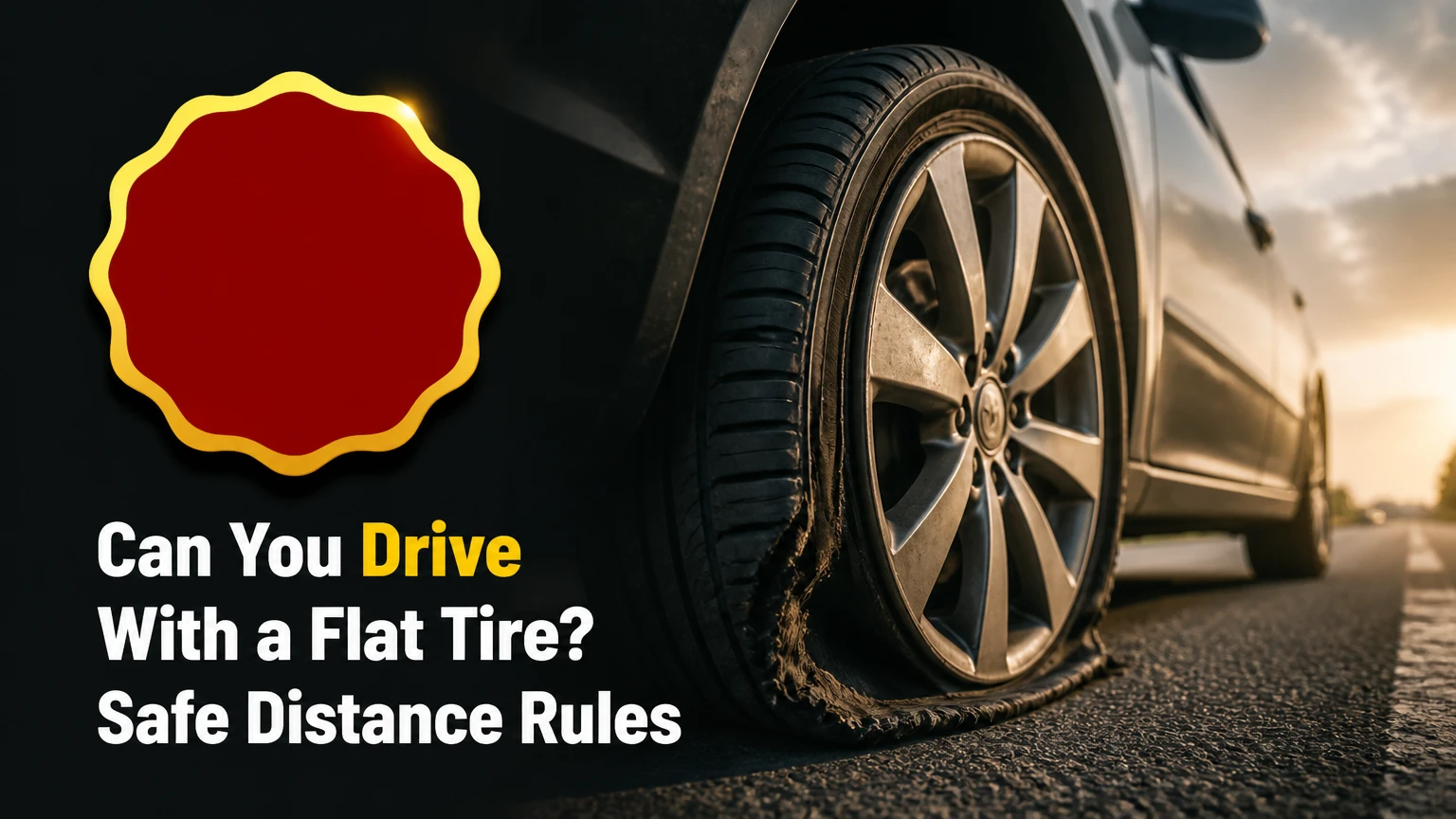
You should not drive with a flat tire except for the shortest distance needed to reach a safer stopping position, such as a nearby shoulder or parking entrance. A deflated tire can lose steering and braking stability, destroy its sidewall internally, damage the wheel, and create a roadside collision risk within a very short distance.
Key Facts / At a Glance
A conventional flat tire has no dependable safe travel distance; drive only far enough to escape immediate danger.
A fully deflated tire can suffer irreversible carcass damage before the tread looks badly damaged from outside.
A temporary spare commonly carries an 80 km/h speed limit, but the vehicle handbook is authoritative.
Run-flat tires commonly permit up to 80 km at up to 80 km/h, although the tire and vehicle manufacturer may specify lower limits.
The correct inflation pressure is printed on the driver-door placard or owner’s manual, not on the tire sidewall.
A puncture in the central tread may be repairable after internal inspection; sidewall and shoulder damage normally requires replacement.
Can You Drive With a Flat Tire?
No, a driver should not continue traveling on a conventional flat tire. Moving a few hundred meters to get out of an active traffic lane can be reasonable when stopping immediately would create a greater danger, but driving to a fuel station, home, or repair shop can ruin the tire and wheel.
The important distinction is relocation for safety, not transportation. If the vehicle is already on a stable shoulder away from traffic, stop there and call roadside assistance. If the vehicle is blocking a lane, move slowly with hazard lights only until the nearest safer position is reached, while avoiding sudden steering, acceleration, or braking.
A tire with low pressure but visible shape is not automatically safe either. A slow leak can become a complete failure when heat, load, speed, or a sharp road impact increases the flexing of the sidewall. The Tire Industry Association and vehicle manufacturers consistently direct drivers to inspect and correct pressure rather than treating the TPMS warning as a permission to finish the journey.
How Far Can You Drive on a Flat Tire?
A conventional tire should be driven zero journey miles after it becomes flat. A distance such as 0.4 kilometers is a practical emergency guideline sometimes given for reaching a safe stopping area, not a guaranteed limit; speed, vehicle weight, road surface, tire construction, and the amount of remaining pressure change the outcome.
| Tire condition | Permitted travel purpose | Typical limit | Main restriction |
|---|---|---|---|
| Conventional tire, fully flat | Escape immediate traffic danger | Only the shortest safe distance | Internal sidewall damage can occur rapidly |
| Conventional tire, low but not flat | Reach a safe stopping place after inspection | No universal distance | Use the door-placard pressure and recheck for leaks |
| Temporary spare or donut | Travel to a tire facility | Often 80 km maximum | Follow the printed speed, distance, and handling limits |
| Run-flat tire | Reach a repair facility | Often 80 km at 80 km/h | Confirm the exact tire and vehicle specification |
Why Is Driving on a Flat Tire Dangerous?
Driving on a flat tire is dangerous because the compressed air normally supports the vehicle’s load and keeps the wheel rim away from the road. Without that support, the sidewall bends and gets pinched between the rim and pavement, generating heat while the vehicle loses its designed contact shape.
The damage can happen inside the tire before an external inspection reveals it. Steel belts, polyester cords, and rubber sidewall layers can separate or shred, and the resulting failure may occur after the tire is reinflated. A tire shop must remove the tire from the wheel to inspect the inner liner and sidewall.
Vehicle control also changes immediately. A flat tire can make the vehicle pull toward one side, increase steering effort, lengthen stopping distance, and reduce cornering stability. The National Highway Traffic Safety Administration identifies underinflation as a condition that can contribute to tire failure because flexing and heat increase when pressure falls.
What Damage Can a Flat Tire Cause?
A flat tire can damage four systems at once:
- Tire carcass: Pinched cords and overheated rubber may make the tire unrepairable.
- Wheel rim: Road contact can bend, crack, or scrape a steel or alloy wheel.
- Suspension and steering: A severe impact or loose tire structure can transfer abnormal loads to wheel bearings, tie-rod components, and suspension parts.
- Vehicle control: Unequal grip and sidewall collapse can cause pulling, fishtailing, or instability during braking.
A counterintuitive workshop rule is that adding air does not reverse damage caused by driving flat. Inflation restores shape, not the strength of cords that have already been crushed or overheated.
What Counts as a Flat Tire?
A flat tire is a pneumatic tire with insufficient air pressure to support the vehicle safely, but the cause may be a slow puncture, sudden blowout, valve failure, bead leak, or wheel damage. A TPMS warning indicates a pressure problem, not the exact cause or the exact pressure.
| Failure type | Typical onset | Visible or driving symptom | Immediate concern |
|---|---|---|---|
| Slow tread puncture | Hours to several weeks | Repeated pressure loss, nail or screw in tread | Internal damage if driven underinflated |
| Valve-stem leak | Minutes to days | Air loss near valve, corrosion, cracked rubber | Pressure may fall after every refill |
| Blowout | Seconds | Loud bang, vibration, sudden pull, loose steering | Maintain control without hard braking |
| Bead leak or unseating | Seconds to hours | Air escaping at rim, uneven tire seating | Wheel or bead damage may prevent reseating |
| Wheel crack or bend | Immediate or gradual | Vibration, rim leak, pressure loss after impact | Tire repair alone will not solve the leak |
A tire that looks round can still be dangerously underinflated. Conversely, a tire that appears low may retain enough pressure for a careful inspection and controlled inflation, so measure it with a gauge rather than judging by appearance alone.
How Did the Tire Go Flat?
A puncture from a nail or screw usually causes a slow leak, while a pothole, sharp debris, failed sidewall, or separated bead can cause rapid deflation. The event matters because a punctured tread and a damaged sidewall have different repair outcomes.
After stopping, look for the object that caused the leak, but do not pull out a nail or screw on the roadside unless a repair professional directs you. The object may temporarily slow the leak. Check for a torn sidewall, exposed cords, a bulge, rim deformation, or a circular abrasion ring inside the sidewall.
What Should You Do When a Tire Goes Flat?
When a tire fails while driving, hold the steering wheel firmly, release the accelerator gradually, activate the hazard lights, and steer smoothly toward the safest available stopping area. Do not slam on the brakes, make a rapid lane change, or stop in a live traffic lane unless the vehicle cannot move.
What Is the Safe Procedure?
- Keep the vehicle pointed straight. Correct only the amount of steering needed to counter pulling.
- Ease off the accelerator. Allow speed to fall naturally; use gentle braking only after the vehicle is stable.
- Switch on hazard lights. Signal your intention early, especially on a motorway or divided highway.
- Move toward safety. Choose a wide shoulder, emergency bay, parking lot, or side road entrance, avoiding soft ground and sharp debris.
- Stop and secure the vehicle. Select Park, apply the parking brake, switch off the engine, and keep occupants away from traffic.
- Call for help if needed. Give the operator the road name, direction of travel, nearest marker, and number of occupants.
- Place warning equipment only if safe. A warning triangle belongs well behind the vehicle according to local law and should never justify walking into traffic.
The safest roadside response is often to remain belted inside the vehicle with doors locked, particularly on a high-speed road. Follow local emergency guidance. A jack change is inappropriate when the shoulder is narrow, the surface slopes, visibility is poor, or passing traffic is close.
What If the Flat Tire Happens on a Highway?
On a highway, priority order is control, separation from traffic, visibility, and assistance. If the vehicle can move, use the shoulder or emergency area; if it cannot, call the emergency number and tell responders that the car is obstructing a lane.
Do not stand between the vehicle and traffic, inspect the tire on the roadway side, or attempt a repair beside a narrow shoulder. A roadside technician or tow truck can provide a protected work area. Nighttime rain and blind bends make self-changing especially hazardous.
Can Inflation Make the Tire Safe?
Inflating a low tire can make it safe to move only after the tire passes a visual inspection, accepts air without rapid loss, and reaches the vehicle manufacturer’s specified cold pressure. Inflation cannot make a tire safe when the sidewall is torn, the bead is displaced, cords are exposed, or the tire was driven while fully deflated.
A portable compressor is useful for a slow leak, but it is not a substitute for diagnosis. Stop inflating if air escapes through a cut, the tire will not seat, the wheel is visibly bent, or sealant sprays from a damaged area. Recheck pressure after several minutes and drive only to a tire professional if the tire remains stable.
The pressure printed on a tire sidewall is generally a maximum load-related inflation figure, not the normal pressure for that vehicle. Use the driver-door placard, fuel-door label, or owner’s manual. Many passenger cars specify roughly 30-36 PSI cold, but that range is not a universal target.
Which Alternative Is Safest?
Roadside assistance or towing is the safest option when the tire is fully flat, the shoulder is dangerous, or the driver cannot verify the tire’s condition. A spare wheel is the best self-service alternative when the ground is firm, the vehicle handbook supports the procedure, and the driver can work away from traffic.
| Alternative | Typical setup time | Typical travel restriction | Best use | Important limitation |
|---|---|---|---|---|
| Roadside assistance | 30-90 minutes wait | Tow or technician-defined | Unsafe locations, damaged wheels, no spare | Requires coverage, signal, or emergency access |
| Full-size spare | 15-30 minutes installation | Often normal vehicle limits | Long trips and repeated travel | Adds weight; spare may also be underinflated |
| Temporary spare | 15-30 minutes installation | Commonly 80 km/h and 80 km | Reaching a tire shop | Limited distance, grip, load, and wet handling |
| Tire inflator and sealant | 10-20 minutes | Temporary trip to repair facility | Small tread punctures without sidewall damage | Sealant may complicate sensor or tire repair |
| Run-flat tire | No roadside change | Often 80 km at 80 km/h | Vehicles designed and equipped for run-flats | Limits vary; handling and repair rules are manufacturer-specific |
A sealant kit is not suitable for every puncture. It generally cannot repair a sidewall cut, large object damage, bead leak, wheel crack, or a tire that has separated internally. Check whether the vehicle uses a direct TPMS sensor, because some sealants can contaminate the sensor and require cleaning or replacement.
Can You Drive on a Run-Flat Tire?
You can drive on a run-flat tire after a pressure loss only within the exact distance and speed limits printed by the tire or vehicle manufacturer. Many self-supporting run-flat systems use a limit near 80 km at 80 km/h, but some vehicles specify less, and the limit falls with heavy loads, high temperature, or repeated cornering.
Run-flat capability does not mean the tire is undamaged or suitable for indefinite use. Drive smoothly to a tire facility, avoid unnecessary distance, and do not assume a normal tire shop can repair it. Michelin, Bridgestone, Continental, and vehicle manufacturers publish different inspection and replacement rules for their products.
| Feature | Conventional tire | Run-flat tire | Practical consequence |
|---|---|---|---|
| Air-loss support | No structural support after deflation | Reinforced sidewall or support ring | Run-flat handling remains limited |
| Common pressure-loss range | Stop immediately | Up to 80 km at up to 80 km/h | Confirm the exact owner’s manual |
| Spare requirement | Often supplied or recommended | Frequently omitted | A compressor and assistance plan remain useful |
| Ride and cost | Softer, lower replacement cost | Firmer, commonly higher cost | Replacement pairs can be more expensive |
| Repair decision | Internal inspection required | Manufacturer policy controls | Some run-flats must be replaced after use |
How Low Is Too Low?
There is no universal PSI number at which every tire instantly becomes unsafe. Pressure below the vehicle placard value reduces load capacity and increases flexing, while a fully flat tire, visible sidewall collapse, or rapid pressure loss requires immediate stopping regardless of the gauge reading.
The commonly repeated 15 PSI threshold is not a general safety rule. A small passenger tire may already be severely compromised at that pressure, while the correct cold pressure depends on vehicle axle load, tire size, and manufacturer calibration. TPMS warning thresholds also vary by vehicle and may not illuminate before structural damage begins.
Check pressure when the tire is cold, ideally after the vehicle has been parked for at least three hours. If pressure differs substantially between tires, inspect for a puncture rather than simply adjusting all four tires and continuing.
Can a Flat Tire Be Repaired?
A flat tire may be repairable when a small puncture lies in the central tread, the tire has not been driven underinflated, and internal inspection finds no liner, belt, or sidewall damage. A professional repair normally requires removing the tire and installing an approved internal repair, not relying on an external plug alone.
Repair policies vary by manufacturer, tire type, puncture size, and local regulation. Many shops use approximately 6 millimeters as an upper limit for certain passenger-tire punctures, but that figure is not permission to repair every hole under 6 millimeters.
| Damage condition | Likely decision | Why |
|---|---|---|
| Nail under 6 mm in central tread | Repair may be possible | Location and internal structure still need inspection |
| Screw in shoulder area | Usually replace | Shoulder flexing makes a lasting repair unreliable |
| Cut in sidewall | Replace | Sidewall carries structural flexing loads |
| Tire driven fully flat | Often replace | Hidden heat and cord damage may remain |
| Exposed cords or bulge | Replace immediately | Structural integrity has been compromised |
| Bent or cracked wheel | Repair or replace wheel, inspect tire | A new tire alone may continue leaking |
A plug inserted from outside can stop air loss temporarily, but it may not seal the inner liner correctly or address internal damage. Use a temporary plug only as an emergency measure when the product instructions allow it, then obtain a professional inspection promptly.
When Must You Replace the Tire?
Replace a tire when damage reaches the sidewall or shoulder, cords are exposed, a bulge or split appears, the bead is damaged, or internal inspection finds evidence of driving flat. A circular wear ring on the inner sidewall is a strong warning that the sidewall rubbed against the rim.
Replace the tire if a blowout removed substantial rubber, if the tread is separated, or if the tire has aged beyond the vehicle or tire maker’s recommended service guidance. Tire age is identified by the final four digits of the DOT code, which state the production week and year, such as 3522 for week 35 of 2022.
The wheel also requires inspection after a flat caused by a pothole or impact. A bent rim can create a new leak, vibration, uneven bead seating, or repeated pressure loss even after a new tire is installed.
What Should You Never Do?
Never continue a normal trip on a fully flat conventional tire, drive quickly on a temporary spare, or use a jack on unstable ground. These actions convert a manageable puncture into tire, wheel, vehicle-control, or personal-injury problems.
Avoid these common mistakes:
- Driving to the next service station: Even 2-3 kilometers can destroy a repairable tire when the sidewall is carrying the rim.
- Braking hard during a blowout: Abrupt braking can increase instability; first stabilize the vehicle and reduce speed gradually.
- Changing a tire beside live traffic: Call assistance when the shoulder is narrow, sloped, dark, or exposed.
- Ignoring the TPMS light: Check pressure at the next safe opportunity, because the warning may indicate a puncture rather than routine maintenance.
- Using the wrong spare: Confirm speed, distance, axle, wheel-nut, and drivetrain restrictions in the handbook.
- Leaving a sealant-filled tire unreported: Tell the technician which product entered the tire, because residue affects inspection and sensor service.
One useful practitioner rule is to inspect the spare every six months, because a spare that has sat for years often has low pressure or an expired sealant cartridge when it is finally needed.
What If the Tire Is Flat at Home?
A flat tire at home is safer to assess because the vehicle is away from moving traffic, but the tire should still not be driven to a shop. Measure pressure, inspect the tread and sidewall, and use a compressor only if the tire has no structural damage and loses air slowly.
If the tire holds the specified pressure for several minutes, drive directly to a tire professional at moderate speed and avoid highways. If it immediately deflates, shows a sidewall injury, or sits on the rim, install the correct spare or arrange a mobile tire service or tow.
What If the Tire Is Flat in a Driveway?
A driveway change is appropriate only on firm, level ground with the parking brake applied and the opposite wheels chocked. Never place any part of your body beneath a vehicle supported only by the factory jack; use an approved jack stand when the vehicle must remain raised.
What Are the Typical Costs?
Typical costs vary by country, tire size, vehicle access, and time of day. A tread repair may cost about $20-$50 in the United States, a temporary replacement tire may cost $80-$300, and an after-hours tow or roadside call may cost $75-$250 without coverage.
| Service or component | Typical price range, United States | Typical time | Cost driver |
|---|---|---|---|
| Tread puncture repair | $20-$50 | 30-60 minutes | Shop policy and tire inspection |
| Standard passenger tire | $80-$300 | 30-90 minutes | Brand, size, speed rating, installation |
| Run-flat replacement | $180-$500+ | 45-120 minutes | Reinforced construction and vehicle fitment |
| Temporary spare wheel | $100-$300 | 15-30 minutes | Vehicle-specific wheel and tire assembly |
| Uncovered roadside assistance | $75-$250 | 30-90 minutes | Location, time, tow distance |
These are typical planning figures, not quotations. Coverage through an automaker, insurer, membership organization, or vehicle warranty can reduce the roadside charge, while a remote location or commercial vehicle can increase it.
Frequently Asked Questions
Can I drive one mile with a flat tire?
You should not drive one mile on a conventional flat tire because the distance is not a reliable safety threshold. A driver may move only far enough to leave immediate danger, then stop and arrange a spare, repair, or tow. A run-flat tire is different only when its manufacturer permits the specified distance and speed.
Can I drive with a nail in my tire?
A nail in the central tread may permit a short, slow trip to a tire shop if the tire still holds pressure and the shop is immediately nearby. Do not remove the nail first, and do not drive if the tire is visibly collapsed, the puncture is near the shoulder, or pressure is falling rapidly.
Is a flat tire safe overnight?
Leaving a flat tire overnight is safer than driving it, but the vehicle should remain parked on firm, level ground away from traffic. The next step is pressure measurement and inspection. Do not reinflate a tire with a torn sidewall, exposed cords, a bulge, or a damaged wheel.
Can I use a donut spare on an AWD vehicle?
An AWD vehicle may require a full-size matching tire because different rolling circumferences can stress the drivetrain. Some manufacturers allow a temporary spare on one axle for a limited distance, while others prohibit it. The owner’s manual, not a generic 80 km/h rule, determines the permitted use.
Does insurance cover a flat tire?
Insurance policies commonly cover towing or roadside assistance only when that service is included, while tire repair or replacement may be excluded unless collision or road-hazard coverage applies. Check the policy, automaker warranty, tire warranty, or membership terms before assuming reimbursement.
How long can a repaired tire last?
A properly inspected and internally repaired tread puncture can remain in service for the tire’s normal usable life when the repair meets the tire maker’s procedure and the tire was not driven flat. Recheck pressure regularly, because a recurring loss indicates an unresolved leak or wheel problem.
The Bottom Line
Can you drive with a flat tire? Only far enough to reach a safer stopping position when remaining where you are creates a greater immediate hazard. Do not treat 0.4 kilometers as a guaranteed allowance, and do not drive to complete your trip or reach a distant repair shop.
Once stopped, use a correctly rated spare, inflate only an undamaged low tire for a direct inspection trip, or call roadside assistance. A tire professional must inspect any tire driven while deflated, because hidden carcass damage can make reinflation unsafe even when the tread and sidewall look acceptable.