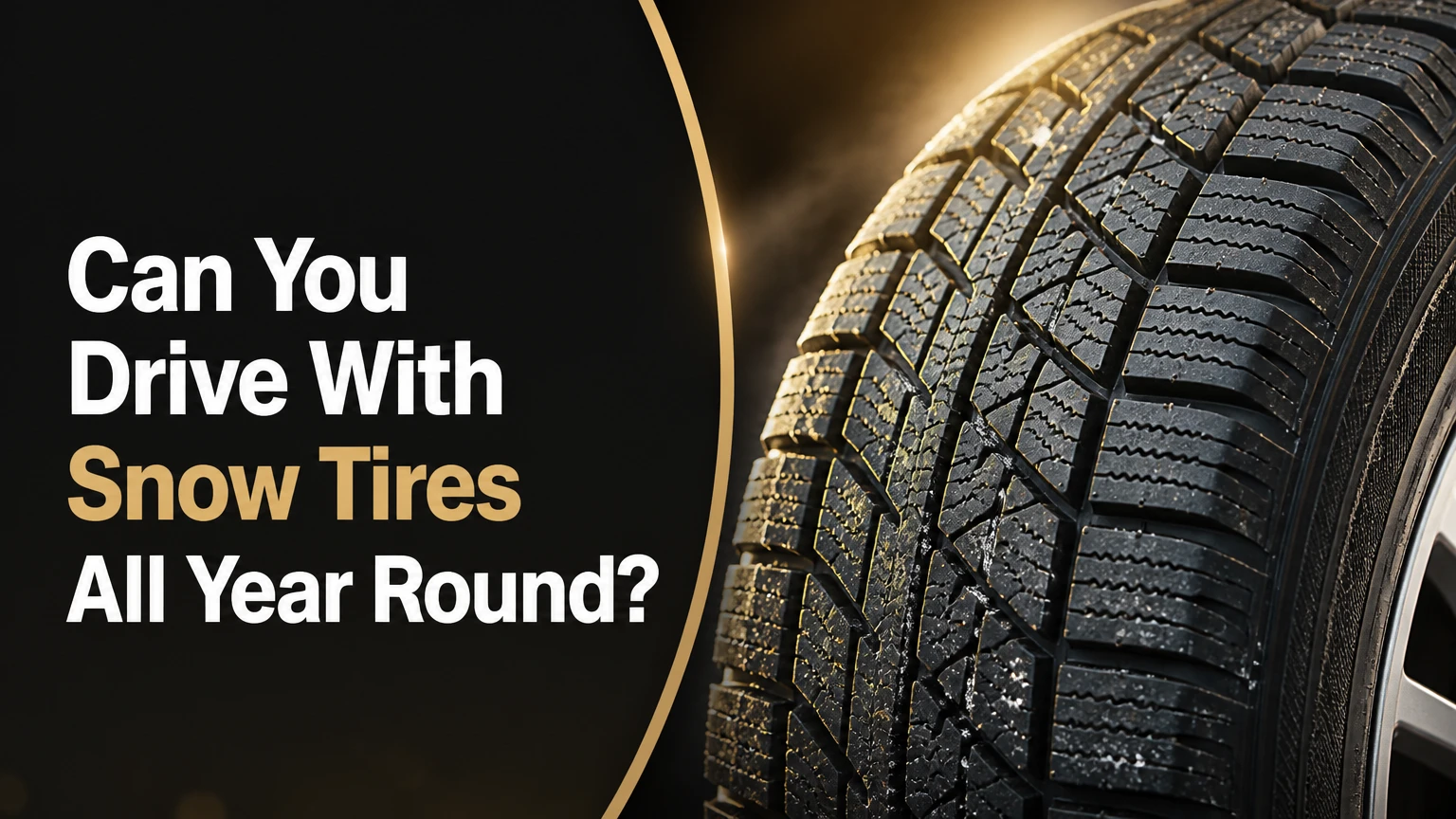
Yes, you can usually drive with snow tires all year round, but winter tires are a poor permanent choice in warm weather. Their flexible rubber wears faster on hot pavement, while heavily siped tread can reduce dry-road steering precision, braking performance, and fuel economy. Local laws, tire markings, climate, and vehicle-maker guidance still control the final decision.
Key Facts at a Glance
Winter tires are designed primarily for sustained temperatures below about 7°C (45°F), especially on snow and ice.
Warm pavement can wear winter tread substantially faster than cold-weather driving, but a universal “60% faster” figure does not apply to every tire or driver.
Winter tires do not automatically damage an engine, transmission, or AWD system; mismatched sizes, load ratings, or tread depths can create vehicle problems.
The 3-Peak Mountain Snowflake, or 3PMSF, symbol identifies a tire that meets a standardized severe-snow performance test.
Ordinary all-season tires marked only M+S are not equivalent to 3PMSF winter or all-weather tires.
A matched set of four tires is the safest configuration unless the vehicle manufacturer specifies another arrangement.
Is It Legal to Drive With Snow Tires All Year?
Driving on snow tires year-round is legal in many jurisdictions, but legality is not universal. Some regions regulate winter tires by calendar dates, weather conditions, road signs, vehicle class, or approved markings, so drivers should check their transport department, insurer, and vehicle manual before relying on a general rule.
For example, Canadian provinces and U.S. states handle winter-tire requirements differently. Quebec commonly requires winter tires during a defined winter period, while British Columbia uses winter-rated tires or chains on designated routes during posted dates. Some European jurisdictions require winter equipment only during snow, ice, or winter-road conditions. A tire that is legal on a passenger car may also fail a commercial-vehicle requirement.
The legal question is separate from the engineering question. A tire can be lawful yet unsuitable for July highway driving. Check the sidewall for the correct size, load index, speed rating, and required winter symbols, then confirm that the insurer does not impose a seasonal condition.
Why Do Winter Tires Behave Differently in Warm Weather?
Winter tires behave differently because their rubber compound stays flexible at low temperatures and their tread blocks are designed to deform around snow and ice. At higher temperatures, that flexibility becomes excessive movement, which increases tread wear and reduces steering sharpness on dry roads.
Winter compounds commonly use silica and a higher proportion of rubber materials selected for cold flexibility. Summer and many all-season compounds use a firmer formulation that maintains shape under hot pavement loads. The 7°C threshold is a practical industry rule of thumb, not a chemical switch where a tire suddenly becomes unsafe at 7.1°C.
Winter tread also contains many sipes, narrow cuts that create biting edges and allow tread blocks to conform to slippery surfaces. On dry pavement, those cuts let the blocks move under braking and cornering. Drivers feel that movement as tread squirm, delayed steering response, or a softer cornering limit.
A common explanation says winter tires “trap heat” by design. That is misleading. Winter tires do not contain a special heat-trapping mechanism; heat comes from rubber flexing, carcass deformation, road friction, ambient temperature, and incorrect inflation. NHTSA accurately describes tires as “the only thing connecting your vehicle to the road,” which explains why compound and tread behavior matter so much.
What happens to braking and handling?
Warm-weather winter tires can increase stopping distance and reduce emergency-maneuver stability, although the exact change depends on tire model, vehicle, speed, surface, temperature, and test method. Published claims of 26% longer braking or six additional meters should be treated as test-specific results, not guaranteed outcomes for every winter tire.
The practical risk grows during sudden braking. A driver may compensate for a vague steering feel during ordinary travel, but cannot easily compensate for several meters of extra stopping distance when a pedestrian, cyclist, or stopped vehicle appears. Wet summer roads add another variable because tread void design, water depth, alignment, and tire wear influence hydroplaning resistance.
How Much Faster Do Snow Tires Wear in Summer?
Snow tires can wear much faster in summer, but no responsible estimate applies to every brand, vehicle, road, or driving style. Typical warm-climate use can consume a meaningful portion of a winter tire’s usable tread in one summer, especially under heavy braking, high cornering loads, high annual mileage, or sustained highway temperatures above 20°C (68°F).
A 60% faster-wear figure appears in consumer guidance, but it is not a universal laboratory constant. A lightly driven vehicle in a mild climate may show less deterioration, while an SUV carrying heavy loads through a hot region may show far more. Tire rotation, alignment, inflation, compound, tread depth, and pavement temperature change the result.
Summer use can also create irregular wear. Soft blocks may develop heel-and-toe wear, feathering, or cupping when alignment or damping is poor. Noise alone does not prove a tire is defective, but new roaring combined with vibration or uneven tread deserves inspection.
What tire condition matters most?
Tread depth, age, damage, and pressure determine whether a tire remains serviceable. The legal minimum varies by location, but replacing a winter tire before the wear bars and maintaining useful snow traction usually requires more tread than the legal minimum.
| Inspection item | Practical benchmark | Action |
|---|---|---|
| Winter tread for snow use | 6/32 inch or more preferred | Preserve for winter traction |
| Tread near wear bars | 2/32 inch legal minimum in many U.S. locations | Replace, regardless of season |
| Cold inflation pressure | Vehicle placard value, commonly 30-36 psi | Adjust before driving |
| Tire age | Six years merits close inspection; 10 years is a common maximum manufacturer limit | Follow tire-maker guidance |
| Visible damage | Bulge, exposed cord, deep cut, or sidewall crack | Remove from service immediately |
The DOT date code on the sidewall identifies the week and year of manufacture. A tire made in week 1423 was produced in the 14th week of 2023. Age, not only tread depth, matters because rubber and internal materials degrade over time.
Does Year-Round Winter-Tire Use Reduce Fuel Economy?
Year-round winter-tire use typically reduces fuel economy by about 2%-5%, although the result varies with rolling resistance, vehicle weight, speed, temperature, tire pressure, and the summer tire used for comparison. A soft winter compound deforms more under load, converting more engine energy into tire heat.
The difference may be small for a low-mileage driver but expensive for a high-mileage commuter. At 15,000 miles per year, a 3% fuel penalty equals 450 additional fuel-equivalent miles. The dollar cost depends on the vehicle’s baseline fuel economy and local fuel price.
Low pressure magnifies the penalty and accelerates shoulder wear. Overinflating to make winter tires feel less soft is unsafe because it changes the contact patch and can reduce grip; use the cold pressure on the driver-door placard, not the maximum pressure molded into the sidewall.
When Should You Remove Winter Tires?
Remove winter tires when local temperatures remain consistently above about 7°C (45°F), winter storms have ended, and warm-weather travel is likely. One warm afternoon is not enough reason to change tires, because overnight freezes and late snow can still occur during spring transition.
A practical schedule uses sustained conditions rather than a single date:
| Climate pattern | Spring changeover | Autumn changeover | Main consideration |
|---|---|---|---|
| Cold continental city | Average lows above 7°C for 7-14 days | Regular lows near 7°C | Late snow and overnight ice |
| Mild coastal region | Warm days above 10°C with no snow forecast | First repeated frost period | Wet-road performance |
| Mountain route | After mountain passes clear | Before elevation snow begins | Route elevation matters |
| Hot inland region | As soon as winter risk ends | Before the first freeze | Summer wear is severe |
Before installation, inspect the incoming set for cracks, bulges, uneven wear, embedded objects, and tread depth. After installation, verify lug-nut torque, wheel direction, TPMS operation, and placard pressure. Recheck pressure when ambient temperature changes significantly.
How Should You Store Snow Tires Between Seasons?
Store snow tires clean, dry, cool, dark, and away from ozone-producing equipment. Wash off salt and road grime, let the tires dry completely, and keep them away from direct sunlight, solvents, fuel, and electric motors that can generate ozone.
Mounted tires can usually be stored horizontally in a stack or vertically if the manufacturer permits, while unmounted tires are commonly stored upright and rotated periodically. Do not hang unmounted tires from a narrow hook, because concentrated force can distort the bead.
Record each tire’s position before removal. A professional can rotate the set during the next installation, but directional tires must remain on the correct side. Storage bags reduce contamination but do not replace a cool, dry location.
Should You Use Two Snow Tires or Four?
Use four matching winter tires unless the vehicle manufacturer explicitly specifies another setup. Installing winter tires only on the front axle can make the rear axle lose grip first, while putting them only on the rear can reduce front-end steering and braking traction.
Mixing tire types creates different grip levels between axles. Anti-lock brakes, traction control, and electronic stability control cannot fully correct a mechanical traction imbalance during a sudden lane change. AWD improves propulsion, but it does not make a vehicle stop faster or remove the need for matched tires.
For AWD vehicles, compare the manufacturer’s maximum permitted tread-depth difference. Some systems require closely matched rolling circumferences, and replacing only one tire can stress the driveline even when the tire size appears identical.
| Vehicle situation | Recommended configuration | Reason |
|---|---|---|
| Front-wheel-drive sedan | Four matching winter tires | Preserves balanced braking and cornering |
| Rear-wheel-drive pickup | Four matching winter tires | Prevents front and rear grip imbalance |
| AWD crossover | Four tires with closely matched tread | Protects traction-control and AWD calibration |
| One damaged tire | Same model and size, or manufacturer-approved replacement | Maintains rolling circumference |
| Mixed winter and all-season set | Avoid unless vehicle maker approves | Different compound and grip response |
Winter, All-Season, or All-Weather: Which Is Best?
The best tire depends on snowfall, ice, summer heat, annual mileage, and whether the driver accepts seasonal changes. Dedicated winter tires provide the strongest cold-weather traction, ordinary all-season tires suit moderate climates, and all-weather tires offer a year-round compromise for drivers who need certified snow performance without two seasonal sets.
| Tire type | Typical temperature use | Snow marking | Warm-weather behavior | Best fit |
|---|---|---|---|---|
| Dedicated winter | Below 7°C (45°F) | 3PMSF | Fast wear and softer handling | Frequent snow and ice |
| Summer | Above 7°C (45°F) | Usually none | Precise dry and wet handling | Snow-free warm climates |
| Ordinary all-season | Broad moderate range | Often M+S only | Longer life than winter tires | Light snow and mild winters |
| All-weather | Year-round compromise | 3PMSF | More wear and noise than all-season | Occasional snow with no swaps |
The 3PMSF symbol shows a mountain with a snowflake and indicates severe-snow testing under a defined standard. M+S means mud and snow tread geometry, but it does not provide the same severe-snow certification.
Are all-weather tires a good alternative?
All-weather tires are a good alternative when a driver faces occasional snow, moderate winter temperatures, and strong resistance to seasonal tire changes. They are not equal to dedicated winter tires on glare ice, packed snow, or consistently severe winter roads, and they usually produce more noise and wear than ordinary all-season tires.
All-weather tires make sense for a driver who lives in a city with periodic snow but must travel before roads are fully cleared. They are less suitable for mountain residents, rural roads, frequent winter highway travel, or drivers who prioritize maximum summer cornering precision.
What Does Year-Round Use Cost?
Year-round snow-tire use can cost less in immediate service fees but more in tread consumption, fuel, and replacement. Typical seasonal mounting and balancing costs range from $60-$150 per visit, or about $120-$300 annually when a driver owns two unmounted sets.
| Cost category | Typical range | Time horizon | Cost driver |
|---|---|---|---|
| Seasonal tire swap | $60-$150 | Each visit | Mounting, balancing, local labor |
| Annual two-swap service | $120-$300 | 12 months | Spring and autumn appointments |
| Passenger winter-tire set | $400-$900 or more | Several seasons | Size, brand, load and speed rating |
| Wheel storage | $50-$150 | 12 months | Retailer storage and region |
| Fuel penalty | 2%-5% typical | Every warm-weather mile | Rolling resistance and pressure |
The “saving” from skipping swaps is often overstated. If summer driving removes a large share of usable winter tread, the driver may replace a $400-$900 set sooner while also paying for extra fuel. The exception is a nearly worn set on a low-mileage vehicle, provided safety compromises are accepted and the tires remain undamaged and legal.
What Are the Main Warm-Weather Failure Modes?
The main warm-weather failure modes are accelerated tread wear, longer emergency braking, vague steering, heat-related pressure problems, and incorrect tire mixing. Winter tires do not normally cause a mechanical failure by themselves, but damaged, underinflated, overloaded, or severely worn tires can fail at speed.
Watch for these symptoms:
- Delayed steering response: Reduce speed, check pressure, and have the tire condition and alignment inspected.
- Loud humming or roaring: Inspect for heel-and-toe wear, cupping, incorrect rotation, or a failing wheel bearing.
- Vehicle wandering: Check pressure, alignment, tread separation, and suspension components.
- Rapid shoulder wear: Correct underinflation and inspect alignment before further highway use.
- Vibration at a narrow speed range: Rebalance the wheel and check for bent rims or internal tire damage.
- Repeated TPMS warning: Check cold pressure and repair leaks; do not disable the warning system.
Do not “fix” mushy handling with extra air. If a tire has a speed rating below the vehicle’s required rating, carries the wrong load index, or shows structural damage, replacement is safer than seasonal experimentation.
Which Driver Should Keep Winter Tires All Year?
Most drivers should change to summer or all-season tires after winter and reinstall winter tires before sustained cold weather. The correct exception is a low-mileage driver in a mild region whose existing winter tires are already near the end of their useful life, provided the vehicle avoids high-speed trips and the tires pass inspection.
The high-mileage commuter
Use dedicated summer or all-season tires for warm months. At 15,000-20,000 miles annually, the wear and fuel penalties can outweigh two seasonal service visits.
The occasional-snow urban driver
Choose all-weather 3PMSF tires if snow is infrequent and storage or appointments are difficult. Choose dedicated winter tires when ice, steep roads, or unplowed routes are routine.
The mountain or rural driver
Use four dedicated winter tires. Maximum snow and ice traction matters more than the convenience of one set, especially when emergency services or road clearing may be delayed.
The low-mileage owner
Using an aging, half-worn winter set through one mild summer can be financially reasonable, but only for short local trips. Do not carry that compromise into hot-weather highway travel, heavy loads, or emergency driving.
How Can You Make the Safest Decision?
Use the following decision sequence before leaving winter tires installed:
- Check local law: Confirm dates, symbols, chains, and insurance requirements.
- Check the tire sidewall: Verify size, load index, speed rating, 3PMSF marking, and DOT age.
- Measure tread and inspect damage: Replace tires with exposed cords, bulges, deep cracks, or inadequate tread.
- Review the climate: Compare sustained temperatures, snow frequency, ice, rainfall, and summer heat.
- Estimate mileage: Separate warm-season miles from cold-season miles.
- Price both options: Compare two annual swaps plus storage against earlier tire replacement and fuel use.
- Follow vehicle guidance: Pay special attention to AWD tread-depth limits and approved tire sizes.
- Use four matched tires: Keep compound, size, construction, and tread depth consistent across axles.
A tire shop should not sell a blanket answer based only on “winter” or “all-season.” The recommendation should account for the vehicle, route, climate, tire age, annual mileage, and the consequence of losing grip.
FAQ
Can snow tires damage an AWD vehicle?
Snow tires do not inherently damage an AWD vehicle. Damage risk comes from mismatched rolling circumference, different tread depths, incorrect sizes, or a tire that violates the manufacturer’s specifications. AWD vehicles often require all four tires to remain closely matched, so replacing one worn tire may require shaving a replacement or replacing the axle or full set.
Can you drive winter tires on dry pavement?
You can drive winter tires on dry pavement, especially when the pavement is cold, but dry pavement does not make them optimal. Above roughly 7°C (45°F), soft compounds and heavily siped blocks can reduce steering precision, increase wear, and lengthen braking compared with a suitable summer or all-season tire.
Are all-season tires safer than winter tires in summer?
All-season tires are generally safer and more efficient than winter tires in warm summer conditions because their compounds and tread blocks resist heat-related movement. Summer tires can outperform both on warm dry and wet pavement, while winter tires remain safer when temperatures are low and snow or ice is present.
What does the 3PMSF symbol mean?
The 3PMSF symbol means a tire passed a standardized severe-snow traction test and is marked with a mountain and snowflake. The symbol appears on dedicated winter and many all-weather tires. An M+S marking alone does not establish the same severe-snow performance.
Should winter tires be removed on a warm spring day?
Winter tires do not need immediate removal after one warm spring day. Change them when warm temperatures persist, winter storms have ended, and the driver’s routes no longer require cold-weather traction. Waiting several days for a stable pattern is safer than changing too early before a late freeze or snowstorm.
Can you leave snow tires on if they are already worn?
Leaving nearly worn snow tires on for a low-mileage summer can avoid wasting their remaining service life, but the tires lose their winter advantage as tread depth falls. Replace them before the next winter if they approach the wear bars, age limit, or show cracks, uneven wear, or structural damage.
The Bottom Line
You can drive with snow tires all year round in many places, but the choice usually trades seasonal convenience for faster wear, higher fuel use, and weaker warm-weather handling. Use four matched winter tires when cold-weather traction is the priority, switch to summer or all-season tires when temperatures stay warm, or choose 3PMSF all-weather tires when one year-round set is the better practical compromise.