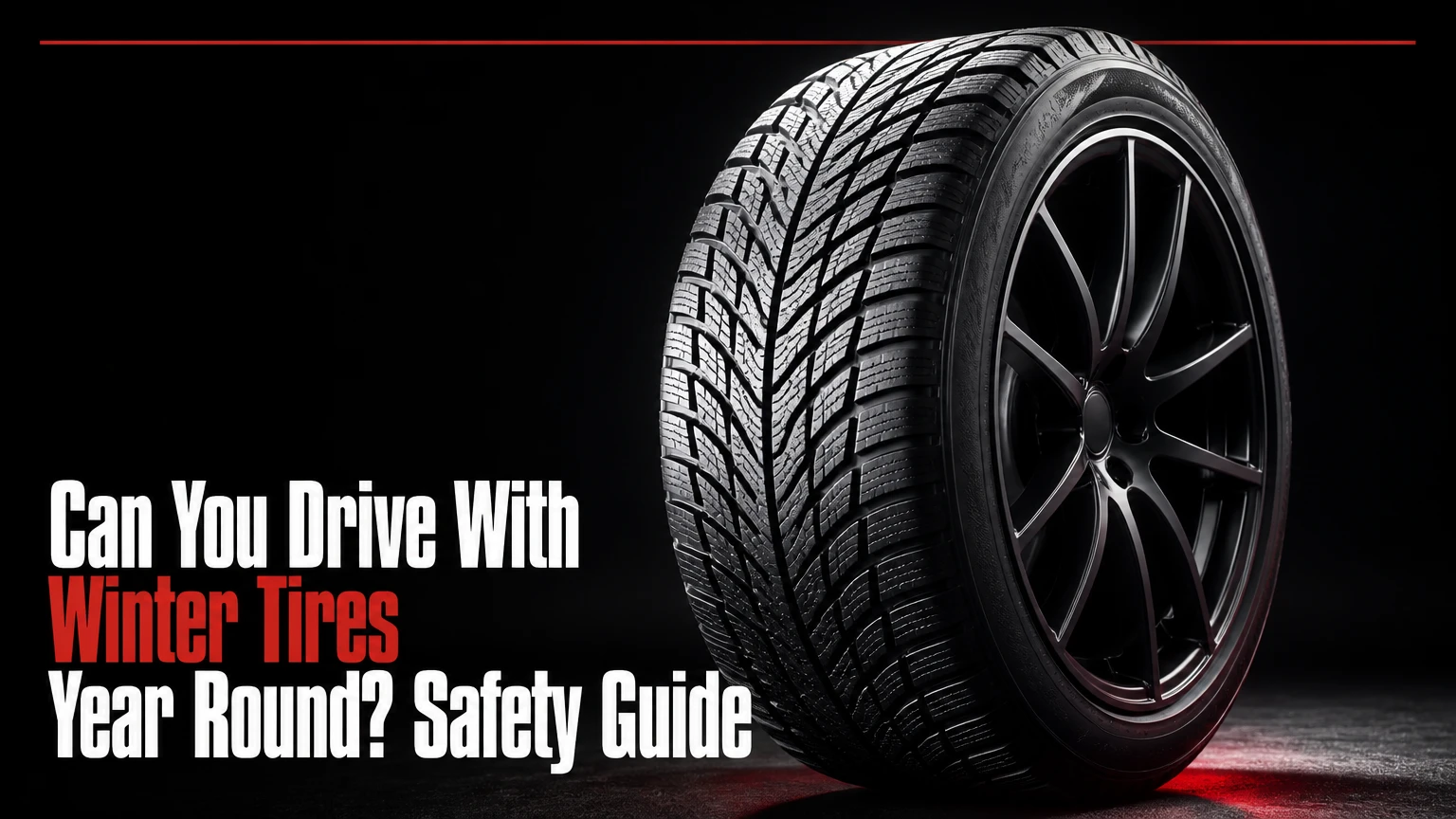
Yes, you can drive with winter tires year round in many jurisdictions, but using them through summer is usually a poor safety and cost decision. Winter tires use a flexible compound and heavily siped tread for cold, snow, and ice; warm pavement accelerates wear, reduces dry and wet-road precision, increases noise, and may lengthen braking distances.
Key Facts at a Glance
The 7°C (45°F) point is a practical tire-changing guideline, not a universal legal cutoff.
Winter tires can wear substantially faster on hot pavement because their compound and tread blocks are designed for cold traction.
Winter tires should be installed on all four wheels, including front-wheel-drive, rear-wheel-drive, and AWD vehicles.
All-weather tires carrying the 3-Peak Mountain Snowflake symbol offer a year-round compromise for moderate winter climates.
Summer heat raises tire pressure, but tires should be inflated to the vehicle manufacturer’s cold-pressure specification, not a lower value.
Local laws may require winter tires during specified dates or on designated roads, while other jurisdictions have no winter-tire mandate.
Are Winter Tires Legal to Use in Summer?
Winter tires are legal during summer in many places, but legality depends on the jurisdiction, tire type, and road being used. Drivers in Canada, the United States, the United Kingdom, Australia, and Europe must check local regulations because winter-tire mandates and studded-tire restrictions differ substantially.
A tire can be legal without being the best choice. Some mountain roads require winter-rated tires or chains during storms, while certain regions restrict studded tires to dates such as late fall through early spring. Insurance policies, leases, fleet rules, and vehicle warranties can also impose conditions that are stricter than general traffic law.
The safest approach is to verify four items:
- Local seasonal rules: Check the transportation department or provincial authority.
- Stud restrictions: Confirm permitted dates, roads, and allowable stud designs.
- Insurance and lease terms: Review requirements for approved tire sizes and winter equipment.
- Vehicle instructions: Follow the owner’s manual for tire size, load index, speed rating, and rotation.
Legality answers whether a driver may use the tire. It does not confirm that the tire delivers suitable braking and handling in July.
Why Do Winter Tires Perform Differently Above 7°C?
Winter tires remain more flexible than all-season and summer tires in cold weather because their rubber compound is formulated to preserve grip at low temperatures. The 7°C (45°F) figure is a useful changeover guideline because performance differences become increasingly noticeable as pavement and air temperatures stay above that range.
The threshold is not an on-off switch. A winter tire does not become unsafe at exactly 8°C, and an all-season tire does not become a winter tire at 6°C. Tire temperature, sunlight, road surface, speed, vehicle load, tread condition, and rain all affect the result.
Continental summarizes the design principle as: “Winter tires are designed to perform best in temperatures below 7°C.” That statement describes the intended operating range, not a legal rule or a precise failure point.
What Makes Winter Tire Rubber Different?
Winter tires combine a cold-flexible compound with tread features that trade summer precision for snow and ice traction. The trade-off comes from several linked design attributes:
| Tire attribute | Winter-tire design | Summer consequence |
|---|---|---|
| Rubber compound | Silica-rich, cold-flexible formulation | Faster wear on hot asphalt |
| Sipes | Numerous narrow cuts across tread blocks | More tread movement and softer steering |
| Tread blocks | Deep, separated blocks | Squirm under hard braking and cornering |
| Grooves | Wide channels for snow and slush | More road noise and less solid dry-road feel |
| Casing and sidewall | Often tuned for cold traction | Less crisp response in high heat |
High sipe density lets tread edges grip compacted snow and ice. On dry pavement, those cuts permit more block deformation, which can create a vague steering response and reduce cornering stability during abrupt maneuvers.
Deep grooves are useful when snow must be packed into the tread and expelled. They do not automatically improve every wet-weather result because wet braking also depends on compound, groove geometry, contact pressure, vehicle speed, and remaining tread depth.
Are Winter Tires Worse on Dry and Wet Summer Roads?
Winter tires can be less precise and may brake less effectively than suitable all-season or summer tires on warm dry pavement. The difference varies by tire model, temperature, tread depth, vehicle, road surface, and test method, so a universal claim that every winter tire stops exactly 10%-26% farther is not reliable.
Warm winter rubber deforms more readily under steering and braking loads. That deformation consumes energy, increases tread temperature, and can make the vehicle feel soft during lane changes. A winter tire with worn tread has less evacuation capacity during heavy rain, increasing the possibility of hydroplaning.
The practical risk is greatest during emergency braking. A driver may perceive adequate grip during ordinary summer driving, yet discover that the tire’s flexible tread blocks cannot transmit braking force as efficiently during a sudden stop.
| Summer driving condition | Likely winter-tire behavior | Main driver concern |
|---|---|---|
| 20°C dry pavement | Soft response and faster tread wear | Longer or less consistent emergency braking |
| 30°C highway travel | Increased tread temperature and squirm | Reduced steering precision |
| Heavy rain at 80-100 km/h | Depends heavily on remaining tread | Hydroplaning risk if worn |
| Hot stop-and-go traffic | High repeated heat cycles | Accelerated compound degradation |
| Loaded SUV or pickup | Greater contact and braking load | Higher wear and handling demands |
Vehicle testing organizations often compare individual tire models rather than tire categories in isolation. Tire Rack testing, for example, evaluates braking, handling, and subjective control under defined conditions. Its results should be applied to the tested models, not copied as a fixed percentage for every winter tire.
How Fast Do Winter Tires Wear in Summer?
Winter tires can lose their usable tread much faster during warm-weather driving, with typical year-round service life often falling near 15,000-25,000 kilometres when the vehicle accumulates substantial summer mileage. Actual life depends on alignment, inflation, acceleration, road temperature, tire construction, and starting tread depth.
A dedicated winter set intended to serve four or five winters may be consumed prematurely by one high-mileage summer. Highway distance is especially demanding because the tread experiences sustained heat and deformation, although aggressive urban acceleration and braking can wear tires even faster.
The “wear them out in summer” strategy is risky when winter tires are already near the manufacturer’s winter-service limit. A tire can retain legal-looking tread while losing the cold-weather traction needed for snow and ice. Many tire professionals recommend replacing winter tires before approximately 4/32 inch of tread remains for winter use, although local rules and manufacturer guidance differ.
| Annual mileage | Summer distance on winter tires | Typical consequence |
|---|---|---|
| 8,000 km | 4,000 km if driven year-round | Moderate but avoidable summer wear |
| 15,000 km | 7,500 km | Noticeable reduction in winter lifespan |
| 20,000 km | 10,000 km | High replacement and safety penalty |
| 30,000 km | 15,000 km | Rapid consumption of a dedicated winter set |
Inspect tread depth across the entire tire, not only the center rib. Shoulder wear, cupping, irregular scalloping, cracks, exposed cords, and a tread-depth difference between tires can matter as much as the average measurement.
Do Winter Tires Reduce Fuel Economy?
Winter tires often reduce fuel economy relative to low-rolling-resistance all-season or summer tires because flexible compounds and tread blocks deform more as they roll. A typical driver may see a small single-digit percentage change, but a universal 5%-10% penalty or 15%-30% rolling-resistance increase cannot be assigned to every tire and vehicle combination.
Fuel consumption also changes with ambient temperature, fuel formulation, road conditions, roof loads, idling, and cold-start frequency. Comparing one January fuel tank with one July tank does not isolate tire effects.
A better comparison uses the same vehicle, route, driving style, tire pressure, and weather range. Record at least three tanks per tire setup, then compare litres per 100 kilometres or miles per gallon. The result will be more useful than a generic online percentage.
Is Year-Round Use Cheaper Than Seasonal Tire Changes?
Year-round winter-tire use may avoid two seasonal appointments, but accelerated wear can erase that saving. Typical tire-shop pricing is approximately $60-$150 per seasonal swap, while a replacement set can cost roughly $400-$1,200 before mounting, balancing, taxes, and specialty sizes.
Separate wheels reduce repeated tire mounting and may shorten appointment time. They do not eliminate inspection, balancing, storage, or pressure checks.
| Ownership item | Typical range | Cost driver |
|---|---|---|
| Winter tire set | $400-$1,200 | Size, brand, load rating, stud option |
| Seasonal swap | $60-$150 | Wheel-mounted versus tire-only service |
| Seasonal storage | $50-$150 per season | Region and storage provider |
| Replacement mounting and balancing | $80-$180 per set | Wheel diameter and shop pricing |
| Steel winter wheels | $250-$700 per set | Diameter, vehicle fit, corrosion protection |
For a 20,000-kilometre driver, preserving a winter set for cold months usually has more financial value than avoiding two annual swaps. For a low-mileage driver, all-weather tires may produce a simpler ownership cost, provided their winter performance matches local conditions.
What Is the Difference Between Winter, All-Season, and All-Weather Tires?
Winter tires provide the strongest snow and ice performance, all-season tires prioritize mild-weather versatility, and all-weather tires occupy the middle ground with a winter-rated 3PMSF certification. The right choice depends on winter severity, summer heat, annual mileage, storage capacity, and the consequences of losing mobility during a storm.
The 3-Peak Mountain Snowflake symbol, commonly called 3PMSF, indicates that the tire passed a standardized severe-snow traction test. It does not mean the tire equals a dedicated studless winter tire on ice, nor does it guarantee identical performance across brands.
| Tire category | Cold-weather design | Snow symbol | Typical service life | Best fit |
|---|---|---|---|---|
| Dedicated winter | Below-freezing flexibility, high sipe density | 3PMSF | 15,000-40,000 km per set, depending on rotation and season | Frequent snow, ice, and mountain driving |
| All-weather | Moderate cold flexibility, reinforced year-round tread | 3PMSF | 50,000-80,000 km typical | Moderate winters and hot summers |
| All-season | Mild-climate compound and balanced tread | Usually no 3PMSF | 60,000-100,000 km typical | Occasional light snow and warmer regions |
| Summer | Warm-weather compound and dry-road focus | No 3PMSF | 30,000-60,000 km typical | Warm climates without winter snow |
Manufacturers publish different warranties and mileage estimates, and many warranties exclude winter use or require regular rotation. Treat the ranges as typical planning figures, not guarantees.
Are All-Weather Tires a Better Year-Round Alternative?
All-weather tires are usually the best single-set alternative for drivers who encounter regular light or moderate snow but also drive through warm summers. Their 3PMSF rating provides certified severe-snow capability, while their compound and tread design tolerate year-round use better than a dedicated winter tire.
All-weather tires remain a compromise. They generally offer less ice grip, snow braking, and cold-weather steering authority than a high-quality dedicated winter tire. They may also generate more noise, consume slightly more fuel, and wear faster in summer than a touring all-season tire.
Choose a dedicated two-set system when winter roads are routinely icy, snow remains packed for weeks, temperatures stay below freezing, or the vehicle travels remote routes where stopping and traction margins matter. Choose all-weather tires when storage, wheel changes, and seasonal appointments are impractical.
Should All Four Tires Be Winter Tires?
All four tires should be winter tires with comparable size, construction, speed rating, load index, and tread condition. Installing winter tires only on the drive axle can create a severe traction imbalance, even when the vehicle can accelerate effectively.
Front-only winter tires can give a front-wheel-drive car strong forward traction while leaving the rear axle with much less lateral grip. The rear can rotate during braking or cornering. Rear-only winter tires can produce the opposite problem, with front-end loss of steering and braking control.
AWD improves the ability to distribute engine torque, but it does not create additional tire grip during braking. An AWD vehicle with unsuitable tires can accelerate confidently and still fail to stop or turn on ice.
Never combine winter, all-season, and summer tires casually. If a tire is damaged and a temporary replacement is unavoidable, consult the vehicle manufacturer or a tire professional about axle placement, size matching, and drivetrain limitations.
When Should Winter Tires Come Off?
Winter tires should usually come off when temperatures remain consistently above about 7°C (45°F) and the local risk of snow and freezing roads has passed. Drivers should also consider seasonal road salt, mountain travel, overnight temperatures, and appointment availability rather than changing on the first warm afternoon.
A practical schedule is:
- Track overnight lows and morning road temperatures. Morning conditions matter more than a warm afternoon.
- Check the local forecast for two weeks. Look for recurring freezing temperatures or late snow.
- Review route requirements. Mountain passes may retain winter-equipment rules after urban roads clear.
- Book before the rush. Shops often become congested during the first warm week.
- Inspect the removed tires. Record tread depth, uneven wear, damage, and storage position.
Drivers in severe climates may keep winter tires into April or May, while coastal or southern regions may change earlier. The calendar provides a starting point, not a universal answer.
How Should Winter Tires Be Stored in Summer?
Winter tires should be stored indoors in a cool, dry, dark location away from electric motors, solvents, fuel, ozone-producing equipment, and direct sunlight. Clean and dry the tires, inspect for damage, label their positions, and maintain the storage provider’s recommended arrangement.
Mounted tires can usually be stored upright, stacked, or suspended according to the tire manufacturer’s guidance. Unmounted tires are commonly stored upright and rotated periodically. Avoid placing heavy objects on unmounted tires or storing tires outdoors under plastic where moisture and heat can accumulate.
Before reinstalling the set, check:
- Tread depth and wear indicators
- Sidewall cracks, bulges, and punctures
- DOT or manufacture date
- Correct size, load index, and speed rating
- Wheel corrosion and valve condition
- TPMS sensor operation
- Pressure against the vehicle placard
Age matters even when tread remains. Michelin advises drivers to have tires professionally inspected annually after five years of service and recommends replacement at ten years from manufacture as a precaution, including spare tires. Follow the tire maker’s specific guidance where it differs.
What Happens If You Keep Winter Tires on During a Heat Wave?
A heat wave can rapidly increase tread temperature, especially during loaded highway travel, and may magnify wear, steering softness, and wet-road performance loss. The tire does not normally fail merely because the weather is hot, but damage, underinflation, overloading, and high speed increase the risk.
Tire pressure rises as air temperature rises. That normal pressure change is not a reason to bleed air from a hot tire. Measure pressure when the tire is cold and adjust it to the vehicle placard value, because underinflation creates excess flex and heat.
The TPMS warning light indicates a pressure problem, not a precise safety assessment. Check pressure with a gauge monthly and before long trips, inspect for embedded objects, and ask a tire technician to evaluate abnormal vibration or rapid pressure loss.
What Are the Most Common Year-Round Winter-Tire Mistakes?
The most damaging mistakes involve incorrect tire placement, pressure adjustments, and relying on tread appearance instead of measured condition. Correcting those habits preserves traction and prevents drivers from confusing legal compliance with safe performance.
Mistake 1: Installing winter tires on one axle
Why it fails: Different axle grip changes yaw behavior during emergency maneuvers.
Fix: Use four matching winter tires, or follow the vehicle manufacturer’s exact replacement guidance.
Mistake 2: Bleeding pressure from hot tires
Why it fails: A pressure increase from heat is normal; bleeding a hot tire can create dangerous underinflation after cooling.
Fix: Set pressure cold using the door-jamb placard, not the maximum pressure molded into the sidewall.
Mistake 3: Driving on winter tires until they are bald
Why it fails: Snow traction declines before legal minimum tread is reached, and worn grooves evacuate less rainwater.
Fix: Measure tread with a gauge and replace the set when winter performance or structural condition is inadequate.
Mistake 4: Assuming AWD replaces winter tires
Why it fails: AWD helps propulsion but does not improve the tire-road friction available for braking.
Fix: Fit four winter or 3PMSF all-weather tires according to the climate and route.
Mistake 5: Ignoring speed and load ratings
Why it fails: A winter tire may have a lower speed rating than the original tire, and exceeding it can create heat and handling risk.
Fix: Verify the owner’s manual, tire placard, and tire sidewall before purchase.
Which Tire Setup Fits Your Driving Situation?
The best setup depends on winter severity and annual mileage, not on whether a driver owns a front-wheel-drive, rear-wheel-drive, or AWD vehicle. Dedicated winter tires offer the largest cold-weather advantage, while all-weather tires reduce ownership complexity for moderate climates.
| Driver situation | Recommended setup | Reason | Main limitation |
|---|---|---|---|
| Snowy city, under 8,000 km annually | 3PMSF all-weather set | One set avoids storage and swaps | Less ice grip than dedicated winter |
| Snowy region, 15,000-25,000 km annually | Winter plus summer/all-season set | Preserves winter tread and handling | Two purchase costs and seasonal service |
| Frequent mountain-pass travel | Dedicated studless or approved studded winter set | Maximizes severe-weather control | Stud laws, noise, and summer removal |
| Warm climate with rare frost | Touring all-season set | Better warm-road comfort and life | Limited packed-snow traction |
| Rural route with prolonged ice | Dedicated winter set on four wheels | Greater braking and lateral margin | Requires storage and timely changeover |
A low-mileage driver does not automatically save money by using winter tires year-round. A 6,000-kilometre annual driver may consume little tread, but still gives up summer handling and may age the tires before wearing them out.
A high-mileage commuter usually benefits from two sets. At 20,000 kilometres per year, the extra seasonal service can be cheaper than replacing a winter set after one hot season.
Expert Rules for Safer Tire Decisions
Rule 1: Use temperature trends, not a single daily reading. A 12°C afternoon does not justify removal if mornings remain below freezing and snow is forecast.
Rule 2: Compare replacement cost per usable season. A $700 winter set used for five cold seasons costs $140 per season before service, while a set destroyed by summer may cost the full $700 in one cycle.
Rule 3: Treat tread depth as a winter-performance measurement. Legal minimums define a regulatory boundary, not the point at which snow and ice traction remains strong.
Rule 4: Match tires across the vehicle. Small differences in tread depth or tire category can alter emergency handling more than many drivers expect.
Frequently Asked Questions
Can winter tires be used in rain?
Winter tires can be used in rain, and a properly inflated, undamaged winter tire can provide safe wet-road service. Warm rain exposes the tire’s softer compound and may increase tread movement, while worn grooves raise hydroplaning risk. Reduce speed in standing water and replace tires with insufficient tread or visible damage.
Do winter tires make a car stop faster on ice?
Dedicated winter tires generally provide shorter braking distances and better control on ice than all-season tires at similar condition and temperature. Results vary by model, vehicle, surface temperature, and ice type. Studded tires can improve performance on some hard ice surfaces, but laws, noise, and dry-road trade-offs limit their use.
Can I use two winter tires and two all-season tires?
Using two winter tires with two all-season tires is unsafe unless the vehicle manufacturer provides a specific approved configuration. Different axle traction can cause oversteer or understeer during braking and cornering. Replace tires in a complete set whenever possible, and consult a tire professional if only one tire is damaged.
How many years do winter tires last?
Winter tires commonly last three to five winter seasons when stored during warm months, rotated correctly, inflated properly, and driven moderate distances. Tread depth, rubber aging, cracking, alignment, mileage, and road temperature determine actual service life. A tire inspection is more reliable than age alone, although manufacturers set age limits.
Are 3PMSF all-weather tires safe for highway driving?
3PMSF all-weather tires are suitable for highway driving when their size, load index, speed rating, pressure, and condition match the vehicle requirements. They provide certified severe-snow traction but are not identical to dedicated winter tires on ice. Drivers should choose dedicated winters for frequent severe storms or prolonged icy routes.
Does tire pressure change between winter and summer?
Tire pressure changes with temperature because the air inside the tire expands when heated and contracts when cooled. Check pressure when tires are cold, preferably before driving, and set it to the vehicle manufacturer’s placard specification. Do not bleed pressure from a hot tire simply because the reading is temporarily higher.
The Bottom Line
Can you drive with winter tires year round? In many places, yes, but the better decision is usually to remove them when sustained warm weather arrives. Summer heat accelerates wear, softens steering response, can reduce warm-road braking performance, and may increase fuel use.
Use four dedicated winter tires during the cold season when snow and ice are common. Choose 3PMSF all-weather tires for a practical single-set solution in moderate climates, and use conventional all-season or summer tires where winter snow is rare. Check local law, tire ratings, pressure, tread depth, storage conditions, and AWD limitations before choosing the setup.