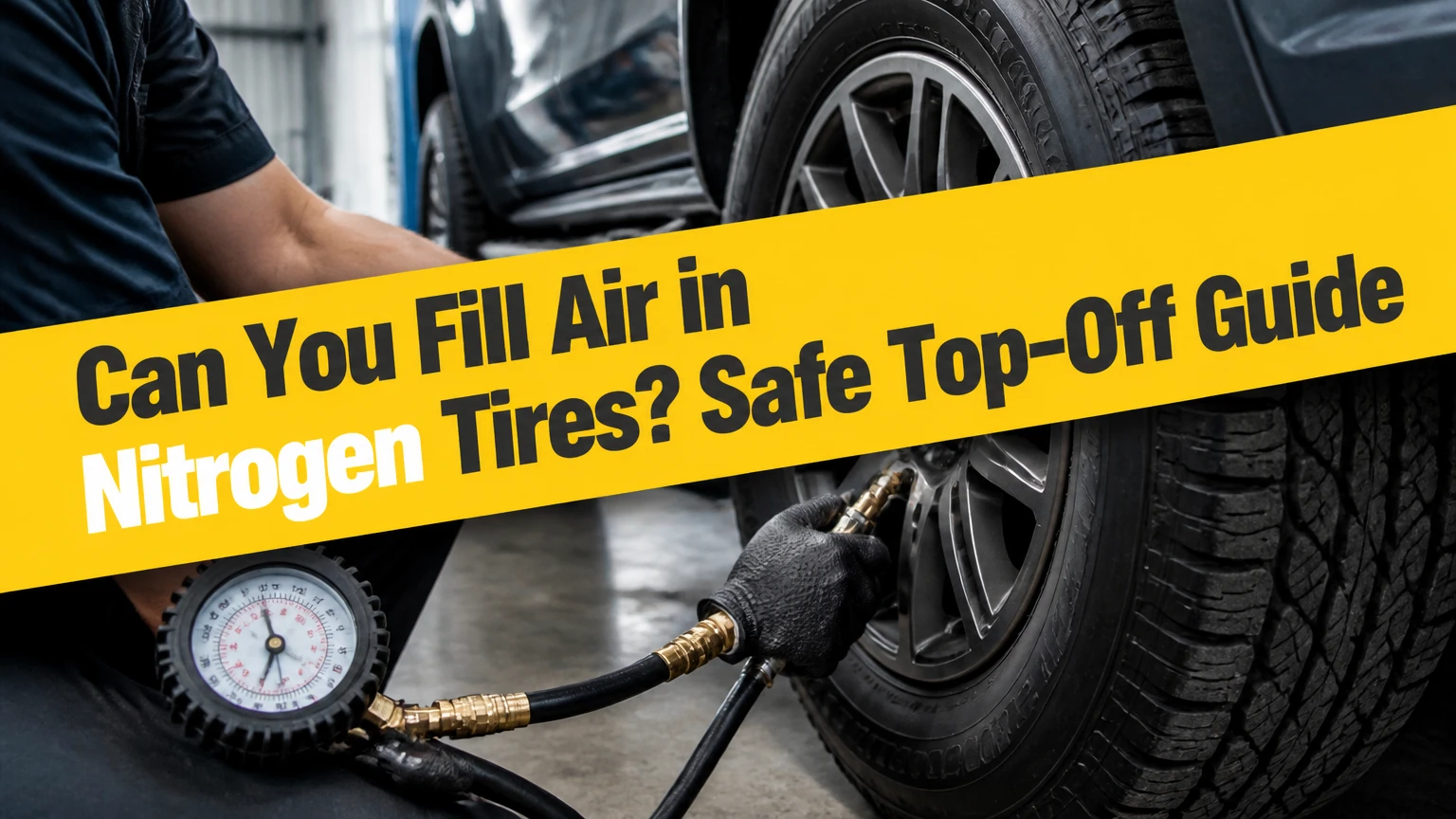
Yes, you can fill nitrogen-filled tires with regular compressed air. Mixing air and nitrogen does not cause a chemical reaction, explosion, or tire damage, but it lowers the nitrogen concentration and removes most of the reason for maintaining a high-purity fill. If a tire is underinflated, add the correct air immediately rather than driving on low pressure.
Key Facts at a Glance
Atmospheric air contains approximately 78% nitrogen and 21% oxygen, with variable water vapor and trace gases.
A commercial nitrogen tire fill commonly contains about 93-95% nitrogen, although purity depends on the equipment and service process.
Regular air and nitrogen mix safely because both are stable gases already present in Earth’s atmosphere.
Nitrogen does not eliminate pressure loss, punctures, valve leaks, bead leaks, or temperature-related PSI changes.
The driver’s door-jamb placard, not the tire sidewall, provides the vehicle’s normal cold inflation pressure.
A nitrogen purge is optional after an air top-off for most passenger cars; correcting pressure is the safety priority.
Can You Fill Air in Nitrogen Tires?
Regular compressed air is safe for topping off nitrogen-filled tires, including passenger-car, SUV, trailer, and light-truck tires. The tire does not become unstable, and the valve, wheel, tread, and TPMS sensor do not react dangerously when the gases mix.
The practical consequence is dilution. A tire that started near 95% nitrogen will contain more oxygen, argon, carbon dioxide, and moisture after receiving ordinary shop air. That change may reduce the small pressure-retention and corrosion-resistance advantages associated with dry nitrogen, but it does not make the tire unsafe.
The immediate risk is underinflation, not mixed gas. Underinflated tires can overheat, wear at the shoulders, reduce steering control, and increase fuel consumption. Transport Canada’s tire-safety guidance tells drivers to use the vehicle manufacturer’s recommended pressure and check inflation regularly. The same rule applies whether the tire contains air, nitrogen, or a mixture.
What Is Inside a Nitrogen-Filled Tire?
A nitrogen-filled tire contains the same physical tire assembly as any other tire. “Nitrogen tire” describes the inflation gas, not a special rubber compound, tread design, or tire category.
| Inflation medium | Typical nitrogen content | Other contents | Practical meaning |
|---|---|---|---|
| Atmospheric compressed air | About 78% | About 21% oxygen, variable water vapor, argon, carbon dioxide | Normal service-station inflation |
| Commercial nitrogen fill | About 93-95% | Residual oxygen and trace gases | Drier, nitrogen-rich inflation |
| High-purity industrial nitrogen | 99% or higher | Very low oxygen and moisture | Used in specialized industrial applications |
| Mixed tire after top-off | Depends on starting pressure and added volume | Air components increase progressively | Safe, but no longer high-purity nitrogen |
The frequently repeated claim that air is 78% nitrogen, 21% oxygen, and “1% water vapor” is too broad. Water vapor changes with temperature and humidity, while argon and other gases make up much of the remaining dry atmosphere. Ordinary compressed-air equipment may remove some water, but it is not automatically moisture-free.
Nitrogen service equipment can produce a drier fill because the generator or cylinder supply contains little moisture. That condition matters more in aircraft, mining, racing, industrial storage, and heavy commercial applications than in a typical family sedan.
Is Mixing Air and Nitrogen Safe?
Mixing regular air with tire nitrogen is chemically safe because nitrogen and the gases in compressed air do not form an explosive mixture inside a normal tire. Oxygen from air does not react with nitrogen under ordinary tire temperatures and pressures.
A standard passenger tire operates at a pressure typically around 30-40 PSI gauge, although the correct value varies by vehicle. Those conditions do not create a dangerous nitrogen-oxygen reaction. The tire’s safety depends on its construction, load, speed, condition, and pressure, not on maintaining one gas exclusively.
The real safety rule is simple: never postpone inflation while searching for a nitrogen pump. Add air until the tire reaches the vehicle manufacturer’s specified cold PSI, then inspect the tire if it loses pressure again. Do not exceed the placard pressure merely because a tire contains nitrogen.
What Air Top-Offs Do Not Cause
| Concern | Actual result after adding air | Correct response |
|---|---|---|
| Explosion | No chemical explosion from mixing nitrogen and air | Inflate normally |
| Tire rupture | No rupture caused by gas mixing | Avoid overinflation and inspect damage |
| TPMS failure | Gas composition does not disable the sensor | Read the pressure and investigate warnings |
| Rubber damage | No immediate rubber reaction | Maintain specified PSI |
| Nitrogen purity loss | Nitrogen percentage decreases | Purge only if a specialized application requires it |
How Do You Add Air to Nitrogen Tires?
Add regular air in the same way you would inflate any compatible tire: measure cold pressure, use the door-placard specification, and add air in short bursts. The process usually takes 2-5 minutes for four tires when the compressor and gauge are accessible.
Step 1: Check the Tire When Cold
Measure pressure before driving, or after the vehicle has been parked for several hours. A practical cold-tire condition means the tire has driven less than about 2 kilometers, although shade, sun exposure, and ambient temperature also affect the reading.
Do not remove pressure from a hot tire to reach the cold specification. Heat raises pressure temporarily, so a hot reading is not a reliable basis for adjustment.
Step 2: Find the Manufacturer’s PSI
Read the placard on the driver’s door jamb, door edge, fuel-filler area, or owner’s manual. The listed number is the recommended cold inflation pressure for the vehicle’s original tire size and load condition.
The maximum PSI molded into the tire sidewall is not normally the vehicle’s target pressure. It identifies a tire limit under specified conditions, not the pressure selected by the vehicle manufacturer.
Step 3: Remove the Valve Cap and Measure
Use a reliable digital or mechanical gauge on each valve stem. Nitrogen does not require a special pressure gauge, and a TPMS display may not update instantly after a small adjustment.
Replace the valve cap after measuring. The cap helps protect the valve core from dirt and moisture, but it does not seal a major leak.
Step 4: Add Air in Short Bursts
Attach the compressor chuck securely and add air for several seconds at a time. Recheck the pressure after each burst because small passenger tires can gain PSI quickly with a high-output compressor.
Inflate each tire to the cold pressure listed for its axle. Some vehicles use different front and rear pressures, especially SUVs, vans, and vehicles with heavy rear-load specifications.
Step 5: Inspect the Tire and Reset the Warning
Look for a nail, screw, sidewall bulge, cut, exposed cord, or visibly damaged wheel. Drive only as far as necessary if the tire has structural damage or cannot hold pressure.
If the vehicle requires a TPMS reset after inflation, follow the owner’s manual. A reset procedure changes the warning system’s reference; it does not repair a leak or measure nitrogen purity.
Does Nitrogen Keep Tire Pressure Longer?
Nitrogen can reduce pressure loss caused by gas permeation and can introduce less moisture when supplied by dry equipment, but nitrogen does not prevent normal tire leakage. A slow leak at the valve core, bead seat, wheel, or puncture can lose pressure much faster than gas permeation through intact rubber.
The often-quoted claim that nitrogen retains pressure three or four times longer is not a universal passenger-car result. Pressure retention depends on tire design, temperature, wheel condition, valve hardware, initial dryness, and measurement accuracy. A well-maintained air-filled tire may perform normally, while a damaged nitrogen-filled tire can become dangerously low.
Nitrogen also does not eliminate pressure changes from temperature. The ideal-gas relationship still applies: when the gas temperature changes, tire pressure changes. Dry nitrogen may produce more consistent results in demanding applications, but the difference is not a license to ignore monthly checks.
What Usually Causes a Low Tire?
| Suspected cause | Typical clue | Inspection or repair |
|---|---|---|
| Tread puncture | Pressure falls over days or weeks | Remove and repair according to tire-industry procedures |
| Valve-core leak | Bubbles form around the valve | Replace the valve core or service the stem |
| Bead-seat leak | Corrosion or dirt at the rim edge | Dismount, clean, inspect, and reseal |
| Temperature drop | All tires lose similar PSI overnight | Adjust cold pressure to the placard |
| Wheel damage | Repeated loss after pothole impact | Check wheel runout and sealing surface |
| TPMS fault | Warning remains despite correct pressure | Diagnose the sensor or system |
Does Nitrogen Make Tires More Temperature Stable?
Nitrogen and ordinary air respond to temperature changes in broadly similar ways because both are gases contained in the same tire volume. The large pressure stability claims sometimes used in nitrogen advertising overstate the difference for ordinary road driving.
Dry nitrogen has a legitimate technical advantage in applications where moisture control matters. Water vapor can condense inside a tire and, under severe heating, contribute to more variable pressure behavior. Passenger-car tires driven on public roads usually do not experience the same sustained thermal demands as racing or aircraft tires.
For daily driving, the useful rule is to set pressure cold and check it when the seasons change. A 10-degree change in ambient temperature can produce a noticeable PSI change, so a nitrogen fill still needs adjustment in cold weather.
Is Nitrogen Worth It for Every Vehicle?
Nitrogen is most defensible when pressure consistency, moisture control, and operational downtime have unusually high costs. For most commuters, the advantage is modest and regular air is easier to obtain, cheaper, and fully adequate when inflation is maintained correctly.
| Driver or vehicle | Nitrogen’s practical value | Better maintenance priority | Typical decision |
|---|---|---|---|
| Daily commuter sedan | Small pressure-retention benefit | Monthly cold-PSI checks | Use air without concern |
| Sports car on public roads | Limited benefit at legal road speeds | Correct pressure and tire condition | Air is usually adequate |
| Track-day vehicle | Dry, consistent inflation can help | Hot-pressure logging and tire setup | Nitrogen may be worthwhile |
| Heavy-duty truck or trailer | Lower moisture and operational consistency may matter | Load-rated tires and frequent inspections | Evaluate fleet requirements |
| Aircraft or industrial equipment | Specified gas purity can be operationally important | Follow the equipment manual | Use the mandated gas |
Nitrogen is not a substitute for alignment, balancing, tread inspection, load compliance, or puncture repair. It is also not a cure for a tire that loses 1-2 PSI every few days.
Why Street Drivers Often Prefer Air
Compressed air is available at tire shops, dealerships, repair facilities, and many fuel stations. A driver with a low-pressure warning can correct the problem immediately instead of spending time locating a nitrogen machine.
A nitrogen-only maintenance plan can create an unnecessary delay. Tire pressure affects safety immediately, while the purity difference after one emergency top-off is usually a secondary concern for a normal passenger vehicle.
How Much Does Nitrogen Service Cost?
Typical consumer pricing ranges from $5-$10 per tire for an initial nitrogen fill, or about $20-$40 for a set of four, although some dealers include the service and others charge substantially more. Nitrogen top-offs may be free at the original provider, while independent nitrogen-equipped shops may charge approximately $2-$5 per tire.
| Service | Typical cost | Typical time | What the service includes |
|---|---|---|---|
| Public air top-off | $0-$2 total | 2-5 minutes | Pressure adjustment |
| Nitrogen top-off | $0-$5 per tire | 5-15 minutes | Pressure adjustment with nitrogen |
| Initial nitrogen fill | $5-$10 per tire | 15-30 minutes | Deflation, filling, and pressure setting |
| Purge and refill | $10-$25 per tire | 20-45 minutes | Gas replacement, depending on equipment |
| Leak diagnosis | $0-$40 | 10-30 minutes | Valve, bead, puncture, or wheel inspection |
Prices vary by region, shop policy, vehicle size, and whether the tire must be removed. A technician should not need to replace a healthy tire simply because air was added.
Should You Purge a Tire After Adding Air?
Most passenger-car owners do not need to purge a nitrogen tire after a normal air top-off. Purging makes sense when a manufacturer, fleet policy, racing procedure, or specialized equipment specification requires a controlled gas composition.
A purge-and-refill service typically involves removing much of the existing gas and refilling with nitrogen, sometimes through repeated cycles. Complete removal is difficult without specialized equipment, so a single refill does not necessarily restore an exact 95% concentration.
The financial calculation is straightforward. If the vehicle is a commuter car and the shop charges $40-$100 for a set purge, maintaining the target purity may cost more than its measurable benefit. If the tire is part of a racing, industrial, or commercial program with documented pressure-control requirements, the service may be justified.
Purge or Leave the Mixed Gas?
| Situation | Purge recommendation | Reason |
|---|---|---|
| Emergency top-off on a sedan | No | Safety and correct PSI matter more |
| One PSI correction at a dealership | Usually no | The purity change is small |
| Repeated air additions | Optional | The tire behaves increasingly like an air-filled tire |
| Track setup requiring dry gas | Yes, if specified | Consistent setup may affect performance |
| Aircraft or industrial equipment | Follow manual | Gas purity can be part of the operating requirement |
Are Green Valve Caps Proof of Nitrogen?
Green valve caps are not universal proof that a tire contains nitrogen. Some service providers use green caps as an identification convention, but color standards vary by manufacturer, country, dealership, and replacement-parts supplier.
A used vehicle may retain green caps after ordinary air has been added, or it may receive green caps from a shop without a high-purity fill. Conversely, a nitrogen-filled tire may have black or another color of cap.
Ask the servicing shop what gas was used if the distinction matters. A standard tire-pressure gauge cannot identify nitrogen purity, and TPMS sensors report pressure and sometimes temperature, not the percentage of nitrogen in the tire.
What If the TPMS Light Is On?
If the TPMS warning light is on, check all tires as soon as possible and inflate them to the door-placard pressure. A nitrogen pump is unnecessary for the initial correction because preventing extended underinflation takes priority.
A steady warning commonly indicates low pressure in at least one tire, but the exact behavior varies by vehicle. A flashing light, a warning that returns after inflation, or a pressure reading that differs sharply from a handheld gauge can indicate a sensor or system fault.
Stop driving and seek tire service if a tire has a sidewall bulge, exposed cord, severe cut, rapid pressure loss, or damage after an impact. Adding air cannot make structural damage safe.
Can Nitrogen-Filled Tires Be Repaired?
Nitrogen-filled tires can generally be inspected, demounted, repaired, rotated, and replaced using normal tire-service procedures. A puncture repair may release the gas, but the tire can be reinflated with regular air or nitrogen afterward.
A repair shop should follow its applicable tire-industry repair standard, inspect the internal liner, and reject tires with prohibited sidewall or shoulder damage. Gas purity does not override the basic rules for puncture location, injury size, speed rating, load rating, or internal damage.
Replacing a valve core, sealing a bead leak, or repairing an eligible tread puncture is usually more valuable than paying to restore nitrogen purity. The leak source determines safety and pressure retention.
What Mistakes Should You Avoid?
The most common mistake is driving to a nitrogen service provider with an underinflated tire. Low pressure creates heat and flexing, while the difference between nitrogen and air purity is not an immediate hazard.
Other avoidable errors include:
- Using the sidewall maximum as the target PSI. Use the placard pressure instead.
- Checking only the visibly low tire. Measure all tires because temperature and slow leaks can affect several positions.
- Trusting TPMS as a precise gauge. Confirm pressure with a calibrated handheld gauge.
- Removing pressure from a hot tire. Recheck when cold and adjust then.
- Assuming green caps prove purity. Confirm the service history instead.
- Ignoring repeated pressure loss. Have the valve, bead, wheel, and tread inspected.
- Paying for a purge without a use case. Most commuters gain more from regular pressure checks.
A practical technician’s rule is to treat the gas choice as a maintenance preference and the pressure reading as a safety measurement. The pressure target is non-negotiable; the nitrogen percentage usually is not.
When Is Nitrogen the Better Choice?
Nitrogen is the better choice when a documented application requires dry gas, repeatable pressure behavior, or reduced moisture exposure. Examples include aircraft tires, some heavy-equipment operations, motorsport programs, and fleets that already have nitrogen equipment and inspection procedures.
Nitrogen is less compelling when the driver pays a premium but rarely checks pressure, cannot access convenient top-offs, or delays inflation during a warning. A dry gas cannot compensate for a leaking valve, overloaded vehicle, worn tread, or incorrect cold pressure.
The honest limitation is that nitrogen offers no special protection against punctures and does not make a tire maintenance-free. For ordinary road vehicles, consistent pressure checks usually produce the larger safety benefit.
Can You Fill Air in Nitrogen Tires? Final Verdict
You can fill air in nitrogen tires safely, and you should do so whenever the tire needs pressure and nitrogen is unavailable. Regular air dilutes the nitrogen but does not damage the tire, create an explosion, disable TPMS, or require automatic replacement.
Afterward, check the pressure monthly and whenever temperatures change sharply. Repair any recurring leak, and pay for a nitrogen purge only when a specialized vehicle, fleet policy, or performance procedure makes gas purity worth the cost.
Frequently Asked Questions
Does regular air void a nitrogen tire warranty?
Regular air usually does not void a tire warranty because tires are designed to operate with compressed air, and air already contains about 78% nitrogen. Warranty terms can differ for specialized equipment, so commercial, racing, and aircraft operators should follow the manufacturer’s written inflation requirements.
Can you switch completely from nitrogen to air?
Yes, a nitrogen-filled tire can be maintained with regular compressed air. No conversion procedure is needed for a normal passenger vehicle. Set the cold PSI correctly, inspect for leaks, and treat the tire as a standard air-filled tire if continued nitrogen access is inconvenient.
How often should nitrogen tires be checked?
Check nitrogen-filled tires at least monthly and before long trips, using a cold-tire gauge. Nitrogen slows some gas permeation but does not prevent punctures, valve leaks, bead leaks, or weather-related pressure changes. Check more frequently when carrying heavy loads or towing.
Can an air compressor add air to nitrogen tires?
Yes, a normal tire compressor can add air to a nitrogen-filled tire. The compressor must have a suitable chuck and accurate pressure gauge, and the operator should use the vehicle’s cold PSI specification. The compressor does not need a nitrogen-compatible hose or special tire valve.
Do nitrogen tires improve fuel economy?
Correct inflation can improve rolling resistance and fuel use, but nitrogen itself usually provides a modest benefit for ordinary passenger vehicles. Underinflation is the larger issue. Maintaining the manufacturer’s recommended PSI matters more than preserving a high nitrogen percentage.
Is nitrogen better for winter driving?
Nitrogen does not eliminate winter pressure loss. Cold air causes tire pressure to fall, and nitrogen-filled tires still require seasonal checks and adjustment. Winter driving safety depends more on correct PSI, suitable winter tires, tread depth, road conditions, and adequate stopping distance.