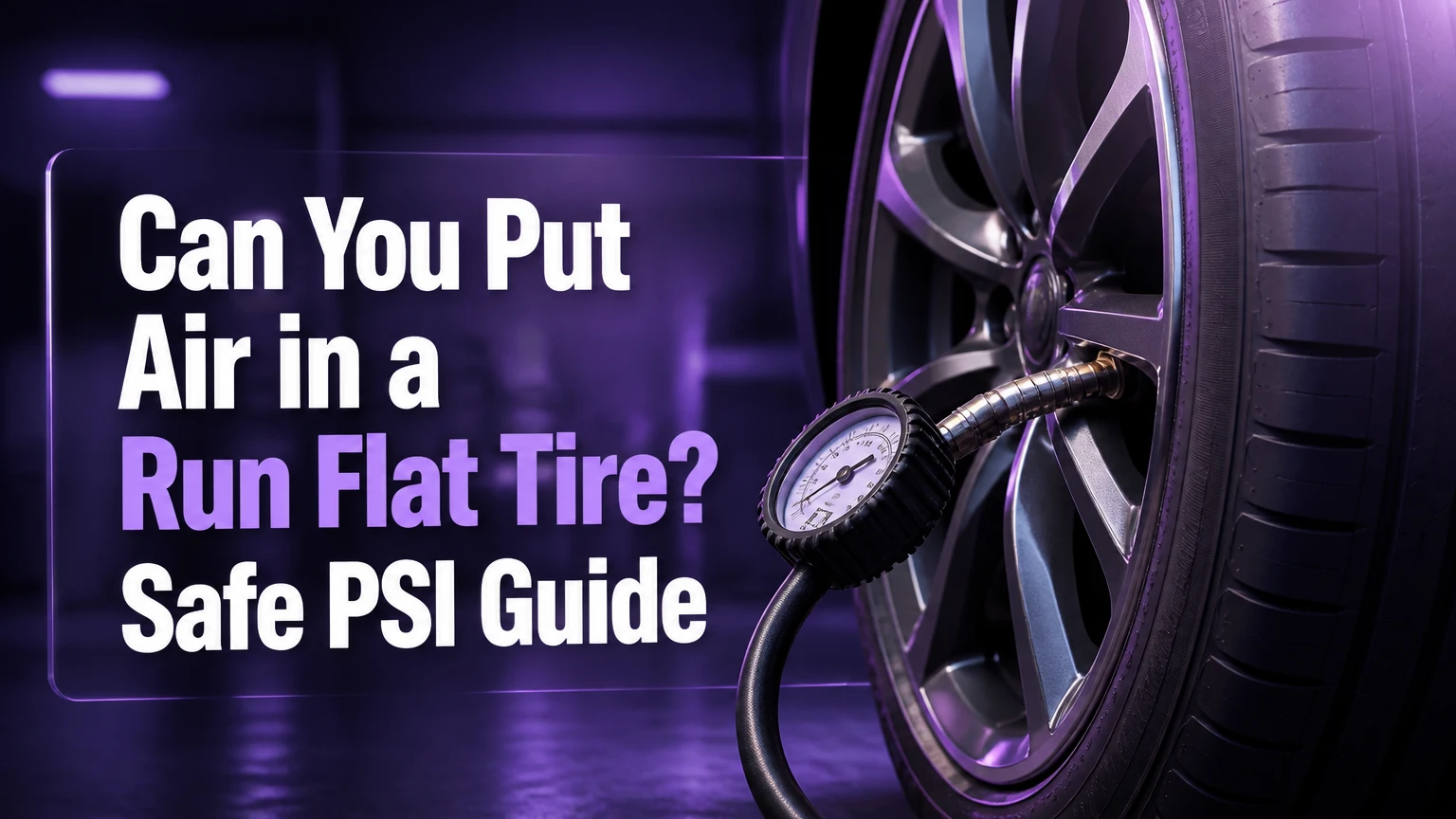
Yes, you can and should put compressed air in a run-flat tire during normal driving. A run-flat tire still uses air to support the vehicle, and its reinforced sidewall only provides temporary support after pressure is lost. Inflate it to the vehicle manufacturer’s door-placard pressure, then inspect the tire if it lost air unexpectedly.
Key Facts at a Glance
A run-flat tire requires normal inflation pressure for its best handling, braking, tread life, and heat control.
The correct pressure appears on the driver-door or door-jamb placard, not on the tire’s maximum-pressure marking.
A run-flat tire that has been driven while severely underinflated may require replacement, even if it accepts air again.
Many manufacturers limit deflated run-flat driving to approximately 50 miles at no more than 50 mph, but the tire and vehicle manual control.
A TPMS warning does not identify the leak location or prove that the tire is safe after inflation.
Do not repair or continue driving on a damaged run-flat until a qualified tire technician has inspected its interior.
Can You Put Air in a Run-Flat Tire?
You can inflate a run-flat tire with a standard tire compressor, service-station air pump, or portable 12-volt inflator. Run-flat construction does not make the tire airtight or eliminate the need for pressure; it gives the tire limited load-carrying ability after deflation.
A properly inflated run-flat behaves as a pneumatic tire. Air carries most of the vehicle’s weight, keeps the tread footprint within its designed shape, and controls sidewall flex. When pressure falls sharply, reinforced sidewalls or an internal support ring carry the load temporarily, generating heat and changing the vehicle’s ride and handling.
Inflation is appropriate when pressure is low because of temperature change or a minor leak. Inflation alone is not a repair for a nail, valve leak, bead leak, sidewall cut, bulge, or damage caused by driving with little or no air.
How much air should a run-flat tire contain?
A run-flat tire should contain the cold inflation pressure printed on the vehicle placard. Typical passenger-car pressures fall around 30-36 psi, but a vehicle may specify different pressures for the front and rear axles, a full load, or a high-speed operating condition.
| Pressure marking | What it means | Safe owner action |
|---|---|---|
| Door placard, 32 PSI | Vehicle’s recommended cold pressure | Inflate to 32 PSI when cold |
| Door placard, 36 PSI | Recommended pressure for another axle or load | Follow the axle-specific value |
| Tire sidewall, 50 PSI | Maximum permitted tire pressure under specified conditions | Do not use as the routine target |
| TPMS threshold, vehicle-specific | Pressure level that triggers a warning | Treat the warning as a prompt to measure pressure |
The number molded into the sidewall is not usually the correct everyday setting. Tire manufacturers such as Bridgestone and Continental direct drivers to use the vehicle manufacturer’s recommended pressure, because the placard accounts for the vehicle’s weight distribution, suspension, wheel size, and load rating.
Check pressure when the tire has been parked for about three hours or driven less than one mile at low speed. Warm air produces a higher gauge reading, so releasing air from a hot tire can leave it underinflated after cooling.
How Do Run-Flat Tires Work?
Run-flat tires use compressed air during ordinary operation and reinforced structures during temporary deflation. Self-supporting models use stiff, heat-resistant sidewalls, while auxiliary-supported designs use a ring mounted inside the wheel.
A self-supporting run-flat, used on many BMW, Mercedes-Benz, MINI, and other vehicles, has reinforced sidewall inserts that resist collapse. The tire remains attached to the wheel bead while the sidewall carries a limited load. The design protects steering control better than an ordinary deflated tire, but it does not preserve normal braking, cornering, comfort, or stopping distance.
An auxiliary-supported run-flat has a support ring fitted to the wheel. When air escapes, the inner surface of the tire rests on that ring. This arrangement is more common in armored, military, and specialized heavy-duty applications than in ordinary passenger cars.
Why does a run-flat tire still need air?
A run-flat tire needs air because pneumatic pressure performs most of the support and suspension work during normal driving. Reinforced sidewalls are an emergency mobility feature, not a replacement for the tire’s designed inflation pressure.
Low pressure increases sidewall flex and heat. Heat can damage rubber compounds, internal cords, and bonding layers even when the tire looks intact from outside. That is why restoring pressure quickly matters, but why adding air to a tire with an active leak must be followed by inspection.
How to Inflate a Run-Flat Tire Safely
Inflate a run-flat tire in five steps: identify the required pressure, measure the cold tire, connect a suitable compressor, fill gradually, and verify the result. The process commonly takes 2-5 minutes for a moderately low passenger-car tire, although a fully deflated tire or small inflator can take longer.
Before You Start
| Requirement | Typical specification | Why it matters |
|---|---|---|
| Tire gauge | Digital or calibrated pencil gauge, 0-60 PSI range | Confirms the compressor display |
| Air source | Portable 12-volt or service-station compressor | Supplies compressed air through the valve |
| Target pressure | Vehicle placard value, often 30-36 PSI | Prevents incorrect inflation |
| Inspection time | 5-10 minutes | Allows a leak and damage check |
| Compressor power | Vehicle-rated 12-volt socket or mains supply | Prevents overheating or blown fuses |
Avoid inflating a visibly damaged tire while standing close to the sidewall. A large cut, bulge, exposed cord, separated tread, or damaged wheel requires roadside assistance or professional inspection.
Step 1: Find the Correct Cold Pressure
Open the driver’s door and read the tire placard on the door pillar, door edge, or fuel-filler area. Record the specified front and rear pressures, because many vehicles use different values.
Do not use the pressure printed on the tire sidewall as the target unless the vehicle manufacturer specifically instructs you to do so. Also confirm whether the placard uses PSI, kPa, or bar; 35 PSI is approximately 241 kPa or 2.4 bar.
Success checkpoint: The target pressure is written down for the correct axle and load condition.
Common mistake: Filling every tire to the same number when the placard specifies different front and rear pressures.
Step 2: Measure the Tire Before Filling
Remove the valve cap and press the gauge squarely onto the valve stem. Measure the pressure before connecting the compressor, then compare it with the placard value.
A difference of 1-2 PSI can result from measurement variation or temperature. A major loss, such as a tire reading 12 PSI instead of 35 PSI, suggests a puncture, valve problem, bead leak, or previous underinflation.
Success checkpoint: You know the tire’s starting pressure and whether the loss is minor or severe.
Common mistake: Assuming the tire is full because the reinforced sidewall does not visibly sag. Run-flats can look normal while carrying dangerously low pressure.
Step 3: Inspect the Tread, Sidewall, and Valve
Look for nails, screws, glass, cuts, bubbles, tread separation, and objects lodged in the tread. Apply a small amount of soapy water around the valve core, valve base, tread object, and rim edge if you suspect a slow leak.
Do not remove a nail before reaching a tire shop unless the tire is already unsafe to drive. Removing the object can turn a slow leak into a rapid leak. A sidewall puncture or cut is generally not repairable.
Success checkpoint: You have identified no severe external damage, or you have decided not to inflate and drive the tire.
Common mistake: Using tire sealant as a substitute for inspection. Sealant can interfere with TPMS sensors and may violate the tire or vehicle manufacturer’s repair instructions.
Step 4: Inflate in Short Bursts
Attach the compressor chuck firmly to the valve stem. Run the compressor in short intervals, especially with a small 12-volt unit, and pause if the manufacturer’s instructions specify a cooling period.
Check pressure after each interval. Stop at the placard value, not at the tire’s maximum sidewall pressure. If the compressor cannot build pressure or the tire loses air as quickly as it gains it, stop and arrange professional assistance.
Success checkpoint: The cold tire reaches the specified pressure and does not immediately fall several PSI.
Common mistake: Holding the compressor continuously until its motor overheats or filling by sound without using a gauge.
Step 5: Recheck and Monitor
Replace the valve cap, measure the pressure again, and compare the result with the first reading. Drive only if the tire has no visible damage, holds pressure, and the vehicle manufacturer permits continued travel.
Check the pressure again after a short trip and the next morning. A repeated loss indicates an unresolved leak. The TPMS warning may take several minutes of driving to clear, depending on the vehicle.
Success checkpoint: The tire remains near the placard pressure after cooling.
Common mistake: Treating a cleared TPMS light as proof that the tire suffered no internal damage.
Can You Drive After Inflating a Run-Flat?
You may drive after inflating a run-flat only when the tire reaches the correct pressure, shows no dangerous damage, and has not exceeded the manufacturer’s deflated-driving limit. A run-flat that was driven at zero or very low pressure still needs a tire-shop inspection before normal use.
Manufacturers commonly publish a temporary mobility limit near 50 miles at no more than 50 mph, or 80 kilometers at 80 kilometers per hour. Those figures are not universal. Continental, Bridgestone, Michelin, and vehicle manufacturers can specify different limits based on tire model, load, temperature, speed, and vehicle.
| Situation | Recommended action | Typical risk |
|---|---|---|
| 3 PSI low, no visible damage | Inflate to placard pressure and monitor | Reduced tread life if ignored |
| TPMS warning, tire holds air | Inflate, inspect, and test for a leak | Slow puncture or valve leak |
| 0 PSI, driven 10 miles at 35 mph | Stop normal use and request inspection | Internal heat damage |
| Sidewall cut or bulge | Do not inflate for driving | Sudden structural failure |
| Pressure falls again within minutes | Do not continue driving | Active puncture or bead leak |
Reduce speed and avoid hard cornering while a pressure-loss warning is active. Run-flat mobility is designed to reach a safe repair location, not to preserve ordinary trip performance.
What happens if a run-flat tire loses all its air?
A deflated run-flat transfers support from air pressure to reinforced sidewalls or an internal support ring. The tire can usually maintain limited mobility, but heat buildup and structural stress rise quickly, especially at high speed, with heavy loads, or on hot pavement.
A TPMS warning is particularly important because a run-flat may not look flat. The U.S. Tire Manufacturers Association describes TPMS as a warning system that alerts drivers to significant underinflation; it does not replace regular pressure checks or a physical inspection.
Can a Punctured Run-Flat Tire Be Repaired?
A punctured run-flat tire may be repairable when the damage is a small puncture in the central tread, the tire has not been driven underinflated, and the tire manufacturer’s repair policy allows it. Many manufacturers recommend replacing a run-flat after any extended deflated driving because internal damage may not be visible.
A tire technician must remove the tire from the wheel and inspect the inside. An external plug alone cannot establish that the cords, inner liner, and sidewall have remained sound. The Tire Industry Association’s repair guidance generally limits permanent repairs to the tread repair area and requires proper internal inspection and combination repair methods.
| Damage or history | Typical outcome | Reason |
|---|---|---|
| Nail in central tread, no low-pressure driving | Possible repair | Damage may fit the repairable zone |
| Puncture near shoulder | Usually replacement | Flexing shoulder area is difficult to repair safely |
| Sidewall cut or bulge | Replacement | Structural sidewall damage cannot be safely patched |
| Puncture larger than about 1/4 inch | Usually replacement | Excessive casing damage |
| Unknown distance driven at low pressure | Inspection or replacement | Hidden heat damage cannot be confirmed externally |
The approximate 1/4-inch threshold is a common industry guideline, not a universal legal limit. Tire model instructions and local regulations control.
Why Does the TPMS Warning Remain After Inflation?
A TPMS warning can remain after inflation because the system has not completed its relearn cycle, a tire still leaks, the sensor is faulty, or the vehicle has not received the correct pressure signal. Some vehicles clear the warning automatically after several minutes of driving, while others require a reset procedure.
A flashing TPMS light, especially when followed by a steady warning, commonly indicates a system fault rather than simple low pressure. A steady light commonly indicates detected underinflation, but dashboard behavior varies by manufacturer.
Check all four tires and the spare if the vehicle monitors it. Then follow the owner’s manual procedure, which may require a reset button, an infotainment-menu calibration, a scan tool, or a short drive above a specified speed.
Do not reset TPMS before correcting the pressure problem. Resetting establishes a reference; it does not inflate a tire or repair a leak.
What Equipment Is Needed?
A run-flat tire can be inflated with ordinary tire equipment, but the compressor must be capable of reaching the vehicle’s required pressure. A portable inflator is useful for topping up, while a service-station compressor is usually faster for a severely low tire.
| Equipment | Typical cost | Best use | Limitation |
|---|---|---|---|
| Digital pressure gauge | $10-$30 | Accurate pressure checks | Requires separate air source |
| 12-volt inflator | $30-$100 | Emergency roadside inflation | Often takes 5-15 minutes per tire |
| Battery inflator | $50-$180 | Convenient topping up | Battery capacity limits repeated use |
| Service-station compressor | $1-$3 or free | Fast inflation | Location may be unavailable |
| Roadside assistance | $75-$150 per call without coverage | Unsafe or damaged tire | Usually provides mobility, not tire repair |
A compressor cannot safely overcome a damaged casing. If air escapes around the bead or through a large puncture, continuing to inflate can waste time and increase risk.
Run-Flat Versus Conventional Tires
Run-flat tires provide temporary mobility after a puncture, while conventional tires generally offer lower purchase cost, greater ride comfort, and broader repair options. Neither design is universally better; the safer choice depends on spare-tire availability, driving environment, vehicle calibration, and tolerance for replacement cost.
| Criterion | Run-flat tire | Conventional tire |
|---|---|---|
| Normal pressure support | Compressed air | Compressed air |
| Temporary deflated mobility | Often about 50 miles at 50 mph, model-dependent | Usually unsuitable for driving |
| Typical replacement price | About $200-$500 each for many passenger vehicles | About $100-$300 each |
| Ride character | Firmer due to reinforced sidewalls | Usually more compliant |
| Puncture repair | More restrictive after deflated driving | Often broader if casing is sound |
| Spare requirement | Many vehicles omit a spare | Spare or inflator kit often needed |
| Tire weight | Commonly higher than comparable standard tire | Commonly lower |
| Inventory | Less common in some local shops | Usually widely available |
A run-flat system is a poor fit for an owner who regularly drives long distances after a warning, carries heavy loads beyond the placard rating, or cannot afford model-specific replacement tires. A conventional tire is a poor fit when the vehicle has no spare and roadside stops would create unacceptable risk.
Are run-flat tires more expensive?
Run-flat tires typically cost 30-50% more than comparable conventional tires, with a broad passenger-car replacement range of approximately $200-$500 per tire. Actual pricing depends on size, speed rating, brand, seasonal design, original-equipment specification, and regional inventory.
Replacement costs can increase when one tire has a different tread depth or model from the others. On some all-wheel-drive vehicles, the manufacturer may limit allowable circumference differences, making two- or four-tire replacement necessary.
Typical tread life is roughly 30,000-40,000 miles, but alignment, pressure, rotation, suspension condition, driving style, and compound determine the result. A run-flat does not automatically wear faster; its stiffer construction can make pressure and alignment errors more consequential.
Common Mistakes and How to Fix Them
Using the sidewall maximum as the target
The sidewall maximum is a tire limit, not the vehicle’s normal cold setting. Release excess pressure only when the tire is cold and the placard confirms a lower value.
Driving because the tire looks full
A reinforced run-flat can hide severe underinflation. Measure every tire with a gauge when the TPMS warning appears, even if the visual inspection looks normal.
Exceeding the temporary mobility limit
The familiar 50-mile and 50-mph figures are maximum emergency guidelines for many products. They are not permission to continue a trip indefinitely, and heat, load, and road temperature can reduce the safe margin.
Mixing run-flats and standard tires casually
Replacing one run-flat with a conventional tire can change steering response, cornering balance, rolling resistance, and electronic-system behavior. Follow the vehicle manufacturer’s axle and tire-type instructions before mixing designs.
Inflating a tire with structural damage
Air pressure can temporarily hide a sidewall injury without restoring its strength. A bulge, exposed cord, deep cut, or distorted bead requires replacement or professional direction.
Resetting TPMS without finding the leak
A reset can silence a warning while the tire continues losing pressure. Record the pressure, check it again after cooling, and have the wheel, valve, bead, and tread inspected.
What If You Have No Compressor?
If a run-flat has a mild pressure loss and no visible damage, drive only the shortest practical distance to a service station while obeying the vehicle’s warning and speed conditions. If the tire is at zero pressure, leaking rapidly, damaged, or on a high-speed road shoulder, use roadside assistance rather than driving to find air.
A tire inflator kit is useful for topping up, but many sealant-and-compressor kits are intended for temporary mobility and may be incompatible with a TPMS sensor or a particular run-flat tire. Read the vehicle manual before injecting sealant.
On a motorway or freeway, move as far from traffic as safely possible, activate hazard lights, and remain behind a barrier when available. The run-flat feature reduces the need for an immediate wheel change, but it does not remove roadside-collision risk.
Frequently Asked Questions
Can a run-flat tire be filled at a gas station?
Yes, a gas-station air machine can fill a run-flat tire because the valve and inflation process are generally the same as for a conventional pneumatic tire. Set the machine to the vehicle placard pressure, verify the result with a separate gauge, and inspect the tire if it lost more than a small amount of air.
Can you use nitrogen instead of air in a run-flat tire?
Yes, nitrogen can inflate a run-flat tire, but ordinary compressed air is safe and more accessible for emergency use. Nitrogen does not correct a puncture, prevent damage from driving underinflated, or replace pressure checks. Maintaining the correct PSI matters more than the gas used.
How long can a run-flat tire sit with low pressure?
A run-flat should not sit or operate at low pressure longer than necessary. If the TPMS warning appears, measure the tire promptly, inflate it if safe, and arrange inspection. Time alone does not determine damage, because load, temperature, speed, and distance also affect heat buildup.
Should all four run-flat tires have the same PSI?
All four run-flat tires should follow the vehicle’s placard, but the front and rear pressures may differ. Load-specific pressures may also apply. Do not equalize the tires by habit, because the manufacturer may tune pressure for axle weight, steering response, and traction.
Can a run-flat tire lose air without a puncture?
Yes, a run-flat can lose air through a leaking valve core, damaged valve stem, wheel corrosion, bead-seat leak, temperature change, or tread puncture. A pressure change of about 1 PSI for every 10 degrees Fahrenheit is a common temperature approximation, but a continuing loss indicates a fault.
The Bottom Line
You can put air in a run-flat tire, and maintaining the correct pressure is necessary for safe normal driving. Use the door placard rather than the sidewall maximum, inspect any tire that lost pressure, and treat temporary zero-pressure mobility as a route to inspection rather than a reason to continue driving.
A run-flat tire that accepts air is not automatically undamaged. If the tire was driven while flat, has sidewall or shoulder damage, loses pressure again, or triggers a flashing TPMS warning, stop relying on the run-flat feature and obtain a professional inspection. That is the safe answer to “can you put air in a run flat tire.”