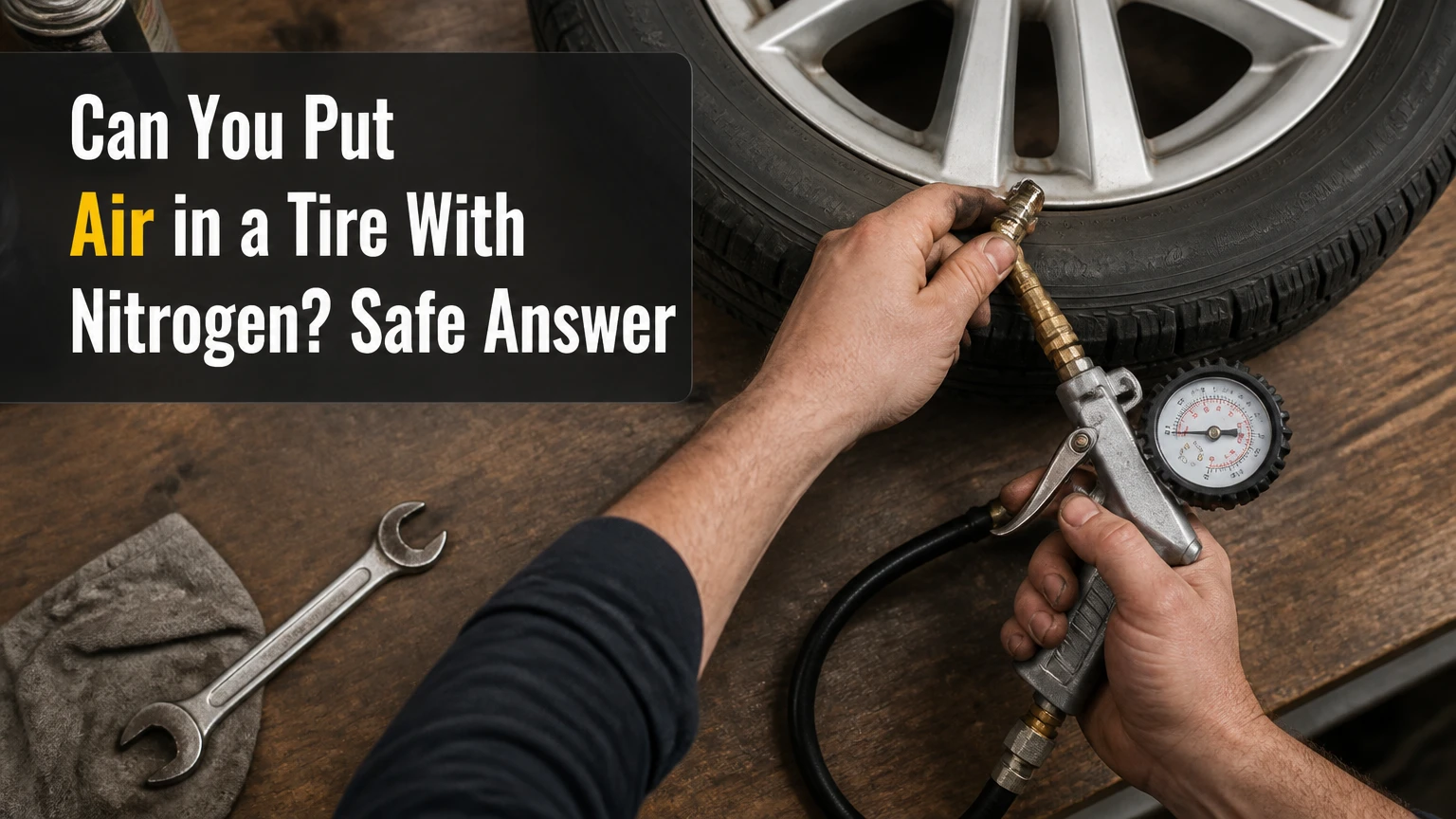
Yes, you can put regular compressed air in a tire filled with nitrogen. Air and nitrogen mix safely because ordinary air is already about 78% nitrogen, and the mixture will not damage the tire, wheel, valve, or TPMS sensor. Add air whenever necessary to reach the vehicle manufacturer’s recommended cold pressure, even if that reduces nitrogen purity.
Key facts at a glance
Regular compressed air is approximately 78% nitrogen, 21% oxygen, and about 1% argon and other gases.
Adding air to a nitrogen-filled tire is chemically safe and does not require immediate purging.
Nitrogen does not prevent punctures, valve leaks, bead leaks, or damage-related pressure loss.
Tire pressure changes with temperature whether the tire contains air, nitrogen, or a mixture.
The driver’s door-jamb placard, not the tire sidewall, gives the correct cold inflation pressure.
A nitrogen purge is optional; restoring correct pressure is the safety priority.
Can You Put Air in a Tire With Nitrogen?
Regular air can be added to a nitrogen-filled tire without harming the tire or changing its safe operating characteristics. The practical result is a mixed gas, not a dangerous reaction, because nitrogen and the gases in compressed air are chemically compatible under normal automotive conditions.
A low tire creates a larger risk than diluted nitrogen. Underinflation increases sidewall flex, heat generation, rolling resistance, and stopping distance, while an air top-off restores the pressure needed for the tire to carry its load correctly. The National Highway Traffic Safety Administration states, “The TPMS low tire pressure warning light is not a substitute for checking tire pressure,” so a nitrogen label does not change basic maintenance.
Nitrogen purity matters in specialized applications, including aircraft tires, industrial equipment, and motorsport procedures that require tightly controlled conditions. For ordinary passenger vehicles, the primary maintenance variable is pressure, not whether the gas is 95% or 99% nitrogen.
Is Mixing Air and Nitrogen Chemically Safe?
Mixing compressed air and nitrogen is chemically safe because both gases remain stable inside a normal tire. The tire does not need a special valve, liner, or seal to tolerate a mixture, and adding air will not cause combustion, corrosion, or a chemical reaction by itself.
| Gas in ordinary dry air | Approximate share | Relevance inside a tire |
|---|---|---|
| Nitrogen | 78% | Main inert component |
| Oxygen | 20.9% | Can support oxidation over long periods |
| Argon | 0.9% | Chemically inactive in normal tire use |
| Carbon dioxide and trace gases | Under 0.1% | Very small contribution |
| Water vapor | Variable, often 0%-4% by volume | Depends on compressor drying and conditions |
Compressed shop air may contain more or less moisture depending on the compressor, tank drainage, filtration, humidity, and service equipment. That moisture does not make a top-off unsafe. Dry nitrogen can reduce moisture-related variability, but passenger tires are designed to operate safely with standard compressed air.
The important distinction is between chemical safety and performance consistency. Air is safe. Dry nitrogen may provide a small maintenance advantage in some conditions.
Does Nitrogen Keep Tire Pressure Longer?
Nitrogen can reduce pressure loss through gradual gas permeation, but the size of the advantage varies and does not justify ignoring monthly inspections. A typical passenger tire may lose roughly 1-2 psi per month from ordinary permeation and minor leakage, while a nitrogen-filled tire may lose somewhat less under comparable conditions, but no single loss rate applies to every tire.
Tire construction, inner-liner material, wheel condition, valve-core sealing, ambient temperature, and punctures affect pressure more than the label on the valve cap. A tire with a damaged valve stem can lose pressure rapidly regardless of its gas composition.
The Tire Rack’s consumer education material describes nitrogen as a way to reduce pressure loss rather than a replacement for maintenance. That framing is more useful than claims that nitrogen prevents leaks. Nitrogen slows some diffusion; it does not seal a nail hole.
Why do air and nitrogen respond to temperature?
Air and nitrogen respond to temperature in broadly the same way because both are gases governed approximately by the ideal gas law. A cold morning can lower tire pressure in either type of inflation, while driving warms the tire and raises its measured pressure.
A common rule of thumb is about 1 psi for each 10°F change, although tire design, initial pressure, speed, load, and measurement conditions change the actual result. Nitrogen does not eliminate the cold-weather TPMS warning. It may contain less moisture, but lower moisture does not override temperature physics.
Measure pressure when the tire is cold, ideally after the vehicle has been parked for at least three hours. Do not release pressure from a hot tire simply because the gauge reads higher after driving.
How Much Nitrogen Is Left After Adding Air?
The remaining nitrogen percentage depends on the starting pressure, the amount added, and whether the tire was previously topped off. A simple example shows why air dilution is gradual rather than an abrupt loss of benefit.
Suppose a tire contains 30 psi gauge pressure and is raised to 35 psi by adding air. Absolute pressure is approximately gauge pressure plus atmospheric pressure, so the starting gas amount is represented by 44.7 psi absolute and the final amount by 49.7 psi absolute. The added gas represents about 10% of the final gas quantity.
If the original tire gas was 95% nitrogen and the added air was 78% nitrogen, the resulting mixture is approximately 93.3% nitrogen. The calculation is approximate because real tires have changing temperature and unknown starting composition, but it demonstrates two points:
- A normal top-off does not instantly turn a nitrogen tire into ordinary air.
- There is no universally valid “critical” 93% or 95% threshold below which nitrogen stops working.
Repeated top-offs with air will progressively move the mixture toward ordinary air. A full deflation and refill can restore a high nitrogen concentration, but the service is optional for most road vehicles.
How Should You Top Off a Nitrogen-Filled Tire?
Use a calibrated air compressor or nitrogen inflator to set every tire to the cold pressure printed on the vehicle placard. The top-off usually takes less than five minutes, and the correct pressure matters more than maintaining gas purity.
Safe top-off procedure
- Check the vehicle placard. Find the recommended cold pressure on the driver’s door frame, door edge, fuel door, or owner’s manual. Use the front and rear values specified for the vehicle and load condition.
- Inspect the tire first. Look for a nail, screw, sidewall bulge, cut, exposed cord, cracked rubber, or a valve stem that moves abnormally.
- Measure pressure when cold. Use a reliable gauge before driving, rather than relying only on the TPMS display.
- Add air immediately if pressure is low. Push the inflator firmly onto the valve and add short bursts until the gauge reaches the placard value.
- Recheck the reading. Remove and reconnect the gauge to confirm the pressure, because a loose chuck can give a false reading.
- Replace the valve cap. The cap helps keep dirt and water away from the valve core, regardless of whether the tire contains air or nitrogen.
- Investigate repeated loss. A tire that loses more than about 2 psi between monthly checks deserves a puncture, valve, bead, or wheel inspection.
You will know the top-off worked when the cold gauge reading matches the placard and the tire does not continue losing pressure. Do not use the maximum pressure molded into the tire sidewall as the vehicle’s normal setting.
Can a Tire Be Converted Back to Nitrogen?
A tire can be converted from a mixed air and nitrogen fill to a higher-purity nitrogen fill, but simply letting the tire down once does not remove all of the original gas. A tire shop must evacuate, purge, and refill the tire while checking for leaks and setting the correct pressure.
A typical shop process includes:
- Deflate the tire completely or remove the valve core using approved equipment.
- Inspect the tire, wheel, valve stem, and TPMS hardware.
- Inflate with nitrogen to a purge pressure, often around 10-15 psi, depending on the machine and service procedure.
- Deflate the purge charge to remove mixed gas.
- Repeat the purge if the desired purity requires it.
- Refill to the manufacturer’s cold-pressure specification.
- Check the valve and bead for leakage before returning the vehicle.
A nitrogen generator may use a membrane system or pressure swing adsorption. Membrane units commonly produce roughly 95%-98% nitrogen for tire service, while PSA systems can produce higher purity, depending on feed-air quality, pressure, flow, and maintenance.
Green valve caps can identify a nitrogen service, but cap color does not prove gas purity. A shop can install green caps after an incomplete purge, and another technician can replace them during ordinary service.
What Is the Difference Between Air and Nitrogen?
Regular compressed air is the better practical choice for most drivers because it is inexpensive, available, and safe. Nitrogen becomes more attractive when free service, long storage, tightly controlled operating conditions, or a large fleet makes small pressure-retention differences valuable.
| Decision factor | Regular compressed air | Nitrogen tire inflation |
|---|---|---|
| Main gas composition | About 78% nitrogen | Commonly about 95%-99% nitrogen |
| Typical availability | Gas stations, repair shops, home compressors | Selected tire shops, dealers, race facilities |
| Typical top-off price | Free to about $2 per tire | Free to about $5 per tire |
| Moisture control | Variable, compressor-dependent | Usually dried and filtered |
| Temperature response | Changes with ambient temperature | Also changes with ambient temperature |
| Puncture resistance | No added protection | No added protection |
| Best practical use | Daily driving and travel | Fleets, motorsport, free service, storage |
| Purge requirement | None | Needed for high-purity conversion |
Does nitrogen improve fuel economy or tread life?
Correct tire pressure improves fuel economy and tread life; nitrogen alone does not guarantee a measurable percentage improvement. Any benefit usually comes from maintaining pressure longer, not from a special chemical effect that makes a correctly inflated tire consume dramatically less fuel.
The U.S. Department of Energy identifies underinflation as a source of increased rolling resistance and reduced fuel economy. That principle applies to both air-filled and nitrogen-filled tires. A driver who checks air pressure monthly can often capture the same meaningful benefit without paying for nitrogen.
Nitrogen can also reduce internal moisture and oxygen exposure, which may matter for long-term wheel or tire aging. In a modern passenger vehicle, however, external road salt, bead corrosion, weather exposure, impact damage, and normal tire aging may matter more.
How Much Does Nitrogen Tire Service Cost?
Typical nitrogen service costs about $5-$10 per tire for an initial fill, or $20-$40 for four tires, although some tire retailers include nitrogen and free top-offs with a tire purchase. A full purge usually takes 15-30 minutes for four tires, while a pressure top-off takes only a few minutes.
| Service scenario | Typical price | Typical time | Practical decision |
|---|---|---|---|
| Gas-station air top-off | $0-$2 per tire | 2-5 minutes | Best emergency option |
| Shop nitrogen top-off | $0-$5 per tire | 2-5 minutes | Useful near the servicing shop |
| Four-tire nitrogen conversion | $20-$40 | 15-30 minutes | Optional for most cars |
| Dealer nitrogen package | $100-$200 | 30-60 minutes | Often poor value unless bundled |
| Fleet nitrogen program | Contract-dependent | Scheduled service | Evaluate across tire and fuel records |
Prices vary by region, membership, tire purchase, and shop policy. A free nitrogen top-off at a warehouse club can remove the main financial disadvantage. Paying a premium while traveling to find a nitrogen station usually creates more inconvenience than value.
Is Nitrogen Worth It for Your Driving Situation?
Nitrogen is worth using when the service is free or when consistent pressure control has a measurable operational value. Regular air is the rational default for most passenger-car owners who can check pressure monthly and need dependable access during travel.
| Driver or vehicle situation | Recommended gas | Reason |
|---|---|---|
| Daily commuter sedan | Regular air | Low cost and universal availability |
| Long-distance traveler | Regular air | Emergency inflation is easier to obtain |
| Warehouse-club tire customer | Nitrogen if included | Free top-offs make the trade-off favorable |
| Track-day or competition vehicle | Dry nitrogen when required | Controlled setup and repeatable operating conditions |
| Heavy-truck or large fleet | Compare measured results | Small pressure differences multiply across vehicles |
| Seasonal classic car | Optional nitrogen | Dry storage conditions may reduce internal moisture |
| RV or trailer | Either, with frequent checks | Load, age, heat, and leaks dominate safety |
Racing teams may use dry nitrogen because they monitor cold and hot pressures precisely and need repeatable setup conditions. That specialized benefit should not be transferred automatically to a family car driven at ordinary road speeds.
Nitrogen is also a poor substitute for correct storage. A vehicle parked for six months still needs pressure checks, flat-spot prevention, battery care, and protection from sunlight and ozone.
What Should You Do if the TPMS Light Comes On?
Inflate the tire to the placard pressure as soon as possible, using regular air if nitrogen is unavailable. A TPMS warning indicates low pressure or a system fault, and the gas type does not make the warning less urgent.
Check all four tires when cold, plus the spare if the vehicle monitors it. If one tire is substantially lower, inspect for a visible puncture and have a tire professional test it. Do not continue driving on a tire that is visibly flat, has sidewall damage, or loses pressure again after inflation.
A sudden cold snap can trigger the warning without a puncture because pressure falls as temperature falls. If the warning remains after inflation, the vehicle may need a TPMS relearn, sensor diagnosis, or repair. Nitrogen does not prevent sensor failures, damaged valve stems, or bead leaks.
What Problems Can Air in a Nitrogen Tire Cause?
The main consequence is lower nitrogen purity, not tire damage. Air may introduce more moisture and oxygen than a properly dried nitrogen supply, but a single top-off does not create a meaningful short-term corrosion hazard in a road tire.
The more serious mistakes are maintenance mistakes:
- Paying for a purge instead of repairing a puncture.
- Deflating a properly inflated tire to preserve a label.
- Setting pressure from the tire sidewall instead of the door placard.
- Measuring a hot tire and releasing pressure.
- Assuming a green cap proves nitrogen purity.
- Continuing to drive after a repeated pressure loss.
A tire that loses pressure repeatedly has a fault requiring diagnosis. Nitrogen may slow gradual permeation, but it cannot fix a punctured tread, leaking valve core, cracked wheel, damaged bead seat, or failing TPMS valve assembly.
Expert rule: prioritize pressure over purity
A correctly inflated air-filled tire is safer than an underinflated nitrogen-filled tire. This rule applies during road trips, winter weather, remote travel, and roadside emergencies because tire load capacity and heat control depend on pressure.
Expert rule: compare cold readings only
A nitrogen-versus-air pressure comparison is invalid when one reading is taken cold and the other immediately after driving. Tire temperature can change the gauge reading enough to overwhelm the small composition-related difference.
Expert rule: investigate unusually fast loss
A loss of more than 2 psi per month is a useful inspection trigger, not a universal failure threshold. Temperature, gauge accuracy, tire age, and seasonal storage affect the number, but repeated loss should prompt leak testing rather than repeated top-offs.
Frequently Asked Questions
Can you mix nitrogen and air in all four tires?
Yes. Mixing nitrogen and compressed air is safe in passenger cars, SUVs, vans, trailers, and motorcycles when the tire, wheel, valve, and pressure rating are correct. The mixture gradually becomes closer to ordinary air as more air is added, but it does not require immediate removal or replacement.
Should you use nitrogen after fixing a flat?
Use whichever clean, available inflation gas restores the correct pressure after the repair. If the vehicle normally uses nitrogen and a shop can refill it conveniently, nitrogen can restore the previous setup, but waiting with an underinflated tire to find nitrogen creates a greater safety risk.
Can a home air compressor fill nitrogen tires?
Yes. A home compressor can inflate a nitrogen-filled tire safely, provided the compressor has a suitable tire chuck and the pressure gauge is accurate. Home compressors may deliver humid air, so they are unsuitable when a specialized application requires controlled gas purity, but they work for normal road vehicles.
Does nitrogen stop a tire from going flat?
No. Nitrogen does not stop punctures, valve leaks, bead leaks, wheel cracks, or impact damage. Nitrogen may reduce slow gas permeation, but a tire that goes flat needs inspection and repair or replacement, regardless of whether it was filled with air or nitrogen.
Can you add nitrogen without removing air?
Yes. A nitrogen top-off adds nitrogen to the existing gas mixture without requiring deflation. A high-purity conversion requires purge cycles because residual air remains inside the tire, but ordinary maintenance does not require removing air before adding nitrogen.
Where should you check the correct tire pressure?
Check the driver’s door-jamb placard or owner’s manual for the vehicle’s recommended cold pressure. The pressure molded into the tire sidewall is generally the tire’s maximum rated inflation pressure, not the normal pressure prescribed for that vehicle.
The Bottom Line
Can you put air in a tire with nitrogen? Yes, and you should do so immediately when the tire is low and nitrogen is unavailable. Air and nitrogen mix safely, but the pressure must match the vehicle placard and a recurring loss must be diagnosed. Nitrogen is an optional maintenance choice, not a requirement for safe everyday driving.