Yes, you can put a wider tire on the same rim when the tire manufacturer approves that tire for the rim’s measured width and the finished assembly clears the vehicle. The tire’s width alone does not decide fitment: rim width, tire diameter, load index, speed rating, offset, suspension clearance, and vehicle specifications all matter.
Key Facts at a Glance
- A wider tire can fit the same wheel only within the tire maker’s approved rim-width range.
- The first number in a tire size, such as 225 in 225/45R17, is the tire’s nominal section width in millimeters.
- Changing width often requires a different aspect ratio to keep rolling diameter near the original specification.
- The commonly quoted 3% diameter guideline is a planning rule, not a universal approval, law, or guarantee of safe operation.
- A wider tire may improve dry cornering, but it can increase road noise, tramlining, rolling resistance, and fender interference.
- Never correct an improperly matched tire by randomly lowering inflation pressure; use the vehicle placard and tire manufacturer’s pressure guidance.
Can You Put Wider Tires on Same Rim?
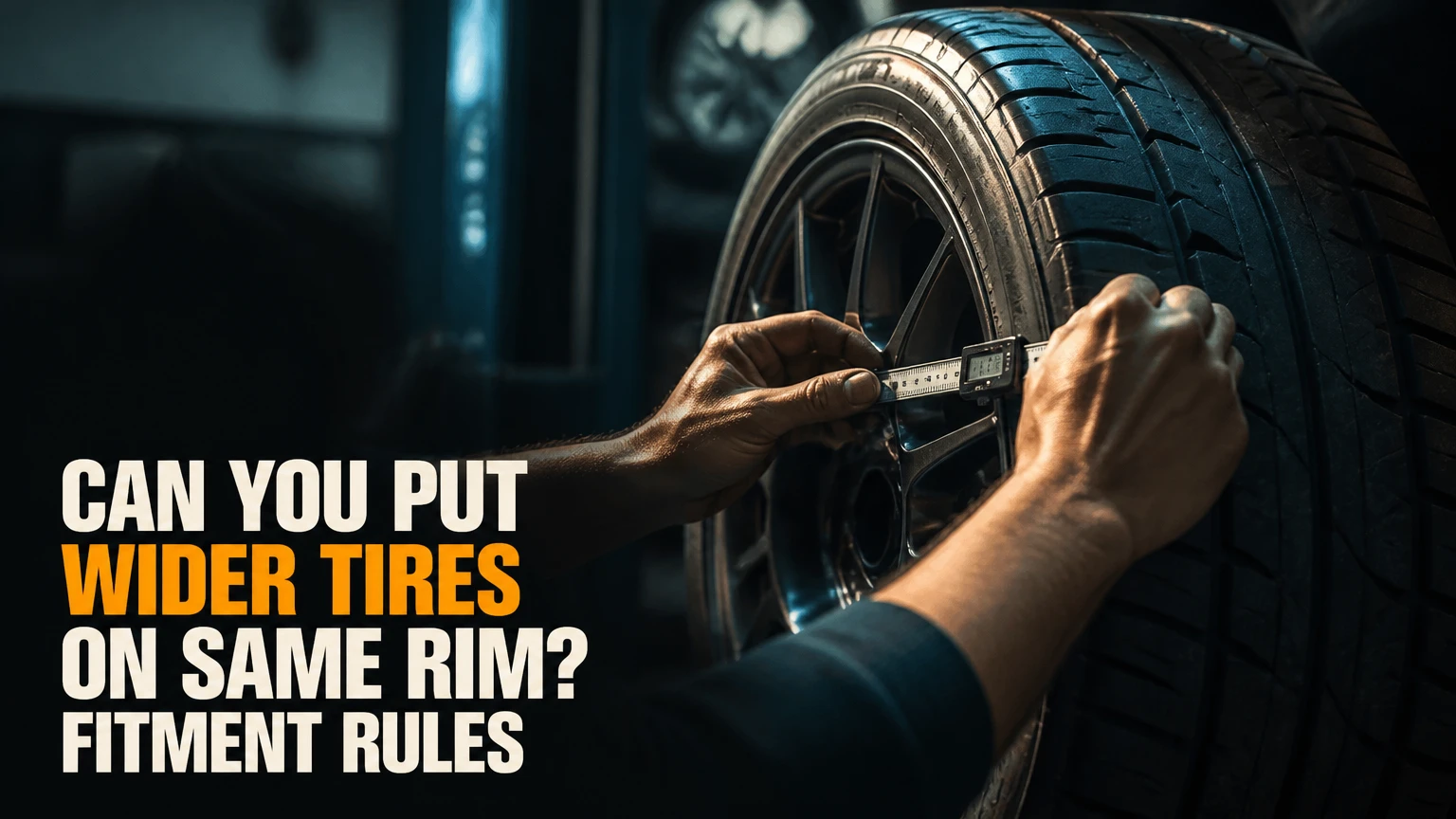
You can put wider tires on the same rim if the proposed tire size appears in the tire manufacturer’s fitment data for that rim width. A 7-inch wheel might accept several tire widths, while another tire model with a similar nominal size may have a different approved range because casing shape and bead construction vary.
A tire shop can physically mount a tire that is outside the preferred range, but successful mounting does not prove that the combination is safe. An overly wide tire can produce excessive sidewall curvature, altered bead seating, poor steering response, center tread wear, or interference with suspension and bodywork.
The correct answer therefore has two parts: the tire must fit the rim, and the complete wheel-and-tire assembly must fit the vehicle. Check both before buying tires.
What does “wider” mean?
A wider tire usually means increasing the first number in the tire size. Moving from 225/45R17 to 235/40R17 increases nominal section width by 10 millimeters while keeping a 17-inch wheel diameter, but the actual mounted width varies by tire model and measuring rim.
Nominal section width is not the same as tread width. Two 235-mm tires can have different tread designs, shoulder shapes, sidewall bulges, and measured section widths. Manufacturer data is more useful than comparing the numbers printed on the sidewall alone.
How Does Tire Size Change?
Tire size changes affect width, sidewall height, overall diameter, circumference, load capacity, steering geometry, and wheel-well clearance. The size code 225/45R17 means a nominal 225-mm section width, a sidewall height equal to 45% of that width, radial construction, and a 17-inch wheel diameter.
For 225/45R17:
- Sidewall height: 225 × 0.45 = 101.25 mm
- Approximate overall diameter: 17 × 25.4 + 2 × 101.25 = 634.3 mm
- Approximate circumference: 1,992 mm
For 235/40R17:
- Sidewall height: 235 × 0.40 = 94 mm
- Approximate overall diameter: 637.8 mm
- Diameter change: approximately 0.55%
That example preserves rolling diameter reasonably well, but it remains acceptable only if the specific 235/40R17 tire is approved for the existing rim and the vehicle has adequate clearance.
Tire-size comparison examples
| Original size | Candidate size | Approximate diameter change | Nominal width change |
|---|---|---|---|
| 195/65R15 | 205/60R15 | -0.43% | +10 mm |
| 205/55R16 | 215/50R16 | -1.66% | +10 mm |
| 225/45R17 | 235/40R17 | +0.55% | +10 mm |
| 245/40R18 | 255/35R18 | -1.36% | +10 mm |
These are mathematical comparisons, not universal fitment recommendations. The tire maker’s approved rim range, the vehicle manufacturer’s replacement-size list, and measured clearance control the final decision.
How Wide Is Too Wide for the Same Rim?
A tire is too wide for the same rim when its approved rim-width range excludes the wheel, when the sidewall assumes an unsafe shape, or when the mounted assembly loses required vehicle clearance. There is no single safe maximum such as “20 millimeters wider” that applies to every vehicle, tire construction, wheel width, and application.
The European Tyre and Rim Technical Organisation, the Tire and Rim Association in North America, and tire manufacturers publish dimensional and fitment information, but their tables are not interchangeable in every market. The approved range can differ for standard-load, extra-load, run-flat, commercial, winter, and off-road tires.
A common passenger-car change of 10 mm may be reasonable. A 20-mm increase may also be approved in one tire-and-wheel combination and unsuitable in another. The number must be verified rather than assumed.
How do you verify rim compatibility?
- Read the wheel marking. A marking such as
17x7.5Jidentifies a nominal 17-inch diameter and 7.5-inch width. The wheel may also show offset, load rating, and manufacturing information. - Confirm the measured width. Rim width is measured between the bead-seat flanges, not across the outer lip.
- Find the tire manufacturer’s table. Check the exact tire model and size, not merely the brand or nominal width.
- Compare the approved measuring rim. Tire specifications often list a measuring rim and an approved minimum and maximum rim width.
- Check the vehicle documentation. The door-jamb placard, owner’s manual, and manufacturer fitment data take priority over generic online calculators.
- Inspect the complete vehicle. Check inner suspension clearance, outer fender clearance, steering lock, and vertical compression.
A tire calculator can identify plausible diameter matches. It cannot approve bead fitment, load capacity, steering clearance, or local legality.
What Changes When the Tire Gets Wider?
A wider tire on the same rim usually develops more sidewall bulge and a different tread shape, while the wheel’s bead seats remain fixed. The sidewalls may angle inward more sharply, and the contact patch can become wider but shorter, depending on inflation pressure, tread design, axle load, and road surface.
A wider tire does not automatically place more usable rubber on the road. If the tire is badly pinched, the center may crown upward and reduce effective contact. If the wheel is too narrow, lateral sidewall flex can delay steering response even when the tire remains inflated.
Tire construction matters more than many buyers expect. A stiff XL casing may respond better than a soft standard-load casing, but XL tires often require different inflation pressures and can ride more firmly. Use the vehicle manufacturer’s pressure instruction unless the tire maker or a qualified engineer specifies otherwise.
Typical effects of a wider tire
| Attribute | Wider tire on same rim | Practical consequence |
|---|---|---|
| Nominal section width | Increases by 10-20 mm | More bodywork and suspension clearance may be required |
| Sidewall shape | More outward bulge | Greater rim-lip protection, but possible steering flex |
| Dry cornering | Often improves on suitable pavement | Benefit depends on compound, temperature, and alignment |
| Wet performance | May decline in standing water | Tread design and speed matter as much as width |
| Rolling resistance | Often increases | Fuel economy or EV range can decrease |
| Ride quality | May become softer with taller sidewall, or harsher with XL construction | Aspect ratio and casing determine the result |
| Steering tracking | Can become heavier or more sensitive to grooves | Commonly called tramlining |
| Vehicle weight | May increase | Extra unsprung and rotational mass affects acceleration and braking |
The U.S. National Highway Traffic Safety Administration emphasizes a basic requirement in its tire-safety guidance: “The tire must be properly inflated.” That principle matters here because neither width nor appearance provides a substitute for correct load support and inflation.
Will a Wider Tire Rub?
A wider tire can rub the strut, control arm, brake hose, fender liner, or outer fender even when the tire fits the wheel. Rubbing risk increases with reduced offset, changed suspension ride height, added steering angle, worn bushings, aftermarket brakes, lowering springs, and suspension compression.
A useful inspection should include more than a stationary visual check. Turn the steering from lock to lock, inspect the inner shoulder, and examine clearance while the suspension is loaded. Front-wheel-drive vehicles often need special attention at full steering lock; trucks and SUVs need inspection at full articulation.
Do not treat 15 mm as a universal minimum clearance. Vehicle manufacturers and tire makers may specify different requirements, and a flexible liner can tolerate less static space than a rigid suspension component. The clearance must remain safe under movement, heat, debris, and tire growth at speed.
Clearance inspection points
| Location | What to inspect | Typical warning sign |
|---|---|---|
| Inner sidewall | Strut, spring perch, control arm | Polished rubber or fresh scuff marks |
| Outer shoulder | Fender lip and arch | Contact during compression |
| Front tire | Liner and splash shield at full lock | Rubbing during parking turns |
| Brake area | Hose, caliper, and wheel barrel | Scraping or heat damage |
| Rear suspension | Lateral movement and articulation | Contact on one side only |
| Tire tread | Stones or debris trapped nearby | Repeated clicking or marks |
If a tire rubs, do not immediately add spacers or roll fender lips. Spacers change wheel offset, bearing loading, scrub radius, and outer clearance. Diagnose the contact point first, then have a qualified technician determine whether the remedy is legal and mechanically appropriate.
Is a Wider Tire Better Than a Wider Wheel?
A wider tire on the existing rim costs less than buying wider wheels, but a wider wheel generally supports the tire’s intended shape more accurately. The best choice depends on whether the goal is appearance, dry-track grip, ride comfort, winter traction, or preserving factory handling.
A wider tire on a narrow wheel can protect the rim and provide a fuller sidewall appearance. A correctly matched wider wheel can reduce sidewall roll and improve steering precision, although it may add weight, reduce ride comfort, expose the rim to impact, and require changes to offset.
| Setup | Main advantage | Main risk | Best use |
|---|---|---|---|
| Factory wheel and factory tire | Predictable calibration and clearance | No width change | Daily commuting and warranty-sensitive vehicles |
| Factory wheel with approved wider tire | Lower wheel purchase cost | Bulge, rubbing, and altered response | Modest appearance or grip change |
| Wider wheel with same tire | More supported sidewall shape | Rim damage and poorer ride if oversized | Precision handling with approved fitment |
| Wider wheel and wider tire | Largest fitment flexibility | Highest cost and clearance complexity | Engineered performance builds |
| Taller narrow tire | Better snow and hydroplaning behavior in some conditions | Less dry-road footprint | Winter and rough-road use |
A wider tire cannot compensate for a wheel whose width is outside the approved range. Conversely, a wide wheel does not solve an incorrect overall diameter, insufficient load index, or vehicle clearance problem.
What Are the Trade-Offs?
A suitable wider tire can improve dry-road cornering and braking feel, but the result is not guaranteed because grip depends on compound, temperature, alignment, pavement, inflation, and available load. Wider tires also commonly increase rolling resistance and sensitivity to road grooves.
Wet-weather performance requires particular caution. A wider tread can be advantageous on wet pavement when its grooves evacuate water effectively, yet a broad tire may hydroplane sooner in deep standing water if speed, tread depth, and water depth are equal. “Wider is better in the wet” and “narrower is always safer” are both oversimplifications.
Ride, noise, and economy also change. A 10-mm increase may be barely noticeable on a heavy sedan, while a low-profile XL tire can produce a clear increase in impact harshness and road noise.
Benefits and drawbacks by driver
| Driver priority | Possible benefit | Likely compromise | Sensible approach |
|---|---|---|---|
| Dry-road cornering | Larger suitable contact area | More tramlining and cost | Use an approved size and tire compound |
| Curb protection | More sidewall beyond rim lip | Sidewall damage remains possible | Keep the tire within the approved range |
| Fuel economy | Usually no direct benefit | Higher rolling resistance and mass | Retain the factory low-rolling-resistance size |
| Ride comfort | Wider size with taller sidewall can help | Low-profile construction can worsen impacts | Compare sidewall height, not width alone |
| Wet-weather driving | Modern tread can maintain water evacuation | Standing-water hydroplaning risk may rise | Prioritize tread depth and wet-grip rating |
| Track use | Better dry response in a matched setup | Heat, wear, and clearance demands increase | Follow the tire maker’s track guidance |
How Should You Check a Candidate Size?
Check a candidate wider tire in seven stages: identify the factory specification, decode the size, verify the rim range, calculate diameter, check ratings, inspect clearance, and confirm pressure and legality. A professional tire shop can complete mounting and balance in roughly 45-90 minutes, but research should happen before installation.
Step 1: Record the factory specification
Photograph the door-jamb placard and note the original tire size, cold inflation pressure, load index, speed rating, and front-to-rear differences. Record whether the vehicle uses a temporary spare, staggered fitment, run-flat tires, or a tire-pressure monitoring system.
Step 2: Measure the wheel information
Clean the wheel and locate markings inside the spokes or barrel. Record diameter, width, offset, bolt pattern, center bore, and wheel load rating. A replacement tire cannot correct an overloaded or structurally damaged wheel.
Step 3: Compare manufacturer fitment tables
Use the exact candidate tire model’s technical data. Confirm that the existing rim width is inside the approved range and that the tire’s load capacity meets the vehicle’s axle requirements.
Step 4: Calculate rolling diameter
Use:
Overall diameter = wheel diameter + 2 × sidewall height
For a metric tire:
Sidewall height = section width × aspect ratio
Keep the calculated difference close to the factory size, but do not treat ±3% as permission. Vehicle speedometer, ABS, traction-control, transmission, and AWD systems may require a much smaller difference or the original diameter.
Step 5: Confirm load and speed ratings
A replacement tire should meet or exceed the vehicle’s specified load index and speed rating unless the vehicle or tire manufacturer provides a specific exception. Passenger, XL, and commercial-load tires should not be substituted casually because their pressure and load relationships differ.
Step 6: Test clearance
Mounting one tire for inspection is safer than purchasing a full set first. Check steering lock, suspension compression, inner and outer sidewalls, brake components, and the spare-tire location where relevant.
Step 7: Set pressure and monitor wear
Use the placard pressure as the starting point for the vehicle, then follow the tire manufacturer’s instructions for special constructions. Recheck pressure cold, inspect after 50-100 miles, and measure tread wear across the inner, center, and outer zones.
What Problems Mean the Setup Is Wrong?
Uneven wear, rubbing, wandering, bead leakage, or changed steering response can indicate incorrect fitment, alignment, pressure, wheel damage, or tire construction. Do not solve these symptoms by making an unverified pressure adjustment, adding a spacer, or continuing to drive until the tire fails.
| Symptom | Likely causes | Correct response |
|---|---|---|
| Center tread wear | Excessive inflation, crowned tread, incorrect tire-rim match | Verify pressure and rim approval; inspect the tire |
| Both shoulders worn | Underinflation, overload, repeated heavy cornering | Check cold pressure, axle load, and alignment |
| Inner shoulder wear | Excessive negative camber or toe error | Perform a four-wheel alignment |
| Rubbing at full lock | Inner liner, offset, steering geometry, oversized section width | Identify contact point before changing offset |
| Steering feels delayed | Excessive sidewall flex, soft casing, low pressure | Confirm approved rim range and pressure |
| Bead leakage | Bead damage, corrosion, poor seating, incompatible rim | Stop using the assembly and have it inspected |
| Vehicle pulls after installation | Unequal pressure, conicity, alignment, staggered mismatch | Check pressure, rotate test positions where permitted, align |
An XL tire is not a universal fix for a tire that is too wide for the wheel. Extra-load construction may stiffen the sidewall, but it does not enlarge the rim’s approved range or create missing fender clearance.
Expert rules of thumb
- Mounting is not approval. A tire machine can install a combination that the tire manufacturer does not endorse.
- The measuring rim matters. Published section width is measured on a specified rim, so the same tire can measure differently on a narrower wheel.
- The sidewall is part of the suspension. A changed casing shape alters compliance, steering response, impact absorption, and the tire’s response to pressure.
- Alignment becomes more important after upsizing. A small toe error can destroy a wider tire’s shoulder quickly, especially on a lowered vehicle.
- AWD systems dislike circumference differences. Four tires should normally remain closely matched, even when the nominal size is identical.
What About AWD, Winter Tires, and EVs?
AWD vehicles, winter tires, and electric vehicles need additional checks before changing tire width. AWD systems can react to unequal rolling circumference, winter tires may need a narrower size for snow performance, and EV tires may have specific load, noise, rolling-resistance, and acoustic requirements.
AWD manufacturers commonly specify a maximum tire circumference difference, but the permitted value varies by drivetrain. Follow the owner’s manual rather than applying a generic percentage. Replace tires in axle pairs or as a complete set according to the manufacturer’s instructions.
Narrower winter tires can cut through slush and deep snow more effectively in some conditions, while a wider tire may float on soft snow. A wider summer tire is not automatically a better winter tire.
EVs place greater emphasis on load index and rolling resistance because battery weight increases axle loads and rolling losses reduce range. Use the vehicle’s approved EV or high-load tire specification when one exists.
What Does the Change Cost?
A wider tire conversion typically costs more than a like-for-like replacement because the tire price, mounting effort, alignment checks, and possible TPMS service add expense. Typical U.S. shop pricing is approximately $100-$240 for mounting and balancing four tires, before tire purchase, taxes, disposal, or alignment.
| Service or item | Typical quantity | Typical U.S. cost | Typical time |
|---|---|---|---|
| Wider passenger tires | 4 tires | $500-$1,200 | 15-30 minutes to select |
| Mount and balance | 4 wheels | $100-$240 | 45-90 minutes |
| Tire disposal | 4 tires | $20-$40 | Included during service |
| Four-wheel alignment | 1 service | $100-$200 | 60-90 minutes |
| TPMS service kits | 4 valves or sensors | $20-$200 | 15-30 minutes |
| Wheel spacers, if approved | 4 units | $150-$400 | 1-3 hours |
Prices vary by tire category, wheel diameter, location, and shop equipment. Low-profile, run-flat, and extra-load tires can require more careful mounting and may cost more.
Is a Wider Tire Legal and Insurable?
A wider tire may be legal and insurable when it meets local equipment regulations, load requirements, fender-coverage rules, and the vehicle manufacturer’s specifications. Regulations differ by jurisdiction, and some areas require the tire to remain inside the bodywork or prohibit certain speed-rating or axle combinations.
Check the vehicle inspection authority, insurer, and tire shop in your location before making a nonstandard change. Keep the factory wheels and tires if the vehicle is leased, under warranty, used for commercial work, or likely to need an emergency roadside replacement.
Frequently Asked Questions
Can I use a wider tire without changing the wheel diameter?
Yes. Keeping the same wheel diameter is common, but the wider tire still needs an approved rim width and a compatible overall diameter. Changing from 225/45R17 to 235/40R17 keeps the 17-inch wheel while changing section width and sidewall height, subject to tire-specific and vehicle-specific approval.
Will a wider tire make my speedometer inaccurate?
A wider tire changes the speedometer only when its overall diameter or circumference changes. The 225/45R17 to 235/40R17 example changes calculated diameter by about 0.55%, which is small, but electronic systems may have tighter requirements than a general 3% planning guideline.
Can I put wider tires only on the rear axle?
Only when the vehicle manufacturer approves a staggered fitment or the tire maker specifies the arrangement. Different front and rear diameters can affect ABS, traction control, handling balance, and AWD operation. A rear-only width increase can also create oversteer or understeer changes.
Should I lower tire pressure after installing a wider tire?
No, not automatically. Tire pressure must support the vehicle’s axle load and follow the door-placard and tire-maker instructions. Lowering pressure by 1-2 psi is not a reliable correction for a pinched profile, incorrect rim width, rubbing, or center tread wear.
Is a wider tire better for a truck or SUV?
A wider truck or SUV tire can improve dry-road appearance and traction on suitable surfaces, but it may reduce mud clearance, increase rubbing during articulation, add weight, and raise hydroplaning risk. Check full compression, steering lock, axle load, wheel offset, and local fender-coverage rules.
What is the safest way to choose the size?
Start with the manufacturer-approved optional sizes for the exact vehicle. Then verify the candidate tire model’s rim-width range, load and speed ratings, rolling diameter, pressure requirements, and physical clearance with a qualified tire professional before purchasing a complete set.
The Bottom Line
Can you put wider tires on same rim? Yes, but only when the exact tire is approved for the rim width and the assembled wheel clears every vehicle component under steering and suspension movement. A 10-mm increase with a carefully calculated aspect ratio can be reasonable, while a 20-mm increase may be unsafe on the same wheel. Verify manufacturer data, load ratings, diameter, pressure, clearance, AWD requirements, and local rules before installation.