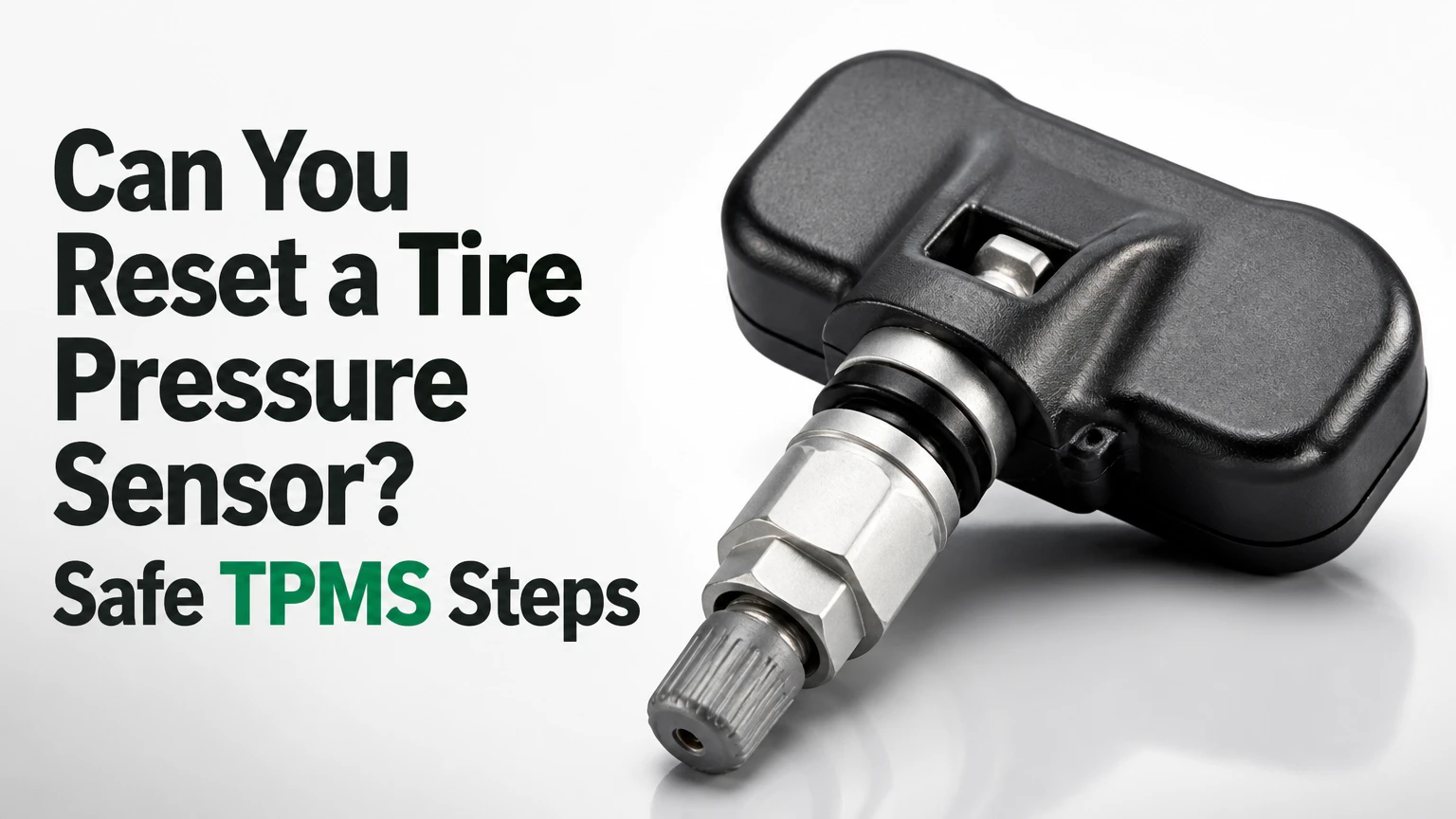
Yes, you can reset a tire pressure sensor or recalibrate a vehicle’s Tire Pressure Monitoring System (TPMS), but the correct method depends on whether the vehicle uses direct or indirect monitoring. Inflate every tire to the driver-door placard pressure first; a reset cannot repair a leak, revive a dead sensor battery, or safely replace diagnosis.
Key Facts
Direct TPMS sensors measure tire pressure inside each wheel and transmit readings to the vehicle.
Indirect TPMS uses ABS wheel-speed data and normally requires calibration after pressure changes.
The recommended pressure is printed on the driver-door placard, not on the tire sidewall.
A solid TPMS light usually indicates low pressure; a flashing light followed by a solid light usually indicates a system fault.
A TPMS reset commonly takes 1-20 minutes, while sensor replacement can require tire removal and programming.
Disconnecting the vehicle battery is not a dependable TPMS reset procedure and can erase other learned settings.
Can You Reset a Tire Pressure Sensor?
You can reset the warning system after correcting tire pressure, but most vehicles do not “reset” the physical sensor itself. A dashboard command usually clears or recalibrates the vehicle’s TPMS control unit, while a relearn procedure registers sensor identities or wheel positions.
The distinction matters because a sensor with a depleted battery, cracked housing, damaged valve, or missing programming data will not become functional after pressing a reset button. Confirm pressure with a reliable gauge before attempting any electronic procedure.
The National Highway Traffic Safety Administration (NHTSA) describes TPMS as a system designed to warn the driver when one or more tires are underinflated by 25% or more below the recommended cold-inflation pressure. That threshold is a warning design requirement, not a target pressure. Tire pressure should be set to the placard value.
What should you check before resetting?
Check all four road tires when cold, inspect for visible damage, and measure pressure with a gauge that reads in 1-psi increments. A tire can look normal while losing enough air to trigger TPMS, especially after an overnight temperature drop.
Use the pressure shown on the vehicle placard, commonly located on the driver-side door jamb, door edge, fuel-filler flap, or owner’s manual. The maximum pressure molded into the tire sidewall describes the tire’s limit and is not the vehicle’s recommended setting.
Which TPMS Type Does the Vehicle Have?
A direct TPMS has a battery-powered pressure sensor mounted inside each wheel, usually as part of the valve-stem assembly. An indirect TPMS has no pressure transmitter in the tire; it estimates a pressure difference from ABS wheel-speed behavior.
Vehicle menus, owner’s manuals, and sensor scans provide the most reliable identification. A live pressure display for each wheel strongly suggests direct TPMS, although some direct systems show only a warning lamp.
| Attribute | Direct TPMS | Indirect TPMS |
|---|---|---|
| Measured input | Internal pressure and often temperature | ABS wheel-speed variation |
| Sensor location | Inside each wheel, usually at valve stem | No tire pressure sensor |
| Works while parked | Yes, when the vehicle receives a transmission | No, calibration needs wheel movement |
| Individual PSI display | Common, depending on vehicle | Uncommon or unavailable |
| Main service item | Sensor, valve seal, battery, programming | ABS data and calibration |
| Typical sensor life | About 5-10 years, vehicle and climate dependent | No dedicated sensor battery |
| Typical reset time | 5-20 minutes, excluding repairs | 1-10 minutes plus driving calibration |
How does direct TPMS measure pressure?
A direct sensor measures air pressure and usually temperature, then sends a radio-frequency message to the TPMS receiver. The vehicle control module associates that message with a wheel position or sensor identification number.
Many original-equipment sensors use a non-serviceable battery. Tire removal can also damage a valve-stem sensor if the mounting area is handled incorrectly, so sensor work belongs with a tire shop when the wheel must be dismounted.
How does indirect TPMS estimate low pressure?
An underinflated tire has a smaller loaded radius and rotates slightly faster than a properly inflated tire. The ABS controller compares wheel-speed signals and flags a pressure difference after the vehicle has a calibrated baseline.
Indirect TPMS cannot reliably detect equal pressure loss in all four tires because the wheel-speed relationship may remain similar. Calibration after setting pressure teaches the system a new reference, but calibration does not measure actual PSI.
How Do You Reset TPMS After Inflating the Tires?
Reset TPMS by correcting cold pressure, selecting the vehicle’s reset or calibration command, and completing the required drive cycle. The exact menu name varies, but the normal process takes about 5-20 minutes for direct systems and 1-10 minutes for indirect systems, excluding tire repairs.
Before You Start
| Requirement | Typical specification | Why it matters |
|---|---|---|
| Tire pressure | Door-placard PSI, such as 32-36 psi | Establishes the safe baseline |
| Tire condition | Cold for roughly 3 hours | Warm air gives a temporarily higher reading |
| Basic tool | Digital or calibrated pressure gauge | Confirms the dashboard is not guessing |
| Reset equipment | Vehicle button or infotainment menu | Handles many indirect systems |
| Relearn equipment | Compatible TPMS activation tool | Needed on selected direct systems |
| Work time | 5-20 minutes | Varies by vehicle design |
| Immediate cost | $0 DIY, roughly $20-$100 shop service | Regional labor and tool access vary |
Step 1: Measure and Correct Cold Pressure
Set all road tires to the placard pressure, including a full-size spare if the vehicle monitors it. Check for nails, cuts, sidewall bulges, valve leakage, and a tire that loses more pressure than the others.
Do not bleed a warm tire down to the placard number unless the manufacturer gives a specific warm-pressure procedure. Pressure normally rises during driving because air temperature increases.
Success checkpoint: Each tire matches the placard value within the gauge’s practical accuracy.
Common mistake: Using the tire sidewall’s maximum pressure instead of the vehicle placard.
Step 2: Switch the Vehicle Into Reset or Calibration Mode
Turn the ignition to the required position, often ON with the engine off, then open the driver-information display or infotainment menu. Common labels include “Tire Pressure,” “TPMS,” “Set Pressure,” “Calibrate,” and “Initialize.”
Some vehicles use a dedicated button beneath the steering column or on the lower dashboard. Hold the button until the indicator blinks, a chime sounds, or the display confirms calibration.
Success checkpoint: The instrument cluster displays a confirmation or the warning lamp changes behavior.
Common mistake: Assuming every vehicle uses the same button sequence. The owner’s manual is the controlling source.
Step 3: Complete the Required Drive Cycle
Start the vehicle and drive on a normal paved road at the speed specified by the manual. A common indirect-system requirement is approximately 20 minutes above 20 mph, or 32 km/h, but some vehicles require a shorter distance, a particular speed range, or several minutes above highway speed.
Avoid aggressive cornering during calibration because wheel-speed differences caused by driving conditions can interfere with the baseline. The light may remain illuminated until the system receives enough valid data.
Success checkpoint: The TPMS lamp turns off after driving, or the display shows current pressure or a completed calibration.
Common mistake: Stopping immediately after pressing reset and concluding that calibration failed.
When Is a TPMS Relearn Required?
A TPMS relearn is required when the vehicle needs to identify new sensor IDs or assign sensors to wheel positions. Relearn is common after replacing a sensor, installing a second wheel set, rotating tires on systems that track positions, or replacing a TPMS control module.
A reset and a relearn are different operations. Resetting establishes a pressure baseline or clears a warning state; relearning teaches the vehicle which sensor is located at each wheel.
| Service operation | Equipment commonly required | Typical time | Result |
|---|---|---|---|
| Inflate and clear warning | Gauge, air source | 5-10 minutes | Corrects pressure-related alert |
| Indirect calibration | Vehicle controls, road test | 5-20 minutes | Stores ABS-based baseline |
| Sensor activation | TPMS trigger tool | 5-15 minutes | Wakes sensor for identification |
| Sensor ID programming | TPMS scan tool or OBD interface | 10-30 minutes | Writes sensor data to vehicle |
| Sensor replacement | Tire machine, new valve sensor | 30-90 minutes | Restores failed hardware |
A TPMS activation tool is not always a programming tool. An activation tool wakes a sensor so the vehicle can read it; a programming-capable scan tool may clone, configure, or write sensor IDs. Buying the wrong inexpensive tool is a common cause of an incomplete repair.
How do you perform a direct-system relearn?
Use the vehicle-specific relearn mode, then activate each sensor in the sequence specified by the manufacturer, often front left, front right, rear right, and rear left. Some vehicles confirm each successful sensor with a horn chirp or dashboard message.
Some Ford models use a brake-pedal and ignition sequence, while selected General Motors vehicles use a dedicated activation procedure. Those examples are not universal instructions. A compatible trigger tool and the owner’s service information prevent incorrect sequences.
Success checkpoint: Every sensor is accepted without a missing-wheel message, and the warning disappears after the vehicle is driven.
Common mistake: Confusing sensor registration with tire inflation. A relearn tool cannot repair a puncture or replace a sensor battery.
What Does the TPMS Warning-Light Pattern Mean?
A solid TPMS light usually means the vehicle has detected low tire pressure, while a light that flashes for roughly 60-90 seconds and then remains solid usually indicates a TPMS malfunction. Manufacturers can vary the timing, so the owner’s manual and diagnostic scan take priority.
| Warning behavior | Most likely meaning | Immediate action | Typical next test |
|---|---|---|---|
| Solid yellow lamp | One or more tires underinflated | Stop safely and measure all tires | Leak and pressure inspection |
| Flashing, then solid | Sensor or TPMS system fault | Check pressure, then arrange diagnosis | TPMS scan and fault-code check |
| Lamp returns after one day | Slow leak or temperature-related pressure loss | Recheck cold pressure | Soapy-water valve and tread test |
| No PSI from one wheel | Missing, dead, or incompatible sensor | Avoid relying on display | Sensor activation scan |
| Warning after wheel change | Sensor IDs not learned or absent | Confirm wheel compatibility | Relearn or sensor programming |
Do not treat a flashing lamp as a harmless reset reminder. A functioning system can have both a pressure problem and a hardware fault, so measure the tires before driving to a repair facility.
Can cold weather trigger the TPMS light?
Cold weather can lower measured tire pressure enough to trigger the warning, even when no puncture exists. A commonly used rule of thumb is about 1 psi change for every 10 degrees Fahrenheit change in air temperature, although tire construction, starting temperature, and measurement conditions alter the result.
Inflate to the placard pressure when the tires are cold, then monitor the reading over the next day. Do not permanently add pressure based only on a hot-tire reading.
Why Does the TPMS Light Stay On After Resetting?
The TPMS light stays on when pressure remains incorrect, a leak continues, the reset procedure was incomplete, or the system has a sensor, receiver, wiring, or software fault. A successful button press does not prove that all sensor data is valid.
Check these causes in order:
- Measure all tires again with the same gauge.
- Inspect the valve stems and tread for leakage.
- Verify the spare tire if the vehicle monitors a fifth sensor.
- Confirm that replacement sensors match the vehicle’s frequency and protocol.
- Perform the correct relearn procedure after wheel or sensor replacement.
- Scan for TPMS fault codes if the light flashes or one wheel gives no reading.
Cheap aftermarket USB chargers, dash cameras, and wireless accessories can occasionally interfere with radio communication on direct systems. Unplug nonessential accessories, drive briefly, and compare the result before replacing hardware.
Can a TPMS reset fix a tire leak?
A TPMS reset cannot fix a puncture, bead leak, corroded wheel, damaged valve core, or loose valve-stem seal. If one tire loses more than about 1-2 psi over several days, treat the condition as a leak until inspection proves otherwise.
A tire shop can use an external inspection, water tank, or soapy-water test to locate leakage. A puncture in the repairable tread area may be repaired under applicable tire-industry rules, but sidewall and shoulder damage generally requires tire replacement.
Should You Disconnect the Battery to Reset TPMS?
You should not disconnect the battery as a routine TPMS reset. Removing the negative cable may reset some vehicle modules, but it does not reliably erase TPMS sensor IDs, repair a failed sensor, or replace the manufacturer’s calibration procedure.
Battery disconnection can also reset the clock, radio presets, window indexing, adaptive transmission values, and diagnostic readiness monitors. Some vehicles require an anti-theft radio code afterward.
The safer approach is pressure correction followed by the factory reset, calibration, relearn, or scan-tool procedure. If the owner’s manual specifically instructs battery removal for a particular repair, follow that documented procedure rather than a generic internet sequence.
What Happens After Tire Rotation or Wheel Replacement?
After tire rotation, an indirect TPMS usually needs calibration because its reference changes with tire pressure and wheel-speed behavior. A direct system may automatically locate each sensor, require a manual relearn, or continue displaying incorrect wheel positions until the IDs are registered.
After installing aftermarket wheels, verify that each wheel contains a compatible sensor before attempting to reset anything. Sensor compatibility includes frequency, communication protocol, valve fitment, and vehicle software support.
| Situation | Reset likely enough? | Additional requirement | Main risk |
|---|---|---|---|
| Added air to original wheels | Often yes | Normal drive cycle | Resetting before finding a leak |
| Rotated tires, indirect TPMS | Usually yes | Calibration after rotation | Baseline stores unequal pressures |
| Rotated tires, direct TPMS | Vehicle dependent | Auto-location or relearn | Wrong wheel displayed |
| New sensor installed | Usually no | Sensor activation and registration | Unprogrammed sensor |
| Winter wheel set added | Usually no | Four compatible sensors and relearn | Missing sensor warning |
| Temporary spare installed | Vehicle dependent | Inflate spare and restore original wheel | Fifth-wheel mismatch |
A temporary spare can disable normal TPMS operation because some compact spares lack a sensor or use a different wheel-speed profile. Drive only as permitted by the spare-tire instructions and restore the correct wheel promptly.
When Should You Replace the Sensor Instead of Resetting It?
Replace or professionally diagnose the sensor when the warning flashes, a wheel reports no pressure, the sensor fails an activation test, or the sensor battery has reached the end of its typical 5-10-year service life. Resetting cannot restore a sealed battery that has lost power.
Typical direct-sensor service costs vary by vehicle and region. A broad independent-shop range is approximately $50-$150 for one sensor, plus tire service or programming; dealer pricing can be higher, while a DIY reset after correct installation may cost nothing.
Replace the valve seal, nut, core, and cap when the sensor manufacturer specifies a service kit. Reusing an old seal after tire work can create a slow valve leak that looks like a sensor failure.
What is the difference between a sensor, gauge, and scan tool?
A tire gauge measures pressure at the valve and does not communicate with the vehicle. A TPMS activation tool wakes a direct sensor and reads its identification data. A scan tool reads fault codes and may program or relearn sensors through the vehicle diagnostic connector.
The tools are not interchangeable. A Bluetooth tire monitor attached to an external valve cap can show pressure on a phone, but it does not repair or reset the factory TPMS.
Is It Safe to Drive With the TPMS Light On?
Driving with a solid TPMS light is safe only long enough to reach a safe stopping place and verify pressure, provided no tire is visibly damaged or severely deflated. Driving normally with an unverified warning increases the risk of heat buildup, poor handling, tread damage, and tire failure.
Do not drive on a tire that is visibly flat, bulging, shredded, rapidly losing air, or damaged in the sidewall. Use the spare or roadside assistance according to the vehicle and tire manufacturer’s instructions.
NHTSA identifies underinflation as a condition that can affect handling, fuel economy, and tire durability. TPMS is a warning aid, not a replacement for monthly pressure checks and inspection before long trips.
How Much Time and Money Does a TPMS Reset Take?
A DIY TPMS reset generally costs $0 and takes 5-20 minutes when the tires are correctly inflated and the vehicle has a built-in reset command. Shop diagnosis or relearn service commonly costs about $20-$100, while sensor replacement typically costs about $50-$150 per sensor before regional labor and tire-service differences.
| Repair scenario | DIY cost range | Shop cost range | Typical completion time |
|---|---|---|---|
| Pressure check and inflation | $0-$10 | $10-$30 | 5-15 minutes |
| Indirect-system calibration | $0 | $20-$60 | 5-20 minutes |
| Direct sensor relearn | $0-$100 tool | $30-$100 | 10-30 minutes |
| One sensor replacement | Usually $40-$100 in parts | $100-$250 installed | 30-90 minutes |
| Four-sensor replacement | $160-$400 in parts | $300-$800 installed | 60-150 minutes |
These are typical planning ranges, not fixed prices. Vehicle access, sensor brand, wheel corrosion, tire size, dealer labor, and whether programming is required can change the final invoice substantially.
What is a realistic home reset workflow?
Budget 10 minutes for pressure measurement and adjustment, 5 minutes for menu operation, and up to 20 minutes for the drive cycle. A home reset is realistic when the warning is solid, all sensors are original, the tires hold air, and the manual provides a dashboard calibration command.
Professional service becomes the better choice when the lamp flashes, a sensor was replaced, the vehicle cannot enter relearn mode, or the warning returns quickly. The cost of a scan is lower than repeatedly replacing parts without confirming the fault.
Common Reset Mistakes and Their Fixes
The most expensive TPMS mistakes come from treating a warning lamp as a software problem. Correct pressure, sensor communication, wheel compatibility, and leak condition must be separated during diagnosis.
- Resetting a low tire: Inflate first, then repeat calibration. Otherwise, the system may store an unsafe baseline.
- Using sidewall pressure: Replace the sidewall number with the door-placard specification.
- Ignoring the spare: Measure the spare when the vehicle monitors a fifth sensor.
- Using an incompatible sensor: Match the vehicle application, frequency, protocol, and programming requirement.
- Expecting instant results: Complete the specified drive cycle before judging the reset.
- Replacing a sensor without checking the valve: Inspect the seal, core, and stem for leakage.
- Using battery disconnection: Restore the cable if removed, then use the documented TPMS procedure.
- Trusting one gauge: Compare a questionable gauge against a known accurate digital gauge or tire-shop gauge.
The Bottom Line
You can reset a tire pressure sensor system, but you must first set every tire to the vehicle’s cold placard pressure and identify whether the vehicle uses direct or indirect TPMS. Use the factory calibration command for ordinary pressure changes, perform a sensor relearn after wheel or sensor work, and seek a scan when the light flashes or returns.
A reset does not repair a tire leak or revive a dead sensor battery. For the query can you reset a tire pressure sensor, the accurate answer is yes, provided the warning reflects corrected pressure and the vehicle’s prescribed reset or relearn procedure is followed.
Frequently Asked Questions
Can I reset TPMS without a tool?
Many vehicles allow a reset without a separate tool through a dashboard button, infotainment menu, or ignition sequence. Indirect systems commonly need only calibration and a drive cycle. Direct systems may require an activation tool after sensor replacement, especially when the vehicle cannot automatically learn new sensor IDs.
How long does the TPMS light take to turn off?
The light may turn off immediately after pressure correction on some vehicles, but many systems need 5-20 minutes of driving before confirming the new data. A flashing light that persists after the drive cycle usually indicates a hardware or communication fault rather than ordinary low pressure.
Do new tires need new pressure sensors?
New tires do not automatically require new pressure sensors. Existing sensors can usually be reused if their batteries, valve hardware, and housings remain serviceable, but the tire installer should inspect the seal and perform a sensor test before mounting the replacement tire.
Can I replace only one TPMS sensor?
You can replace one sensor when testing identifies one failed unit and the other sensors remain functional. Replace the sensor with a vehicle-compatible part, install the correct valve service kit, and complete the required relearn. Replacing all four becomes sensible when several original batteries are near the same age.
Why does my car show pressure after I add air but keep the warning light?
The vehicle may need a completed calibration cycle, or one tire may still be below the placard pressure after cooling. Check pressures again when cold, inspect for a slow leak, and check the spare if monitored. If the lamp flashes, obtain a TPMS diagnostic scan instead of repeating resets.
Can a tire-pressure warning be caused by a bad ABS sensor?
An indirect TPMS can report a fault when an ABS wheel-speed sensor, tone ring, wiring circuit, or ABS module has a problem. A direct TPMS generally points toward tire sensors, the receiver, or related wiring. Diagnostic trouble codes distinguish these systems, so repeated calibration will not repair failed ABS hardware.


