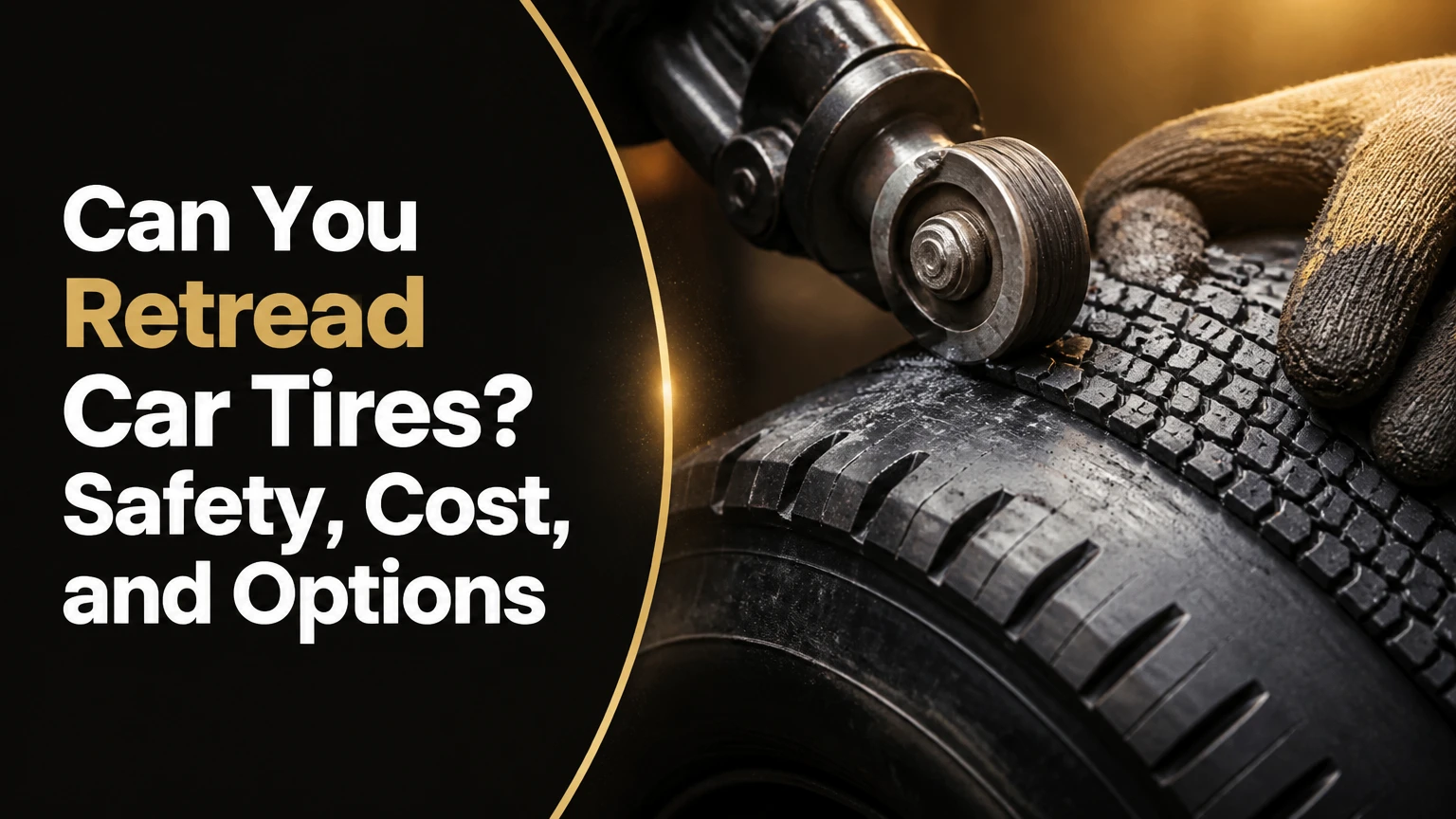
Passenger car tires can be physically retreaded, but consumer-car retreading is uncommon because suitable facilities, sound casings, and low prices rarely align. Retreading is usually practical for commercial truck, bus, aircraft, agricultural, and specialty off-road tires, while most daily drivers receive better value and simpler warranty support from a properly selected new tire.
Key Facts at a Glance
- A tire retread replaces worn tread while preserving the inspected casing, also called the carcass.
- Passenger-car retreads exist, but most tire shops do not manufacture or stock them.
- A retread cannot make an aged, overheated, impact-damaged, or internally separated casing safe.
- Commercial retreading can reduce purchase cost and raw-material use because one casing may receive more than one tread.
- A new budget tire is often cheaper than a passenger retread after shipping, fitting, balancing, and casing charges.
- United States requirements for retreaded tires include applicable Federal Motor Vehicle Safety Standards, labeling, and traceability rules; local requirements differ.
Can You Retread Car Tires?
Yes, a passenger car tire can be retreaded when a qualified retreader accepts the casing and the finished tire meets applicable safety requirements. The practical answer for most sedan, hatchback, crossover, and minivan owners is usually no, because consumer casings are inexpensive, retail demand is limited, and replacement options are easier to source.
Retreading is a manufacturing operation, not a tread-replacement service performed with glue. The retreader removes the worn tread, examines the casing for hidden damage, repairs only permitted defects, applies bonding rubber and new tread, then cures the assembly under controlled heat and pressure.
The distinction between “can” and “should” matters. A commercial truck casing may be designed, maintained, and tracked for retreading, whereas a passenger tire may have experienced pothole impacts, low-pressure flexing, curb strikes, long storage, or heat exposure that is difficult to document.
Passenger retreads were more common when new tires cost substantially more relative to household income. Modern high-volume manufacturing has narrowed that price gap. The result is a technically possible product with a weak consumer market.
What Does Tire Retreading Replace?
Tire retreading replaces the worn tread rubber and preserves the casing only if inspection confirms that the casing remains structurally sound. The steel belts, textile plies, bead area, inner liner, and sidewall structure remain part of the reused foundation, although approved repairs may restore limited localized damage.
The casing carries the vehicle load and contains inflation pressure. Tread rubber supplies the contact surface, drainage channels, braking edges, and traction compound. Retreading therefore treats tread as a replaceable wear component, but it does not reset the tire’s age, usage history, or previous damage.
Terms vary by industry:
- Retread is the general manufacturing term.
- Recap is common in North American commercial tire language.
- Remold often describes a process that applies tread and sometimes sidewall rubber inside a mold.
- Casing and carcass refer to the structural tire body.
- Buffing removes the old tread and prepares the casing radius.
A retread is not the same as a used tire. A used tire has its original tread and history. A retread has a new tread bonded to an inspected used casing.
How Is a Tire Retreaded?
A commercial retread normally passes through inspection, buffing, casing repair, bonding, tread application, curing, and final inspection. The exact machinery differs by manufacturer, but every credible process must control casing selection, tread alignment, bond quality, curing conditions, and final verification.
The Industrial Retreading Process
| Stage | Typical operation | Main defect or control |
|---|---|---|
| Initial inspection | Visual, tactile, inflation, and nondestructive checks | Separations, bruises, bead damage, exposed cords |
| Buffing | Removes old tread and creates a uniform radius | Correct buffing depth and casing profile |
| Skiving and repair | Removes localized damaged rubber and installs approved repair material | No unrepaired cord, liner, or belt damage |
| Tread building | Applies pre-cured tread or uncured rubber | Centering, splice quality, uniform gauge |
| Enveloping and curing | Uses vacuum, heat, pressure, and time to bond materials | Complete adhesion without trapped air |
| Final inspection | Checks appearance, balance, dimensions, and bond integrity | Rejects blisters, voids, runout, and surface defects |
The first inspection is the most important decision point. Shearography, inflation inspection, electrical checks, and trained visual examination can reveal separations or voids that a casual external inspection misses, but no test gives a damaged casing the properties of a new one.
Buffing removes oxidized and worn tread rubber while truing the casing. Excessive buffing can reduce the remaining structural material; insufficient buffing can leave contaminated rubber that weakens adhesion.
Minor repair work may include drilling out a localized injury, repairing the inner liner, and filling the prepared cavity with compatible rubber. A retreader should reject a casing with severe sidewall flex damage, bead-wire damage, major belt separation, repeated puncture injury, or evidence of prolonged operation while underinflated.
How Does the New Tread Bond to the Casing?
The new tread bonds through cushion gum and vulcanization, not through a simple surface adhesive. Heat and pressure cause compatible rubber compounds to cross-link into a durable bond, while the cement layer improves tack and helps protect the prepared casing surface during assembly.
Two common methods are used:
| Method | Tread material | Typical curing range | Common application |
|---|---|---|---|
| Pre-cure | Already molded tread strip | About 100-125°C | Long-haul and regional commercial tires |
| Mold-cure | Uncured rubber shaped and cured in a mold | About 150-165°C | Specialty, off-road, and selected remold products |
| Ring or Unicircle | Seamless pre-cured tread ring | About 100-125°C | Selected commercial casings |
| Custom mold remold | Uncured tread and sidewall compound | Manufacturer-specific | Specialty and some light-truck products |
“Cold retread” is an imperfect shorthand for pre-cure. Pre-cure still uses heat during bonding; it simply avoids molding the entire tread pattern from uncured rubber at the same temperature used by a mold-cure process.
Which Retread Technology Fits Each Tire?
Pre-cure is the dominant commercial method because a retreader can apply many tread designs without owning a dedicated mold for every size. Mold-cure can produce a seamless appearance and integrated sidewall treatment, but its tooling cost and heat exposure make it less flexible for low-volume passenger sizes.
| Decision factor | Pre-cure | Mold-cure | Seamless ring |
|---|---|---|---|
| Tread appearance | Visible splice possible | Seamless molded pattern | Seamless tread face |
| Tooling requirement | Tread strips by size and design | Dedicated mold sizes | Diameter-specific rings |
| Flexibility | High, multiple patterns | Lower, mold-dependent | Medium, ring-dependent |
| Typical market | Truck fleets and buses | Specialty and off-road | Premium commercial service |
| Passenger-car relevance | Limited | Historically used in niches | Rare |
A passenger-car owner should not select a retread by process name alone. Casing condition, manufacturer traceability, speed rating, load index, wet-grip behavior, warranty, and local regulatory compliance matter more than whether a tread was pre-cured or mold-cured.
Are Retreaded Tires Safe?
Certified retreaded tires can be safe when the casing is suitable, the manufacturing process is controlled, the tire is correctly matched to the vehicle, and inflation is maintained. Retread safety is not guaranteed by the presence of new tread, because the reused casing remains the pressure vessel and structural load path.
The U.S. Tire Manufacturers Association identifies underinflation, overloading, improper maintenance, and road hazards as major contributors to tire failures across tire categories. The familiar strips of rubber on highways, often called “alligators,” do not prove that a retread splice failed; new tires can also separate after severe heat and flex damage.
A useful practitioner rule is simple: retreading preserves casing history, not merely casing shape. A fleet that records pressure, rotation, repairs, mileage, and removal reasons can identify good casing candidates. A private owner who bought an unknown used tire cannot usually reconstruct that history.
Safety also depends on application. Passenger cars generate frequent steering, braking, cornering, and suspension loads, while commercial retread programs often use standardized casings with known construction and controlled axle service. That difference does not make every passenger retread unsafe, but it reduces the margin for casual purchasing.
How Much Do Passenger Retreads Cost?
A passenger-car retread may historically have sold for roughly $40-$70 per tire in markets where the product was available, while a typical new economy tire may cost about $55-$90 before installation. Current prices vary sharply by country, size, brand, shipping, casing exchange, taxes, and whether the quoted price includes mounting and balancing.
| Purchase factor | Passenger retread, typical | New economy tire, typical | Cost consequence |
|---|---|---|---|
| Tire-only price | $40-$70 | $55-$90 | Retread has a possible $15-$50 headline advantage |
| Mount and balance | $20-$40 | $20-$40 | Usually similar for both products |
| Shipping or special order | $0-$60 | $0-$25 | Rare retreads can lose the price advantage |
| Warranty and returns | Seller-specific | Often standardized | New tire usually has simpler recourse |
| Availability | Days to weeks | Same day to several days | Downtime can outweigh savings |
These are typical market ranges, not a current quote. A retread may also require a usable casing exchange, a shipping fee, or a minimum order. The relevant comparison is installed cost per usable mile, not the tire’s advertised price.
For example, a $60 retread that requires $35 shipping and has uncertain warranty coverage may cost more than a $78 new tire purchased locally. A fleet buying hundreds of uniform commercial casings has a different calculation because casing exchange, predictable supply, and mileage data reduce transaction costs.
How Long Do Retreaded Tires Last?
A quality commercial retread can deliver approximately 80%-100% of the mileage of a comparable mid-tier new tire when the casing, tread compound, axle position, load, inflation, and maintenance are appropriate. Passenger-car mileage is less predictable because consumer retreads have fewer standardized casing histories and more varied driving conditions.
Premium commercial casings are often retreaded two or three times, but that figure does not transfer to passenger tires. Each retread cycle removes material, adds heat exposure, and depends on the casing’s original design and service record.
| Tire application | Typical retread potential | Main limiting factor |
|---|---|---|
| Long-haul truck steer or trailer casing | 1-3 retreads | Casing inspection and removal history |
| Regional delivery truck | 1-2 retreads | Curbs, loading cycles, and urban impacts |
| Bus or coach tire | Manufacturer-specific | Load, speed, and local regulation |
| Passenger sedan tire | Often 0-1, where offered | Low casing value and unknown history |
| Light-truck off-road casing | Manufacturer-specific | Cuts, sidewall bruising, and heat |
Tire age remains relevant after retreading. A new tread does not make an old casing new, and manufacturers may impose age limits or inspection conditions. The Department of Transportation identification code, date code, manufacturer markings, and retreader documentation should remain traceable.
Are Retreads Legal on Passenger Cars?
Retreaded passenger tires are legal in some jurisdictions when they comply with the applicable technical, labeling, and sale requirements. In the United States, Federal Motor Vehicle Safety Standard No. 117, codified at 49 CFR 571.117, addresses retreaded pneumatic tires, including requirements that apply to covered tire categories.
Legal treatment is not identical everywhere. Canada, the United Kingdom, the European Union, Australia, and individual U.S. states may apply different approval, marking, testing, or sale rules. A DOT symbol alone is not a substitute for checking the complete tire marking and the seller’s compliance documentation.
Before purchase, verify:
- The finished tire carries the markings required in the country of sale.
- The tire’s load index and speed rating meet or exceed the vehicle manufacturer’s specification.
- The retreader can identify the casing and manufacturing facility.
- The product has a written warranty covering tread separation and workmanship.
- The tire is approved for the intended axle, vehicle class, and operating speed.
- The seller can explain whether the product is a retread, remold, or used tire.
A reputable installer should also confirm wheel condition, inflation pressure, TPMS compatibility, and whether the vehicle manufacturer restricts mixed tire types or axle combinations.
Should You Retread or Buy New Tires?
Most owners of standard passenger cars should buy new tires, while commercial fleets should compare retreading through cost-per-mile and casing-management data. The decision changes with vehicle type, annual mileage, tire size, local availability, and the consequences of downtime.
| User and vehicle | Retreading decision | Better default | Reason |
|---|---|---|---|
| Sedan or hatchback, under 15,000 miles yearly | Usually avoid | New tire | Low annual mileage and weak supply |
| Crossover or minivan, family use | Usually avoid | New tire with correct load rating | Frequent mixed-weather and passenger loads |
| Delivery van, high annual mileage | Evaluate professionally | Fleet retread program | Data can support casing reuse |
| Heavy truck or bus fleet | Often appropriate | Managed retread cycle | High casing value and predictable mileage |
| Specialized off-road vehicle | Case-by-case | Specialty retread or new LT tire | Cuts and sidewall damage dominate risk |
A new tire generally offers clearer DOT date information, broader availability, predictable vehicle fitment, and a manufacturer-backed warranty. A retread can offer lower material consumption and a useful cost-per-mile advantage, but only when the supply chain and casing controls are strong.
The most important comparison is not “new versus retread” in the abstract. It is “verified retread on a documented casing versus new tire with known specifications.” An unknown retread from an informal seller is a poor substitute for either option.
What Are the Environmental Benefits?
Retreading reduces demand for new casing materials because the structural body is reused instead of manufactured again. The U.S. Tire Manufacturers Association describes retreading as a way to conserve materials and divert usable tire components from waste streams, although the precise savings vary by tire size, process, compound, and plant.
Commercial sources commonly report that retreading can preserve a substantial portion of the original tire’s material investment. Claims such as 70% raw-material savings or 50 kilograms of rubber per truck tire are application-specific and should not be applied to a passenger tire without a product life-cycle assessment.
Environmental value depends on the complete system:
- A local retread with a durable casing may reduce transport and material demand.
- A short-lived product that requires early replacement may reduce the benefit.
- Proper collection and recycling of the removed tread reduce waste further.
- A new tire made efficiently and used for its full service life remains a competing baseline.
Environmental benefit is therefore strongest in commercial fleets that inspect, retread, and eventually recycle casings through documented channels.
What Causes a Retread to Fail?
Underinflation, overloading, impact damage, casing separation, poor bonding, incorrect installation, and excessive age can cause a retreaded tire to fail. Tread separation is not automatically evidence of a defective retread, because heat generated by low pressure can damage the casing before the separation becomes visible.
Common Failure Modes
| Symptom | Likely cause | Immediate response |
|---|---|---|
| Tread lifting at a seam | Bonding or splice problem, heat damage | Stop driving and have the tire inspected |
| Bulge in the sidewall | Impact or ply separation | Replace the tire; do not repair a bulge |
| Repeated vibration | Runout, imbalance, bent wheel, poor centering | Rebalance and inspect wheel and casing |
| Rapid shoulder wear | Incorrect pressure, alignment, or overload | Check pressure, alignment, and load |
| Air loss at bead | Wheel corrosion, bead damage, valve issue | Deflate safely and inspect professionally |
| Cracking between tread blocks | Aging, ozone, heat, or compound stress | Remove from service if cracking is deep |
Never continue driving on a tire with a sidewall bulge, exposed cord, deep cut, rapid pressure loss, or visible tread separation. A plug or patch cannot correct structural damage, and a new tread layer cannot restore a broken belt.
A practical fleet rule is to record cold inflation pressure at least monthly and before long trips, inspect after major impacts, and remove a casing when its history becomes uncertain. TPMS helps detect pressure loss, but it does not replace a gauge check or physical inspection.
Where Can You Buy a Passenger Retread?
Passenger retreads are usually available only through specialty retreaders, regional distributors, commercial tire dealers, or mail-order sellers that identify the product clearly. Most ordinary retail tire shops sell new tires and may not accept a consumer casing for custom retreading.
Ask the seller these questions:
- Who manufactured the retread and where?
- What casing brands and sizes are accepted?
- What inspection method screens for separations?
- What are the load index, speed rating, and tread depth?
- Is the casing age documented?
- Does the warranty cover workmanship, bonding, and road hazards?
- Is the quoted price installed, balanced, and inclusive of disposal fees?
- Can the product be legally sold for the intended vehicle in your jurisdiction?
Avoid listings that describe a product only as “like new,” “recapped,” or “used” without a manufacturer name, size markings, date information, rating, and warranty. A lower price cannot compensate for missing traceability.
What Should Fleet Managers Do Differently?
Fleet managers should treat retreading as a casing-management program rather than a one-time tire purchase. The program should record tire identification, removal reason, inflation history, repair events, mileage, axle position, and retread count so that poor casing candidates are removed before they reach the plant.
Retreading tends to work best when fleets standardize tire sizes, use approved tread designs by axle, maintain inflation, and purchase from a retreader with consistent inspection and warranty procedures. Commercial brands such as Bandag, Michelin Retread Technologies, Goodyear, and independent regional retreaders operate in different markets, so brand availability does not eliminate the need to check the specific product.
A fleet should compare:
| Metric | New tire program | Retread program | Decision signal |
|---|---|---|---|
| Initial tire cost | Higher per casing | Lower per tread cycle | Retread advantage if casing survives |
| Casing control | Not required | Required at every removal | Poor records increase rejection |
| Supply lead time | Often same day | Commonly 24-48 hours for managed batches | Stock planning matters |
| Cost-per-mile data | Simple | Requires tracking by casing | Use actual fleet history |
| Failure investigation | Manufacturer and installer | Retreader and casing history | Traceability is essential |
Commercial operators should also confirm whether the retread is suitable for steer, drive, trailer, bus, or specialty service. A tread designed for one axle position is not automatically appropriate for another.
FAQ
Can You Retread a Tire With a Puncture?
A casing with a properly repairable puncture may be eligible for retreading, but the retreader must inspect the injury, remove damaged material, repair the inner liner and cord area according to its procedure, and confirm that the repair meets its standards. Sidewall, shoulder, bead, and run-flat damage often disqualify the casing.
Are Retreaded Tires Good in Winter?
A retread can perform in winter only when its tread pattern, rubber compound, siping, and rating suit snow and cold temperatures. Many commercial retreads use specialized regional or winter designs, but a generic passenger retread should not be assumed to match a new winter tire’s cold-weather performance.
Can You Put One Retread on a Car?
Installing one retread on a car may create differences in tread depth, construction, traction, and handling, even when the size matches. Follow the vehicle and tire manufacturer’s placement guidance, avoid mixing incompatible products on the same axle, and have a qualified installer assess the complete set.
Does Retreading Reset a Tire’s Age?
Retreading does not reset a tire’s age. The casing retains its original manufacturing date, heat cycles, repairs, and service history, while the tread receives a new production date or retread identification. Check the casing and retreader markings before treating the tire as suitable for service.
Can SUV Tires Be Retreaded?
Some light-truck and specialty SUV tires can be retreaded, particularly heavy-duty LT casings used in commercial or off-road service. Passenger-rated crossover tires are less attractive candidates because their casings are inexpensive, their sizes change quickly, and retail retread supply is limited.
Is a Used Tire a Retread?
A used tire is not automatically a retread. A used tire retains its original worn or partially worn tread, while a retread has undergone casing inspection, tread removal, bonding, curing, and final inspection. Sellers should identify which product they are offering and provide its markings and warranty.
The Bottom Line
Can you retread car tires? Yes, technically and legally in qualifying markets, but most passenger-car owners should replace worn tires with new tires from a reputable manufacturer. Retreading becomes more compelling for high-mileage commercial fleets, heavy-duty light trucks, buses, and specialty equipment where documented casings, controlled maintenance, and cost-per-mile data justify the process.
For a daily driver, compare the complete installed price, warranty, age, load index, speed rating, wet-weather performance, and local support. For a fleet, evaluate casing records and failure data before choosing a retread cycle. The safest purchase is the tire whose construction, history, rating, and maintenance requirements you can verify.