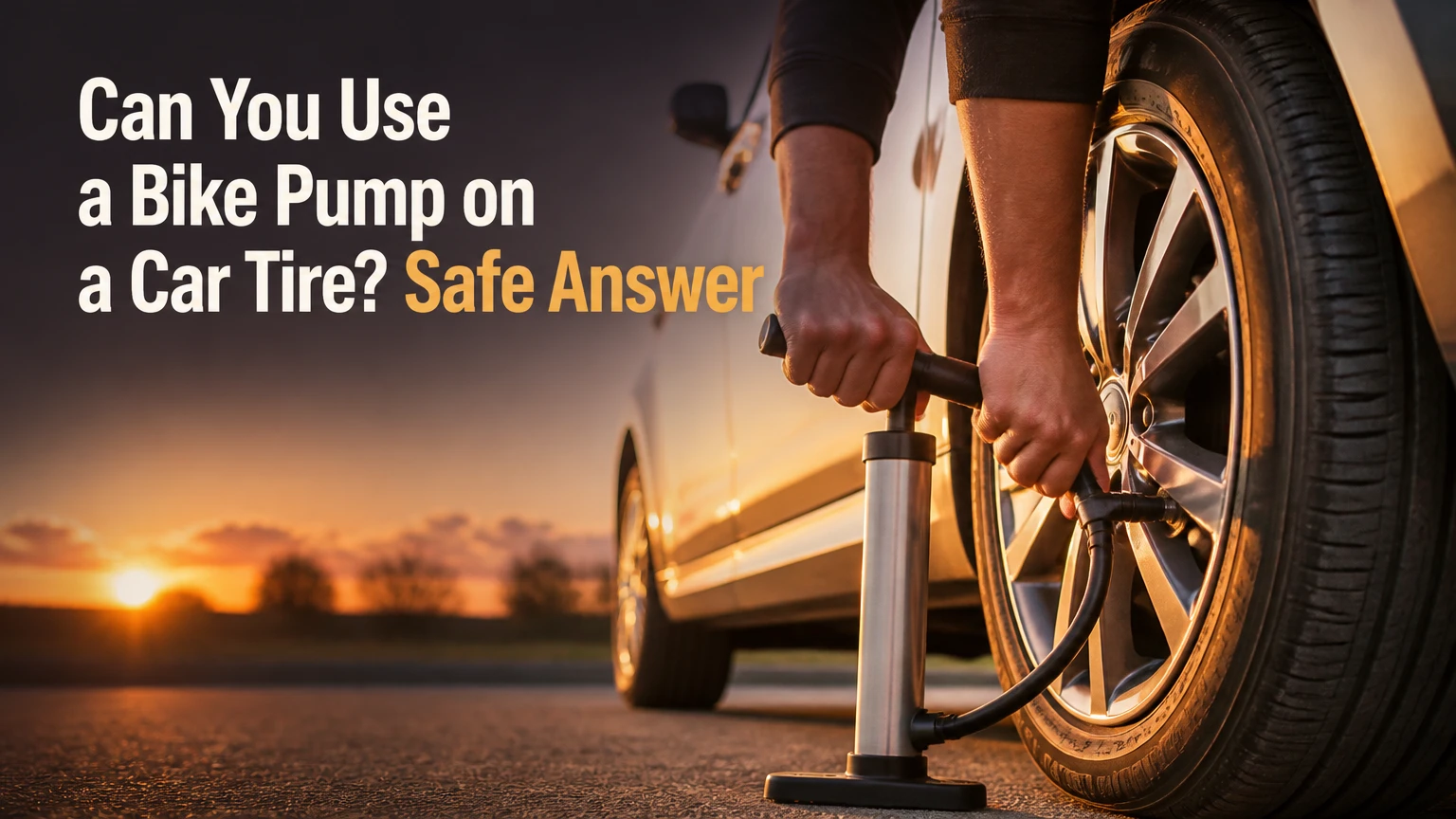
Yes, you can use a bicycle pump on a car tire if the pump head fits the tire’s Schrader valve, which most car tires and many bicycles use. A floor pump can safely add several PSI, but a car tire holds far more air than a bicycle tire, so a hand pump may require hundreds of strokes and considerable effort.
Key Facts at a Glance
- Most car tires use a spring-loaded Schrader valve, the same valve found on many mountain, hybrid, and children’s bicycles.
- A bicycle pump can reach a car tire’s normal operating pressure, commonly 30-36 PSI, but it moves much less air per stroke.
- A high-volume floor pump is practical for correcting a modest 3-8 PSI loss; a mini pump is an emergency-only option.
- The correct inflation pressure appears on the vehicle’s driver-side door-jamb placard, not as the maximum pressure molded into the tire sidewall.
- A fully flat tire may have a puncture, bead problem, or structural damage and should be inspected before driving.
- A portable compressor is usually the better tool when speed, repeated inflation, or roadside convenience matters.
Can You Use a Bike Pump on a Car Tire?
A bicycle pump can inflate a car tire because the connection is usually mechanical rather than vehicle-specific. The pump head seals against the tire’s Schrader valve, and the pump’s piston forces air through the valve’s spring-loaded core.
The important limitation is air volume. A typical passenger-car tire is much larger than a bicycle tire, even though its target pressure is lower than the pressure used in many road-bike tires. A bike pump therefore has enough pressure capability but poor volume efficiency for automotive inflation.
A floor pump typically moves about 300-500 cubic centimeters of air per stroke, while a compact hand pump may move approximately 60-100 cubic centimeters. Actual output falls as pressure rises, and pump specifications often describe theoretical rather than measured volume. A reasonable field estimate is 100-250 strokes to add about 5 PSI with a floor pump, depending on tire size, pump design, and starting pressure.
The method is safe for the tire when the pump is compatible, the tire is sound, and the operator stops at the vehicle’s specified cold pressure. The process is inconvenient, not inherently dangerous.
Why Does a Bike Pump Fit a Car Tire?
A car tire normally uses a Schrader valve, a metal valve stem with external threads, a removable cap, and a spring-loaded pin in the center. Pressing the pin opens the valve so air can enter, while the valve core closes when the pump head is removed.
Many bicycle pumps support Schrader valves through a larger opening, a reversible rubber seal, or an automatic “smart” head. Road bicycles frequently use Presta valves, which are narrower and have a threaded locking nut, so a pump configured only for Presta valves will not attach directly to a car tire.
| Valve type | Typical vehicle or bicycle use | Physical feature | Car-tire compatibility |
|---|---|---|---|
| Schrader | Cars, SUVs, motorcycles, mountain bikes | Wide stem and spring-loaded center pin | Direct fit with Schrader pump head |
| Presta | Road bikes, many performance bicycles | Narrow stem and threaded tip nut | No direct fit |
| Dunlop | Some city bicycles in Europe and Asia | Removable internal valve mechanism | No direct fit without an adapter |
| TPMS valve | Cars with tire-pressure monitoring sensors | Schrader-style stem plus sensor assembly | Compatible, but avoid bending or striking the stem |
Do not force a Presta-only head onto a Schrader valve. A wrong attachment can damage the pump seal, bend the valve stem, or create a leak. A threaded adapter can convert some valve systems, but using the correct pump head is more reliable.
What PSI Should a Car Tire Have?
The correct car-tire pressure is the cold inflation pressure printed on the driver-side door-jamb placard, fuel-door label, owner’s manual, or manufacturer information panel. Passenger vehicles commonly specify about 30-36 PSI, but compact cars, SUVs, vans, winter tires, and loaded vehicles may require different pressures.
The tire sidewall shows a maximum permitted pressure or a load-related specification. That number is not the vehicle’s normal target. Inflating to the sidewall maximum can reduce the intended contact patch, alter handling, and increase harshness.
Check pressure when the tire is cold, meaning before driving or after the vehicle has been parked for several hours. Driving heats the air and can raise the gauge reading by several PSI. The U.S. Department of Energy has stated that fuel economy can fall by about 0.2% for each 1 PSI of underinflation, although the exact effect varies by vehicle, speed, tire, and road conditions.
A pump gauge is useful for tracking progress but may be inaccurate. A separate digital or pencil tire gauge gives a better final check.
How Long Will Inflation Take?
A typical floor pump needs about 5-15 minutes to add 5-10 PSI to one passenger-car tire. A compact hand pump may take 20-60 minutes for the same correction, while a foot pump commonly falls between those ranges.
Time depends on tire volume, starting pressure, pump barrel size, stroke length, temperature, and leakage at the pump head. A large SUV tire can take substantially longer than a small hatchback tire because the casing holds more air. A pump’s advertised maximum PSI does not predict its inflation speed.
| Pump type | Typical air volume per stroke | Typical time to add 10 PSI | Typical price | Practical use |
|---|---|---|---|---|
| High-volume floor pump | 300-500 cc | 10-20 minutes | $30-$100 | Garage backup or modest pressure loss |
| Dual-action hand pump | 60-150 cc | 25-60 minutes | $15-$45 | Emergency use when no other tool exists |
| Foot pump | 200-300 cc | 15-30 minutes | $20-$50 | Occasional manual inflation |
| 12-volt compressor | Electric motor output varies | 3-8 minutes | $25-$80 | Roadside correction and routine checks |
| Cordless inflator | Electric motor output varies | 3-10 minutes | $40-$150 | Convenient portable use |
These are typical field ranges, not guaranteed specifications. A pump may take longer if its gauge, hose, valve seal, or piston seal leaks.
Which Bike Pump Type Works Best?
A high-volume floor pump is the best bicycle pump for a car tire because its large barrel moves more air and its long handle permits body-weight-assisted strokes. A mini hand pump can work, but it is inefficient and physically demanding for the same task.
Foot pumps reduce arm fatigue but often have smaller or less durable mechanisms than a quality floor pump. Dual-cylinder foot pumps may initially move air quickly, yet their seals and hinges can heat or fail when used for a large automotive tire.
| Decision factor | Floor pump | Mini hand pump | Foot pump | Portable compressor |
|---|---|---|---|---|
| Typical output | 300-500 cc per stroke | 60-100 cc per stroke | 200-300 cc per stroke | Continuous electric airflow |
| Human effort | Moderate arm and body effort | High arm effort | Moderate leg effort | Minimal physical effort |
| Typical 5 PSI correction | 5-10 minutes | 15-30 minutes | 8-15 minutes | 2-5 minutes |
| Storage size | 60-75 cm tall | 20-35 cm long | 25-40 cm long | 15-30 cm long |
| Gauge quality | Usually analog, variable accuracy | Often small or absent | Usually analog | Often digital |
| Best setting | Home garage | True roadside backup | Infrequent household use | Vehicle emergency kit |
A practitioner rule of thumb is simple: use a floor pump for a warning-light correction, not for repeatedly rescuing a tire that loses pressure. Repeated pressure loss points to a puncture, leaking valve, wheel corrosion, or bead leak.
How to Inflate a Car Tire With a Bike Pump
Inflating a car tire with a bicycle pump takes seven practical steps and usually 5-20 minutes with a floor pump for a moderate pressure correction. The most important factor is a sound Schrader connection, because leakage at the pump head can cancel much of the air entering the tire.
Step 1: Find the Required Cold Pressure
Read the pressure on the driver-side door placard or in the owner’s manual. Record the front and rear values separately if the manufacturer specifies different pressures.
Success checkpoint: You have a target such as 33 PSI, rather than guessing from the tire sidewall.
Common mistake: Setting the tire to the sidewall’s maximum pressure.
Step 2: Check the Tire Before Pumping
Look for a nail, screw, cut, bulge, separated tread, damaged sidewall, or object lodged in the tread. If the tire is visibly shredded, has a sidewall bulge, or has come off the wheel bead, do not attempt to make it roadworthy with a bicycle pump.
Success checkpoint: The casing has no obvious structural damage and the valve stem is upright and intact.
Common mistake: Treating a completely flat tire as an ordinary low-pressure adjustment.
Step 3: Configure the Pump Head
Select the Schrader opening. On a two-hole head, the Schrader port is usually the wider opening. On an automatic head, push the connector straight onto the valve stem.
Success checkpoint: The head sits squarely on the stem without tilting.
Common mistake: Using a narrow Presta opening or forcing an incompatible connector.
Step 4: Lock the Pump Head
Push the head fully onto the valve stem, then move the locking lever to its locked position. A brief hiss during attachment is normal, but continuous hissing means the seal is poor.
Success checkpoint: The head remains attached when you gently pull the hose.
Common mistake: Flipping the lever before the connector is fully seated.
Step 5: Pump With Full, Controlled Strokes
Stand with both feet on the floor pump base and use your body weight on the downward stroke. Keep the pump barrel vertical and avoid short, rapid movements that produce little air while heating the seals.
Success checkpoint: Each complete stroke has consistent resistance and no air escapes around the valve.
Common mistake: Pumping so fast that the barrel, hose, or head becomes hot.
Step 6: Read the Gauge Between Strokes
Stop every 20-40 strokes and allow the needle to settle before reading. Pump gauges can show a transient pressure spike while the piston is moving, so the settled reading is the useful value.
Success checkpoint: The separate tire gauge and pump gauge give reasonably similar readings.
Common mistake: Stopping at a high stroke pressure that does not represent the tire’s static pressure.
Step 7: Remove the Head and Recheck
Unlock the lever, pull the head straight off, and replace the valve cap. Check the pressure again with a separate gauge because removing the connector can release a small amount of air.
Success checkpoint: The final cold reading matches the placard within the gauge’s practical accuracy.
Common mistake: Leaving the valve cap off, which allows dirt and moisture to contaminate the valve core.
Do not jack up the car simply to make inflation easier. A properly seated, partially deflated tire can normally be inflated while supporting the vehicle’s weight. Jacking introduces a separate risk of vehicle movement, incorrect jack placement, or injury, and it does not fix a puncture or damaged bead.
Is a Bike Pump Safe for a Completely Flat Tire?
A bicycle pump is not automatically a safe solution for a completely flat car tire. A tire that has lost all pressure may have been driven while underinflated, which can damage the sidewall internally even if the exterior looks acceptable.
A fully deflated tire can also have a bead that has separated from the rim. A manual pump may not deliver the high initial airflow needed to reseat that bead, and attempting to force it can waste time beside traffic. Tire shops use controlled compressed air and inspect the assembly before returning it to service.
If the tire is flat at home, inflate it only enough to move the vehicle a short distance to a safe inspection location if the tire and wheel appear undamaged. If the tire is on a highway shoulder, has visible damage, or loses pressure immediately, use roadside assistance or install the spare according to the vehicle manual.
Run-flat tires require their own manufacturer guidance. A tire-pressure monitoring system can warn about low pressure, but TPMS does not identify every puncture, confirm structural safety, or replace a physical inspection.
Bike Pump Versus Portable Compressor
A portable compressor is the better everyday automotive tool because it transfers air continuously and requires little physical effort. A bicycle floor pump remains valuable as a silent, electricity-free backup, especially when a tire has lost only a few PSI.
A 12-volt compressor typically plugs into a vehicle accessory socket, while a cordless inflator uses a rechargeable battery. Check the compressor’s duty cycle, hose length, connector quality, fuse requirement, and rated operating time. Some inexpensive compressors need a cool-down period after several minutes.
| Alternative | Typical correction time | Power requirement | Typical cost | Main limitation |
|---|---|---|---|---|
| 12-volt compressor | 3-8 minutes | Accessory socket and live battery | $25-$80 | May overheat or exceed socket limits |
| Cordless inflator | 3-10 minutes | Charged lithium-ion battery | $40-$150 | Battery may be empty when needed |
| Gas-station compressor | 2-5 minutes | Mains or station power | $1-$3 or free | Availability and gauge accuracy vary |
| Roadside service | 15-90 minutes | Service vehicle | Membership or call-out fee | Waiting time and location dependence |
A bicycle pump has two advantages that compressors do not: it cannot blow a vehicle fuse and it does not depend on battery charge. Its major disadvantages are time, fatigue, and the risk that the operator stops before finding the underlying leak.
Common Mistakes and How to Fix Them
Using the Wrong Pressure Reference
Use the door placard rather than the tire sidewall maximum. If the placard is unreadable, consult the vehicle manual or manufacturer information for the exact model and tire size.
Pumping Without Finding the Leak
Spray soapy water around the tread puncture, valve core, and rim edge after inflation. Growing bubbles identify a leak, but a tire shop should repair or replace the tire according to puncture location and damage.
Trusting an Unverified Pump Gauge
Compare the pump gauge with a known digital gauge. A 3-4 PSI discrepancy is common among inexpensive gauges, and the discrepancy can produce underinflation or overinflation if never checked.
Continuing When the Pump Gets Hot
Pause when the barrel, hose, or connector becomes hot to touch. Heat increases seal wear and can distort a plastic pump head. Cooling periods protect the pump, but they do not make a leaking tire safe to drive.
Driving on a Newly Inflated Tire Without Inspection
Inflation restores pressure, not tire integrity. Inspect for a screw, nail, sidewall injury, bulge, exposed cord, or pressure loss before driving beyond a short trip to a repair facility.
Removing the Valve Cap Permanently
The valve cap helps protect the valve core from dirt and moisture. Replace it after every pressure check, especially on vehicles with tire-pressure sensors integrated into the valve assembly.
How Much Does It Cost to Use a Bike Pump?
Using an existing bicycle pump costs nothing, but a suitable high-volume floor pump typically costs $30-$100. A separate digital tire gauge costs approximately $10-$30, while a basic portable compressor commonly costs $25-$80.
The financial trade-off is different from the time trade-off. A pump already in the garage can correct a low tire without a fuel-station visit, while a compressor is usually worth buying for vehicles that experience seasonal pressure changes, frequent warning lights, or long-distance travel.
A compressor is not a repair tool. It supplies air, but it cannot permanently seal a puncture, correct a bent wheel, or restore a tire damaged by driving while flat.
When Should You Stop and Get Professional Help?
Stop manual inflation and seek professional help when the tire has a sidewall bulge, deep cut, exposed cord, separated tread, damaged wheel, repeated pressure loss, or a bead that will not seat. A tire that drops several PSI again within hours may have a puncture or valve problem even if the first inflation appears successful.
Do not continue driving on a tire that cannot hold the vehicle’s specified pressure. Underinflation increases sidewall flex and heat, which can cause internal failure after the visible leak has been addressed.
The National Highway Traffic Safety Administration advises motorists to check tire pressure regularly and inspect tires for damage. That guidance matters because a pressure number alone cannot reveal internal run-flat damage or a compromised casing.
FAQ
Can a mini bike pump inflate an SUV tire?
A mini bike pump can inflate an SUV tire if its head fits the SUV’s Schrader valve and the tire is intact. Expect substantial effort, often 30-60 minutes to add 10 PSI, because the larger casing requires more air. A floor pump or portable compressor is a more practical choice.
Will pumping a car tire with a bicycle pump damage the tire?
A bicycle pump will not damage a car tire when the pump head is correctly attached and inflation stops at the vehicle’s specified pressure. Damage is more likely from overinflation, driving while flat, a defective valve connection, or a tire with existing structural failure.
Can you use a Presta pump on a car tire?
A Presta-only pump cannot attach directly to a car tire’s Schrader valve. Some bicycle pumps have reversible seals or adapters that support both systems. Use the pump’s Schrader setting rather than forcing the narrow Presta connector onto the wider automotive valve.
How many pumps does a car tire need?
A car tire commonly needs about 100-250 full strokes from a high-volume floor pump to gain roughly 5 PSI. A mini pump may need several hundred strokes for the same increase. Tire size, pump output, leakage, and starting pressure can change the result substantially.
Can a bicycle pump inflate a tire after a puncture?
A bicycle pump can temporarily replace air lost through a slow puncture, but it cannot repair the puncture. Inflate only to reach a safe inspection or repair location when the tire remains structurally sound. A tire that loses pressure immediately requires roadside assistance or a spare.
Is a bike pump better than a gas-station air machine?
A bike pump is quieter and independent of electricity, but a gas-station air machine is usually faster for a car tire. A quality portable compressor provides similar convenience at home or on the road. A bicycle floor pump is best treated as a backup for modest pressure loss.
The Bottom Line
You can use a bike pump on a car tire when the pump has a Schrader-compatible head and the tire is not structurally damaged. A high-volume floor pump can correct a modest pressure loss, but a mini pump is slow and exhausting because car tires require much more air volume. Check the door-placard PSI, inflate the tire cold, verify the final pressure with a reliable gauge, and inspect for a puncture before driving. If the tire is completely flat, visibly damaged, or losing air quickly, use the spare or call roadside assistance rather than relying on manual inflation.