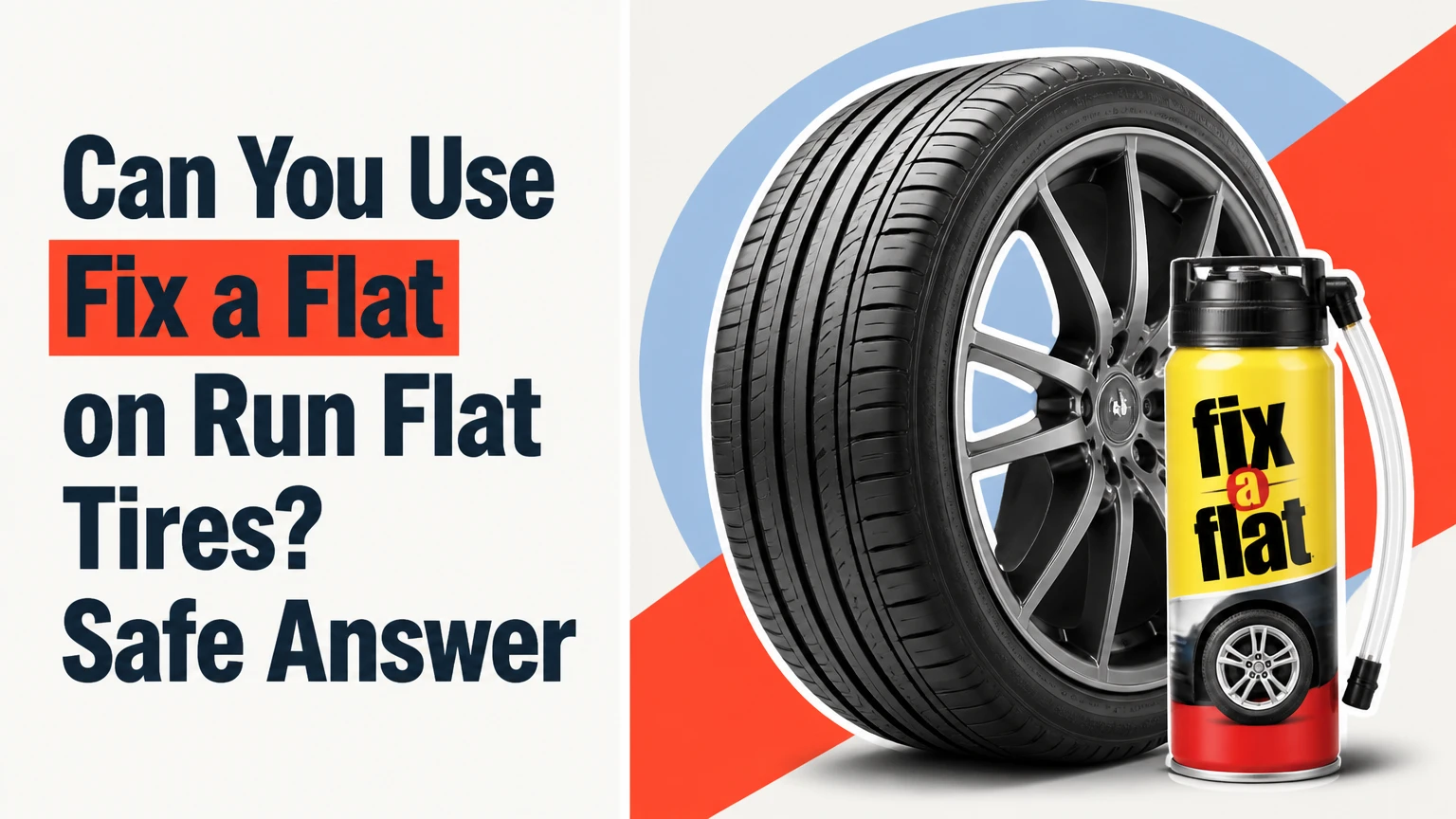
No, you should not use Fix-a-Flat in run-flat tires during normal roadside repair. Fix-a-Flat’s manufacturer advises against using its sealant in run-flat tires, while tire manufacturers may reject repairs after sealant use or driving at zero pressure. Use the run-flat’s vehicle-specific distance limit, call roadside assistance, or obtain a professional inspection instead.
Key Facts at a Glance
Fix-a-Flat is not an approved routine repair for run-flat tires.
A run-flat’s distance and speed limits are tire-specific, although many specify approximately 50 miles at no more than 50 mph.
Acoustic foam is common on some quiet run-flat models, not every run-flat tire.
Driving at zero pressure can cause hidden sidewall damage, even when the outside looks acceptable.
A puncture in the repairable tread area may sometimes be professionally repaired, but only after the tire is removed and inspected internally.
A sidewall, shoulder, bead, bulge, tear, or heat-damaged run-flat generally requires replacement.
Can You Use Fix a Flat on Run Flat Tires?
You should not use Fix-a-Flat on run-flat tires unless the tire or vehicle manufacturer specifically permits that product and no safer option exists. The sealant can contaminate the tire-pressure monitoring sensor, complicate inspection, create wheel imbalance, and provide no dependable solution for a tire that has already suffered internal run-flat damage.
Fix-a-Flat is a pressurized aerosol containing a sealant and propellant. In a conventional tire, the product may temporarily seal a small tread puncture while adding limited pressure. The product is not a structural repair, does not restore a damaged sidewall, and usually requires later tire removal.
Run-flat tires use reinforced sidewalls or internal support structures to carry the vehicle after air loss. That construction changes the repair question: the tire may remain drivable for a limited distance, but it can accumulate heat and flex damage while underinflated. The absence of an obvious collapse does not prove that the casing remains safe.
The manufacturer’s own position is decisive for routine use. Fix-a-Flat states, “Fix-a-Flat should not be used in run-flat tires,” so the product should not be treated as a normal alternative to a spare, tow, or inspection.
How Do Run-Flat Tires Work?
Run-flat tires support a vehicle temporarily after pressure loss through reinforced sidewalls, internal support rings, or other self-supporting construction. The tire’s TPMS warning tells the driver that pressure has fallen, while the reinforced structure preserves enough shape for controlled travel to a safe location.
Most self-supporting run-flats use rubber inserts in the sidewalls. These inserts resist the buckling and collapse that occur in a conventional tire. Some models use a support ring mounted inside the tire, although that design is less common on ordinary passenger vehicles.
A run-flat remains a pneumatic tire. Its limited post-puncture capability is not permission to continue driving normally. Speed, load, road temperature, tire condition, and the distance already traveled all affect the remaining safety margin.
The 50-mile and 50-mph figures are common examples, not universal specifications. A BMW, Mercedes-Benz, MINI, Chevrolet, or other vehicle may have a different limit in its owner’s manual or tire documentation. A heavily loaded vehicle, hot pavement, repeated cornering, or a damaged wheel can reduce the practical limit.
Do All Run-Flats Have Acoustic Foam?
No, all run-flat tires do not contain acoustic foam. Some premium tires use a polyurethane noise-absorbing insert, often marketed as acoustic or “quiet” technology, but the insert is a model-specific feature rather than a defining requirement of run-flat construction.
This distinction matters because sealant behavior varies by tire design. Foam can absorb or obstruct some liquid, but a run-flat without foam can still suffer sensor contamination, imbalance, chemical cleanup problems, or an unsuccessful seal. Reinforced sidewalls alone are sufficient reason to follow the tire manufacturer’s instructions.
Why Is Fix-a-Flat a Poor Choice for a Run-Flat?
Fix-a-Flat is a poor choice for a run-flat because the aerosol does not restore the tire’s structural safety, may interfere with the TPMS sensor, and can make a professional internal inspection more difficult. A sealant can temporarily slow a tread leak while leaving a heat-damaged casing unfit for service.
The main risks are practical rather than theoretical:
- The puncture may not seal. Sealant is intended for limited tread punctures, not sidewall cuts, bead leaks, valve damage, or wheel cracks.
- The TPMS sensor may become contaminated. Many sensors sit inside the wheel near the valve stem, where liquid sealant can coat the pressure port.
- The wheel may become unbalanced. Uneven liquid distribution can produce vibration, especially if the tire has not regained normal pressure.
- Inspection becomes less convenient. A technician must disclose, remove, and clean sealant before assessing the casing.
- The sealant can conceal continued air loss. A slowly leaking tire may appear usable while pressure and temperature move into an unsafe range.
- The product may violate the tire warranty or repair policy. The tire maker’s instructions control, not the universal label of “temporary.”
Fix-a-Flat does not convert a run-flat into a repaired tire. It only attempts to seal a small air leak.
What Should You Do When a Run-Flat Loses Pressure?
When a run-flat loses pressure, slow down, avoid sudden steering or braking, confirm the warning, and drive only as far as necessary to reach a safe location or tire professional within the tire’s stated limit. Do not use Fix-a-Flat first, because the sealant can complicate the inspection needed to decide whether the tire is repairable.
Step 1: Reduce Speed and Stabilize the Vehicle
Release the accelerator gradually and avoid abrupt lane changes. Keep both hands on the wheel because a puncture, damaged wheel, or severe pressure loss can alter steering response.
Do not assume the tire is safe because the car feels normal. Run-flat sidewalls are designed to preserve control, not to eliminate heat or casing stress.
Step 2: Read the Owner’s Manual and Tire Sidewall
Find the vehicle’s run-flat driving instruction, then check the tire model and size. The sidewall may identify the tire as a run-flat through markings such as RFT, ROF, ZP, EMT, SSR, or another manufacturer-specific designation.
Record the warning time, estimated distance traveled, and approximate speed. That information helps a technician judge whether the tire experienced excessive heat or flexing.
Step 3: Stop if the Tire Shows Physical Damage
Stop driving and request a tow if the tire has a sidewall tear, bulge, exposed cord, separated tread, damaged bead, visible wheel impact, burning smell, vibration, or repeated pressure loss. These symptoms exceed what the run-flat structure is intended to manage.
A nail or screw in the central tread is materially different from a shoulder rupture. Location matters more than the size printed on a sealant can.
Step 4: Travel Only to a Safe Service Location
If the tire has no visible destructive damage and the manual permits limited travel, drive directly to a tire shop at or below the stated speed. Avoid highways where possible, keep the load light, and stop if vibration, pulling, noise, or heat becomes apparent.
Roadside assistance is safer than extending the run-flat’s advertised maximum. The 50-mile figure is an upper design reference under specified conditions, not a guaranteed rescue distance for every puncture.
Can a Run-Flat Tire Be Plugged or Patched?
A run-flat tire can sometimes be repaired after a small tread puncture, but only a qualified technician can approve the repair after removing and inspecting it. Some manufacturers prohibit repairing run-flats altogether, while others allow repair if pressure was not lost for an excessive distance and the casing has no internal damage.
A plug inserted from outside is not equivalent to a permanent tire repair. Industry practice generally favors a combination repair consisting of an internal patch and a plug, installed after the tire is removed, because the technician can inspect the inner liner and seal the puncture channel.
The frequently repeated rule that a run-flat is repairable if it never fell below 15 PSI is not a universal safety standard. Tire makers differ, and a tire may suffer damaging heat even above that pressure depending on load, speed, road temperature, and travel duration.
Which Tire Damage Requires Replacement?
| Damage or condition | Typical decision | Reason |
|---|---|---|
| 3 mm nail in central tread, no pressure-loss driving | Possible professional repair | Repair zone and casing may remain sound |
| 6 mm puncture in central tread | Manufacturer-dependent | Near the common maximum repair diameter |
| Shoulder puncture within the outer tread edge | Replace | Flexing zone has inadequate repair margin |
| Sidewall cut, bulge, or exposed cord | Replace | Sidewall damage compromises load support |
| Tire driven at zero pressure for an unknown distance | Usually replace | Internal heat and abrasion may be hidden |
| Bead damage or bent wheel flange | Repair wheel or replace tire | Air seal and structural fit are compromised |
| Separated tread or severe vibration | Replace | Internal failure may progress suddenly |
The final decision belongs to the tire maker’s service policy and the inspecting technician. A shop should never approve a repair solely from an external photograph.
Fix-a-Flat, Sealant Kits, Plugs, or Towing: Which Option Is Safer?
Towing is the safest option for a run-flat with severe damage, unknown zero-pressure travel, or a location outside the tire’s approved operating range. A professional repair may be appropriate for a verified tread puncture, while aerosol sealant is generally the least suitable option because it does not address structural damage or guarantee a seal.
| Option | Typical cost | Typical time | Run-flat suitability | Main limitation |
|---|---|---|---|---|
| Roadside tow | $75-$200 before membership or mileage fees | 30-120 minutes | Highest for unknown damage | Requires service availability |
| Professional inspection | $25-$50, often waived with purchase | 20-45 minutes | Appropriate first decision | Tire must be removed |
| Internal patch-plug repair | $25-$50 where permitted | 30-60 minutes | Conditional | Not valid for sidewalls or damaged casings |
| Fix-a-Flat aerosol | $8-$20 per can | 2-5 minutes | Generally not recommended | Sensor contamination and unreliable sealing |
| Compressor and approved sealant kit | $30-$100 | 10-20 minutes | Vehicle-specific only | Manufacturer approval is required |
| Replacement run-flat tire | $180-$500 each, typical passenger range | 45-120 minutes | Required for unsafe casing | Matching and availability matter |
A plug kit and compressor can be useful emergency equipment for conventional tires, but carrying them does not create a universal repair method for run-flats. A driver should verify the tire brand’s policy before relying on a plug, particularly on an all-wheel-drive vehicle.
How Much Does Run-Flat Replacement Cost?
A typical replacement run-flat costs approximately $180-$500 per tire for common passenger sizes, while high-performance, large-diameter, or specialty fitments can exceed $600. The final bill may include mounting, balancing, disposal, TPMS service, alignment, and shipping.
| Replacement scenario | Typical tire cost | Additional work | Typical total |
|---|---|---|---|
| One 16-18 inch touring run-flat | $180-$300 | Mount and balance, $25-$60 | $205-$360 |
| One 19-21 inch performance run-flat | $300-$600 | Mount, balance, disposal, $40-$90 | $340-$690 |
| Two tires on one axle | $360-$1,200 | Pair installation, $50-$120 | $410-$1,320 |
| Four matched tires | $720-$2,400 | Installation and alignment, $100-$220 | $820-$2,620 |
Replacing one tire can be acceptable when the remaining tire has similar tread depth and the vehicle manufacturer permits it. Some all-wheel-drive systems require closely matched rolling circumferences, so a single new tire beside a heavily worn tire can create drivetrain stress or electronic-control problems.
Ask the tire shop to compare tread depth, model, load index, speed rating, diameter, and manufacturer approval before ordering one replacement.
What Happens to TPMS After Sealant Use?
Liquid sealant can coat or clog a tire-pressure monitoring sensor, especially when the sensor’s pressure port is exposed inside the tire cavity. Tell the technician exactly which product was used, because the sensor may require cleaning or replacement and the tire may need a complete internal inspection.
A TPMS warning also does not identify the cause of pressure loss. The warning may result from a puncture, valve leak, wheel corrosion, temperature change, or sensor fault. A sealant can temporarily suppress the symptom while the underlying leak remains.
After any repair or replacement, the shop should verify cold inflation pressure against the vehicle placard, inspect the valve stem, and relearn or test the TPMS system when the vehicle requires it. Do not treat a dashboard light that disappears as proof of a successful repair.
Is Fix-a-Flat Safe in Cold Weather?
Fix-a-Flat and similar products have temperature and storage limits printed on their labels, so winter use requires checking the specific can rather than assuming every sealant freezes at 32°F. A cold can may discharge poorly, and a water-based formula can behave differently from a latex or hydrocarbon formulation.
The more important winter risk is pressure. Tire pressure commonly drops as ambient temperature falls, but a temperature-related warning is different from a puncture that continues losing air. Check pressure with a gauge when possible, inspect the tread, and do not add sealant merely because the TPMS warning appeared during a cold snap.
Never store an aerosol can where temperatures exceed its label limits. A pressurized container left in a hot vehicle can become a safety hazard, regardless of whether it is intended for a run-flat.
What Should You Carry if Your Vehicle Has No Spare?
Drivers without a spare should carry a charged phone, roadside-assistance coverage, a pressure gauge, a vehicle-compatible compressor, reflective warning equipment, and the tire manufacturer’s repair instructions. Those items help identify the problem and reach safety without introducing unapproved chemicals into the tire.
| Equipment | Typical price | Primary use | Limitation |
|---|---|---|---|
| 12-volt compressor | $35-$100 | Restores pressure for permitted tires | Does not repair structural damage |
| Digital pressure gauge | $10-$30 | Confirms pressure independently | Cannot reveal internal casing damage |
| Reflective triangles or LED beacon | $20-$60 | Protects a stopped vehicle | Does not replace roadside assistance |
| Tire plug kit | $10-$30 | Emergency conventional-tire repair | Run-flat approval is manufacturer-specific |
| Roadside-assistance plan | $50-$150 annually | Towing and tire service | Coverage limits vary |
| Correct spare and jack kit | $150-$600 | Provides a physical replacement | May not fit the vehicle or brake package |
A compressor is particularly useful when a tire has a slow leak and the owner’s manual permits inflation and travel to a shop. It is not a reason to drive a run-flat indefinitely after repeated pressure loss.
Common Mistakes With Run-Flat Punctures
Driving Until the Tire Is Completely Destroyed
A run-flat is designed to reach service, not to continue a commute for several days. Repeated zero-pressure driving increases heat, abrasion, and the chance that a repairable puncture becomes a replacement.
Removing the Nail or Screw at the Roadside
Leave a penetrating object in place until the tire can be inspected, unless the object creates an immediate hazard. Removing it can convert a slow leak into rapid deflation before the driver reaches a safe location.
Trusting a Plug Without Internal Inspection
An exterior rope plug cannot reveal inner-liner abrasion, sidewall wrinkling, or separation. A tire that was driven underinflated requires removal from the wheel before repair approval.
Installing Only One Mismatched Tire
A different model, size, load index, or substantially different tread depth can alter handling and, on some AWD vehicles, create rolling-circumference differences. Match the vehicle’s approved specifications first.
Using Two Cans When One Does Not Seal
A second can rarely fixes a sidewall, bead, valve, or large tread failure. More sealant increases cleanup and sensor risk while delaying the correct response, which is stopping and arranging service.
FAQ
Can you drive 50 miles on a run-flat tire?
You can drive up to the distance specified by the tire and vehicle manufacturer, but many run-flats advertise approximately 50 miles at no more than 50 mph after pressure loss. The limit assumes suitable load, road, and tire conditions; visible damage, vibration, heat, or unknown prior travel requires towing instead.
Can a run-flat tire be repaired after a nail puncture?
A run-flat tire may be repairable after a small nail puncture in the central tread, but the tire must be removed for internal inspection. Manufacturers differ on repair permission, and driving at low or zero pressure can make the casing unsafe even when the puncture itself is repairable.
What if a run-flat has a sidewall puncture?
A sidewall puncture, cut, bulge, exposed cord, or shoulder injury normally requires tire replacement. Sidewalls flex heavily and carry the vehicle’s load, so a patch or aerosol sealant cannot reliably restore their structural strength.
Should you inflate a run-flat after the TPMS warning?
Check and restore pressure only if the tire is visibly intact and the vehicle instructions permit it. Inflation can help identify a slow tread leak, but it cannot validate the internal condition of a run-flat that has already been driven without adequate pressure.
Can you replace one run-flat tire?
You can replace one run-flat when the vehicle and tire manufacturer permit it and the replacement matches size, load index, speed rating, construction, and model requirements. All-wheel-drive vehicles may require closely matched tread depths, so the shop should measure the other tires before installation.
Is a compressor better than Fix-a-Flat for run-flats?
A compressor is generally more useful because it adds measurable air without contaminating the TPMS sensor, but it does not make every run-flat repairable. Use a compressor to reach service only within the manufacturer’s pressure, speed, distance, and damage limits.
The Bottom Line
Can you use Fix a Flat on run flat tires? The safe answer is no for routine use. Follow the vehicle and tire manufacturer’s run-flat limits, avoid sealant unless the manufacturer explicitly approves it for that exact tire, and arrange a professional inspection or tow when damage, zero-pressure travel, vibration, or distance makes the tire’s condition uncertain.