Yes, you can physically drive on snow tires in the summer, but you should not use them as a seasonal choice. Winter tires use flexible compounds and heavily siped tread that improve cold-weather traction, yet warm pavement makes the tread wear quickly, steering feel less precise, and braking less effective than with summer or all-season tires.
Key Facts at a Glance
Winter tires are generally intended for sustained temperatures below about 7°C (45°F), not hot summer pavement.
Warm weather makes winter-tire tread blocks flex more, which can reduce dry-road steering precision.
Summer use can consume a season of winter tread, especially during highway driving, aggressive cornering, or high ambient temperatures.
A single necessary trip is different from leaving winter tires installed for three or four warm months.
AWD improves acceleration on slippery surfaces, but it does not restore summer braking or cornering performance.
Replace or inspect winter tires after summer use if tread depth, cracking, bulges, uneven wear, or tire age raises a safety concern.
Can You Use Snow Tires in the Summer Safely?
Snow tires are not the right tires for summer, even though a short emergency drive may be manageable. The principal risks are accelerated wear, reduced steering response, longer stopping distances in some conditions, and increased heat buildup in the tire.
The 7°C threshold is a useful tire-industry rule of thumb, not a worldwide legal cutoff. Michelin describes winter tires as intended for “temperatures below 7°C (45°F),” while actual performance changes gradually as temperature rises rather than switching at one precise degree.
A driver who leaves winter tires installed through a mild spring week faces a smaller problem than a driver completing a 5,000-mile summer road trip. Speed, inflation, vehicle load, road surface, tire condition, and tire design determine the severity.
What happens during one emergency trip?
One unavoidable summer trip usually will not destroy a sound winter tire, provided the tire is correctly inflated, undamaged, and driven conservatively. Avoid treating that exception as permission for regular warm-weather use.
Before driving, check cold inflation against the vehicle door-jamb specification, inspect for cracks or bulges, remove heavy loads, and reduce speed in rain. Arrange a tire change at the earliest practical opportunity.
Why do winter tires behave poorly in warm weather?
Winter tires trade warm-weather precision for cold-weather flexibility and snow penetration. Their rubber remains pliable at low temperatures, while their tread contains many sipes and open channels that create edges for snow and ice.
Summer pavement reverses those priorities. The compound becomes softer, tread blocks move under steering and braking loads, and the tire can generate more heat through repeated flexing. The result is a less direct steering response and faster tread loss.
Rubber compound and temperature
Winter tire compounds contain materials selected to remain flexible in freezing conditions. Summer tires use compounds that resist deformation at higher temperatures, allowing the tread to maintain a larger, more stable contact patch during braking and cornering.
The temperature of the pavement can exceed the reported air temperature by a substantial margin on sunny asphalt. A 27°C (80°F) afternoon can therefore expose a winter tire to a much harsher operating surface than the weather forecast suggests.
Tread blocks, sipes, and road response
Sipes divide winter tread blocks into many small edges. Those edges help a tire grip compacted snow and ice, but they also allow more tread movement on dry pavement.
The driver may notice a vague center feel, delayed turn-in, or greater body movement during lane changes. Those sensations do not prove imminent tire failure, but they indicate that the tire is operating outside its strongest design range.
How much does summer use damage winter tires?
Summer use can shorten winter-tire life substantially, but no defensible universal figure applies to every model. A few weeks of gentle local driving may cause modest wear, while sustained hot-weather highway use can remove a large portion of usable tread within one season.
| Use pattern | Typical exposure | Likely consequence | Recommended action |
|---|---|---|---|
| One emergency trip | 20-100 miles | Limited additional wear if properly inflated | Inspect and schedule replacement |
| Mild spring commuting | 500-1,500 miles | Noticeable shoulder and block wear | Remove when temperatures stay warm |
| Hot urban summer | 2,000-4,000 miles | Rapid tread loss and softer handling | Change immediately |
| Summer highway travel | 4,000-8,000 miles | High heat cycles and accelerated wear | Inspect tread, age, and casing |
| Aggressive driving | Any mileage | Excessive block squirm and shoulder wear | Replace worn or damaged tires |
Tread depth alone does not tell the entire story. Winter tires may still show acceptable depth while their siping has worn away, their blocks have developed irregular wear, or their rubber has hardened with age.
What should you inspect after summer driving?
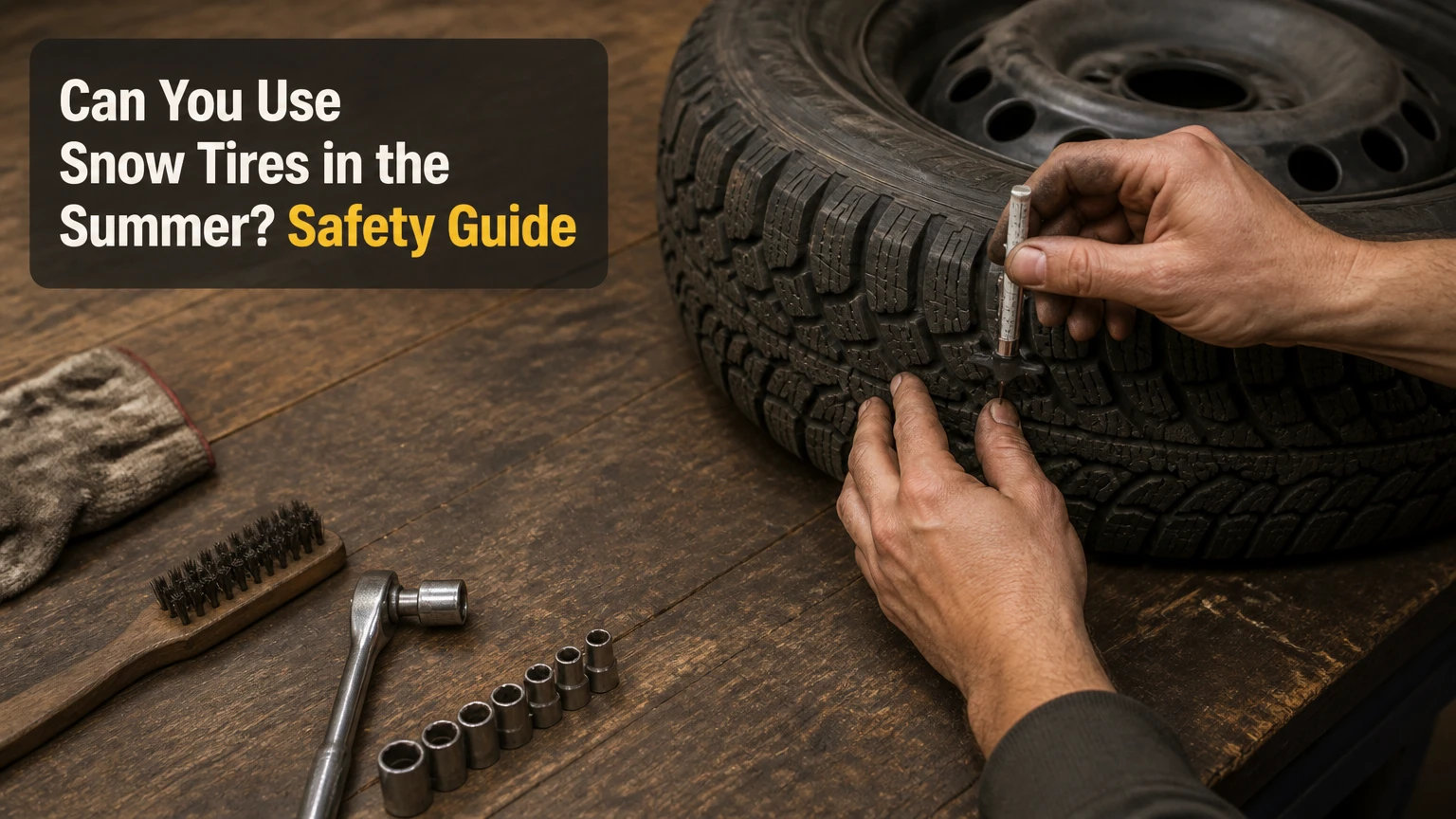
Measure tread depth across the inner, center, and outer grooves. Compare the result with the tire manufacturer’s winter-service recommendation, because a winter tire that remains legal for general road use may no longer provide dependable snow traction.
Look for cupping, feathering, flat spots, sidewall cracking, exposed cords, bulges, and embedded objects. Check the DOT date code as well. Tire age is not determined by tread depth, and storage conditions influence how quickly rubber deteriorates.
Are winter tires worse than summer tires in rain?
Winter tires can remain usable in rain, but summer tires usually provide sharper wet-road braking and handling once temperatures are warm. Winter tread can evacuate water, yet its flexible blocks may move more during braking and cornering than the firmer blocks on a summer tire.
Hydroplaning depends on speed, water depth, tread design, inflation, load, and road texture. A winter tire is not automatically unsafe in every rainstorm, and a summer tire is not immune to hydroplaning.
| Driving condition | Winter tire in warm weather | Summer tire | Practical concern |
|---|---|---|---|
| Dry city streets, 20°C/68°F | Soft response, faster wear | Firm response, lower deformation | Steering precision |
| Wet highway, 25°C/77°F | Variable braking and block movement | Strong warm-weather grip | Following distance |
| Standing water at 60 mph | Hydroplaning remains possible | Hydroplaning remains possible | Speed and tread depth |
| Emergency lane change | More tread squirm | More stable tread support | Vehicle control |
| Cold rain, 5°C/41°F | Winter compound advantage | Summer compound can stiffen | Temperature matters |
A commonly repeated claim that winter tires always create exactly 26% longer stopping distances is too broad. Published test results differ by tire, surface, temperature, and speed, so the reliable conclusion is directional: warm-weather winter tires can lose braking and handling performance relative to tires designed for that environment.
What types of snow tires are affected most?
All winter tires are poor long-term summer choices, but their behavior differs by construction. Studless ice tires usually prioritize cold grip and may feel especially soft, while performance winter tires can feel more controlled without becoming summer tires.
| Winter-tire type | Primary design feature | Summer behavior | Main limitation |
|---|---|---|---|
| Studless ice tire | Dense siping, soft compound | High block movement | Weak warm steering feel |
| Studless snow tire | Open channels, snow edges | Faster tread wear | Reduced dry precision |
| Studdable tire without studs | Reinforced tread, winter compound | Warm deformation | Still unsuitable year-round |
| Studded tire | Metal studs and winter tread | Noise, wear, possible legal issue | Poor bare-road match |
| Performance winter tire | Firmer construction, winter compound | Better response than ice tire | Compound still favors cold |
Are studded snow tires legal in summer?
Studded-tire rules vary by jurisdiction, and some regions restrict them to defined winter dates or permit them only when road conditions justify their use. Summer use may therefore violate local law even when the tire itself remains mechanically serviceable.
Metal studs can damage bare pavement and create noise on dry roads. Check the transportation authority, province, state, or country where the vehicle will operate; a tire retailer’s general advice cannot replace local regulations.
When should winter tires come off?
Remove winter tires when the local forecast shows consistently warm conditions and snow or ice risk has ended, rather than waiting for the first genuinely hot day. Many drivers use sustained overnight and daytime temperatures above roughly 7°C (45°F) as a practical changeover signal.
Calendar dates are less reliable than climate. A driver in Denver, Colorado, may face late spring snow, while a driver in Toronto, Ontario, may follow a local seasonal rule or studded-tire deadline. Mountain passes and early-morning commutes also justify keeping winter tires longer than a warm urban route.
Use this decision sequence:
- Review two weeks of morning and afternoon temperatures.
- Identify late-season snow, ice, and mountain-route risks.
- Confirm that the replacement tires have adequate tread and correct size.
- Book the change before local demand peaks.
- Ask the installer to check alignment, brakes, valve stems, and TPMS sensors.
- Record the removed tire positions and store the set correctly.
A tire swap commonly takes 30-90 minutes. Typical North American seasonal mounting, balancing, or wheel-change charges range from about $60-$150 per visit, but prices vary by wheel ownership, vehicle size, storage, and region.
Is it better to use all-season, all-weather, or summer tires?
The best warm-weather replacement depends on winter severity, summer heat, mileage, and whether the vehicle must operate during snow emergencies. Summer tires maximize warm dry and wet performance, all-season tires broaden the operating range, and all-weather tires add certified severe-snow capability.
| Tire category | Warm-weather strength | Snow certification | Typical use case | Main compromise |
|---|---|---|---|---|
| Summer tire | Highest warm-road response | No 3PMSF rating | Hot climates, performance driving | Poor ice and snow |
| All-season tire | Balanced at moderate temperatures | Usually no 3PMSF rating | Mild winters, mixed commuting | Limited severe-snow grip |
| All-weather tire | Usable in warm seasons | 3PMSF symbol | One-set ownership in variable climates | More noise and wear |
| Winter tire | Cold, snow, and ice traction | 3PMSF rating | Persistent winter conditions | Poor warm efficiency |
| All-terrain tire | Gravel and mixed surfaces | Model-dependent 3PMSF | Trucks and off-road travel | Road noise and compromise |
The Three-Peak Mountain Snowflake, or 3PMSF, identifies a tire that meets a defined severe-snow performance requirement. The symbol does not mean the tire performs like a dedicated winter tire on ice, nor does it eliminate the need to select an appropriate summer setup.
Does AWD make summer winter tires safe?
AWD can help a vehicle accelerate on snow, but AWD does not shorten braking distances on dry or wet pavement. Every vehicle still relies on the four tire contact patches for steering, stopping, and cornering.
An AWD crossover with winter tires remains subject to the same warm-compound limitations as a front-wheel-drive sedan. Drivetrain layout changes power delivery, not the tire’s temperature range.
Can you use snow tires all year if you want to wear them out?
Using winter tires until they are worn out is usually a false economy. The driver saves one seasonal change but sacrifices winter-tire tread, increases warm-season wear, and may enter the next winter with tires that have lost the depth or siping needed for snow.
The risk is greatest for drivers who make high-speed motorway trips, carry heavy loads, drive through frequent summer rain, or depend on sudden braking around pedestrians and cyclists. A worn winter tire can also become unusable before its owner has recovered the purchase cost.
A practical rule is simple: preserve winter tires for winter. If the set is already near its replacement threshold in spring, ask a tire professional whether its remaining tread is suitable for another cold season rather than deliberately consuming it in heat.
Can you install winter tires on only two wheels?
Install four matching winter tires on vehicles that require winter traction. Putting winter tires on only the front axle can create a dangerous grip imbalance, especially on a rear-wheel-drive vehicle, while mixing winter and summer tires can change oversteer and understeer behavior.
Vehicle manufacturers and tire organizations generally advise using the same tire type and comparable tread condition on all four positions. Follow the vehicle owner’s manual for permitted size differences, rotation direction, staggered fitments, and replacement procedures.
| Setup | Likely handling effect | Suitable choice? | Reason |
|---|---|---|---|
| Four winter tires | Balanced seasonal grip | Yes, in winter | Similar response at every corner |
| Four summer tires | Balanced warm-road grip | Yes, in warm conditions | Correct compound for heat |
| Winter front, summer rear | Rear grip may fall first | No | Potential oversteer |
| Summer front, winter rear | Front grip may fall first | No | Potential understeer |
| Two winter tires on AWD | Drivetrain mismatch | Usually no | Owner manual may prohibit it |
What should you do if winter tires are still installed in July?
If snow tires remain installed in July, check inflation and condition, reduce speed in heat or rain, avoid towing or heavy loading unless approved, and arrange a change as soon as practical. Do not assume TPMS will warn about heat-related damage or poor tread performance.
For an immediate trip, increase following distance and avoid abrupt steering, hard braking, and sustained high speeds. Stop driving if the vehicle develops vibration, pulling, thumping, a burning odor, visible bulging, or a sudden pressure loss.
How should you store winter tires?
Clean and dry winter tires before storage, mark their vehicle position, and keep them in a cool, dark, dry location away from electric motors, solvents, fuel, and direct sunlight. Bagging loose tires can reduce exposure to ozone and contaminants.
Store mounted tire-and-wheel assemblies horizontally in a stack or suspend them appropriately; store unmounted tires upright and rotate them periodically. Do not place heavy equipment on them, and keep storage temperatures stable rather than exposing rubber to repeated heat cycles.
How much can a summer setup cost?
The cost depends on whether the owner already has a second wheel set and whether the summer tires need replacement. The following figures are typical planning ranges, not universal prices.
| Expense | Typical range | Timing | Cost-control option |
|---|---|---|---|
| Seasonal wheel change | $60-$150 | Each visit | Use a second mounted wheel set |
| Mount and balance four tires | $100-$240 | At tire purchase | Compare package pricing |
| Seasonal tire storage | $50-$150 | Per season | Store at home correctly |
| Replacement passenger tire | $100-$300+ | Per tire | Match size and load rating |
| Four all-weather tires | $500-$1,200 | Every several years | Compare warranty and treadwear |
| Alignment inspection | $0-$150 | After uneven wear | Correct suspension causes |
A second wheel set can reduce repeated mounting work, but steel wheels add purchase cost, weight, and corrosion considerations. The financially sound choice depends on how many years the vehicle will remain in service and how often seasonal changes occur.
Which setup fits each driver?
The correct answer changes with climate and driving exposure, not with drivetrain branding or tire price alone.
- Warm-climate commuter: Use summer or quality all-season tires. Dedicated winter tires provide little value if freezing precipitation is rare.
- Driver with regular snow and ice: Use four winter tires during cold months and a summer or all-season set in warm months.
- Mild-winter, no-storage driver: Consider all-weather tires with the 3PMSF symbol, while accepting more noise and a compromise in extreme conditions.
- High-mileage highway driver: Use a warm-weather tire as soon as winter conditions end because braking, stability, and tread economics matter more at sustained speed.
- Mountain traveler: Keep winter tires until route conditions and overnight temperatures are reliably safe, even when the home town is already warm.
FAQ
Can snow tires be used in the summer for a road trip?
A single short road trip on undamaged, correctly inflated winter tires is unlikely to cause immediate failure, but it remains a compromise. Lower speed, greater following distance, and frequent pressure checks reduce risk. Change to warm-weather tires before repeated highway travel, especially in hot weather or heavy rain.
Do winter tires use more fuel in warm weather?
Winter tires often increase rolling resistance compared with fuel-efficient all-season or summer tires, and warm pavement can increase tread deformation further. The actual fuel difference depends on tire model, pressure, vehicle, speed, alignment, and load, so no single MPG penalty applies universally.
Are all-weather tires safe during hot summers?
All-weather tires are designed for year-round use and can remain safe in hot summers when correctly sized and inflated. They generally do not match a dedicated summer tire’s dry handling or wet braking, but they avoid the severe warm-weather mismatch of a soft winter tire.
Should I replace winter tires after one summer?
One summer does not automatically require replacement. Measure tread depth, inspect the casing and sidewalls, check for irregular wear, and compare the tire’s age with the manufacturer’s guidance. Replace tires with cracking, bulges, exposed cords, severe block wear, or inadequate winter tread.
Can tire pressure prevent summer winter-tire problems?
Correct inflation helps control heat and wear, but tire pressure cannot convert a winter compound into a summer compound. Check pressure when tires are cold and follow the vehicle placard, not the maximum pressure molded into the tire sidewall.
Is 7°C exactly the point to change tires?
No. Seven degrees Celsius is a practical guideline used by tire manufacturers because winter compounds and summer compounds begin favoring different conditions around that range. Local snow risk, overnight temperatures, road elevation, tire type, and expected driving conditions should determine the actual changeover date.
The Bottom Line
Can you use snow tires in the summer? You can drive a limited emergency distance, but you should not leave winter tires installed for the warm season. Summer heat accelerates tread wear, softens handling response, and can reduce braking and wet-road control compared with a suitable summer, all-season, or all-weather tire. Change all four tires when winter conditions have ended, inspect the winter set before storage, and choose the replacement category according to your climate and driving risk.