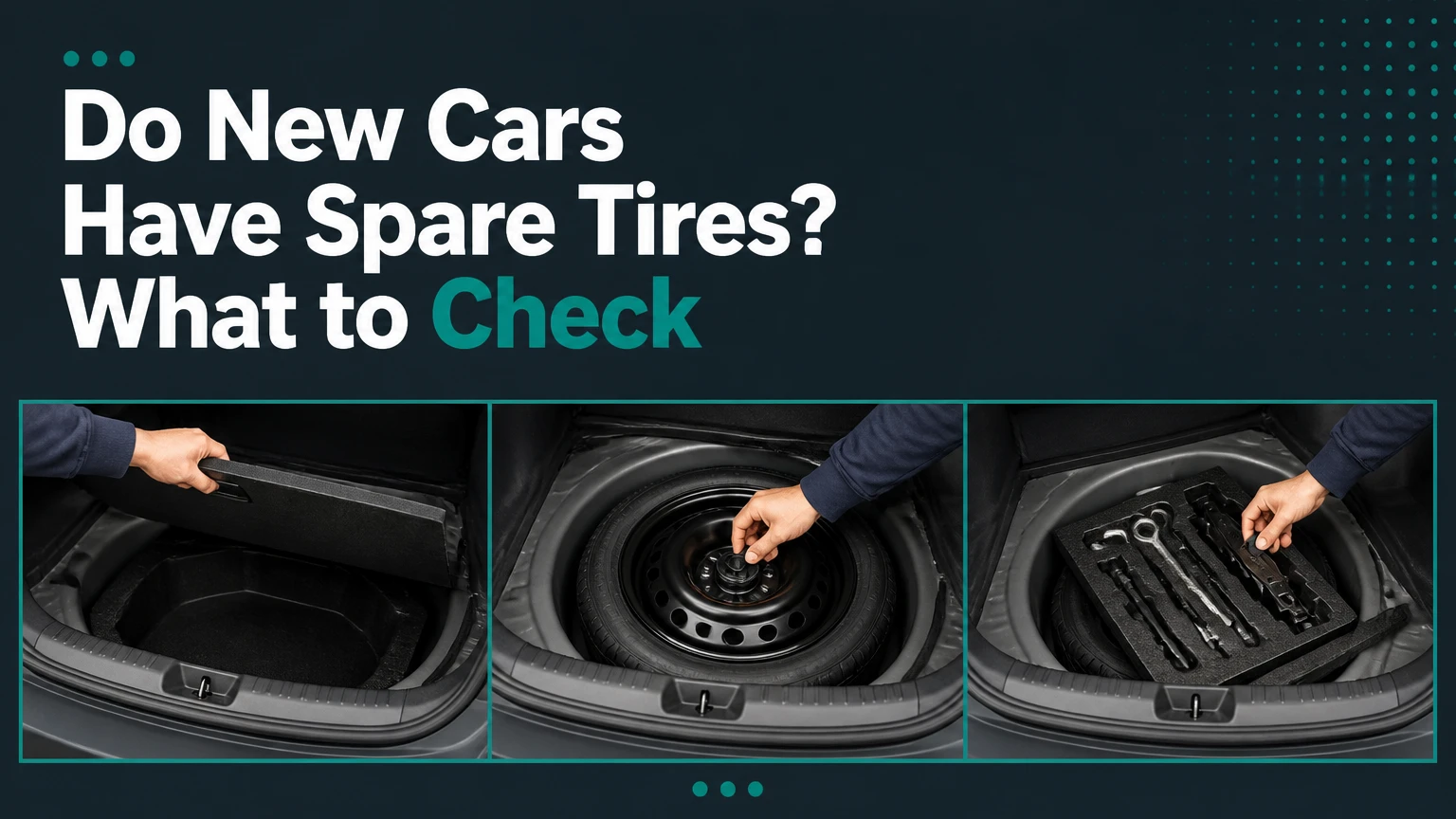
Most new cars do not include a traditional spare tire as standard equipment, although some trims, trucks, SUVs, and off-road models still do. A new vehicle may instead carry a compact spare, tire mobility kit, self-sealing tire, or run-flat tire, and the exact equipment can change between model years and trim levels.
Key Facts at a Glance
- A complete factory spare-tire setup includes a wheel, tire, jack, lug wrench, and secure retention hardware.
- A compact spare commonly carries a 50-55 mph limit and a vehicle-specific distance limit, often about 50-70 miles.
- A tire inflator and sealant kit usually repairs only small punctures in the central tread, not sidewall cuts or blowouts.
- Run-flat tires can often travel approximately 50 miles after pressure loss, but the vehicle manual controls the actual limit.
- Spare-tire pressure can be much higher than normal tire pressure, often near 60 psi for a temporary compact spare.
- EV and hybrid battery packaging frequently removes the deep underfloor cavity that once held a spare tire.
Do New Cars Have Spare Tires?
No, many new cars do not have spare tires, but “new car” does not identify the equipment precisely enough. Spare-tire availability depends on the make, model, model year, drivetrain, wheel size, body style, and trim, so a base sedan and an off-road version of the same model may have different emergency equipment.
Consumer Reports has documented the continuing disappearance of spare tires from newer vehicles, while automotive manufacturers increasingly supply tire mobility kits or run-flat tires. Estimates that 45%-60% of new vehicles lack a physical spare are useful as broad market descriptions, not as a universal annual statistic, because the result changes with country, vehicle mix, and whether optional equipment is counted.
A vehicle with no spare may still have a complete puncture-response system. The system could include a compressor, sealant cartridge, self-sealing tire, roadside-assistance coverage, or run-flat construction. Those solutions handle some punctures well, but none replaces a spare in every failure scenario.
What counts as a complete spare-tire setup?
A complete spare-tire setup contains more than a tire. The wheel and tire must have a compatible bolt pattern, center bore, load rating, brake-clearance profile, and rolling diameter; the jack must reach the vehicle’s reinforced lifting points; and the wrench must fit the lug hardware.
Retention hardware matters. A loose spare, jack, or wrench can become a dangerous projectile during a collision, so the vehicle’s original hold-down bolt, basket, bracket, or strap should remain installed.
| Component | Typical specification | What to verify |
|---|---|---|
| Compact spare tire | 50-55 mph maximum, 50-70 mile typical limit | Owner’s manual and sidewall label |
| Full-size spare | Same nominal diameter and load rating as road tires | Tire size, tread, wheel offset |
| Scissor jack | Vehicle-specific lifting range and capacity | Jack-point compatibility |
| Lug wrench | Commonly 17, 19, or 21 mm socket size | Exact lug-nut size |
| Retainer hardware | Center bolt, bracket, basket, or strap | Cargo-floor and crash-securement fit |
Why Are Spare Tires Disappearing?
Automakers remove spare tires primarily to reduce mass, preserve packaging space, and meet efficiency targets. A conventional spare wheel, tire, jack, and tools commonly weigh about 30-50 pounds, while a compressor and sealant kit may weigh only 2-6 pounds.
Lower vehicle mass can reduce rolling and acceleration energy, although the fuel-economy effect for one spare assembly is modest. Manufacturers also gain a deeper cargo floor, more room for exhaust, suspension, all-wheel-drive components, or battery hardware, and fewer parts to manufacture and transport.
Cost is another factor, but “saving several hundred dollars” is not a reliable universal figure. A manufacturer avoids the parts, assembly, storage, retention hardware, and warranty obligations associated with the spare package, yet some vehicles receive more expensive run-flat tires or roadside-assistance benefits instead.
Why do EVs and hybrids often lack a spare?
Electric vehicles and hybrids often lack a spare because battery modules occupy the low, flat space beneath the passenger compartment. A tire well requires depth, crash protection, thermal management, and additional structure, all of which compete with battery volume and underbody components.
EVs also create a fit problem. A spare wheel must clear large brake calipers and match the vehicle’s load capacity, electronic stability controls, and, on some all-wheel-drive models, drivetrain requirements. A generic donut can be unsafe even when its bolt pattern appears correct.
The absence is not universal. Some EVs provide a spare, some offer one as an accessory, and some rely on roadside assistance plus sealant. The window sticker, equipment list, cargo compartment, and owner’s manual provide better evidence than the vehicle’s fuel type alone.
How Can You Check Whether a New Car Has a Spare?
Check the cargo area, owner’s manual, vehicle build sheet, and tire sidewalls before assuming a new car has a spare. A tire kit may be hidden under a removable floor panel, behind a side trim panel, beneath a rear seat, or in a front trunk on an EV.
Use this verification sequence:
- Lift the cargo-floor panel and inspect for a wheel well, retaining bolt, jack, and wrench.
- Search the owner’s manual for “changing a flat,” “temporary spare,” “tire mobility kit,” and “run-flat.”
- Read the vehicle’s build sheet or window sticker for terms such as spare tire, inflator kit, sealant, or mobility kit.
- Inspect each tire sidewall for run-flat markings such as RFT, ROF, SSR, ZP, or a manufacturer-specific symbol.
- Ask the dealer to identify the exact factory-installed equipment by VIN and trim.
- Confirm whether the advertised spare is included or an optional package.
A dealer’s generic statement that “the model has a spare” is insufficient. Wheel size, hybrid packaging, and trim-level changes can alter the answer.
What Does a Car Use Instead of a Spare Tire?
A car without a traditional spare usually uses one of four backup systems: a compact spare, full-size spare, tire mobility kit, or run-flat tire. Self-sealing tires form a related fifth option, but they do not provide mobility after every kind of puncture and do not repair sidewall damage.
| Backup system | Typical capability | Main limitation | Typical replacement cost |
|---|---|---|---|
| Compact spare | Temporary travel at 50-55 mph | Vehicle-specific distance limit, reduced handling | $100-$250 complete tire and wheel |
| Full-size spare | Normal rolling diameter and extended use | 30-50 lb weight, cargo-space demand | $150-$500+ |
| Mobility kit | Small tread puncture repair and inflation | No repair for sidewall cuts or blowouts | $40-$100 |
| Run-flat tire | Approximately 50 miles after pressure loss | Usually 50 mph limit, harsher ride | $180-$450 per tire |
| Self-sealing tire | Seals some tread punctures automatically | Seal range and damage limits vary by model | $200-$500 per tire |
Is a compact spare the same as a full-size spare?
No. A compact spare, often called a donut, has a narrower tire and temporary-use limits, while a full-size spare uses a wheel and tire that closely match the road wheels. Compact spares reduce cargo and weight, but they alter braking, cornering, ground clearance, and wheel-speed behavior.
A full-size spare is not automatically interchangeable with the other four wheels. The replacement still needs compatible diameter, load index, speed rating, bolt pattern, offset, and brake clearance. An old tire with adequate tread can also be unsafe because rubber ages even when the tire is rarely driven.
Are run-flat tires better than a spare?
Run-flat tires are more convenient for a minor puncture on a paved road, while a physical spare is more versatile for blowouts, sidewall damage, remote travel, and repeated tire failures. Run-flats use reinforced sidewalls or internal support structures to carry vehicle weight after inflation pressure falls.
The driver must reduce speed and travel only as far as the manufacturer allows. A pressure-monitoring system is essential because the tire may feel nearly normal while operating under severe internal stress. Run-flats can also produce a firmer ride, cost more, and require replacement after damage that a conventional tire might repair.
How Long Can You Drive on a Donut or Run-Flat?
A compact spare or run-flat commonly permits about 50 miles at no more than 50-55 mph, but the vehicle owner’s manual and tire sidewall override general figures. Some compact spares allow 70 miles, and some run-flat systems specify different limits based on load, temperature, and remaining pressure.
Drive directly to a tire shop. Avoid high-speed highways, heavy loads, hard cornering, sudden braking, towing, and long trips. A compact spare can reduce wet traction and increase stopping distance, while a mismatched tire can create additional stress in an all-wheel-drive system.
The distance limit is not a warranty of safe travel. A tire that has operated at zero pressure, overheated, or suffered structural damage may need immediate replacement even if the nominal mileage limit has not been reached.
How much pressure does a compact spare need?
Many compact spares require approximately 60 psi, but the correct pressure is printed on the spare’s sidewall or listed in the manual. The pressure on the driver-door placard usually applies to the four road tires, not the temporary spare.
Inspect a spare at least monthly and before long trips. Temperature changes and slow permeation reduce pressure while the tire sits unused, and a compact spare at 20-30 psi may be unusable when needed. Do not reduce a spare’s pressure to match the road tires.
What Damage Can a Tire Sealant Kit Repair?
A tire sealant kit can often address a small puncture in the central tread, commonly around 6 mm or less, but the exact limit belongs to the kit manufacturer. Sealant cannot reliably repair a sidewall tear, bead leak, bent wheel, tread separation, valve failure, or a tire destroyed by a blowout.
Use the kit only after reading its instructions. Typical steps are:
- Remove the puncturing object only if the kit instructions permit it.
- Connect the sealant hose to the valve stem.
- Inject the specified quantity of sealant.
- Connect the compressor to the vehicle’s 12-volt outlet.
- Inflate to the pressure listed on the door placard.
- Drive only the stated distance and speed, then seek professional inspection.
Sealant can contaminate a tire-pressure sensor and complicate repair-shop cleanup. Tell the technician which product entered the tire, and check the cartridge’s expiration date because many sealants have a service life of roughly four years.
Self-sealing tires differ from liquid kits because a sealant layer is built inside the tire. Both systems have limits. Neither is a solution for a torn sidewall.
How Do You Change a Flat Tire Safely?
Changing a flat tire usually takes 20-40 minutes for a prepared driver, but roadside safety matters more than speed. The most important factor is a level, solid location away from traffic, because a factory jack is intended for lifting rather than supporting a vehicle during extended work.
Before you start
| Requirement | Typical value |
|---|---|
| Time | 20-40 minutes |
| Tools | Jack, lug wrench, spare, gloves, flashlight |
| Optional safety equipment | 2-4 wheel chocks, reflective vest, warning triangles |
| Surface | Level, firm pavement, away from moving traffic |
| Final lug tightening | Vehicle-specific torque, commonly 80-120 lb-ft |
| Spare pressure | Often 60 psi for a compact spare |
Step 1: Secure the vehicle
Pull as far from traffic as the location permits, activate the hazard lights, select Park, apply the parking brake, and switch off the engine. Exit on the side away from traffic when possible.
Move passengers behind a barrier or well away from the roadway. If the shoulder is narrow, soft, sloped, or exposed to fast traffic, call roadside assistance instead of using the jack.
Step 2: Loosen the lug nuts before lifting
Remove the wheel cover if necessary and turn each lug nut counterclockwise about half a turn. Keep the vehicle on the ground so the tire’s contact with the pavement resists rotation.
Do not fully remove the nuts yet. A breaker bar can help with over-tightened hardware, but never use an improvised extension that may slip or damage the nut.
Step 3: Lift at the specified jack point
Consult the manual for the reinforced jack point near the flat wheel. Place the jack on solid ground and raise the vehicle only until the flat tire clears the pavement by roughly 1-2 inches, unless the manual specifies otherwise.
The rocker-panel pinch weld or marked lifting notch is usually the correct location. Jacking under plastic trim, floorpan metal, suspension arms, or an unidentified crossmember can cause structural damage or make the vehicle unstable.
Step 4: Install the spare and tighten the nuts
Remove the loosened nuts, pull the flat wheel straight off, and mount the spare without placing hands beneath the vehicle. Thread every nut by hand before using the wrench.
Tighten in a star pattern while the tire remains slightly above the ground. This centers the wheel more evenly than tightening adjacent nuts in sequence.
Step 5: Lower and torque the wheel
Lower the vehicle until the tire contacts the pavement, remove the jack, and tighten the nuts to the torque specified by the manufacturer. A torque wrench is more accurate than the emergency lug wrench.
Recheck the pressure, stow the damaged wheel and tools securely, and confirm that the wheel is not rubbing the brake, suspension, or bodywork. Drive cautiously to a repair facility and replace the temporary spare promptly.
How Much Does Adding a Spare Tire Cost?
Adding a spare-tire system typically costs $250-$600 for a compatible wheel, tire, jack, wrench, and retention hardware, although large alloy wheels, specialty tires, and dealer labor can raise the total above $800. A tire alone is not a complete emergency kit.
| Purchase | Typical price | What the price includes | Main risk |
|---|---|---|---|
| Compact spare tire only | $80-$180 | Tire, sometimes no wheel | No usable wheel or tools |
| Compact spare wheel and tire | $150-$350 | Mounted temporary assembly | Brake-clearance mismatch |
| Full-size wheel and tire | $250-$700 | Matching or compatible assembly | Weight, storage, tire-age issue |
| Jack and wrench set | $50-$180 | Basic lifting and removal tools | Incorrect capacity or fit |
| Complete aftermarket kit | $300-$800 | Spare, tools, hardware, storage | Model-specific compatibility |
| Dealer-installed package | $500-$1,000+ | Factory or approved parts and labor | Higher labor and parts cost |
Before buying an aftermarket kit, verify bolt pattern, center bore, offset, brake clearance, load rating, tire diameter, and storage security. A wheel that bolts on can still contact a caliper or create an unsafe rolling-diameter difference.
A salvage-yard wheel can reduce cost, but inspect it for bends, cracks, corrosion, and the correct load rating. Replace an aged or damaged tire rather than treating a cheap, unused-looking spare as automatically safe.
Which Spare Setup Fits Your Driving?
Rural commuters and long-distance travelers generally benefit most from a physical spare because towing services may be far away or unreachable. Urban drivers with strong cellular coverage may reasonably choose a factory mobility kit if they understand its damage limits and maintain roadside coverage.
| Driver situation | Preferred setup | Reason | Important limitation |
|---|---|---|---|
| Rural commute | Full-size or compact spare | Fewer nearby repair facilities | Must maintain pressure |
| Urban EV commute | Mobility kit or approved spare | Saves battery and cargo space | Sidewall damage still requires towing |
| Highway road trips | Full-size spare | Handles extended, remote travel better | Uses cargo capacity |
| Off-road driving | Full-size, matching spare | Blowouts and sidewall damage are more likely | Confirm departure angle and mounting |
| AWD vehicle | Matching-diameter spare | Protects drivetrain compatibility | Manual may require immediate replacement |
| Trailer towing | Full-size spare | Temporary tires may have towing restrictions | Check combined load limits |
The “best” arrangement is therefore situational. A lightweight sealant kit is a poor substitute for a spare on remote gravel roads, while a full-size wheel may be unnecessary cargo for a city-only commuter who can reach assistance within minutes.
What Problems Can Occur Without a Spare?
A no-spare vehicle becomes vulnerable when the tire failure exceeds the replacement system’s design limits. Sidewall cuts, pothole-induced wheel damage, multiple punctures, valve-stem leaks, and tire separation can defeat both sealant and run-flat technology.
Common failure points include:
- Expired or empty sealant: The compressor runs, but the cartridge cannot seal the puncture.
- Low spare pressure: A compact spare loses pressure over time even when unused.
- Wrong aftermarket wheel: The wheel fits the studs but fails brake clearance or load requirements.
- AWD mismatch: Different rolling diameters can stress differentials and clutch packs.
- Missing retention hardware: The wheel or jack moves around the cargo area during braking.
- Unsafe roadside location: A correct tire change remains dangerous beside fast traffic.
A temporary spare may trigger TPMS, ABS, or stability-control warnings because its circumference differs from the road tires. Do not disable traction control merely to suppress a warning. Follow the manual, drive slowly, and have the system scanned if the warnings remain after the original wheel is restored.
The National Highway Traffic Safety Administration warns that “a tire blowout can be a frightening experience.” NHTSA’s practical advice is to hold the steering wheel firmly, avoid sudden braking, and gradually release the accelerator while moving to a safe location.
What Should You Ask Before Buying a New Car?
Ask the salesperson to identify the exact flat-tire equipment for the specific VIN and trim, then inspect the equipment yourself. The most useful questions concern the spare’s presence, pressure, distance limit, repair capability, and roadside-assistance terms.
Use this checklist:
- Does the vehicle include a full-size spare, compact spare, mobility kit, run-flats, or self-sealing tires?
- Is the equipment standard on this trim or included only in an option package?
- Where are the jack, wrench, compressor, sealant, and retention hardware stored?
- What speed and distance limits apply after a flat?
- Does the warranty or roadside plan cover towing after an unrepairable puncture?
- Can the vehicle accept an approved spare for winter tires or long trips?
- Does an AWD system require a matching tire diameter?
- What is the sealant expiration date and replacement price?
- Does the spare fit over the largest brake package?
- Is towing allowed while a compact spare is installed?
Read the tire label and owner’s manual before signing. Sales brochures often describe tire technology without listing the emergency equipment supplied in the cargo compartment.
Frequently Asked Questions
Do new cars have spare tires in the United States?
Many new cars sold in the United States omit a traditional spare, but no single rule applies to every vehicle. Trucks, body-on-frame SUVs, off-road models, and some sedans still include compact or full-size spares, while other trims use mobility kits or run-flat tires. Verify the exact model year and VIN.
Do electric cars have spare tires?
Some electric cars can carry a spare, but many do not because battery packs occupy underfloor space and large brakes restrict wheel compatibility. EV owners should check the manufacturer’s accessory catalog and owner’s manual rather than buying a universal donut, especially when the vehicle has all-wheel drive.
Can I put a regular tire on a compact spare wheel?
No. A compact spare wheel is engineered for its specified temporary tire, load rating, and inflation pressure. Mounting a conventional tire with the wrong width, diameter, or load rating can create clearance, handling, and structural problems. Use only a wheel and tire combination approved for the vehicle.
Does roadside assistance replace a missing spare?
Roadside assistance may inflate a tire, install a vehicle-supplied spare, or tow the vehicle, depending on the plan and location. A technician normally cannot provide a guaranteed replacement wheel at the roadside. Check towing distance, service limits, wait times, and coverage for run-flat or EV failures.
Should I carry a spare in a new car without one?
Carry an approved spare if you drive in rural areas, travel long distances, tow, explore unpaved roads, or cannot depend on mobile coverage. City drivers may prefer the factory mobility kit for its low weight, provided they maintain sealant, compressor, tire pressure, and roadside-assistance coverage.
The Bottom Line
Do new cars have spare tires? Many do not, and the replacement may be a mobility kit, run-flat tire, self-sealing tire, or optional compact spare. Check the exact trim, not the model name, and match the emergency setup to your driving environment. A physical spare remains the most versatile response to sidewall damage, blowouts, remote travel, and wheel damage, while a maintained inflator kit is lighter and adequate for small tread punctures in accessible areas.


