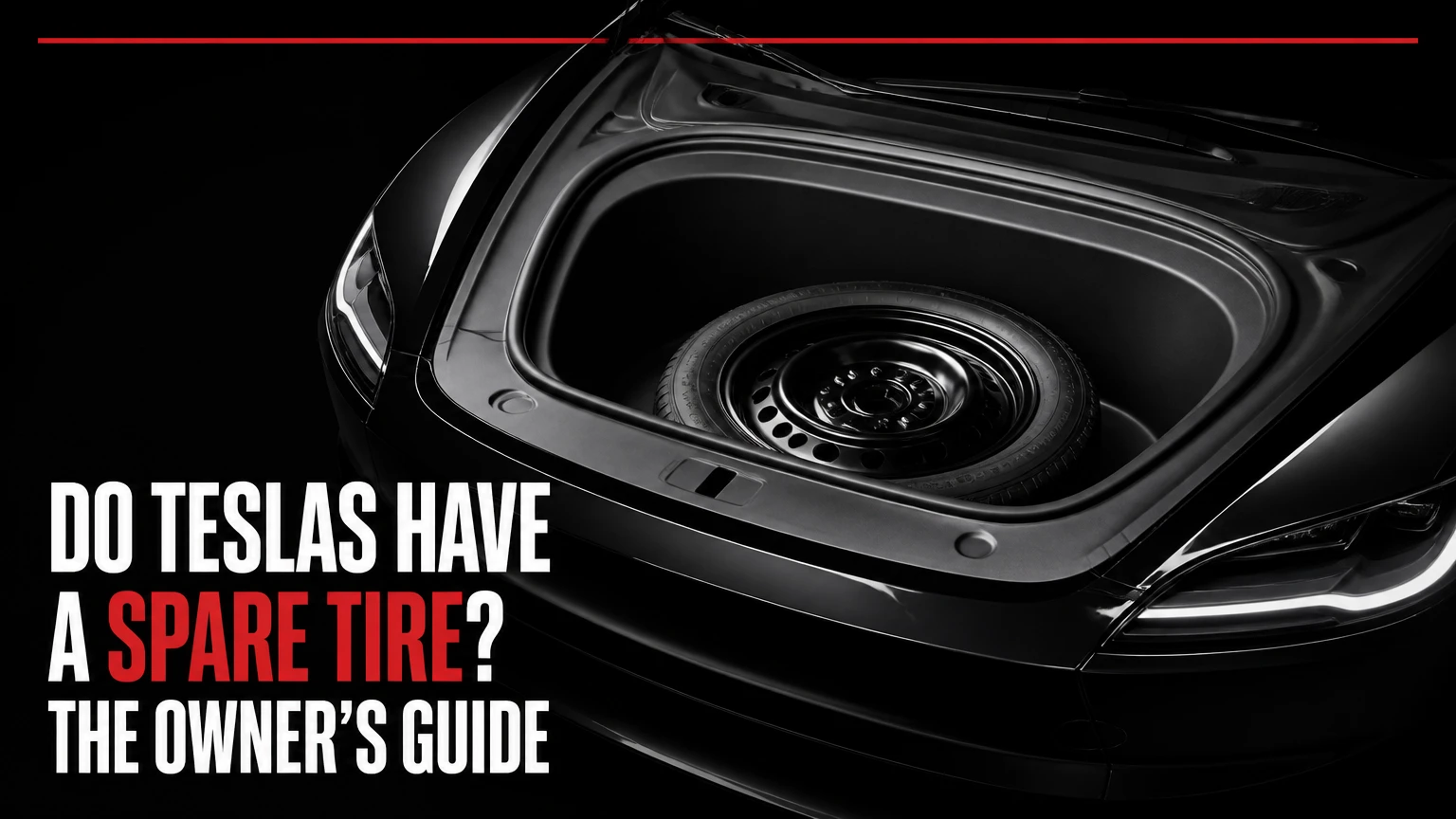
No, Tesla vehicles generally do not come with a factory spare tire. Model 3, Model Y, Model S, and Model X owners usually receive no donut or full-size spare, although equipment can vary by market and delivery configuration. Tesla relies instead on tire inflation or repair equipment, mobile service, and roadside towing.
Key facts at a glance
Tesla Model 3, Model Y, Model S, and Model X generally have no factory-installed spare tire.
Tesla tires are not automatically run-flat tires; most are conventional pneumatic tires, with some using acoustic foam.
Tesla tire sealant can address some small tread punctures, but it cannot repair a sidewall cut, bead failure, or blowout.
Tesla Roadside Assistance is requested through the Tesla app, but response time, towing distance, and loaner-wheel availability vary by location and coverage.
A compatible aftermarket spare kit typically costs about $350-$600 and must clear the vehicle’s brake calipers.
A Tesla must be lifted only at its designated lift points, using suitable jack pucks or an equivalent lifting adapter.
Which Tesla models have a spare tire?
Model 3, Model Y, Model S, and Model X are normally delivered without a spare tire. Tesla has not made a conventional spare a standard factory item across its current mainstream passenger lineup, so owners should verify the actual equipment in the vehicle rather than assume a spare is hidden under the trunk floor.
| Tesla model | Factory spare status | Typical factory alternative | Main storage consideration |
|---|---|---|---|
| Model 3 | Usually absent | Tire-pressure monitoring and roadside support | Limited trunk and underfloor space |
| Model Y | Usually absent | Compressor or roadside service, depending on equipment | Sub-trunk may hold some compact kits |
| Model S | Usually absent | Roadside support and tire service | Larger wheel and brake fitment varies |
| Model X | Usually absent | Roadside support and tire service | Heavy vehicle requires correct load rating |
Used Teslas can contain equipment added by a previous owner, including a compressor, plug kit, or aftermarket wheel. Tesla’s vehicle-specific support information and the delivery inventory remain the best confirmation for a particular car, because included accessories and regional roadside terms can change.
A tire repair kit is not the same thing as a spare. A compressor restores air temporarily, while a spare replaces the damaged wheel and tire so the vehicle can leave the scene without relying on the damaged tire.
Why does Tesla omit the spare tire?
Tesla omits the spare primarily to reduce mass, preserve storage volume, and avoid carrying equipment most drivers rarely use. Removing a spare assembly can save roughly 35-60 pounds depending on the wheel, tire, jack, and tools, while the empty well can support underfloor storage or vehicle hardware.
The range effect is real but modest. A 40-pound reduction does not create a fixed number of additional miles, because efficiency also depends on temperature, speed, tires, wheel size, payload, and battery state. Tesla does not publish a universal “spare removed equals X miles” figure for every model.
The packaging argument is more visible in practice. A Tesla’s battery occupies much of the floor, while electric drive components and suspension packaging leave less conventional room for a spare. Model 3 and Model Y storage wells can accommodate some accessories, but a complete spare kit may consume useful cargo capacity.
The often-repeated claim that “85% of spare tires are never used” should not be treated as a Tesla-specific published statistic. Automakers commonly cite low spare-tire usage when explaining the industry trend, but the exact percentage depends on the study, vehicle population, and definition of “used.”
What does Tesla provide instead of a spare?
Tesla provides a combination of tire-pressure monitoring, service support, and roadside assistance rather than a universal spare-tire system. Some vehicles or markets may include an inflation compressor, while Tesla also sells tire-repair products through its online store; owners should inspect their delivery equipment before buying duplicates.
Tesla Support has stated that Tesla vehicles do not come equipped with spare tires. The practical replacement is therefore a response system, not a component that guarantees immediate mobility.
| Alternative | What it does | Typical capability | Important limitation |
|---|---|---|---|
| Air compressor | Adds air to a leaking tire | Restores pressure for a temporary drive | Cannot seal a large puncture or cut |
| Chemical sealant | Plugs some tread punctures | Often rated for holes up to about 6 mm | Not for sidewalls, beads, or blowouts |
| Tesla Roadside Assistance | Sends mobile help or a tow | App-based request, subject to coverage | Wait and destination vary by location |
| Aftermarket spare | Replaces the damaged wheel | Enables travel to a tire shop | Requires compatible brake and load fitment |
| Plug kit | Inserts rubber into a simple tread hole | Low-cost roadside repair option | Needs inspection and correct installation |
Tesla roadside coverage is not a promise that a technician will repair the tire at the roadside. Depending on the country, warranty status, and cause of the failure, service may involve a tow to a Tesla Service Center or an independent tire facility.
Are Tesla tires run-flat?
Tesla tires are generally not run-flat tires. Most Tesla tires are conventional tires that require air pressure to support the vehicle, although some vehicles use self-supporting or specially specified tires depending on the wheel package and market.
Run-flat tires have reinforced sidewalls or an internal support structure that can carry the vehicle for a limited distance after pressure loss. A typical run-flat specification permits approximately 50 miles at no more than 50 mph, but the exact limit belongs to the tire manufacturer and sidewall marking.
Acoustic foam creates a separate source of confusion. Tesla may use tires with polyurethane noise-absorbing foam bonded inside the tread area, often identified by markings such as “Acoustic” or manufacturer-specific terminology. Foam reduces cavity noise; it does not let the tire drive after a puncture.
| Tire type | Can it support driving without air? | Typical post-puncture limit | Repair implication |
|---|---|---|---|
| Standard pneumatic tire | No | Stop promptly and inspect | Normal tire-repair rules apply |
| Acoustic-foam tire | No | Same as the underlying tire | Foam may require careful removal |
| Self-sealing tire | Limited sealing function | Follow tire-maker instructions | Seal range and repair rules vary |
| Run-flat tire | Yes, temporarily | Often 50 miles at 50 mph | Replacement may be required after use |
Check the tire sidewall and the vehicle’s original specification before assuming run-flat capability. Driving a conventional Tesla tire while it is flat can damage the sidewall, wheel, tire-pressure sensor, and possibly the wheel itself within a short distance.
How does the Tesla tire repair kit work?
A Tesla tire repair kit combines an electric compressor with sealant, allowing the driver to inflate a tire and temporarily close a small tread puncture. The process normally takes 10-20 minutes, but success depends on the puncture location, hole size, remaining tire structure, and whether the tire still sits properly on the rim.
Step 1: Stop and inspect the tire
Move onto a stable shoulder away from traffic and activate hazard lights. Do not remove a nail or screw immediately, because the object may be slowing the air loss and its location helps determine whether the tire is repairable.
A puncture in the central tread area may qualify for repair. A shoulder or sidewall injury generally does not.
Step 2: Use inflation mode first
Connect the compressor to the vehicle’s 12-volt outlet if the kit requires that connection, then attach the hose to the valve stem. Inflate to the pressure shown on the driver-door placard or Tesla display, not the maximum pressure molded into the tire sidewall.
If pressure rises and remains stable for several minutes, drive directly to a tire professional. A tire that loses pressure immediately needs roadside assistance rather than a normal drive.
Step 3: Use sealant only for a suitable puncture
If the kit instructions identify a sealant mode, connect the sealant canister and inject it according to the product directions. Tesla’s repair products and third-party products are not interchangeable, so follow the canister’s expiration date, connection method, and speed restriction.
Sealant is a temporary mobility measure. It is not an approved repair for a sidewall cut, exposed cord, separated tread, bent wheel, bead leak, or hole beyond the product’s stated size.
Step 4: Recheck pressure and drive to service
Inflate to the placard pressure, then monitor the tire-pressure display while traveling slowly to a tire shop. Many sealant products specify a maximum speed of about 50 mph, but the product label controls.
Tell the tire technician that sealant was used. Chemical sealant can contaminate the inside of the tire, interfere with pressure sensors, and require cleaning before an inspection. Some shops will decline the tire because internal damage or contamination makes replacement more appropriate.
When should you not use Tesla sealant?
Do not use sealant for sidewall damage, a tire that has separated from the rim, a blowout, a visibly bent wheel, or a tire driven while completely flat. Sealant cannot restore the structural strength of a damaged sidewall, and driving on a flat can destroy a tire that might otherwise have been repairable.
Do not use sealant as the first response when the tire is losing air rapidly or the puncture is not visible. The canister can make later inspection messier without solving the actual failure.
A repairable puncture generally lies within the tread’s repairable area, has not damaged the internal cords, and meets the tire manufacturer’s size and repair rules. The U.S. Tire Manufacturers Association emphasizes that puncture repair requires an internal inspection, because an external plug alone cannot reveal hidden run-flat or underinflation damage.
Does acoustic foam prevent Tesla tire repair?
Acoustic foam does not automatically make a Tesla tire unrepairable. A qualified tire technician can often remove or work around the foam, inspect the inner liner, repair an eligible puncture, and restore the foam when the tire maker’s procedure permits it.
Foam can increase labor time. A technician may need to peel back or cut away material around the puncture, and sealant can add another layer of contamination. Some high-volume retailers decline foam-lined EV tires because their equipment, procedures, or liability policy does not cover that work.
Tesla owners should call before arriving and identify the tire as an acoustic-foam EV tire. Tesla Service, Discount Tire or America’s Tire in participating locations, and independent shops experienced with EV tires may be better choices than a shop that only handles conventional passenger tires.
A tire with foam is still a pneumatic tire unless its sidewall specifically identifies run-flat construction. Acoustic treatment changes noise behavior, not flat-tire mobility.
How much do Tesla tire solutions cost?
A Tesla owner typically spends $10-$25 for a basic plug kit, about $40-$120 for a compressor and sealant setup, or approximately $350-$600 for a complete compatible spare kit. Actual prices vary by model, wheel diameter, vendor, shipping, regional taxes, and whether the tire or wheel must be replaced.
| Solution | Typical purchase cost | Typical response time | Best use |
|---|---|---|---|
| Plug kit | $10-$25 | 10-20 minutes | Simple tread puncture with visible access |
| Compressor | $30-$90 | 5-15 minutes | Slow leak or pressure adjustment |
| Sealant refill | $25-$40 | 10-20 minutes | Small eligible tread puncture |
| Complete compact spare | $350-$600 | 5-15 minutes to install | Remote travel and severe punctures |
| New Tesla tire | $180-$500 per tire | Same day to several days | Structural damage or worn tire |
Roadside towing may be included under Tesla warranty or a roadside plan within stated distance and eligibility limits, but tire replacement is usually the owner’s expense. A tow outside the covered distance, a discharged vehicle, or a non-covered incident can produce an additional charge.
Call the service provider before authorizing a tow if the vehicle is outside warranty coverage. Coverage is market-specific and can change with time.
Do you need jack pucks for a Tesla?
Tesla lifting requires the vehicle’s designated lift points, and jack pucks are the safest practical way to align a conventional floor jack with those points. A standard jack placed under the battery enclosure, rocker panel, suspension arm, or an arbitrary flat surface can damage the battery pack or underbody.
Jack pucks are small adapters, commonly sold in sets of four, that fit into the Tesla lift-point openings. A typical set costs $15-$35 and occupies little glovebox or trunk space.
A puck does not make every jack suitable. The jack must have adequate capacity, a stable base, enough lift height, and a saddle that supports the puck correctly. Tesla’s emergency documentation and the vehicle’s lifting instructions take precedence over aftermarket advice.
If changing a wheel yourself, use wheel chocks, a level surface, and a torque wrench. Tighten the wheel fasteners to the specification for that model and wheel, because torque varies by vehicle and hardware. Never work beneath a Tesla supported only by a jack.
How do you choose an aftermarket Tesla spare?
Choose an aftermarket spare by vehicle generation, brake clearance, tire diameter, load rating, rolling circumference, and included tools. A wheel that physically fits the hub may still contact the brake caliper or carry too little weight for a Model X or heavily loaded Model Y.
| Selection factor | What to verify | Why it matters |
|---|---|---|
| Model and year | Model 3, Y, S, or X plus production year | Brake and hub dimensions can change |
| Brake clearance | Vendor fitment for the exact wheel package | Caliper contact can make installation unsafe |
| Load rating | Tire and wheel rating above axle requirements | EV curb weight is high, especially Model X |
| Overall diameter | Near the original tire diameter | Reduces stability-control and drivetrain concerns |
| Hardware | Correct lug nuts or bolts and socket | Thread and seat mismatch can damage fasteners |
| Speed limit | Printed kit limit, often 50 mph | Compact spares are temporary equipment |
| Storage | Trunk, frunk, or sub-trunk dimensions | A kit may remove useful cargo capacity |
A compact spare is a temporary solution, not an upgrade for normal driving. Install it only on the position and axle allowed by the kit manufacturer, avoid hard acceleration, and drive to a tire shop as soon as practical.
A full-size matching wheel offers better handling and range consistency, but it costs more and is difficult to store. It also may not fit in the underfloor compartment, especially with larger performance wheels.
Which solution fits your driving pattern?
The best Tesla flat-tire strategy depends on distance from service, road conditions, cargo needs, and tolerance for waiting. A compressor alone suits drivers near populated areas, while a complete compatible spare becomes more valuable when a single puncture could end a remote trip.
| Driver situation | Recommended equipment | Main benefit | Main drawback |
|---|---|---|---|
| Urban commuter | Compressor plus roadside plan | Low cost and little cargo loss | Waiting for a tow |
| Interstate traveler | Complete compact spare and pucks | Leaves a dangerous shoulder quickly | $350-$600 and storage space |
| Rural driver | Spare kit plus plug kit | Covers more failure types | Added weight and tool complexity |
| Winter traveler | Spare kit, gloves, chocks, flashlight | Works during cold roadside stops | Tire may not match winter traction |
| Fleet or rideshare driver | Compressor, service account, spare access | Reduces downtime | Requires inventory checks |
City commuting
Urban drivers usually have nearby tire shops and cellular coverage. A compressor, tread-depth inspection, and active roadside account may provide adequate protection, provided the driver accepts a possible 30-120 minute wait.
Long-distance travel
Road-trip drivers face longer tow distances, nighttime closures, and tire shops without Tesla-specific equipment. A compact spare, jack pucks, wheel wrench, gloves, and a flashlight reduce dependence on a service truck.
Rural and winter driving
Rural owners should prioritize self-recovery because a tow may travel from another town. Snow, mud, and freezing temperatures make a roadside sealant procedure less pleasant and can make a small spare’s traction substantially different from the other tires.
What should you do when a Tesla tire goes flat?
A Tesla driver should stop safely, protect the wheel, assess the damage, and request assistance instead of continuing on a completely flat tire. The safest decision depends on whether the tire holds air, whether the damage is in the tread, and whether a compatible spare or trained service provider is available.
- Pull over safely. Avoid driving on the rim, even for a short distance, because the wheel can be bent and the tire’s internal structure destroyed.
- Read the tire-pressure warning. Record which wheel is affected and note whether pressure is falling rapidly.
- Inspect without crawling under the car. Look for a nail, screw, sidewall cut, separated tread, or visible wheel damage.
- Inflate only when the tire remains seated and structurally intact. Use the compressor at the door-placard pressure.
- Use sealant only for an eligible tread puncture. Do not use it for a blowout or sidewall injury.
- Open the Tesla app and select Roadside Assistance. Choose the flat-tire or towing option and provide the vehicle’s exact location.
- Tell the operator about wheel size, damage, and foam lining. The information helps determine whether a suitable truck or loaner wheel is available.
- Photograph the tire and wheel before towing. Images document the condition and help the receiving shop prepare.
Tesla may provide a loaner wheel in select markets, but availability is not guaranteed. A loaner wheel normally must be returned to Tesla or the supplying service location after the original wheel is repaired.
Common roadside mistakes
- Driving several miles on zero pressure: destroys the sidewall and can turn a repair into a replacement.
- Removing a nail before checking the leak: can accelerate air loss and eliminate a temporary option.
- Using a household jack: risks battery or underbody damage.
- Assuming foam means run-flat: leaves the driver stranded farther from safety.
- Installing an unverified donut: may cause brake-caliper contact or an unsafe load mismatch.
- Failing to disclose sealant: prevents the tire shop from preparing for internal cleaning or sensor service.
How long can a Tesla drive after a puncture?
A Tesla should be driven only as far as necessary to reach a safe location or nearby tire facility after a suitable temporary inflation. There is no universal safe mileage after a puncture, because pressure loss, tire construction, speed, load, road temperature, and internal damage determine the outcome.
A run-flat tire has a manufacturer-defined distance limit, but a standard Tesla tire does not gain that capability from acoustic foam or a tire-pressure monitoring system. If pressure continues falling, stop and call for service rather than repeatedly adding air.
A tire-pressure warning can also appear during seasonal temperature changes. That situation differs from a puncture, but the tire still needs a physical inspection and inflation to the placard specification.
Is a Tesla aftermarket spare worth carrying?
An aftermarket spare is worth carrying when roadside delay creates a larger cost than the kit, especially for remote travel, family trips, work appointments, or areas with limited Sunday tire service. The kit is less attractive for urban drivers who have reliable towing and do not want to surrender trunk space.
The compact wheel is insurance, not a guarantee. It cannot solve a damaged suspension, a bent hub, multiple punctures, or a vehicle immobilized by a collision. Owners must also confirm that the kit fits the exact brake package before an emergency occurs.
A tire plug kit is a useful supplement but a poor replacement for a spare. Plugging requires locating the puncture, reaming the hole, inserting the plug, and confirming pressure. The tire still needs professional internal inspection.
FAQ
Can I buy a spare tire directly from Tesla?
Tesla generally does not offer a universal factory spare-tire package for Model 3, Model Y, Model S, or Model X. Tesla may sell compressors, sealant, and tire-service products, while aftermarket suppliers sell model-specific compact spares. Confirm fitment against the vehicle identification number and brake package before purchasing.
Can I use any donut spare on a Tesla?
No. A donut spare must clear the brake caliper, match the hub and fastener design, carry the vehicle’s load, and maintain a suitable overall diameter. Model X and performance versions deserve particular caution because their weight and brake dimensions can exceed generic compact-spare specifications.
Will Tesla Roadside Assistance replace my tire?
Tesla Roadside Assistance may tow the vehicle or provide mobile assistance, but tire replacement is generally not included as a free replacement benefit. Warranty eligibility, towing distance, country, and service availability determine the actual response. Requesting service through the Tesla app provides the most accurate coverage information for the vehicle.
Can a tire shop repair a Tesla tire with acoustic foam?
Often, yes. A shop experienced with foam-lined EV tires can remove or work around the foam and inspect the tire internally. Repair remains dependent on puncture location, hole size, internal damage, and the tire maker’s rules. Call ahead because some retailers refuse foam-lined or sealant-contaminated tires.
Is a tire plug permanent on a Tesla?
A roadside plug is not automatically a permanent repair. A qualified technician should remove the tire, inspect the inside, and install an approved combination repair when the puncture qualifies. A plug in the shoulder, sidewall, or a tire driven flat should not be treated as safe because the external hole appears sealed.
Where should I store a Tesla spare kit?
Store a compact kit where it remains secured and accessible, such as the Model Y sub-trunk when the specific kit fits, the rear cargo area, or the frunk when dimensions allow. Verify clearance with the cargo floor installed, because a kit that fits only after removing a liner may be impractical during an emergency.
The Bottom Line
Do Teslas have a spare tire? Generally, no. Model 3, Model Y, Model S, and Model X owners should treat a compressor, approved sealant, Tesla Roadside Assistance, and a verified aftermarket spare as separate tools for different failure conditions. For city driving, roadside coverage may be sufficient; for remote or long-distance travel, a compatible spare kit and jack pucks provide the strongest practical backup.