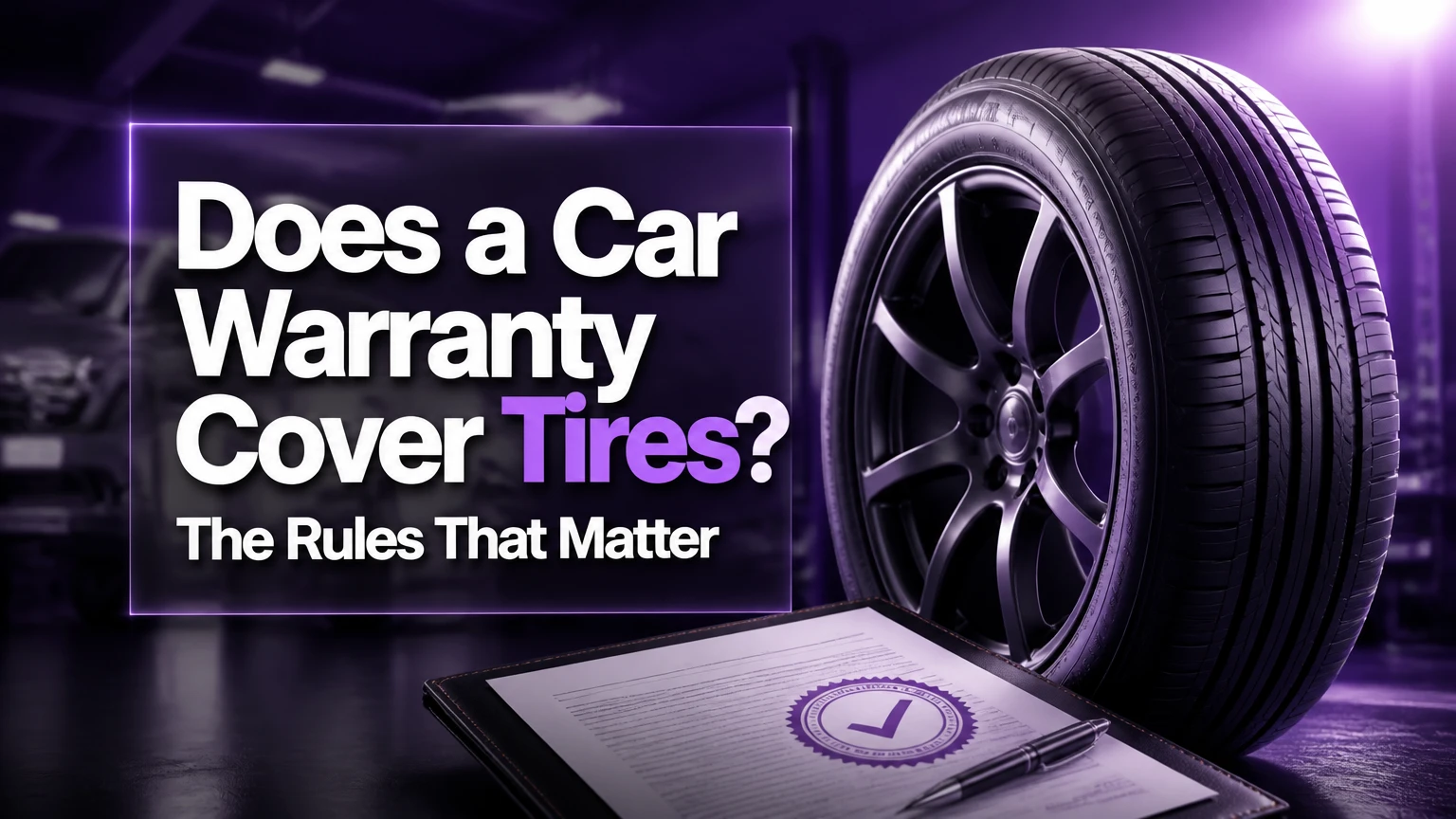
A standard new-car warranty usually does not cover tires for normal wear, punctures, nails, potholes, curb impacts, or other road hazards. The tire manufacturer generally covers defective materials, workmanship, and sometimes premature tread wear, while a separate road-hazard plan may cover accidental damage.
Key Facts at a Glance
- A bumper-to-bumper vehicle warranty generally excludes tires because the tire manufacturer warrants the tire itself.
- Tire workmanship claims usually require evidence of a manufacturing defect, not ordinary wear or impact damage.
- Tread-life warranties commonly provide prorated credit rather than a free replacement.
- Mounting, balancing, taxes, valve stems, and disposal fees usually remain the customer’s responsibility.
- Road-hazard protection is separate from a tire manufacturer’s defect warranty and may cover nails, glass, and pothole damage.
- A 2/32-inch tread depth is a common limit for treadwear claims, but the controlling warranty document may use different conditions.
Does a Car Warranty Cover Tires?
A car warranty normally covers the vehicle’s factory-installed mechanical and electrical components, not tires consumed through driving. The manufacturer’s limited warranty may cover a defect in a wheel, suspension component, steering part, or electronic tire-pressure monitoring system, but the tire itself usually falls under a separate tire warranty.
The distinction matters because the same symptom can have different causes. A tire with a sidewall bulge from a pothole is usually a road-hazard issue; a tire with an internal separation caused by defective construction may qualify for a manufacturer claim. Uneven tread caused by a failed alignment component can become a suspension or alignment dispute rather than a simple tire warranty claim.
The National Highway Traffic Safety Administration describes tires as “the only thing connecting your vehicle to the road.” That safety role does not make every tire failure a vehicle-warranty event. Warranty eligibility depends on the failure’s cause, the tire’s age and tread depth, maintenance records, and the exact terms issued by the tire brand.
What a factory vehicle warranty can cover
A vehicle warranty may cover a defective component that damages a tire or causes abnormal wear. For example, a covered wheel bearing could create looseness that produces irregular tread wear, although the tire replacement still may require separate proof and approval.
Potentially relevant vehicle-warranty claims include:
- A defective TPMS sensor, if the sensor itself fails.
- A covered suspension component that creates abnormal tire wear.
- A defective wheel that causes an air leak.
- A factory alignment error, where the automaker’s warranty terms recognize the condition.
- A tire fitted incorrectly at the factory, subject to the automaker and tire supplier’s procedures.
A dealer cannot automatically approve a tire claim simply because the vehicle is under warranty. The dealer must identify a covered defect and apply the correct warranty authority.
Who Actually Warrants the Tire?
The tire brand generally warrants the tire’s materials, workmanship, and stated tread performance. The vehicle manufacturer typically warrants the automobile, while the selling tire retailer may administer claims and provide an optional road-hazard contract.
A new vehicle may have original-equipment tires supplied by Michelin, Goodyear, Bridgestone, Continental, Pirelli, Yokohama, or another brand. The tire’s sidewall identifies the manufacturer, model, size, load index, speed rating, and production code. Those details determine which warranty document applies.
Replacement tires usually carry the tire maker’s limited warranty from the date of purchase. Some brands offer separate policies for original-equipment tires and replacement tires, so a tire installed on a new car may have different mileage or adjustment terms from the same model purchased later.
Which tire warranties exist?
Tire warranties fall into four practical categories: workmanship and materials, tread life, road hazard, and satisfaction or trial guarantees. A tire can qualify under one category while failing under another, because each category uses different proof and exclusions.
| Warranty type | Typical covered event | Typical limit | Common customer cost |
|---|---|---|---|
| Workmanship and materials | Tread separation or sidewall defect without impact evidence | 4-6 years or 2/32-inch tread | Mounting, balancing, taxes |
| Tread-life guarantee | Tire reaches 2/32-inch tread before 40,000-80,000 miles | 40,000-80,000 miles | Prorated replacement balance |
| Road-hazard plan | Nail, glass, pothole, or impact damage | 12-36 months or 2/32-inch tread | Plan deductible or installation fees |
| Ride trial or satisfaction policy | Approved dissatisfaction with noise, comfort, or handling | 30-45 days | Possible installation or return fees |
These ranges are typical industry terms, not universal promises. The brand’s current written warranty controls.
How Does a Tread-Life Warranty Work?
A tread-life warranty compares the tire’s actual service mileage with its advertised mileage guarantee, then usually applies a prorated credit based on usable tread remaining. A 60,000-mile tire that becomes worn at 30,000 miles may generate roughly 50% credit, but the brand’s tread-depth formula and conditions control the calculation.
Suppose four identical tires cost $800 before tax and installation. If an eligible tire has used 50% of its warranted tread life, the manufacturer might credit approximately 50% of that tire’s eligible purchase price, not 50% of the entire invoice. The owner still pays for the unused portion, labor, balancing, disposal, and taxes.
Tread-life guarantees usually require regular rotation, correct inflation, proper alignment, and use on the specified vehicle. Performance tires, winter tires, mud-terrain tires, trailer tires, and original-equipment fitments often have different or absent mileage guarantees.
What does “usable tread” mean?
Usable tread normally runs from the tire’s original tread depth down to the warranty adjustment limit, often 2/32 inch. The calculation may exclude the first few thirty-seconds of tread because that material is not treated as warranty-usable life.
A tire beginning at 10/32 inch and reaching 2/32 inch has 8/32 inch of usable tread. If the tire reaches 6/32 inch after 30,000 miles on a 60,000-mile guarantee, it has used 4/8 of its usable tread, or approximately 50%. The result is an illustrative calculation, not a guaranteed settlement.
Staggered fitments need special attention. A vehicle with different front and rear sizes cannot rotate tires across both axles, but the warranty may reduce coverage by a stated percentage, use axle-specific mileage, or exclude the guarantee entirely. It is not accurate to assume every staggered vehicle automatically receives exactly half coverage.
Are Punctures and Potholes Covered?
Standard tire defect and treadwear warranties generally do not cover punctures, potholes, curb strikes, cuts, sidewall impact damage, or vandalism. Those events may qualify under a separately purchased road-hazard plan, a retailer guarantee, a manufacturer-specific protection program, or an insurance policy with applicable coverage.
A nail in the repairable center tread is often handled as a repair rather than a warranty replacement. The Rubber Manufacturers Association, now part of the U.S. Tire Manufacturers Association, has long treated repairability as dependent on puncture location, size, internal condition, and professional inspection. Sidewall punctures are generally not safely repairable.
| Damage or symptom | Standard tire warranty | Road-hazard plan | Likely action |
|---|---|---|---|
| Tread separation without impact mark | Often eligible | Usually eligible | Brand inspection and adjustment |
| Nail in repairable tread area | Usually excluded | Often covered | Professional puncture repair |
| Pothole sidewall bulge | Excluded | Often covered | Replace tire, inspect wheel |
| Inner-edge wear from bad alignment | Excluded | Excluded | Repair alignment cause first |
| Valve or TPMS leak | Tire or vehicle terms vary | Plan terms vary | Diagnose valve, sensor, and rim |
A road-hazard plan may pay for one replacement tire but not guarantee that all four tires match. On all-wheel-drive vehicles, replacing one tire with substantially different circumference can create driveline stress. The manufacturer’s owner’s manual may require tire shaving, replacing an axle pair, or replacing all four tires.
What Does a Tire Claim Cost?
A tire warranty claim can cost $20-$100 or more for incidental service even when the replacement tire receives full or prorated credit. Typical charges include mounting, balancing, a new valve stem, tire-pressure sensor service, shop supplies, environmental fees, disposal, sales tax, and alignment correction.
| Claim situation | Typical tire credit | Typical out-of-pocket items | Typical total added cost |
|---|---|---|---|
| Defect adjustment on one tire | 50%-100% of eligible tire price | Mounting and balancing | $30-$80 |
| Treadwear adjustment at 50% life | About 50% of eligible tire price | Remaining tire price plus labor | $100-$250 |
| Road-hazard replacement | 0%-100% under plan | Deductible, labor, disposal | $0-$75 |
| Alignment-related denial | $0 tire credit | Alignment and replacement tire | $150-$500 |
These are typical U.S. consumer ranges for passenger vehicles, not fixed industry prices. Run-flat tires, 20-inch wheels, luxury vehicles, tire-pressure sensors, and mobile service can increase labor costs substantially.
“Free replacement” therefore rarely means a zero-dollar invoice. Ask the retailer for a written estimate separating tire credit, replacement balance, labor, disposal, taxes, and any plan deductible.
How Do You File a Tire Warranty Claim?
File a tire warranty claim through an authorized dealer or retailer for the tire brand, and bring the tire, purchase record, vehicle mileage, and maintenance evidence. The inspection normally takes 20-60 minutes, although a manufacturer review can take several days.
Step 1: Identify the tire and failure
Record the tire brand, model, size, DOT identification code, position on the vehicle, and current mileage. Photograph the tread, sidewall, damage, and odometer before driving farther.
Do not continue driving on a bulging, separating, or rapidly deflating tire. Safety comes before documentation.
Step 2: Gather purchase and maintenance records
Bring the original invoice if available, plus digital bank records, retailer account history, rotation receipts, alignment printouts, and repair invoices. A missing rotation receipt does not always make a claim impossible, but it weakens a mileage-warranty case.
The most persuasive records connect dates, mileage, tire position, and service performed. A generic invoice stating “tire service” is weaker than one listing rotation, four tire positions, and the odometer reading.
Step 3: Visit an authorized tire retailer
A tire shop authorized by the brand can inspect construction defects, measure tread, identify impact evidence, and calculate a credit. A vehicle dealership may inspect the car, but it may not have authority to settle a tire manufacturer claim.
Ask the shop to document the reason for approval or denial. A verbal statement such as “uneven wear” does not identify whether the cause was alignment, inflation, suspension, rotation history, or a manufacturing issue.
Step 4: Request the calculation in writing
The estimate should show original purchase price, eligible credit percentage, remaining tire balance, labor, taxes, disposal, and alignment charges. Compare the calculation with the tire brand’s current warranty booklet, not with an internet summary.
You will know the process is complete when the retailer provides an inspection result and an itemized invoice. A common mistake is accepting a replacement recommendation without first asking whether the damaged tire qualifies for a manufacturer adjustment or road-hazard benefit.
Why Are Tire Claims Denied?
Tire claims are commonly denied because the inspection finds road impact, underinflation, overloading, irregular alignment wear, lack of maintenance, unauthorized repair, racing use, or tread below the applicable adjustment limit. A denial must identify the exclusion or condition, not merely state that the tire is “not covered.”
Typical denial causes include:
- Uneven inner-edge wear: Often indicates toe or camber misalignment.
- Shoulder wear: Frequently linked to underinflation or overloaded operation.
- Center tread wear: Often associated with overinflation.
- Sidewall scuffing or bulging: Usually indicates impact or curb damage.
- Mismatched tire sizes: Can violate vehicle or tire warranty conditions.
- Missing maintenance evidence: Prevents verification of a tread-life guarantee.
- Commercial, racing, or off-road use: May fall outside passenger-use terms.
Expert insight: tread depth alone cannot prove a workmanship defect. A tire may retain 8/32 inch of tread and still be unsafe because an impact broke internal cords, while a worn tire at 3/32 inches may have no manufacturing defect at all.
How can you challenge a denial?
Request the inspection notes, photographs, tread-depth readings, and alignment measurements. Then contact the tire manufacturer’s consumer-affairs department with the tire identification code, invoice, retailer decision, and independent inspection evidence.
An independent alignment report can help when the retailer alleges mechanical neglect. It cannot reverse a genuine impact exclusion, but it can expose a mistaken diagnosis. Do not authorize disposal of the tire until the manufacturer has had a reasonable opportunity to inspect it.
What Changes for Used Cars and Leases?
Used-car buyers usually receive whatever portion of the vehicle warranty remains, but tire warranties often follow the tire’s purchase date and original owner conditions. A used car’s dealer warranty may cover a defective vehicle component without covering worn or damaged tires installed by a prior owner.
Ask the seller for:
- Tire purchase date and original retailer.
- Brand warranty booklet and tire model.
- Remaining tread depth at each position.
- Tire age and DOT production week and year.
- Rotation and alignment records.
- Any road-hazard or tire-and-wheel protection contract.
Lease agreements create a separate issue. A lease company may require minimum tread depth, matching tire sizes, and specific speed or load ratings at return. A road-hazard plan can reduce replacement costs before lease return, but it does not excuse returning tires below the lessor’s specifications.
Should You Buy Road-Hazard Protection?
Road-hazard protection is most defensible for expensive low-profile tires, pothole-prone commuting, run-flat tires, and vehicles with difficult-to-source fitments. It is less attractive when the plan costs nearly as much as the likely benefit, excludes sidewall damage, or duplicates coverage already included by the tire retailer.
| Driver situation | Typical plan price | Main benefit | Main limitation |
|---|---|---|---|
| Compact-car commuter | $40-$100 for four tires | Puncture and pothole assistance | Low replacement tire price |
| Luxury SUV owner | $150-$500 for four tires | Protects $250-$500 tires | Contract exclusions |
| Low-profile performance owner | $100-$300 for four tires | Covers costly sidewall damage | Some plans exclude racing |
| Lease customer | $100-$400 for contract | Reduces lease-end replacement risk | Return standards still apply |
Compare the written contract against retailer goodwill policies, tire-brand trial periods, and credit-card benefits. Roadside assistance may tow a vehicle after a failure, but it usually does not pay for the tire. Collision or comprehensive auto insurance may cover road debris or pothole damage only after a deductible and policy review.
An honest limitation matters: road-hazard plans are not a substitute for correct inflation, rotation, alignment, or safe driving. They also may replace only the damaged tire, leaving an all-wheel-drive owner with a tread-depth mismatch.
What If the Original Tire Is Unavailable?
If the original tire is discontinued or unavailable, the warranty usually provides the remedy described in the applicable policy, such as a prorated credit toward a comparable current tire. The manufacturer is not universally required to supply an identical tire or guarantee a perfect match.
The replacement should preserve the vehicle’s required size, load index, speed rating, construction, and seasonal suitability. A retailer may recommend replacing the axle pair when the remaining tire has substantially different tread depth.
For all-wheel-drive vehicles, consult the automaker’s tolerance for circumference difference. Some vehicles permit only a narrow difference, such as 2/32-4/32 inch of tread variation, while others require replacement of all four tires. The owner’s manual outranks a generic retailer recommendation.
What Limits Depend on the Brand or Location?
Warranty terms vary by tire model, original-equipment status, country, state, retailer, and purchase date. A 70,000-mile replacement-tire guarantee does not mean the same tire installed by an automaker carries a 70,000-mile promise.
Brand documents may differ on:
- Adjustment period, such as 4 years from purchase or 5 years from manufacture.
- Minimum remaining tread, often 2/32 inch but not universal.
- Rotation intervals, commonly 5,000-8,000 miles.
- Required proof of alignment and inflation maintenance.
- Proration formula and eligible replacement price.
- Exclusions for winter, competition, commercial, trailer, or off-road use.
- Whether the policy transfers to a later vehicle owner.
U.S. state consumer-protection rules can affect disclosure and written-warranty remedies, but they do not transform ordinary tire wear into a covered defect. The Federal Trade Commission advises consumers to read written warranty limitations and retain purchase documentation because warranty rights depend on the promised terms and the product’s use.
Frequently Asked Questions
Does a bumper-to-bumper warranty cover a flat tire?
A bumper-to-bumper warranty usually does not cover a flat caused by a nail, puncture, road debris, or impact. The tire brand or a separate road-hazard plan may cover the event. The vehicle warranty could cover a defective wheel, valve, TPMS component, or suspension part that caused the air loss.
Are tires covered during a new-car warranty period?
New-car warranty timing does not automatically cover tires. Original-equipment tires generally have separate coverage from their tire manufacturer, and that coverage may include workmanship, materials, or limited tread performance. The automaker may investigate a related wheel, alignment, or suspension defect that damaged the tire.
Does tire warranty cover alignment problems?
A tire warranty generally excludes wear caused by incorrect alignment, worn suspension parts, underinflation, overloading, or neglected rotation. A vehicle warranty may cover a defective alignment-related component, but the owner normally must prove that the component failed and caused the tire damage.
Can a tire warranty cover a sidewall bubble?
A sidewall bubble caused by a pothole or curb impact is usually excluded from a standard tire warranty and may qualify under road-hazard protection. A manufacturing-related sidewall defect without impact evidence may qualify for inspection. Do not drive on a bulging tire because internal structural damage can cause sudden failure.
How long do tire warranties usually last?
Workmanship warranties commonly last 4-6 years from purchase or until the tire reaches the stated tread limit. Tread-life guarantees often range from 40,000-80,000 miles, while road-hazard plans commonly last 12-36 months. The exact period depends on brand, model, fitment, use, and purchase documentation.
Should I replace one tire or a full set after a warranty claim?
Replace one tire only when its size, model, construction, and tread circumference remain compatible with the other tires and the vehicle manufacturer permits that difference. Front-wheel-drive and rear-wheel-drive vehicles may tolerate more variation than all-wheel-drive vehicles, whose manuals often specify tighter tread-depth limits.
The Bottom Line
The answer to “does a car warranty cover tires” is usually no for normal wear, punctures, potholes, and road damage. A tire manufacturer warranty may cover a construction defect or premature tread wear, while a separate road-hazard plan may cover accidental damage. Identify the failure cause, measure tread, collect purchase and maintenance records, and request an itemized written decision from an authorized tire retailer before paying for replacement.