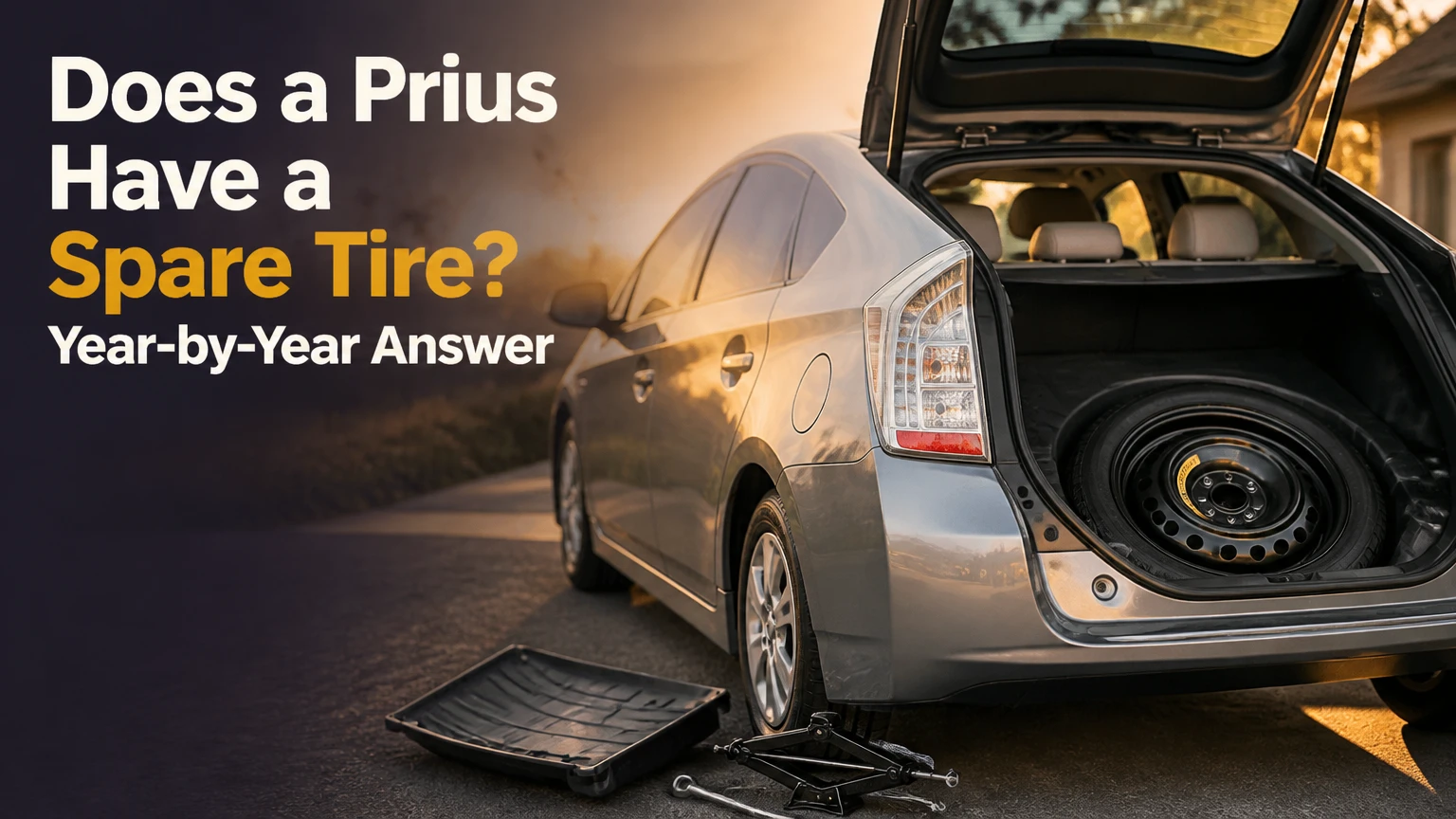
Most modern Toyota Prius models do not include a conventional spare tire, although older Prius generations and selected fourth-generation trims did. Toyota commonly supplies a Tire Mobility Kit containing a 12-volt compressor and sealant instead. The exact equipment depends on model year, Prius Prime status, trim, drivetrain, and market, so inspect the trunk compartment and owner’s manual before relying on it.
Key Facts at a Glance
- A Tire Mobility Kit is not a spare tire; it temporarily seals a limited tread puncture.
- First- and second-generation Prius models generally included a compact temporary spare.
- Third-generation Prius models generally included a donut spare in the United States.
- Fourth-generation equipment varies by trim, especially on Prius Prime and fuel-economy-focused versions.
- Fifth-generation Prius and current Prius Prime models generally use a Tire Mobility Kit instead of a spare.
- Sealant cannot safely repair a sidewall cut, tire blowout, separated tread, or bent wheel.
Does a Prius Have a Spare Tire?
The answer is usually no for a newer Toyota Prius, but “Prius” covers five generations with different tire equipment. A 2001-2015 Prius commonly carried a compact spare beneath the cargo floor, while many 2016-and-newer cars replaced the wheel with a compressor-and-sealant kit to reduce mass and preserve storage space.
Toyota’s design choice trades emergency capability for efficiency and packaging. A spare wheel, jack, and wrench can add roughly 25-35 pounds, while a repair kit occupies less space and weighs substantially less. That trade-off works for a small tread puncture near a city, but it does not solve structural tire damage.
The definitive check is physical: lift the cargo-floor panel and identify either a molded spare-wheel well containing a wheel or a compressor and sealant container. Also check the vehicle’s equipment list and owner’s manual because a regional specification or dealer-installed kit can differ from an online chart.
Which Prius Years Usually Include a Spare?
The following United States-oriented guide describes common factory configurations, not a substitute for the VIN-specific manual. Toyota changed equipment between trims, and imported or non-US Priuses may follow different specifications.
| Prius generation | Approximate model years | Common factory equipment | Practical verification |
|---|---|---|---|
| First generation | 2001-2003 | Compact spare, jack, lug wrench | Lift the rear cargo floor |
| Second generation | 2004-2009 | Compact spare in under-floor well | Check for wheel and jack hardware |
| Third generation | 2010-2015 | Compact spare on many US-market liftbacks | Confirm equipment label and manual |
| Fourth generation | 2016-2022 | Trim-dependent, spare or mobility kit | Check trim, Prime status, and floor well |
| Fifth generation | 2023-present | Mobility Kit on most standard and Prime models | Inspect compressor and sealant bottle |
The fourth-generation Prius deserves special caution. Some standard Prius trims and all-wheel-drive configurations may differ from front-wheel-drive, fuel-economy-oriented, or plug-in versions. Prius Prime packaging also changed across model years. Treat a generic statement such as “all 2016 Prius models have a spare” as unreliable.
Where Is the Prius Spare or Repair Kit Located?
The spare tire or Tire Mobility Kit is usually beneath the rear cargo floor, under a removable deck board. Older cars may place the donut, jack, and wrench in a circular recessed well; newer cars often use molded foam storage around the compressor, sealant bottle, towing eye, and tools.
Check the compartment before a trip, not during a nighttime puncture. A used Prius may have lost its original sealant bottle, jack, lug wrench, or wheel during a previous repair, and a dealer or previous owner may have changed the cargo-floor arrangement.
Use this inspection sequence:
- Park on level ground and switch the vehicle off.
- Remove the cargo mat and lift the deck board.
- Identify a wheel, jack, and wrench, or identify the compressor and sealant.
- Read the sealant expiration date and inspect the compressor cable.
- Confirm that the lug-nut socket matches the wheel and that the tire-pressure label is readable.
A factory repair kit does not prove that the car can repair every flat. It only confirms that Toyota supplied a temporary repair method for eligible punctures.
How Does a Prius Tire Mobility Kit Work?
A Prius Tire Mobility Kit injects liquid sealant through the tire valve while a 12-volt compressor restores air pressure. The sealant spreads along the inner tread area as the tire rotates and may close a small puncture in the tread, commonly around 1/4 inch, depending on the Toyota kit and the damage.
The compressor generally connects to the vehicle’s accessory outlet, while the sealant bottle connects between the compressor hose and valve stem. The driver must follow the kit-specific instructions because connector order, operating time, and pressure targets differ among Toyota suppliers and model years.
The kit is a temporary roadside measure, not a permanent tire repair. Toyota and tire manufacturers generally require the tire to be removed and inspected internally after sealant use. Sealant can contaminate a TPMS sensor, obscure internal damage, and complicate professional repair.
Toyota’s Prius owner documentation uses a blunt safety rule: “Do not drive with a flat tire.” That instruction matters because driving on an uninflated tire can destroy the sidewall and wheel, turning a repairable tread puncture into a tow-only failure.
What Damage Can the Sealant Repair?
A mobility kit may handle one small puncture in the central tread when the tire remains structurally intact. The kit will not reliably repair a sidewall injury, shoulder puncture, tire bead leak, exposed cord, separated tread, bent rim, or multiple large holes.
| Tire condition | Sealant suitability | Correct response | Why |
|---|---|---|---|
| Nail hole in central tread | Possibly suitable | Use kit, then visit tire shop | Damage may fall within kit limit |
| 1/4-inch tread puncture | Borderline maximum | Follow kit instructions or tow | Size limit depends on kit |
| Sidewall cut | Not suitable | Call roadside assistance | Sidewall flex prevents durable sealing |
| Bent or cracked wheel | Not suitable | Tow the Prius | Air loss originates at the wheel |
| Tire driven flat | Not suitable | Tow and request inspection | Internal cords may be damaged |
| Blowout or separated tread | Not suitable | Tow the Prius | Sealant cannot restore structure |
Do not remove a penetrating object before reading the instructions. Removing a nail can enlarge the leak, while leaving it in place may help identify the puncture for a technician.
How Do You Use the Prius Repair Kit?
Use a Prius Tire Mobility Kit only on a safe, intact tire with a small tread puncture, and expect roughly 5-10 minutes for inflation plus a short pressure check drive. The most important success factor is stopping immediately after the puncture, before driving destroys the tire’s internal structure.
Step 1: Stop Safely
Pull onto a firm, level shoulder away from traffic, apply the parking brake, activate the hazard lamps, and have passengers exit on the side opposite moving vehicles when conditions require it.
Do not work beside a tire on an unstable shoulder or in a live traffic lane. Call roadside assistance instead if the vehicle cannot be positioned safely.
Step 2: Inspect the Tire
Look for a nail or screw in the tread and check whether the tire remains seated on the wheel. Do not use sealant if the sidewall is torn, the wheel is visibly bent, the tire has separated, or the tire is shredded.
You will know this step is complete when the damage appears limited to the tread and the tire has no obvious structural failure. A common mistake is treating every loss of pressure as a sealable puncture.
Step 3: Connect the Sealant and Compressor
Place the sealant container in the prescribed orientation, attach the hose to the valve stem, and connect the compressor to the Prius accessory outlet. Start the vehicle in READY mode so the 12-volt battery is supported by the hybrid system.
The exact compressor runtime and connection sequence belong to the label or owner’s manual. Many portable compressors require a cool-down period after approximately 10 minutes, so never exceed the printed duty cycle.
Step 4: Inflate to the Door-Jamb Pressure
Switch on the compressor and monitor the pressure gauge until the tire reaches the pressure shown on the driver’s door-jamb label. Prius tire pressures vary by year and tire size, so do not substitute a generic 32-35 psi assumption for the vehicle label.
Stop if pressure does not rise or sealant leaks visibly from the sidewall. A failed pressure increase indicates damage beyond the kit’s capability.
Step 5: Drive and Recheck
Drive cautiously for the distance specified by the kit, often about 3-5 miles, so the sealant can distribute inside the tire. Stop in a safe location and recheck pressure with a gauge.
If the tire loses pressure again, stop driving and arrange a tow. If it holds pressure, drive directly to a tire professional and disclose that sealant was used.
Step 6: Replace the Tire
Treat the repaired tire as temporary until a technician inspects it. Toyota sealant bottles are commonly single-use and often have a shelf life of approximately four to five years, although the printed expiration date controls.
A used bottle should be replaced even if the compressor still operates. The compressor and sealant are separate service items.
Is a Prius Repair Kit Better Than a Donut Spare?
A repair kit is lighter and faster for a small tread puncture, while a compact spare is more capable when the tire or wheel has suffered structural damage. Neither option is universally better: the right choice depends on driving distance, roadside safety, storage space, and access to towing.
| Decision factor | Tire Mobility Kit | Compact temporary spare | Full-size spare |
|---|---|---|---|
| Typical deployment time | 5-10 minutes | 15-30 minutes | 20-35 minutes |
| Handles sidewall damage | No | Yes, if correctly fitted | Yes, if correctly fitted |
| Handles bent wheel | No | Yes, if wheel clears damage | Yes, if wheel fits |
| Added vehicle mass | Typically 3-8 pounds | Typically 35-50 pounds with tools | Typically 45-65 pounds |
| Storage in newer Prius | Usually under floor | Often cargo area | Usually cargo area |
| Typical purchase cost | $40-$60 sealant refill | $250-$500 complete kit | $300-$700, typical |
| Driving restriction | Temporary repair instructions | Often maximum 50 mph | Vehicle and tire specifications apply |
The repair kit wins for urban drivers who have reliable roadside coverage and can reach a tire shop quickly. A donut wins for rural drivers, long-distance travelers, and anyone who regularly drives where a tow could take hours.
Do not compare a spare by bolt pattern alone. Tire diameter, wheel offset, brake clearance, load rating, TPMS compatibility, and all-wheel-drive requirements also matter.
Which Spare Tire Fits a Prius?
A replacement Prius spare must match the vehicle’s bolt pattern, center bore, brake clearance, load rating, and overall rolling diameter. Common Prius applications use a 5×100 mm bolt pattern on many 2004-2022 models, while many fifth-generation cars use 5×114.3 mm, but compatibility must be confirmed for the exact vehicle.
Aftermarket listings often advertise a tire size such as T125/70R17 or T145/80R17. Those numbers are not universal Prius specifications. A 17-inch wheel may not clear every brake package, and a spare designed for one generation may contact suspension components on another.
| Compatibility check | Example value | Why it matters | Verification source |
|---|---|---|---|
| Bolt pattern | 5×100 mm or 5×114.3 mm | Lug holes must align | Wheel specification or VIN fitment |
| Center bore | Often near 60.1 mm on listed applications | Hub must support the wheel correctly | OEM wheel data |
| Spare size | T125/70R17 or T145/80R17 | Diameter and clearance vary | Exact kit listing |
| Speed limit | Commonly 50 mph | Temporary tires handle differently | Spare sidewall |
| Inflation pressure | Often 60 psi | Compact spares require high pressure | Spare sidewall |
| Lug torque | Vehicle-specific | Prevents loose or damaged fasteners | Owner’s manual |
A 5-lug Toyota wheel is not automatically compatible. Gen 3 and Gen 5 Prius vehicles can use different bolt patterns, and even a matching pattern does not guarantee brake or diameter clearance.
How Do You Install a Prius Donut Spare?
Install a compact spare only on firm, level ground with the Prius secured, and follow the jacking points and torque specification in the owner’s manual. A typical roadside swap takes 15-30 minutes and requires a jack, lug wrench, and compatible spare wheel.
- Turn on the hazard lamps and apply the parking brake.
- Loosen each lug nut about half a turn while the tire remains on the ground.
- Position the jack at the designated lifting point nearest the flat tire.
- Raise the vehicle until the flat tire clears the ground.
- Remove the lug nuts and the damaged wheel.
- Mount the spare and hand-tighten the lug nuts.
- Lower the Prius until the tire contacts the ground.
- Tighten the nuts in a star pattern, then lower the vehicle fully.
- Torque the lug nuts with a calibrated torque wrench as soon as possible.
Never place any part of your body under a Prius supported only by its emergency jack. Do not use the donut on the front axle if the specific spare instructions prohibit that arrangement; some temporary-spare procedures require moving a full-size rear tire to the front and installing the donut at the rear.
After installation, obey the spare’s sidewall speed limit, commonly 50 mph, and drive only far enough to reach a tire facility. Confirm the tire-pressure monitoring system after the wheel is installed.
When Should You Tow a Prius Instead of Repairing It?
Tow a Prius when the tire has sidewall or shoulder damage, the wheel is bent, the tire was driven flat, the compressor cannot build pressure, or traffic conditions make roadside work unsafe. A tow is also the correct option when no compatible spare is available and the repair kit cannot seal the puncture.
The most dangerous mistake is using sealant to postpone a structural repair. Sealant can escape through a sidewall gash, while continued driving can damage the wheel and hybrid vehicle components near the tire.
Choose towing in these situations:
- The tire has a cut, bulge, exposed cord, or separated tread.
- The rim is cracked, bent, or leaking at the bead.
- The puncture is outside the central tread area.
- The tire went completely flat before you stopped.
- The vehicle is on a narrow shoulder, soft ground, or steep slope.
- The sealant cannot raise pressure to the door-jamb specification.
- An AWD Prius has a replacement tire with a materially different circumference.
Roadside assistance providers commonly quote arrival times from 30 minutes in metropolitan areas to several hours in rural areas. Those are typical operating ranges, not guarantees. A spare can reduce dependence on service availability, but it cannot replace safe roadside positioning.
What Does a Prius Spare Kit Cost?
A replacement sealant bottle typically costs about $40-$60, while a complete aftermarket Prius spare kit commonly costs $250-$500. A kit assembled from separate wheel, tire, jack, wrench, and storage parts can exceed $600, particularly when OEM components are purchased through a dealer.
| Purchase option | Typical cost | Contents | Best use |
|---|---|---|---|
| Sealant refill | $40-$60 | One compatible bottle | Existing compressor is functional |
| Portable compressor | $40-$120 | 12-volt inflator | Pressure maintenance or backup |
| Plug-and-pump kit | $30-$90 | Plugs, insertion tools, pump | Off-road or emergency use with training |
| Compact spare package | $250-$500 | Tire, wheel, often jack and wrench | Road trips and remote travel |
| OEM component set | $400-$700+ | Toyota-specific parts | Factory-style replacement |
A plug kit is not equivalent to Toyota’s sealant system and should not be used casually on a tire with internal damage. External plugs may be accepted for certain tread punctures under tire-industry repair practices, but the tire still requires professional inspection and correct internal repair.
Secure any aftermarket wheel in the cargo area with a rated strap or tie-down. A loose 40-pound wheel can become a dangerous projectile during emergency braking.
What If the Prius Compressor Does Not Work?
A nonworking Prius compressor usually results from a disconnected cable, failed accessory outlet fuse, poor valve connection, discharged 12-volt power, or an expired or empty sealant assembly. Check the simple electrical and connection faults first, but stop troubleshooting if the tire has structural damage.
Use this sequence:
- Put the Prius in READY mode, not merely accessory mode.
- Confirm the 12-volt plug is fully inserted into the accessory outlet.
- Inspect the hose connection at the valve stem.
- Check the compressor power switch and cable for damage.
- Consult the fuse diagram before replacing an outlet fuse.
- Verify that the tire valve core is present and not visibly damaged.
- Try a known-good gauge to distinguish compressor failure from gauge error.
Do not install a higher-amperage fuse. If the replacement fuse fails again, an electrical fault may exist, and roadside service is safer than repeated attempts.
A compressor that runs without increasing tire pressure may be working electrically but unable to overcome a large leak. Listen for air escaping and inspect the sidewall, bead, and wheel before using more sealant.
Which Prius Flat-Tire Setup Should You Carry?
Urban Prius drivers can generally rely on the factory mobility kit plus roadside assistance, while rural drivers and frequent road-trippers benefit from carrying a compatible compact spare. Drivers who cross mountain roads, remote highways, or areas with poor cellular coverage should prioritize structural-failure coverage over minimum cargo weight.
City Commuter
Keep the compressor charged, the sealant in date, a pressure gauge, gloves, and roadside assistance details in the vehicle. The kit is efficient for a nail puncture when a tire shop is nearby.
Long-Distance Traveler
Carry a compatible donut, jack, lug wrench, reflective warning equipment, and a tie-down strap. Verify the spare’s pressure before departure because compact tires can lose pressure during months of storage.
Rural or Pothole-Prone Driver
A physical spare is the stronger fallback because potholes commonly damage wheels and sidewalls, which sealant cannot repair. Carrying a full-size tire provides greater range but consumes cargo space and adds more weight.
Prius Prime Owner
Confirm the exact Prime model before purchasing a kit. Plug-in-hybrid battery packaging can reduce under-floor space, and a spare may need to ride in the cargo compartment rather than a factory wheel well.
Common Prius Spare-Tire Mistakes
Mistaking a Compressor for a Spare
A compressor and sealant bottle do not provide a replacement wheel. Check for the actual tire and wheel before assuming the Prius includes one.
Using Expired Sealant
Sealant loses effectiveness as it ages. Replace the bottle by its printed date, and do not assume a functional compressor makes old chemical sealant usable.
Buying by Bolt Pattern Alone
Bolt pattern is only one fitment requirement. Check diameter, offset, center bore, brake clearance, load rating, and AWD compatibility.
Driving Too Far on a Donut
A temporary spare is emergency equipment, not a normal replacement tire. Keep speed within the sidewall limit and drive directly to a repair facility.
Storing the Wheel Loose
A spare placed without restraint can shift during cornering or become hazardous in a collision. Use a tie-down and preserve visibility through the rear glass.
Forgetting the 12-Volt Outlet
The mobility kit cannot inflate a tire without power. Test the compressor periodically and keep the vehicle in READY mode during operation.
Frequently Asked Questions
Does a Prius Prime have a spare tire?
Most Prius Prime models use a Tire Mobility Kit rather than a conventional spare tire. The exact arrangement varies by generation and market, but plug-in-hybrid battery packaging often limits under-floor storage. Inspect the cargo compartment and confirm the equipment in the Prius Prime owner’s manual before purchasing a replacement wheel.
Can you use Fix-a-Flat in a Prius?
You can use a tire sealant only if the product is compatible with the tire, TPMS sensor, and vehicle instructions, but Toyota’s supplied kit is the safer reference. Sealant remains temporary, may contaminate the TPMS sensor, and requires professional tire inspection after use.
How far can you drive on a Prius donut?
Drive only the distance needed to reach a tire professional, with a common temporary-spare limit of 50-70 miles and a maximum speed near 50 mph. The spare’s sidewall and the Prius owner’s manual control. Avoid highways, sharp cornering, heavy loads, and extended use.
Can a Prius use a full-size spare tire?
A Prius can use a full-size spare only when the wheel and tire match the vehicle’s fitment, load rating, brake clearance, and rolling diameter requirements. A mismatched tire can affect ABS, traction control, and AWD systems. A full-size wheel also occupies cargo space in many newer Priuses.
Does Prius AWD change spare-tire compatibility?
Prius AWD can change wheel clearance, tire circumference requirements, and under-floor storage, so an AWD-compatible spare must be verified separately. Do not assume a front-wheel-drive Prius spare fits an AWD model. Match all four rolling diameters as closely as the manufacturer requires.
How do you reset the Prius TPMS after fixing a flat?
Inflate every tire, including the replacement spare if it has a sensor, to the door-jamb specification and follow the vehicle’s TPMS initialization procedure. Some temporary spares lack a compatible sensor, so the warning may remain until the original wheel is repaired and reinstalled.
The Bottom Line
Does a Prius have a spare tire? Older Prius models commonly do, while most newer Prius and Prius Prime models carry a Tire Mobility Kit instead. Verify the exact year, trim, drivetrain, and market specification before a trip. For a small tread puncture, use the kit exactly as directed; for sidewall damage, a bent wheel, or a tire driven flat, tow the Prius.