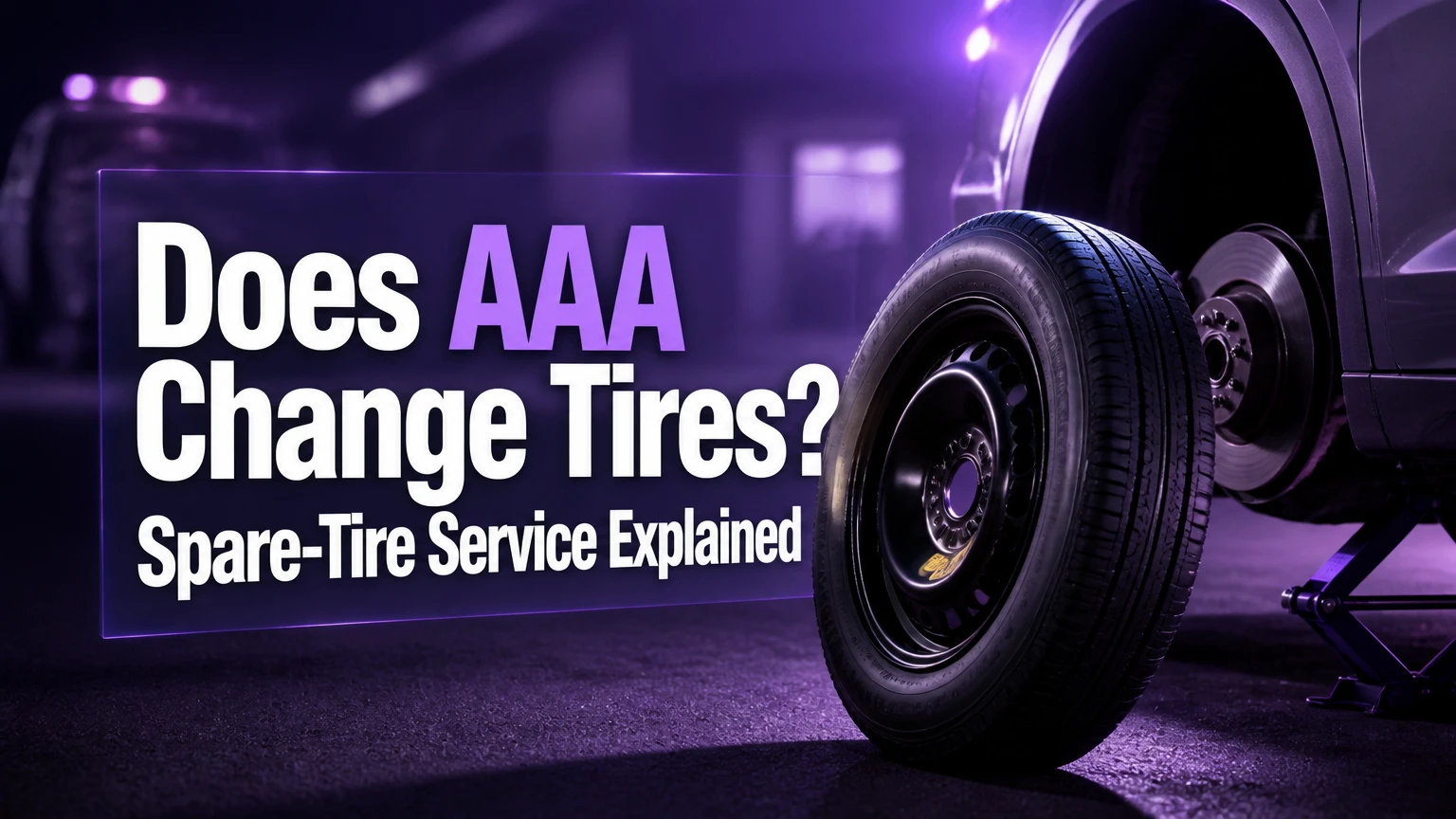
AAA changes flat tires by installing the vehicle’s usable spare tire. AAA Roadside Assistance usually does not bring a replacement tire, mount a new tire, or perform a full tire-shop repair at the roadside. If the vehicle has no safe spare, AAA generally provides inflation when possible or tows the vehicle to a repair facility.
Key Facts at a Glance
- AAA roadside technicians typically replace a flat tire with the vehicle’s existing spare.
- AAA roadside assistance normally does not carry a new replacement tire for emergency installation.
- A missing, damaged, expired, or inaccessible spare can change the service from a tire swap to a tow.
- AAA membership includes roadside service, but towing distance, annual dues, and same-day rules vary by regional AAA club.
- A temporary donut spare commonly has a 50 mph limit, but the vehicle manufacturer’s label takes priority.
- AAA mobile tire installation is a separate retail service available only in selected markets and usually requires purchasing tires in advance.
Does AAA Change Tires for Members?
Yes, AAA changes tires for members when the vehicle has a safe, accessible spare and the roadside request qualifies under the member’s regional plan. The technician removes the damaged wheel and installs the spare, but the technician normally does not supply a new tire or permanently repair the punctured tire.
AAA regional pages describe this as flat-tire service. AAA Mid-Atlantic, for example, explains that technicians can change a flat using the member’s spare; AAA clubs commonly apply the same basic roadside model, although service terms differ by territory. The practical distinction is important: “change a tire” means a spare-tire swap in this context, not tire replacement from inventory.
The service may also include adding air to a low tire. A technician can refuse to install a spare that is visibly damaged, severely underinflated, corroded, or otherwise unsafe. AAA’s published membership terms also allow local restrictions involving vehicle type, location, commercial use, and repeated service calls.
What AAA roadside tire service includes
AAA roadside tire assistance commonly includes the following:
- Locating the vehicle and confirming the member or eligible driver.
- Inspecting the flat tire and the available spare.
- Removing the flat wheel with the vehicle’s jack or service equipment.
- Installing the spare and tightening the lug nuts.
- Inflating the spare to an appropriate pressure when equipment and conditions permit.
- Providing limited mobility advice, such as driving to a tire shop for repair.
AAA does not normally patch a puncture, plug a sidewall, mount a new tire, balance a wheel, align the vehicle, or diagnose a TPMS fault during a basic roadside call. Those jobs require a tire retailer or repair shop.
Will AAA Bring a Replacement Tire?
AAA roadside assistance generally will not bring a new tire to a stranded driver. The standard emergency service is designed to restore limited mobility with equipment already carried in the vehicle, so drivers who need a new tire usually receive a tow to a tire shop.
Some AAA clubs offer mobile tire installation as a separate retail service. In that arrangement, the customer purchases eligible tires through the local AAA program, schedules an appointment, and a mobile tire van mounts and balances the tires at a home, workplace, or other approved location. Availability is market-specific.
Mobile installation should not be confused with emergency roadside dispatch. A scheduled van may not carry the exact tire size, arrive on a highway shoulder, or respond immediately to a blowout. Confirm these points with the local AAA club before purchasing.
| Service type | Tire supplied by AAA | Typical location | Emergency roadside use |
|---|---|---|---|
| Flat-tire roadside call | No | Roadside, driveway, parking area | Yes |
| Spare-tire installation | No, vehicle spare required | Vehicle location | Yes |
| Mobile tire installation | Yes, if purchased through program | Home or workplace | Usually no |
| Tire-shop replacement | Yes, retailer inventory | Repair facility | After tow or self-arrival |
What Happens Without a Spare Tire?
Without a usable spare, AAA normally cannot complete a conventional tire change. The technician may inflate the damaged tire if the failure is a simple air loss and the tire remains safe, but a sidewall cut, separated tread, missing tire, or damaged wheel usually requires towing.
Many newer vehicles omit a spare and provide a tire inflator and sealant kit instead. A sealant kit may work for a small tread puncture within the vehicle manufacturer’s limits, but it is not suitable for sidewall damage, a large tear, a tire that has come off the rim, or continued driving after pressure loss.
A technician’s decision depends on safety, not merely whether air enters the tire. A tire with internal damage can fail again after inflation, especially when driven at highway speed. AAA’s roadside role is to reduce immediate danger, not certify a structurally compromised tire for normal travel.
Spare conditions that can stop the installation
| Problem | Likely roadside result | Why it matters | Recommended next action |
|---|---|---|---|
| No spare installed | Tow or inflation attempt | No replacement wheel exists | Request a tow to a tire shop |
| Spare has zero pressure | Inflation or tow | Rubber may be damaged or aged | Inspect before driving |
| Dry-rot cracks | Technician may refuse installation | Aged rubber can fail under load | Replace the spare |
| Wrong size spare | Possible refusal or limited use | Drivetrain and clearance risks | Follow vehicle manual |
| Missing wheel-lock key | Tow if lock cannot be removed | Standard socket may not fit | Locate key or arrange removal |
| Damaged rim or studs | Tow | Wheel attachment may be unsafe | Use a repair facility |
How to Request AAA Tire Assistance
Request AAA roadside assistance through the AAA Mobile app or by calling 1-800-AAA-HELP, which is 1-800-222-4357. Give the dispatcher the vehicle’s exact location, direction of travel, visible landmarks, tire condition, vehicle type, and whether a spare and wheel-lock key are present.
The app can share location data and display dispatch status, but phone service may be more useful when the vehicle is on a divided highway or an unfamiliar rural road. Have the membership number, vehicle identification details, and a callback number available if conditions permit.
AAA may verify membership digitally or request identification. Service is generally tied to the member rather than exclusively to one vehicle, but local rules and coverage eligibility control the final decision.
What to do before the technician arrives
- Move as far from traffic as possible without driving on a dangerously flat tire.
- Turn on hazard lights and activate roadside warning equipment when safe.
- Keep occupants away from passing traffic and never stand between the vehicle and moving lanes.
- Tell AAA if the vehicle is in a travel lane, tunnel, bridge, construction zone, or other high-risk location.
- Keep the spare, jack, lug wrench, wheel-lock key, and cargo access point available.
- Do not begin a roadside repair on a narrow shoulder merely to reduce the wait.
The Federal Motor Carrier Safety Administration advises motorists with a disabled vehicle to remain aware of traffic and move away from the roadway when possible. On a high-speed shoulder, waiting safely is usually preferable to attempting a tire change without adequate clearance.
How Long Does AAA Take?
AAA commonly quotes an arrival estimate rather than a guaranteed response time; a 20-60 minute arrival is typical in ordinary urban conditions, while storms, traffic, rural distances, major holiday travel, and contractor shortages can extend the wait beyond one hour. The tire swap itself often takes 15-25 minutes after arrival.
Dispatch time and repair time are separate. A short tire installation does not compensate for a long queue during a snowstorm, and the quoted ETA can change when the driver cannot safely reach the vehicle’s exact position.
| Stage | Typical time | Main delay factors | Driver action |
|---|---|---|---|
| Online or phone request | 4-10 minutes | Missing location details | Share landmarks and travel direction |
| Dispatch assignment | 5-30 minutes | Contractor availability | Monitor app or answer callback |
| Technician arrival | 20-60 minutes | Traffic, weather, rural distance | Remain in a safe position |
| Spare inspection and swap | 15-25 minutes | Corrosion, wheel locks, cargo access | Provide key and equipment |
| Tow to repair shop | 30-120+ minutes | Distance and queue | Confirm destination and coverage |
These figures are typical planning ranges, not AAA guarantees. The local club, dispatch contractor, traffic authority, and weather determine the actual timeline.
What Does AAA Tire Service Cost?
For an eligible member, a basic spare-tire change is generally included in the annual AAA membership, so there is no separate roadside labor charge. Membership dues often fall near $60-$130 per year, but prices vary by club, plan, household, promotion, and state.
A nonmember may be allowed to purchase membership and request service, but same-day service fees, waiting periods, limited benefits, or local exclusions can apply. A typical same-day fee is around $75, although the actual amount must be confirmed with the regional AAA club before dispatch.
| Cost situation | Typical member charge | Coverage variable | Likely result |
|---|---|---|---|
| Usable spare installed | $0 roadside labor | Eligible membership | Spare swap |
| Low tire inflated | $0 roadside labor | Service terms and safety | Temporary inflation |
| No spare, covered tow | $0 within limit | Classic, Plus, or Premier mileage | Tow to destination |
| Same-day membership request | $60-$130 dues plus about $75 typical fee | Regional club policy | Possible restricted service |
| Tow beyond included distance | Local overage or market rate | Destination and plan | Extra miles billed |
| Replacement tire | Retail price plus installation | Tire size and retailer | Shop or mobile purchase |
The costliest mistake is assuming a five-mile tow covers a remote breakdown. A short-distance entry-level plan may be adequate for city driving but inadequate for a highway trip where the nearest tire shop is dozens of miles away.
How Membership Level Changes the Outcome
AAA membership levels commonly differ most in towing distance, not in the basic ability to install a spare. Classic plans may include a short tow, Plus plans often provide a substantially longer tow, and Premier plans may provide the longest benefit with additional limits or frequency conditions.
The exact mileage is regional. The commonly cited pattern is approximately 5 miles for Classic, 100 miles for Plus, and 200 miles for Premier, but members must check their own club’s terms because benefit amounts, eligible calls, and annual restrictions can change.
| Plan pattern | Common included tow | Best fit | Important limitation |
|---|---|---|---|
| Classic | About 5 miles | Local commuting | Remote tire failures can exceed coverage |
| Plus | About 100 miles | Regional driving and road trips | Terms vary by club |
| Premier | About 200 miles, often with special limits | Long-distance travel | Long tow may be limited to one annual use |
| Nonmember dispatch | No standard benefit | Immediate emergency only | Membership and service fees may apply |
AAA’s roadside benefit is usually attached to the member account, but the driver must satisfy local eligibility rules. Ask the dispatcher whether the tow covers the intended repair shop, whether mileage is measured from the breakdown point, and whether a destination restriction applies.
Can AAA Inflate or Repair a Damaged Tire?
AAA can often add air to a low tire, but roadside inflation is not the same as tire repair. Inflation may be appropriate when a tire has slowly lost pressure and passes a visual and safety inspection; it is not a safe solution for sidewall damage, a detached tread, severe puncture, or a tire driven while flat.
AAA technicians generally do not perform permanent puncture repairs at the roadside. The Tire Industry Association recommends removing a tire for internal inspection before repairing a puncture, because exterior-only plugs cannot reveal internal damage caused by driving underinflated.
A tire pressure monitoring system warning also requires follow-up. TPMS sensors detect pressure changes, but the warning lamp does not identify the cause, confirm structural integrity, or reset every vehicle automatically after a spare is installed.
Common failure scenarios
- Nail in the tread: Air may be added for controlled travel to a shop, but the puncture still needs a proper internal inspection.
- Sidewall puncture: Inflation or plugging is not an acceptable permanent repair.
- Blowout: AAA can install a safe spare, but the damaged tire must be replaced.
- Slow leak: The vehicle should be inspected even if the tire holds air after inflation.
- Run-flat tire: Driving distance depends on the manufacturer’s specification, pressure history, load, and speed.
What Should You Check Before Calling AAA?
Check five items before requesting a tire change: the spare’s presence, pressure, age, physical condition, and accessibility. Also confirm that the jack, lug wrench, wheel-lock adapter, and key for the locking lug nuts are in the vehicle.
A compact spare may lose pressure while sitting unused. Tire manufacturers commonly recommend replacing tires based on age and condition, and several manufacturers advise heightened inspection after six years and replacement by ten years from manufacture, regardless of tread. Those are tire-age guidelines, not a universal AAA installation rule.
Spare-tire readiness checklist
- Read the pressure printed on the spare or vehicle placard.
- Inspect for cracks, bulges, exposed cords, and severe corrosion.
- Confirm that the spare matches the wheel bolt pattern and vehicle drivetrain requirements.
- Locate the locking-lug key and verify that it fits.
- Check that the jack has a handle and the lug wrench fits the nuts.
- Remove cargo that blocks the spare well or jack compartment.
- Photograph the equipment location for another driver in the household.
A common practitioner rule is simple: check the spare whenever the vehicle receives an oil change. A vehicle can have four properly inflated road tires and still be stranded by a useless spare.
What to Do on a Highway Shoulder
On a highway shoulder, safety takes priority over speed. Turn on hazard lights, stop as far from traffic as possible, keep the seat belt fastened inside the vehicle when remaining inside is safer, and tell AAA that the vehicle is exposed to moving lanes.
Do not place yourself behind the vehicle to inspect a tire if traffic is passing close by. If the vehicle is in a live lane, call emergency services first so law enforcement or a highway incident-response team can protect the scene.
AAA may send a roadside contractor, but the contractor cannot eliminate the risk created by high-speed traffic. A spare swap that takes 20 minutes in a driveway may be inappropriate on a narrow shoulder, where a tow or traffic-control response is safer.
AAA Compared With Other Options
AAA is usually the strongest choice when the driver prioritizes organized dispatch, member benefits, and towing protection beyond a local radius. Insurance roadside coverage can cost less as an add-on, while a tire retailer is better equipped to supply, mount, balance, and repair tires.
DIY replacement is fastest only when the vehicle is in a safe location and the driver has the correct tools and physical ability. On a highway shoulder, avoiding exposure to traffic is usually worth more than saving a service call.
| Option | Emergency tire supply | Typical direct cost | Best capability | Main limitation |
|---|---|---|---|---|
| AAA roadside | Existing spare only | $0 for eligible member | Spare swap and towing | No normal replacement tire |
| Auto insurer roadside | Usually existing spare | About $0-$10 annually as add-on | Basic dispatch | Coverage and priority vary |
| Tire retailer mobile van | Purchased tire, market dependent | Tire price plus installation | Mounting and balancing | Scheduled, limited locations |
| Independent tow service | Usually no tire | About $75-$150+ for local call | Towing and recovery | No membership benefit |
| DIY tire change | Vehicle’s spare | $0 after equipment purchase | Immediate replacement | Traffic, injury, and tool risks |
Insurance and AAA may use overlapping roadside contractors. The deciding differences are often the membership’s tow mileage, dispatch rules, number of covered calls, and whether the provider assists when the member is a passenger in someone else’s vehicle.
Common Mistakes and Their Fixes
Assuming AAA carries every tire size
AAA roadside trucks are not mobile tire stores. If a replacement tire is required, ask for a tow to a shop with the correct size, load rating, speed rating, and drivetrain compatibility.
Driving too far on a donut spare
A temporary spare is not a normal replacement tire. Follow the sidewall and owner’s manual limits, which often include 50 mph and approximately 50 miles, then repair or replace the original tire promptly.
Forgetting the wheel-lock key
A missing locking-lug adapter can turn a simple spare swap into a tow. Keep the adapter with the jack rather than in a location that becomes inaccessible when the trunk floor is loaded.
Treating inflation as a repair
Adding air can restore pressure temporarily, but it cannot reverse sidewall damage or internal heat damage. Drive only as far as necessary to reach a qualified tire facility when the tire passes inspection.
Buying membership after the breakdown without asking about restrictions
Same-day enrollment may include a fee or restricted benefits. Ask the AAA representative for the total charge, waiting period, tow mileage, and eligibility before accepting dispatch.
The Bottom Line
AAA changes tires when “change” means installing a safe spare already carried by the vehicle. AAA usually does not bring a new tire, permanently repair a puncture, or perform full tire-shop installation during a standard emergency roadside call.
The decisive preparation step is checking the spare, jack, lug wrench, and wheel-lock key before a breakdown occurs. If the spare is missing or unsafe, AAA can often provide limited inflation or a tow, and the membership level determines how much of that tow is included.
For local driving, basic coverage may be sufficient. For long trips, confirm the regional AAA club’s towing mileage and restrictions before relying on the benefit.
Frequently Asked Questions
Does AAA change a tire if the car is not mine?
AAA commonly provides roadside benefits to the member, rather than limiting service to one registered vehicle, but eligibility rules vary by regional club and membership type. The member may need to be present, and the vehicle must be accessible and legally located. Confirm coverage when requesting service, especially for a rental, borrowed car, or passenger vehicle.
Will AAA change two flat tires?
AAA may install available spares, but a vehicle with two flat tires usually has only one usable spare. The technician may inflate one tire if safe and tow the vehicle if the second damaged tire prevents travel. Multiple failures, wheel damage, or an inaccessible spare can also change the request to a tow.
Can AAA help if the tire is locked by a wheel lock?
AAA can usually remove ordinary lug nuts, but a missing wheel-lock key may prevent removal of the wheel. Technicians generally avoid damaging security hardware or forcing a tool that could damage the stud. If the key cannot be located, the practical result is often a tow to a repair facility equipped to remove the lock.
Does AAA cover a flat tire on a rental car?
AAA may assist a member in an eligible rental vehicle, but the rental agreement, vehicle location, commercial-use rules, and regional membership terms can affect coverage. The rental company may require its own roadside number for certain incidents. Contact AAA and the rental provider before authorizing a paid tow or tire replacement.
Can AAA change a run-flat tire?
AAA can install a usable spare when the vehicle carries one, but many run-flat-equipped vehicles do not include spares. If the run-flat has exceeded its manufacturer-specified distance or suffered structural damage, AAA may tow the vehicle instead. Never assume that visible remaining tread makes a driven-flat run-flat safe.
Title tag: does aaa change tires: spare-tire service explained
Meta description: AAA usually installs your spare, not a new tire. Check tow limits, same-day fees, and the 20-60 minute arrival range before calling.