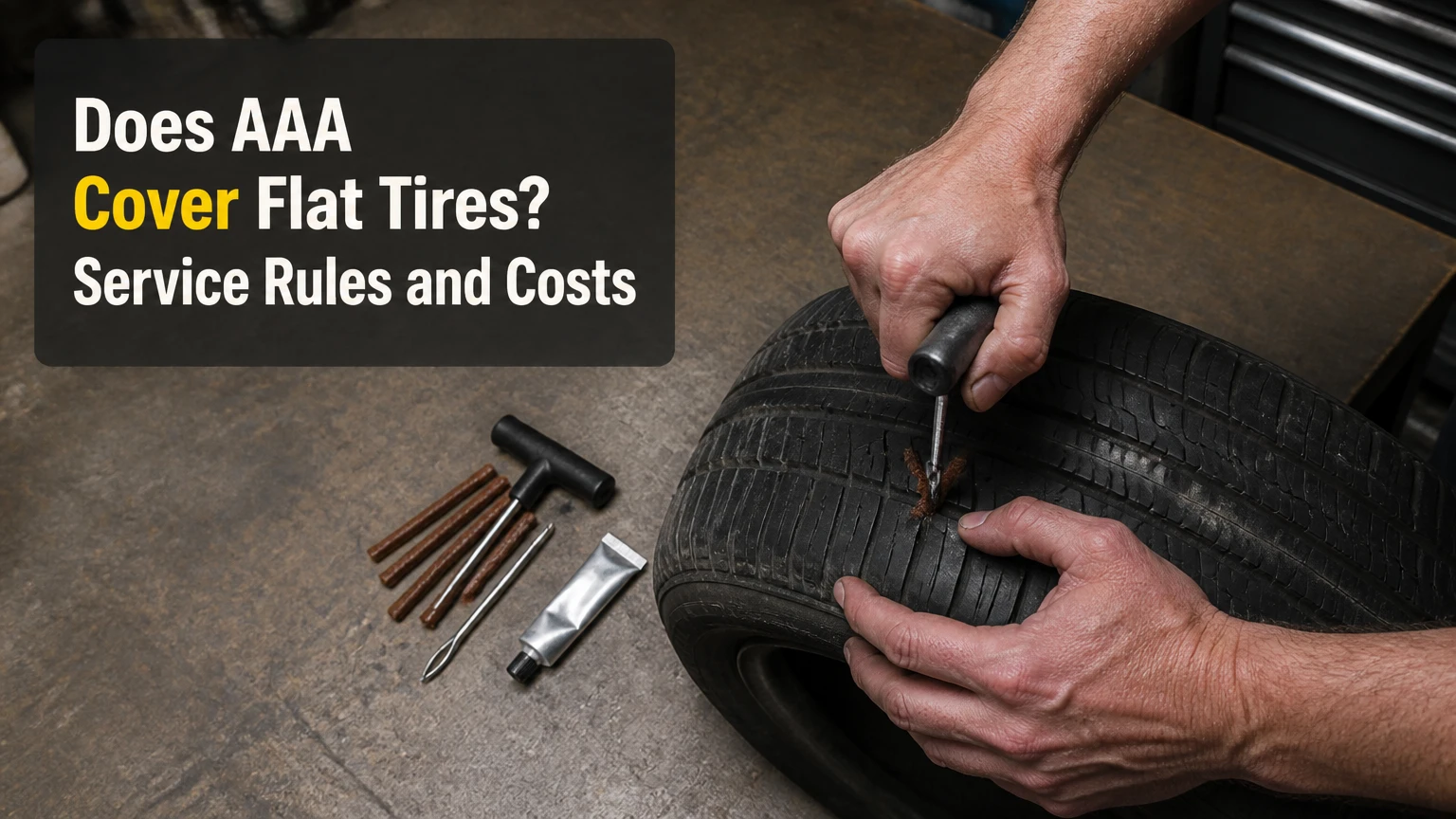
AAA generally covers roadside assistance for a flat tire at every standard membership level, but AAA usually does not permanently repair the tire at the roadside. A AAA technician normally removes the damaged wheel and installs a usable spare supplied with your vehicle; without a safe spare, AAA typically provides a tow within your membership’s applicable mileage limit.
Key Facts at a Glance
AAA flat-tire service normally means installing your vehicle’s usable spare, not plugging or patching the damaged tire.
A missing, flat, incompatible, or unsafe spare can change the result from a tire change to a tow.
Wheel-lock keys, jack-point access, vehicle clearance, and safe roadside conditions determine whether a technician can change the wheel.
Classic, Plus, and Premier towing distances differ by regional AAA club, so the towing limit matters most when no spare is available.
A temporary spare commonly carries a 50 mph maximum and a limited driving distance, but the vehicle’s tire label and owner’s manual control.
AAA membership usually covers service labor, while a replacement tire, tire repair, excess towing, and some special equipment can cost extra.
Does AAA Cover Flat Tires?
AAA covers a roadside call for a flat automobile tire under its roadside assistance benefit, subject to the membership terms of the regional AAA club and the vehicle’s eligibility. The benefit is intended to restore mobility or move the vehicle to a repair facility, rather than replace the tire or perform a permanent repair.
AAA’s regional service descriptions commonly state that technicians will install a usable spare tire. That wording matters because the member must supply the spare, and the spare must be safe, inflated, compatible, and accessible. AAA does not generally provide a new tire, repair a puncture with a plug, or guarantee that a damaged tire can be driven after service.
A flat tire at home is usually handled the same way as a flat tire on a public road, provided the vehicle can be safely accessed and the membership terms allow service at that location. A vehicle stuck in mud, snow, a restricted garage, or an unsafe traffic lane may require specialized recovery rather than ordinary tire-changing service.
What Does AAA Actually Do?
AAA roadside tire service normally follows this sequence:
- A service vehicle reaches the reported location.
- The technician assesses traffic, terrain, vehicle position, wheel damage, and available equipment.
- The technician removes the flat wheel if the lug nuts and wheel can be safely handled.
- The technician installs and secures the vehicle’s spare tire.
- The driver receives any applicable restrictions for the temporary spare.
- AAA arranges a tow when the spare is absent, unusable, incompatible, or unsafe.
The outcome is therefore either a spare-tire installation or a tow. The damaged tire remains the member’s responsibility unless a separate tire warranty, insurance policy, or roadside plan provides additional benefits.
Does AAA Fix or Patch a Flat Tire?
AAA generally does not plug, patch, vulcanize, or permanently reseal a flat tire during a standard roadside call. AAA’s roadside operation is a remove-and-replace service, because permanent tire repairs require an inspection of the tire’s interior, puncture angle, tread condition, speed rating, and prior damage.
A puncture in the center of a healthy tire’s tread may be repairable at a tire shop. A sidewall cut, shoulder puncture, bulge, exposed cord, run-flat failure, or tire driven while severely underinflated may require replacement instead. A roadside technician cannot reliably make that final determination without the inspection equipment and controlled workspace available at a shop.
Sealant and an air compressor can sometimes restore pressure temporarily, but they do not make every tire safe. AAA may use a vehicle’s emergency inflator kit when appropriate, yet sealant is unsuitable for many sidewall failures and can interfere with some tire-pressure monitoring sensors.
Why Does AAA Usually Avoid Permanent Repairs?
A tire repair is safe only when the injury and casing meet recognized repair criteria. The U.S. Tire Manufacturers Association limits ordinary puncture repairs to the tread area and commonly uses a maximum repairable injury diameter of one-quarter inch, or 6 millimeters, when the tire has not been driven damaged.
That standard does not mean every 6-millimeter puncture is repairable. A shop must remove the tire, inspect the inside, verify that the tire was not run flat, and use an approved plug-patch repair method. Roadside plugging without an internal inspection can conceal casing damage.
AAA is therefore useful for the first response, not for tire diagnosis or tire replacement. The correct next destination is a tire retailer, dealership, or repair facility.
How Do You Get AAA Flat-Tire Service?
Request AAA service through the AAA Mobile app or by calling 1-800-AAA-HELP, which is 1-800-222-4357 in the United States. Give the dispatcher the vehicle’s exact location, direction of travel, vehicle make and model, tire position, safety conditions, and whether a spare and wheel-lock key are available.
Step 1: Move to a Safe Location
Stop on a level shoulder, parking area, or other location away from moving traffic. Turn on hazard lights, set the parking brake, and leave the vehicle only when doing so is safer than remaining inside.
Do not continue driving on a flat tire to reach a service station. Driving even a short distance can destroy the tire’s sidewall and bend the wheel, changing a repairable puncture into a replacement and increasing the tow requirement.
Step 2: Check the Spare and Tools
Locate the spare tire, jack, lug wrench, and wheel-lock key before contacting AAA if conditions permit. Check whether the spare is visibly damaged, flat, corroded, or the wrong size.
Tell AAA if the vehicle has run-flat tires, an inflator kit, a locking lug nut, a lowered suspension, a heavily loaded cargo area, or a tire trapped in a damaged wheel well. Accurate information helps dispatch send an appropriate truck.
Step 3: Submit the Service Request
The app can transmit location data and provide status updates, while the phone line is useful when the vehicle has poor data coverage or the situation requires explanation. Keep the membership number, driver’s name, callback number, and vehicle identification details available.
A roadside request does not automatically authorize unlimited towing. Ask the dispatcher what towing mileage, vehicle restrictions, or out-of-pocket charges may apply before accepting a longer destination.
Step 4: Confirm the Resolution
Before driving away, verify that the spare is fully seated, the lug nuts are tightened, and the vehicle does not lean abnormally. If the spare is a temporary “donut,” follow the sidewall speed limit and the owner’s manual distance restriction.
You will know the service succeeded when the tire holds pressure, the wheel is secure, warning lights are understood, and the vehicle can travel safely to a tire shop. A temporary spare is a transportation measure, not a normal replacement tire.
How Long Does AAA Take to Arrive?
AAA arrival time is commonly about 30-60 minutes in ordinary urban conditions, but the actual wait can be shorter or substantially longer. Dispatch volume, weather, traffic, rural distance, road closures, nighttime demand, and the availability of a suitable service truck are the main variables.
AAA does not publish one nationwide guaranteed response time for every flat-tire call. A winter storm, large event, holiday weekend, or multi-vehicle crash can place a request in a queue for several hours.
| Situation | Typical response range | Main delay factor |
|---|---|---|
| Urban daytime flat | 20-60 minutes | Traffic and active call volume |
| Suburban evening call | 30-90 minutes | Truck distance and staffing |
| Rural highway shoulder | 45-120 minutes | Long dispatch distance |
| Snowstorm or major event | 90 minutes to several hours | Demand, road closures, weather |
Stay inside the locked vehicle when traffic makes standing outside dangerous. Place warning devices only if you can do so safely and legally; a reflective vest and roadside emergency kit improve visibility but do not eliminate traffic risk.
Does Membership Level Change Flat-Tire Coverage?
The basic flat-tire response is usually available across Classic, Plus, and Premier memberships, but the towing distance, annual service-call allowance, vehicle eligibility, and waiting-period rules differ by regional AAA club. The membership tier becomes especially important when AAA must tow a car without a usable spare.
| Membership tier | Typical included tow | Flat-tire labor | Important limitation |
|---|---|---|---|
| Classic or Basic | About 5-7 miles in many clubs | Spare installation | Regional terms and excess-mile fees apply |
| Plus | About 100 miles in many clubs | Spare installation | Long tow may be limited by annual benefit rules |
| Premier | About 200 miles for one qualifying tow in some clubs | Spare installation | Other tows may use a shorter limit |
| Add-on vehicle plan | Club-specific mileage | May include motorcycle or RV service | Separate enrollment and vehicle restrictions apply |
These figures are representative, not a national AAA price sheet. AAA operates through regional motor clubs, and a member in AAA Northeast may have different mileage, pricing, service-call, and vehicle terms from a member in Southern California or the Mid-Atlantic region.
A membership upgrade made after a breakdown may not apply immediately. Some clubs impose a waiting period or restrict enhanced benefits for a pre-existing incident, so buying Plus after a flat should not be treated as a guaranteed way to obtain a long tow.
What Does AAA Flat-Tire Service Cost?
For an eligible roadside call, the tire-changing labor is generally included in the membership fee. The member may still pay for a replacement tire, tire-shop repair, towing beyond the included mileage, special recovery equipment, or service requested from a non-AAA provider.
Typical annual membership prices often fall near $55-$65 for Classic, $90-$100 for Plus, and $120-$130 for Premier, but regional clubs, promotions, household plans, taxes, and enrollment fees can change those amounts. Verify the current price and benefit terms on the local AAA website.
| Expense category | Typical member charge | When it applies |
|---|---|---|
| Standard spare installation | $0 included labor | Eligible membership and safe roadside access |
| New replacement tire | About $80-$350 per tire | Tire is destroyed or unrepairable |
| Tire-shop puncture repair | About $20-$45 | Shop finds a repairable tread puncture |
| Excess towing mileage | About $5-$15 per mile | Tow exceeds the plan’s included distance |
| Non-AAA emergency provider | About $75-$250 or more | AAA cannot dispatch or police require another provider |
The non-AAA figures are typical market ranges, not guaranteed AAA charges. Ask for an itemized estimate before authorizing an independent tow.
Can You Get Reimbursed for Another Tow?
Reimbursement may be available when AAA cannot provide service or when a qualifying emergency requires another provider, but it is not automatic. Call AAA first when practical, obtain authorization if possible, retain the itemized receipt, and submit the claim through the applicable regional club.
An acceptable receipt generally identifies the service provider, date, location, vehicle, service performed, and separate charges. Reimbursement can be limited to the amount AAA would have paid its contracted provider, leaving the member responsible for the difference.
Police-ordered towing, restricted-access roads, severe weather, and remote locations can change the reimbursement rules. The regional membership agreement controls.
What Happens If You Have No Spare Tire?
AAA usually changes the service from spare installation to towing when the vehicle has no spare, a flat spare, a damaged spare, or a spare that does not fit safely. Many newer cars, including some Tesla, hybrid, performance, and electric models, use an inflator kit or run-flat tires instead of a conventional spare.
An inflator kit may work for a small tread puncture if the sealant is present, within its expiration date, and compatible with the tire. It will not repair a split sidewall, large blowout, separated tread, bent wheel, or tire that has been driven without pressure.
| Vehicle condition | Likely AAA action | Likely final destination |
|---|---|---|
| Full-size spare, accessible | Install spare | Tire shop or destination |
| Inflated temporary spare | Install spare | Tire shop within vehicle limits |
| Spare is flat or expired | Tow vehicle | Tire retailer or repair shop |
| No spare, small tread puncture | Possible inflator use | Tire shop if pressure holds |
| Sidewall blowout or bent wheel | Tow vehicle | Tire retailer, dealer, or wheel shop |
Check the spare at least during every oil change and before long trips. The pressure printed on the spare’s sidewall or specified in the owner’s manual may be much higher than the pressure listed on the driver-door placard for the normal tires.
Why Can AAA Refuse to Change the Tire?
AAA may decline a roadside tire change when the work cannot be performed safely or when the vehicle cannot be serviced with ordinary equipment. A refusal usually leads to a tow, although a tow can also be limited by the membership’s mileage and vehicle rules.
Common obstacles include:
- Missing wheel-lock key: A security lug nut requires the vehicle-specific adapter. AAA technicians do not carry a universal master key for every lock pattern.
- Unsafe traffic position: A car stopped in a live lane, narrow shoulder, bridge, tunnel, or work zone may require police or specialized recovery.
- Severe wheel damage: A bent rim, seized lug, stripped stud, or damaged hub can prevent safe removal.
- Inaccessible spare: A spare trapped under cargo, behind locked panels, or beneath a lowered vehicle may require extra work.
- Insufficient clearance: A jack cannot safely lift a vehicle on soft ground, steep terrain, deep snow, or an unstable shoulder.
- Wrong or unsafe spare: A spare with low pressure, a damaged sidewall, or incompatible dimensions should not be installed.
The wheel-lock key is the most preventable failure. Store it with the jack and lug wrench, not in a separate location that cannot be reached when the trunk is inaccessible.
What If You Cannot Find the Wheel-Lock Key?
Tell the dispatcher before the truck arrives. The technician may confirm whether the lock can be removed with available equipment, but forced removal can damage the lug nut, wheel, stud, or lock socket.
If the wheel cannot be removed safely, AAA will generally tow the vehicle to a tire shop or dealership. The shop can remove the locking lug with extraction equipment and install a replacement lock set, typically at an additional charge.
Is a Temporary Spare Safe to Drive?
A temporary spare is safe only within the limits printed on its sidewall and in the owner’s manual. Many compact spares specify a maximum of 50 mph, while distance guidance commonly ranges from 50-70 miles, although the vehicle manufacturer’s instruction takes priority.
Temporary spares often have a smaller contact patch, different tread, lower load capacity, and different traction characteristics from the normal tire. On vehicles with all-wheel drive, the manufacturer may restrict temporary-spare use because different rolling diameters can stress the driveline.
| Spare type | Common speed limit | Common use limit | Main concern |
|---|---|---|---|
| Compact donut | 50 mph | 50-70 miles | Reduced grip and braking |
| Full-size matching spare | Vehicle-rated speed | No special mileage if maintained | Must match load and drivetrain requirements |
| Full-size temporary spare | 50-65 mph | Manufacturer-specific | May differ in tread or diameter |
| Run-flat tire | Vehicle-specific | About 50 miles after pressure loss | Speed and load restrictions vary |
Drive directly to a tire professional, avoid high speed and hard cornering, and replace or repair the original tire promptly. Do not use cruise control with a temporary spare unless the manufacturer specifically permits it.
Does AAA Cover Motorcycles, RVs, Bicycles, or Rental Cars?
AAA coverage for motorcycles, recreational vehicles, bicycles, and rental cars depends on the regional club and the membership add-on. A standard automobile membership should not be assumed to cover every vehicle a member owns or operates.
Bicycle roadside benefits generally transport the rider and bicycle to a safe location, a home address, or a repair shop within the plan’s mileage rules. The bicycle benefit usually does not mean that a technician removes and patches the bicycle tube at the roadside.
| Situation | Common coverage position | Verification needed |
|---|---|---|
| Member’s personal car | Roadside tire service commonly included | Local club and vehicle eligibility |
| Motorcycle | Often requires motorcycle add-on | Motorcycle service terms |
| RV or motorhome | Often requires RV add-on | Vehicle length, weight, and mileage limits |
| Bicycle flat | Transport commonly included in participating clubs | Bicycle benefit and destination limit |
| Rental car | May be covered when member is present | Rental agreement and regional terms |
Rental-car coverage can involve the rental company’s roadside plan, AAA membership terms, and the driver’s authorization under the rental agreement. Contact the rental company as well as AAA when a damaged wheel, tire, or vehicle component may create a contractual charge.
Should You Use AAA, Insurance, or a Tire Warranty?
AAA is usually the clearest first call for roadside assistance when the goal is safe tire replacement or towing. Auto insurance may cover roadside service only if roadside assistance was added, while collision or comprehensive coverage generally does not pay for ordinary tire wear or a simple puncture.
A tire manufacturer warranty or road-hazard plan may pay for repair or replacement, but it normally does not provide the immediate roadside labor that AAA provides. The best sequence is often AAA for mobility, then a tire shop or warranty administrator for the permanent resolution.
| Option | Immediate roadside help | Permanent tire repair | Typical cost structure |
|---|---|---|---|
| AAA membership | Spare install or tow | Usually no | Annual fee plus uncovered charges |
| Auto-insurance roadside add-on | Tire change or tow | Usually no | Policy premium or per-use terms |
| Tire road-hazard plan | Usually limited | Repair or replacement may qualify | Included or purchased tire coverage |
| Manufacturer warranty | Rarely immediate | Defect-related replacement | Warranty conditions and prorating |
| Independent mobile tire service | Often yes | Sometimes | Per-call labor plus tire or repair cost |
Do not make an insurance claim for a low-cost puncture without checking the deductible and claim history implications. A tire warranty can be more valuable than insurance for a replacement tire, but its coverage depends on purchase date, tread depth, road-hazard terms, and proof of maintenance.
How Can You Prepare Before a Flat?
The strongest preparation is mechanical, not financial: maintain the spare, carry the wheel-lock key, and know the exact roadside number for your regional AAA club. These three actions prevent common delays that membership alone cannot solve.
Use this pre-trip checklist:
- Check normal tire pressure monthly when tires are cold.
- Check the spare at least every six months and before long travel.
- Confirm that the jack, lug wrench, and wheel-lock adapter are present.
- Check the inflator-kit sealant expiration date.
- Save the AAA app and 1-800-222-4357 in the phone.
- Keep a reflective vest, flashlight, gloves, and charged power bank.
- Record the vehicle’s tire size and spare limitations.
- Verify whether an all-wheel-drive vehicle permits a temporary spare.
A tire-pressure monitoring system is an early warning tool, not a substitute for inspection. TPMS may warn after pressure has already fallen significantly, and it cannot reliably identify every slow leak, sidewall cut, or tread separation.
Practitioner Rules That Prevent Bigger Bills
- Never drive a flat farther than necessary. A $25 puncture repair can become a $150 tire and wheel problem after a short high-speed drive.
- Treat a five-year-old spare as suspect until measured. Trunk-mounted tires lose pressure and age even when they are never used.
- Ask for a destination before the tow begins. A short included tow to a closed shop may leave the car stranded overnight, while a farther open facility may create excess-mileage charges.
- Photograph the tire and wheel before service. Photos document sidewall damage, wheel condition, and the vehicle’s position if a dispute later concerns damage or reimbursement.
AAA roadside assistance is not a substitute for tire maintenance. It reduces the consequences of a failure, but it cannot guarantee a tire change when traffic, equipment, or vehicle design makes the operation unsafe.
FAQ
Does AAA cover a flat tire at home?
AAA generally provides flat-tire roadside assistance at a member’s home when the vehicle and location qualify for service. The technician normally installs a usable spare rather than repairing the puncture. A blocked garage, unsafe ground, inaccessible wheel, or missing wheel-lock key can change the result to a tow.
Will AAA bring a new tire?
AAA normally does not bring a replacement tire as part of standard flat-tire service. AAA may install the vehicle’s usable spare or tow the car to a tire retailer. A replacement tire, mounting, balancing, disposal fee, and any excess towing charge are generally separate expenses.
Does AAA cover a flat tire if I am not the vehicle owner?
AAA membership is generally tied to the enrolled member, not exclusively to one vehicle, but regional rules govern who may receive service and which vehicles qualify. The member usually must be present, and commercial, oversized, motorcycle, RV, rental, or borrowed-vehicle coverage may require additional conditions.
Can I call AAA for a tire with low pressure?
You can generally request AAA when low pressure leaves the vehicle unsafe to drive. A technician may add air or install a spare when the service equipment and membership terms permit it. A recurring pressure loss still requires a tire-shop inspection because inflation alone does not identify the leak.
Does AAA cover a tire blowout on the highway?
AAA generally responds to a highway blowout, but roadside safety determines how the vehicle is handled. A technician may install a usable spare if the shoulder is wide and safe; otherwise, AAA or law enforcement may move the vehicle before a tire change or arrange a tow.
Does AAA cover tire damage from a pothole?
AAA can usually provide roadside assistance for the resulting flat, but membership does not normally pay for the tire, wheel, alignment, or suspension damage caused by the pothole. Collision coverage, road-hazard protection, a tire warranty, or a responsible public agency may provide separate recovery options.
The Bottom Line
Does AAA cover flat tires? Yes, AAA generally covers roadside assistance for flat tires across its standard membership levels, but the normal benefit is spare-tire installation or towing, not permanent tire repair. Check the spare’s pressure, keep the wheel-lock key accessible, and verify your regional towing limit before an emergency.


