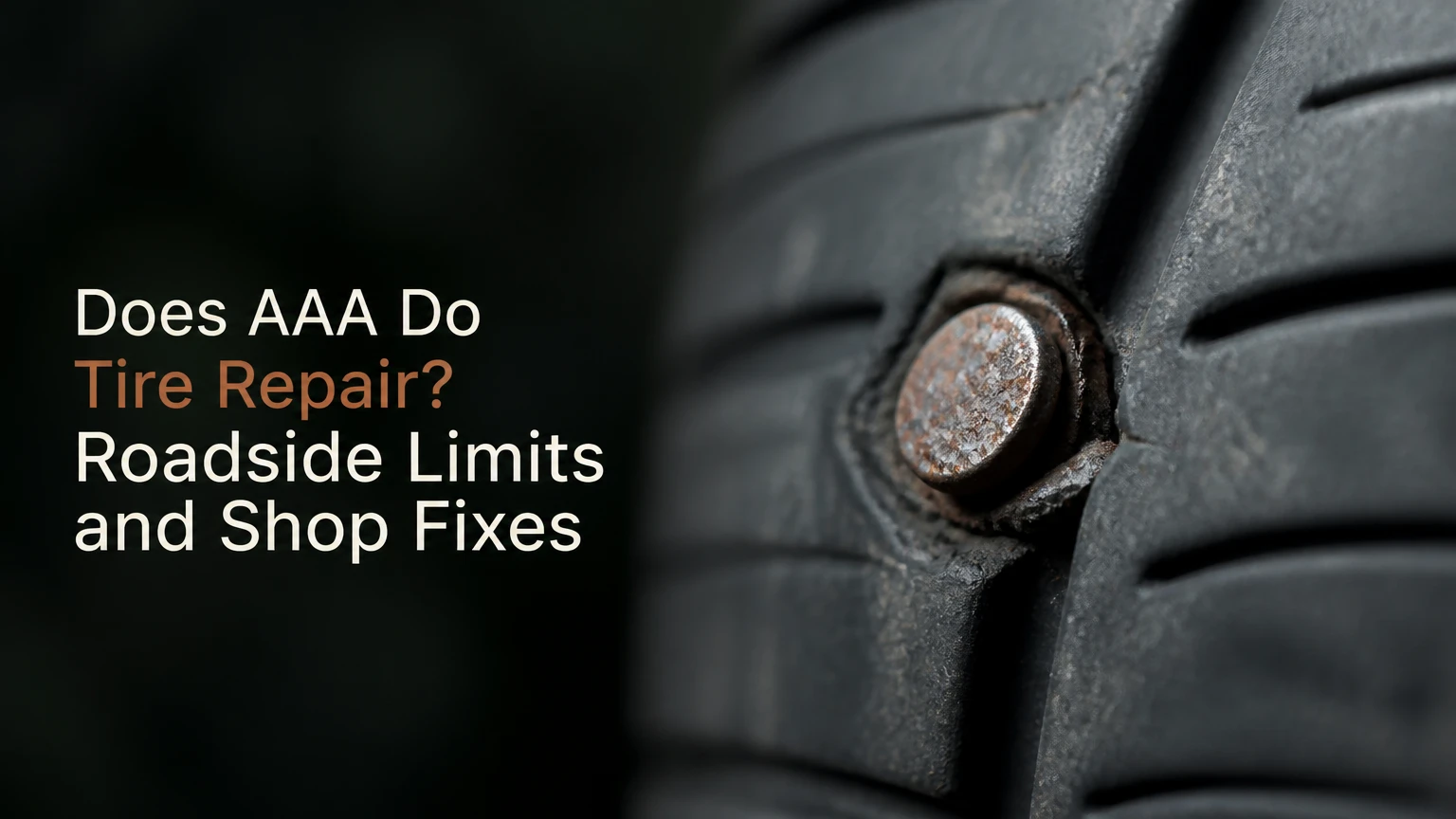
AAA usually does not perform a permanent tire repair at the roadside. AAA roadside technicians generally install your usable spare, inflate a tire, apply temporary emergency assistance where available, or tow the vehicle to a repair facility. A permanent internal patch-plug repair may be available at an AAA Car Care Center or AAA Approved Auto Repair facility.
Key Facts at a Glance
- AAA roadside tire service normally restores mobility temporarily rather than repairing the tire permanently.
- AAA technicians install the vehicle owner’s usable spare; they generally do not carry a replacement tire inventory for every vehicle.
- A permanent puncture repair requires removing the tire from the wheel and inspecting the inside for damage.
- Repairable damage is usually a small puncture in the central tread, not a sidewall, shoulder, bead, or large tear.
- AAA membership benefits, tow mileage, shop discounts, and immediate-use restrictions vary by regional AAA club.
- A temporary spare commonly carries a 50 mph limit, but the vehicle owner’s manual controls the actual speed and distance limits.
Does AAA Do Tire Repair?
AAA does tire-related roadside assistance, but roadside assistance and permanent tire repair are different services. At the vehicle, AAA may change the flat tire, inflate a leaking tire, provide temporary sealant in some regions, or arrange towing when the tire cannot safely support travel.
AAA physical service locations can inspect and permanently repair eligible tires. Availability differs because AAA operates through regional clubs, AAA Car Care Centers, and independently owned AAA Approved Auto Repair facilities, each with its own hours, equipment, inventory, and pricing.
That distinction answers the query directly: AAA can help with a flat tire immediately, while a permanent repair usually requires a shop visit. A technician should not treat a roadside rope plug or a quick inflation as an inspection of the tire’s internal structure.
Roadside Assistance Versus Shop Repair
| Situation | Typical AAA roadside response | Permanent result? | Next action |
|---|---|---|---|
| Flat tire with usable spare | Remove flat and mount spare | No | Drive within spare limits to a tire facility |
| Slow leak with safe vehicle position | Inflate or assess tire | No | Recheck pressure and obtain an internal inspection |
| Shredded tire | Tow or transport vehicle | No | Replace tire at a qualified shop |
| No spare available | Attempt approved temporary aid or arrange tow | Usually no | Confirm whether the vehicle can be safely moved |
| Small tread puncture at an AAA shop | Dismount, inspect, and repair if eligible | Yes, if approved | Follow shop and tire-maker recommendations |
The roadside technician’s decision also depends on traffic exposure, wheel damage, vehicle design, weather, and whether the vehicle can be lifted safely. A service that appears mechanically simple can become a towing situation on a narrow highway shoulder.
What Will AAA Do for a Flat Tire?
AAA’s usual flat-tire response is spare installation when the vehicle has an accessible, inflated, correctly sized spare. If no usable spare exists, AAA may provide limited emergency assistance or tow the vehicle, depending on the club, vehicle, damage, and roadside conditions.
A roadside technician typically locates the spare, jack, and lug-wrench equipment supplied with the vehicle. Some technicians carry additional tools, but the vehicle owner should not assume that AAA will arrive with the correct replacement tire, wheel, or specialty locking-lug key.
Roadside service may include inflation when the tire appears capable of holding pressure long enough to reach a safe destination. Inflation does not correct a puncture, bead leak, bent wheel, valve failure, or internal sidewall damage. Driving afterward requires a conservative decision, not simply a pressure reading.
What AAA May Provide at the Vehicle
- Spare-tire installation: The technician replaces the damaged wheel and tire with the vehicle’s usable spare.
- Air or temporary sealant: Some regional operations may inflate a tire or use an approved temporary product when conditions permit.
- Safety assessment: The technician determines whether the vehicle can be moved without creating an immediate hazard.
- Towing: AAA sends or coordinates a tow when the vehicle lacks a safe spare, has severe damage, or cannot be serviced roadside.
AAA’s published roadside materials describe tire service as part of emergency assistance, but membership wording is not identical across the United States. The member’s local AAA terms and the dispatched service provider control the exact benefit.
How Do You Request AAA Tire Assistance?
Request AAA tire assistance through the AAA Mobile App or the phone number listed on the membership card. Provide the vehicle’s precise location, travel direction, make and model, license plate, tire problem, passenger details, and whether a spare tire is present.
Use the following sequence:
- Move away from traffic if possible. Turn on hazard lights and remain inside the vehicle when exiting would be more dangerous.
- Call from a precise location. Give the nearest exit, mile marker, cross street, business, or GPS position.
- Describe the damage accurately. State whether the tire is flat, shredded, detached from the wheel, or leaking slowly.
- Confirm the spare situation. Tell dispatch whether the spare is inflated, whether the vehicle has run-flat tires, and whether a locking-lug key is available.
- Ask about the planned response. Confirm spare installation, inflation, temporary aid, or towing before the technician arrives.
- Follow the technician’s movement recommendation. A temporary fix is a way to reach a safer destination, not permission to resume normal driving.
Do not stand behind or in front of a disabled vehicle while waiting. AAA arrival times can range from roughly 30 minutes to several hours, depending on traffic, weather, call volume, road access, and the need for a specialized tow vehicle.
When Will AAA Tow Instead of Changing the Tire?
AAA will generally tow when the tire is destroyed, the wheel is unsafe, no usable spare is available, multiple tires are flat, or the vehicle cannot be lifted and serviced safely. Towing is also the appropriate response when the car is stopped in a dangerous location where a roadside tire change would expose people to traffic.
A tow does not guarantee transport to any tire shop selected by the driver. Free towing distance and destination rules depend on the membership level and local AAA terms.
| Common membership example | Typical included tow range | Important limitation |
|---|---|---|
| Classic or Basic | About 3-5 miles | Local plan terms may use a different distance |
| Plus | About 100 miles | Usually applies to qualifying service calls |
| Premier | About 200 miles on one call | Annual, vehicle, and regional restrictions may apply |
| Nonmember immediate request | Plan purchase plus possible fee | Immediate-use restrictions can apply |
These figures are commonly published examples, not a universal national promise. Before relying on a long-distance tow, verify the member’s club, plan tier, eligible vehicle, call allowance, and per-mile charge.
What a Tow Does Not Cover
AAA towing usually does not include unlimited transport, tire replacement at the roadside, or automatic payment for a new tire. A tow operator may transport the vehicle to an open AAA facility, another approved shop, a dealership, or a destination permitted by the member’s plan.
Ask dispatch whether the selected destination is within the included radius. An apparently free tow can produce an out-of-pocket charge when the destination exceeds the plan limit or the call falls outside covered conditions.
Can an AAA Shop Permanently Repair a Tire?
An AAA Car Care Center or AAA Approved Auto Repair facility may permanently repair a tire when the puncture, tread condition, tire construction, and internal inspection meet safety requirements. The facility must remove the tire from the wheel before deciding whether a repair is appropriate.
A proper repair normally combines an internal patch with a puncture-channel plug, often called a patch-plug or combination repair. The patch seals the inner liner, while the plug fills the puncture path through the tread. An exterior string plug alone does not reveal whether the tire was driven while underinflated.
AAA shop availability is local. Some facilities inspect and repair customer tires, while others may recommend replacement because of tire age, tread wear, internal damage, run-flat construction, specialty fitment, or a manufacturer prohibition.
What Makes a Tire Repair Permanent?
A permanent repair involves dismounting, cleaning, inspecting, repairing, remounting, inflating, and checking the tire. The technician should also verify that the repair does not conflict with the tire maker’s instructions or applicable industry guidance.
The usual workflow is:
- Remove the wheel and dismount the tire.
- Inspect the inner liner for abrasion, heat damage, or separation.
- Prepare the puncture channel with the correct repair tools.
- Install a combination patch-plug from inside the tire.
- Cure or secure the repair material according to its instructions.
- Trim the exterior stem and inspect the finished repair.
- Remount, inflate to the vehicle specification, and check for leaks.
- Balance the wheel when required by the service procedure or observed symptoms.
A tire that has been driven flat can suffer invisible internal damage even when the tread puncture is small. The internal inspection is therefore the dividing line between a qualified repair decision and an unverified roadside patch.
Which Tire Damage Can AAA Repair?
AAA shops may repair a small puncture located entirely within the central tread, provided the tire has adequate tread, no internal damage, and no conflicting prior repair. Sidewall, shoulder, bead, belt, and large tear damage normally requires tire replacement.
The U.S. Tire Manufacturers Association commonly identifies 1/4 inch, or about 6 millimeters, as the maximum puncture diameter for many standard passenger-tire repairs. That threshold does not override the tire manufacturer, shop policy, tire construction, or the condition of the tire.
| Damage condition | Typical repair decision | Reason |
|---|---|---|
| Nail in central tread, 3 mm | Often repairable | Small puncture within common tread zone |
| Screw near shoulder transition | Usually replacement | Flexing shoulder cannot maintain a dependable repair |
| Cut in sidewall, 8 mm | Replace tire | Sidewall carries structural and flexing loads |
| Tread puncture, 9 mm | Usually replacement | Exceeds common 6 mm repair threshold |
| Tire driven while flat | Inspect first, often replace | Heat and abrasion may damage inner structure |
| Three overlapping repairs | Usually replacement | Remaining structure and repair spacing may be unacceptable |
The frequently repeated “16-inch separation” rule should not be treated as a universal AAA promise. Repair spacing can depend on tire type, repair diameter, manufacturer guidance, and the technician’s inspection; overlapping repairs and repairs too close to one another are generally rejected.
Why Are Sidewalls Not Normally Repairable?
Sidewalls flex repeatedly and carry significant structural load, so a puncture or cut can damage cords that a patch cannot safely restore. A sidewall plug may stop air loss temporarily, but it does not recreate the tire’s original strength or speed capability.
The same concern applies to shoulder damage, where tread and sidewall flex meet. A puncture that appears to sit in the tread may cross into the shoulder once the tire is dismounted and examined from inside.
How Much Tread Is Enough?
The legal replacement threshold in many U.S. jurisdictions is 2/32 inch, but legal minimum does not equal good wet-weather performance. AAA safety materials commonly encourage earlier replacement around 4/32 inch because braking and water evacuation deteriorate before the legal limit.
Tread depth is only one factor. Tire age, cracking, uneven wear, exposed cords, bulges, vibration, prior repairs, and the vehicle manufacturer’s requirements can independently make a tire unsuitable for repair.
How Much Does AAA Tire Repair Cost?
AAA roadside tire changing is generally included for active members within their plan’s service allowance, while a permanent shop repair typically costs about $25-$75 as a broad market range. Exact charges depend on the AAA club, facility, labor rate, tire size, repair method, taxes, and whether replacement is necessary.
Membership does not necessarily make the tire repair itself free. AAA members may receive a shop labor discount at participating AAA facilities, but discount percentages, caps, exclusions, and participating locations vary.
| Service or outcome | Typical cost or condition | Main price variable |
|---|---|---|
| Roadside spare installation, active member | Usually included | Membership allowance and regional terms |
| Permanent patch-plug repair | About $25-$75 | Shop labor and tire construction |
| Tire replacement | About $80-$500 or more per tire | Size, brand, speed rating, and vehicle |
| Nonmember roadside request | Membership plus possible immediate-use fee | Club policy and service eligibility |
| Tow beyond included distance | Per-mile charge may apply | Membership tier and destination |
A shop may charge an inspection fee, waive it with paid repair, or decline repair without charging, depending on local policy. Ask for the total before authorizing work, especially if the tire has a specialty size or requires a replacement pair.
How Long Does AAA Tire Help Take?
AAA roadside arrival commonly takes 30 minutes to several hours, while a straightforward in-shop tire repair may take about 30-45 minutes after the vehicle reaches the service bay. The total elapsed time can be much longer because dispatch, towing, queueing, inspection, and parts availability add separate delays.
A spare installation usually takes less time than a tow, but the roadside location can dominate the schedule. A shop may finish the repair quickly yet have no open bay or matching replacement tire.
| Stage | Typical timeframe | What changes it |
|---|---|---|
| Dispatch acceptance | 5-15 minutes | App connectivity and call volume |
| Roadside arrival | 30 minutes to several hours | Traffic, weather, location, demand |
| Spare installation | 15-30 minutes | Wheel locks, seized lug nuts, vehicle access |
| Shop tire inspection | 10-20 minutes | Tire construction and damage severity |
| Patch-plug repair | 30-45 minutes in bay | Queue, balancing, equipment, technician workload |
| Replacement tire sourcing | Same day to several days | Local inventory and uncommon size |
Treat every time range as typical rather than guaranteed. Highway incidents, severe storms, rural roads, and holiday traffic can extend roadside response substantially.
Can You Drive After AAA Installs a Spare?
You can usually drive after AAA installs a spare if the spare is correctly secured, inflated, and approved for the vehicle, but you must follow the spare tire’s speed and distance restrictions. Many temporary “donut” spares specify no more than 50 mph and approximately 50 miles.
The owner’s manual and the spare’s sidewall label control. Some full-size spares have no special distance limit, while compact temporary spares may have different restrictions. A temporary spare can also alter braking, cornering, traction-control behavior, and all-wheel-drive operation.
Before leaving, confirm:
- The spare’s inflation pressure matches the label or vehicle instructions.
- Lug nuts are seated and tightened correctly.
- The spare does not contact brake or suspension components.
- The vehicle does not have an all-wheel-drive restriction.
- The route ends at a tire facility, not a distant destination.
Do not use a donut spare for normal commuting, high-speed travel, towing, or extended highway driving. Its purpose is controlled travel to repair or replacement.
Why Won’t AAA Usually Plug a Tire Roadside?
AAA usually avoids treating an exterior rope plug as a permanent roadside repair because a plug alone cannot expose hidden inner-liner or sidewall damage. A tire may have been driven underinflated long enough to create heat abrasion, even when the puncture appears to be a simple nail hole.
Some regional AAA operations may use temporary sealant or other emergency technology, but the product’s purpose remains limited mobility. Sealant can complicate later repair, may be incompatible with tire-pressure sensors, and does not correct structural damage.
The safe sequence is to use roadside assistance to reach a controlled location, then have a qualified tire professional remove and inspect the tire. A cheap plug can become expensive if it delays replacement of a structurally compromised tire.
What If Your Vehicle Has No Spare?
A vehicle without a spare may receive inflation, temporary sealant, or towing, depending on the AAA club and the vehicle’s equipment. Many newer cars replace the spare with a tire-inflator compressor and sealant kit, run-flat tires, or no emergency tire system at all.
Check these items before a breakdown:
- Locate the compressor and sealant cartridge.
- Check the cartridge expiration date.
- Confirm whether the sealant is compatible with the tire-pressure monitoring system.
- Verify whether the vehicle has run-flat tires and a permitted driving distance.
- Keep the locking-lug key with the vehicle rather than in a misplaced home toolbox.
A tire sealant kit is unsuitable for some puncture locations, large cuts, sidewall damage, and tires that have separated from the bead. If the tire is shredded or the wheel is bent, towing is the safer response.
Is AAA Tire Service Free for Members?
AAA roadside tire assistance is generally included for active members, subject to the plan’s service-call allowance, eligible vehicle rules, local terms, and any restrictions on recently purchased memberships. Permanent tire repair and replacement at a shop usually cost extra.
Many AAA plans include a limited number of roadside calls per membership year, often four, but the exact allowance and treatment of additional calls vary. Membership purchased after the breakdown may involve an immediate-use fee or delayed eligibility.
Confirm these details before relying on coverage:
- Local club and membership tier.
- Remaining roadside calls.
- Included towing distance.
- Immediate-use restrictions.
- Whether the vehicle and driver qualify.
- Participating AAA repair facilities and discounts.
The membership card, local AAA website, and dispatch representative are more reliable than a national estimate. AAA is a federation of regional clubs, so a benefit advertised in one state may not match a plan sold elsewhere.
What Alternatives Should You Check?
Manufacturer roadside coverage, tire road-hazard warranties, tire retailers, insurance endorsements, and independent repair shops can provide alternatives to AAA. The best option depends on whether the problem is an emergency, a warranty claim, a repairable puncture, or a replacement need.
| Alternative | Best use case | Typical response or benefit | Limitation |
|---|---|---|---|
| Vehicle manufacturer roadside plan | New vehicle under warranty | Tow and flat assistance | Coverage expires by time or mileage |
| Tire retailer road-hazard plan | Covered puncture or tire failure | Repair or replacement under terms | Only applies to enrolled tires |
| Auto insurance roadside endorsement | Existing insurance policy | Towing or tire-change dispatch | May affect claim records or have limits |
| Independent tire shop | Permanent repair or replacement | Inspection and same-day service | No roadside response unless separately offered |
| Mobile tire service | Replacement at a safe location | Brings a selected tire to the vehicle | Higher travel and emergency labor cost |
Check the tire purchase invoice before paying for replacement. A road-hazard policy may cover damage that AAA can only transport, although deductibles, treadwear adjustments, and excluded locations can reduce the benefit.
What Should You Do While Waiting for AAA?
While waiting for AAA, protect people first and the tire second. Turn on hazard lights, move behind a barrier when safe, avoid standing near traffic, and do not attempt a roadside repair on a high-speed shoulder unless emergency services direct you.
Take photographs only from a safe position. Record the tire’s location on the vehicle, the dashboard warning, the nearest roadway marker, and the condition of the spare, but do not crawl under the vehicle or use the jack in moving traffic.
Expert Safety Rules That Prevent Secondary Damage
- Do not keep inflating a visibly damaged tire. A bulge, exposed cord, separated tread, or sidewall cut indicates structural failure, not merely low pressure.
- Do not assume a TPMS warning identifies the damaged tire. Confirm pressures manually when the vehicle is stationary and safe.
- Do not discard the puncturing object before inspection. The entry angle and object size help a technician locate the repair channel.
- Do not drive to a shop on a nearly flat tire. The short distance can destroy an otherwise repairable casing through heat and sidewall flex.
- Do not request a spare change without checking its pressure. A neglected spare may be as unusable as the flat tire.
These rules matter because roadside service solves the immediate access problem, while tire repair solves the structural problem. Confusing those outcomes causes preventable damage.
How Do You Decide Between Repair and Replacement?
Choose repair only when a qualified technician confirms that the puncture is within the repairable tread area, within the tire maker’s size limit, and free from internal damage. Choose replacement when the tire has sidewall or shoulder damage, a large cut, exposed cords, severe wear, incompatible prior repairs, or evidence of driving flat.
Use this decision sequence:
- Is the damage in the central tread?
- Is the puncture small and round rather than a tear?
- Was the tire driven while substantially underinflated?
- Does the inner liner look clean and undamaged?
- Does remaining tread meet the shop and manufacturer standard?
- Are age, cracking, bulges, and previous repairs acceptable?
- Does the vehicle require matching tires on the same axle or across an all-wheel-drive system?
A repair preserves the existing tire at lower cost, but replacement is the correct outcome when structural confidence is absent. No roadside membership benefit should override a tire manufacturer’s safety instruction.
The Bottom Line
AAA does tire repair in two different senses. AAA roadside assistance typically changes the tire, inflates it, provides limited temporary aid, or tows the vehicle; an AAA Car Care Center or AAA Approved Auto Repair facility may perform a permanent internal patch-plug repair on an eligible tire.
For a flat tire, call AAA if the vehicle is unsafe to move or lacks a usable spare. After a spare installation or temporary inflation, drive only within the stated limits and obtain a professional inspection. Verify local membership terms, repair availability, towing mileage, shop pricing, and eligibility before authorizing work.
Frequently Asked Questions
Will AAA Replace a Tire?
AAA roadside technicians generally do not carry a universal inventory of replacement tires for roadside installation. AAA can often install the vehicle’s spare or tow the car to a shop, where the facility may sell and mount a correctly sized replacement tire. Confirm tire availability before selecting the destination.
Does AAA Fix Run-Flat Tires?
AAA can provide roadside assistance for a run-flat tire, but technicians generally do not restore a damaged run-flat at the roadside. Run-flat tires have manufacturer-specific repair rules, and driving distance after pressure loss may already have caused internal damage. A tire shop must inspect the casing before approving repair.
Can AAA Repair a Tire Without Removing It?
A qualified permanent repair should not be approved without removing the tire from the wheel for internal inspection. AAA roadside service may provide temporary inflation or sealant without dismounting the tire, but that action does not establish that the tire is structurally safe for continued normal use.
Does AAA Repair Valve Stems or TPMS Sensors?
AAA roadside technicians may identify a valve or tire-pressure monitoring system problem, but roadside capability varies by vehicle and service provider. Valve stems and TPMS sensors usually require shop equipment, replacement parts, sensor programming, and a leak test. Ask the dispatch representative whether the local facility handles the specific component.
Can AAA Tow a Car to Any Tire Shop?
AAA can often tow a disabled vehicle to a qualifying destination, but the permitted distance, destination rules, and charges depend on the membership plan and local club. Ask dispatch to confirm the included tow radius and whether the chosen independent tire shop, dealership, or AAA facility is allowed before the tow begins.