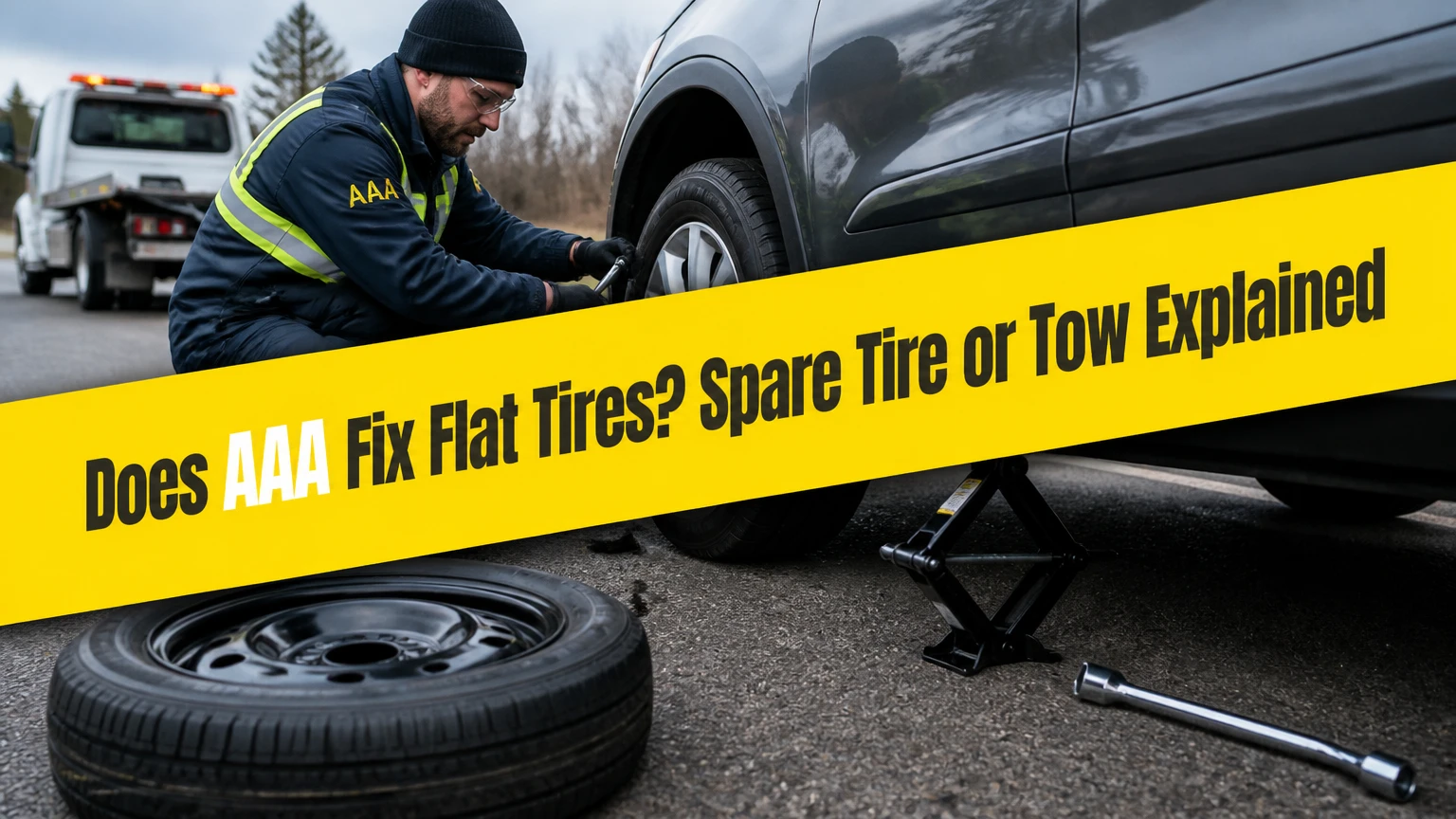
AAA usually does not patch or plug a punctured tire at the roadside. AAA roadside assistance generally inflates a tire that is merely low, installs your usable spare tire when one is available, or tows the vehicle when no safe spare exists. Local clubs may offer limited mobile tire-repair pilots, but members should assume a tire change or tow.
Key Facts at a Glance
- AAA roadside technicians usually replace a flat wheel with the vehicle’s spare tire, not repair the puncture.
- AAA can often add air to a low tire when inspection shows no puncture, sidewall damage, or unsafe deformation.
- A vehicle without a usable spare will generally need a tow to a tire shop, mechanic, dealership, or another permitted destination.
- AAA membership covers roadside assistance under plan rules, but tire replacement, tire repair, parts, and shop labor usually cost extra.
- Typical response time is 20-40 minutes in urban areas and 60-90 minutes during severe weather, heavy traffic, or rural dispatches.
- A temporary “donut” spare commonly carries a 50-mph limit and an approximately 50-mile driving range, but the vehicle owner’s manual controls.
Does AAA Fix Flat Tires?
AAA usually changes flat tires rather than fixing the puncture. A roadside technician removes the damaged wheel and installs the vehicle’s inflated spare, while a vehicle without a usable spare is normally towed for professional tire service.
A patch or plug is a different operation from roadside tire replacement. Tire repair requires an inspection of the puncture location, puncture size, internal condition, tread depth, and previous repairs. The Tire Industry Association and tire manufacturers generally require the tire to be removed from the wheel for a proper internal inspection, which roadside trucks are not normally equipped to perform.
AAA’s published roadside guidance in several regional clubs describes the service plainly: “We will put on your spare tire” when a member has a flat. That wording explains the practical distinction. AAA solves the immediate mobility problem, but a tire retailer determines whether the damaged tire can be repaired or must be replaced.
A plug-only roadside repair can also hide internal damage caused by driving on an underinflated tire. A tire shop can reject a repair when the puncture is in the sidewall or shoulder, exceeds the manufacturer’s repair limits, or follows extended driving while flat.
What does AAA do instead of patching a tire?
AAA generally provides one of three outcomes:
- Inflation: Air is added when the tire is low but appears serviceable.
- Spare installation: The flat wheel is removed and a usable spare is fitted.
- Towing: The vehicle is transported when a spare is missing, flat, incompatible, inaccessible, or impossible to install safely.
AAA does not normally supply a replacement tire at the roadside. The member typically pays a tire shop for a new tire, patch, plug-and-patch repair, mounting, balancing, or valve-stem work.
Can AAA Inflate a Low Tire?
AAA can often inflate a low tire if the tire holds air and has no visible or suspected damage. Inflation is not a repair, so air that escapes again indicates a puncture, leaking valve, wheel damage, or another condition requiring inspection.
A driver should not treat a warning light alone as proof that adding air is safe. Inspect the tread and sidewall from a safe position. A nail in the tread, a bulge, exposed cords, a torn sidewall, or a tire that has separated from the bead requires roadside assistance and likely towing rather than repeated inflation.
The National Highway Traffic Safety Administration recommends checking tire pressure when tires are cold and following the vehicle placard, usually located inside the driver’s door. The correct pressure is not necessarily the maximum pressure molded into the tire sidewall.
When should you stop driving immediately?
Stop driving and request help when any of these conditions exists:
- The tire is visibly flat or the wheel is contacting the road.
- The sidewall has a cut, bulge, blister, or exposed reinforcement.
- The vehicle pulls sharply, vibrates, or makes repeated thumping sounds.
- TPMS warning remains on after inflation.
- A tire has lost pressure rapidly more than once.
- The tire was driven a substantial distance while severely underinflated.
Driving on a flat can destroy a tire that might otherwise have been repairable. It can also bend a wheel, damage suspension components, or create a loss-of-control hazard.
What Happens When You Call AAA for a Flat Tire?
When a member requests flat-tire assistance, AAA records the vehicle location, dispatches a suitable roadside or towing provider, verifies service eligibility, and attempts the safest available roadside solution. The exact truck type, response time, and destination options vary by local AAA club and membership plan.
Step 1: Move away from traffic
Pull into a parking lot, service area, wide shoulder, or other stable location if the vehicle can move safely. Turn on hazard lamps, apply the parking brake, and keep occupants away from passing traffic.
Do not stand between the vehicle and active lanes. On a motorway or freeway, remain inside the vehicle with the doors locked when leaving the car would create greater danger, unless emergency personnel direct otherwise.
Step 2: Request roadside assistance
Use the AAA Mobile app or call 1-800-AAA-HELP, or 1-800-222-4357 in the United States. Provide the exact location, direction of travel, nearest exit or landmark, vehicle make and model, license plate, and the nature of the tire problem.
Tell AAA immediately whether the vehicle has a spare, a run-flat tire, an inflator kit, locking lug nuts, or an electric drivetrain. Accurate details help dispatch the right equipment and reduce a second response.
Step 3: Prepare access to the vehicle
Unlock the trunk or cargo area if the spare is stored there. Locate the jack, lug wrench, wheel-lock key, tow eye, and any manufacturer-specific tools.
A security lug nut without its matching key can prevent normal wheel removal. If the technician cannot remove the wheel safely, the practical outcome may change from spare installation to towing.
Step 4: Let the technician inspect the setup
The technician checks the tire, wheel, spare, lifting point, and roadside conditions. AAA guidance commonly limits roadside work when the shoulder is unstable, traffic exposure is excessive, the vehicle is overloaded, or the required equipment is unavailable.
Step 5: Drive only after the replacement is verified
The technician installs the spare and checks its pressure when the spare is serviceable. Before leaving, confirm the spare type, pressure, speed limit, and destination for the damaged tire.
How Much Does AAA Flat-Tire Service Cost?
For an eligible member, the roadside tire-change call is typically included in the annual membership, but AAA does not usually pay for the replacement tire or tire-shop repair. A nonmember may face a membership fee, same-day service charge, or separate commercial roadside price, depending on local club rules.
AAA prices and service restrictions vary by region, so the figures below are typical ranges rather than universal prices.
| Cost item | Typical amount | Usually included? | What changes the amount |
|---|---|---|---|
| Classic membership | $60-$75 per year | Membership access | Local club, promotions, enrollment date |
| Plus membership | $100-$125 per year | Membership access | Local club and household benefits |
| Premier membership | $125-$160 per year | Membership access | Regional pricing and benefit package |
| Same-day enrollment fee | $50-$75 typical | Usually no | Immediate-use restrictions and club policy |
| Replacement tire | $80-$350 per tire | No | Tire size, brand, vehicle, specialty construction |
| Mobile tire repair | $100-$200 typical | Usually no | Distance, nighttime service, tire inspection |
| Tire-shop patch or repair | $20-$50 typical | No | Shop, tire condition, prior repairs |
A membership is not a guarantee of immediate unrestricted service after enrollment. Some AAA clubs apply a same-day service fee or delay certain benefits, and the member should ask for the exact terms before purchasing during a breakdown.
Tipping is optional. A $5-$10 tip is a common courtesy for a routine tire change, while difficult weather, hazardous positioning, or a prolonged tow may justify more.
Which AAA Plan Matters If You Need a Tow?
The towing allowance matters more than the tire-change benefit when a vehicle has no usable spare. Basic, Plus, and Premier plans generally provide the same roadside tire-change function, while their towing mileage and other benefits differ.
| AAA plan level | Typical single-service tow | Flat-tire outcome | Practical fit |
|---|---|---|---|
| Classic | 5-7 miles | Spare installation or short tow | Urban driver near a repair shop |
| Plus | Up to 100 miles | Spare installation or longer tow | Commuter, traveler, vehicle without spare |
| Premier | Up to 200 miles for one qualifying tow annually | Spare installation or extended tow | Long-distance traveler |
| Nonmember dispatch | Policy-dependent | Commercial quote or enrollment rules | Occasional driver comparing pay-per-use |
Mileage is not the only restriction. Plans can limit the number of service calls, define eligible vehicles, apply waiting periods, or charge for mileage beyond the covered distance. Local AAA club terms control.
For an EV, luxury vehicle, specialty tire, or car without a spare, Plus-level towing can be more useful than Classic coverage because the nearest suitable tire shop may be well beyond a few miles.
How Far Can You Drive on a Temporary Spare?
A temporary spare commonly permits no more than 50 mph and approximately 50 miles, but the tire sidewall and vehicle owner’s manual are authoritative. A full-size matching spare may have different limits, while some vehicles prohibit a temporary spare on a particular axle or drivetrain.
| Spare type | Typical speed limit | Typical distance | Main restriction |
|---|---|---|---|
| Compact donut | 50 mph | About 50 miles | Temporary use only |
| Full-size matching spare | Vehicle-specific | Vehicle-specific | Must match pressure and load rating |
| Full-size temporary spare | 50-70 mph | Often 50-100 miles | Check sidewall instructions |
| Run-flat tire | Often 50 mph | Commonly up to 50 miles | Depends on pressure and manufacturer |
| Tire inflator sealant kit | No driving limit until sealed | Kit-specific | Replacement tire may still be required |
A temporary spare changes handling, braking, traction, and ground clearance. Some all-wheel-drive vehicles require a closely matched rolling circumference, so driving with one small spare can stress the differential, transfer case, or electronic stability systems.
AAA installs the spare; the driver remains responsible for following the vehicle’s restrictions. Go directly to a tire professional instead of using the spare for commuting.
What If Your Car Has No Spare Tire?
A vehicle without a usable spare normally requires a tow unless the tire can safely accept air and remain inflated. Many Tesla, BMW, Mercedes-Benz, hybrid, and other modern vehicles use run-flats or tire mobility kits to reduce weight, cargo intrusion, and fuel consumption.
Check the cargo compartment before assuming there is no spare. Some vehicles store a compact spare under the floor, behind a side panel, beneath the rear cargo area, or in a separate carrier.
| Vehicle situation | AAA’s likely roadside action | Likely next cost | Best destination |
|---|---|---|---|
| Inflatable spare holds pressure | Install spare | $0 for covered service | Tire shop |
| No spare, punctured tread | Tow | Tow over plan limit may cost extra | Tire shop |
| No spare, sidewall tear | Tow | Replacement tire and tow | Tire shop or dealer |
| Run-flat with safe residual pressure | Inspect or inflate | Tire replacement likely | Approved tire retailer |
| EV with damaged tire | Tow on suitable equipment | Possible specialty tire cost | EV-capable tire shop |
Tell the dispatcher that the vehicle is an EV or all-wheel-drive model. Some vehicles require a flatbed or specific wheel-lift procedure to prevent drivetrain or body damage.
Can AAA Patch a Tire on Location?
AAA may offer mobile tire repair in limited local programs, but availability is not consistent across the national network. Members should verify the service with their regional AAA club rather than expecting a patch, plug, or replacement tire from a standard roadside truck.
A mobile tire-repair company may arrive with tire-changing equipment, plugs, patches, balancing tools, and replacement inventory. Typical private mobile service costs about $100-$200 before a tire or parts, with premiums for nights, long distances, and hazardous roadside locations.
Ask four questions before booking:
- Does the technician perform an internal patch-and-plug repair?
- Does the quoted price include diagnosis, labor, travel, and materials?
- Will the company install a replacement tire in your exact size and load rating?
- Does the company service the vehicle’s TPMS sensor and wheel-lock hardware?
A roadside plug is not automatically equivalent to a tire-industry repair. A professional tire shop removes the tire, examines the inside, and evaluates whether the injury falls within repairable tread limits.
AAA Versus Other Flat-Tire Options
AAA is usually the strongest choice when the driver needs safe roadside handling plus tow backup, but another provider may be faster or cheaper in a specific situation. The decisive variables are location, vehicle equipment, membership status, and distance to a suitable tire shop.
| Option | Typical direct cost | Typical response | What the provider does | Best use |
|---|---|---|---|---|
| AAA member service | $0 covered call | 20-90 minutes | Spare installation, inflation, or tow | Drivers wanting broad roadside backup |
| DIY tire change | $0 service cost | 15-30 minutes | Driver installs spare | Safe location and capable driver |
| Manufacturer roadside plan | $0 during coverage | 30-90 minutes | Often tire change or tow | New vehicle under warranty |
| Credit-card roadside | $50-$100 allowance typical | 30-90 minutes | Pay-per-use dispatch | Infrequent drivers |
| Private mobile repair | $100-$200 typical | 30-120 minutes | Patch, tire replacement, or inflation | Driver specifically needs on-site repair |
| Local tire retailer | Shop pricing | Same day if open | Inspection and permanent repair | Vehicle already at a shop |
DIY is a poor choice on a narrow freeway shoulder, during heavy rain, or when the wheel is seized. The fastest theoretical option is not the safest practical option.
Manufacturer assistance can be valuable for a new car, but its towing destination may be limited to an authorized dealer. Credit-card coverage often has a dollar cap rather than a free service benefit, leaving the driver responsible for the balance.
What Can Prevent AAA From Changing the Tire?
AAA may be unable to install a spare when the vehicle lacks the correct hardware, the spare is unsafe, or roadside conditions make lifting the vehicle dangerous. In those cases, AAA normally changes the service outcome to a tow.
Missing wheel-lock key
A wheel-lock key is required to remove security lug nuts. Check the glove box, center console, spare-tire compartment, and tool kit before a breakdown.
A technician should not force a locking lug nut with improvised equipment beside traffic. The vehicle may need a tow to a shop with extraction tools.
Flat or incompatible spare
A spare tire that has been stored for years may be below its required pressure. A spare can also be the wrong size, too old, damaged, or unsuitable for an all-wheel-drive system.
Inspect the spare at every oil change and before every long trip. Compare its pressure with the door-jamb placard or spare-tire label.
Seized wheel or damaged wheel studs
Corrosion can bond a wheel to the hub, and damaged studs can make installation unsafe. A roadside technician may stop rather than risk stripped threads or an unstable wheel.
Unsafe lifting surface
A jack needs a stable, manufacturer-approved lifting point. Soft soil, steep slopes, active traffic, and a vehicle positioned too close to a barrier can require towing instead.
What Should You Do Before AAA Arrives?
A few preparations reduce dispatch delays and prevent a second failure after the spare is installed. Keep the vehicle stationary, make the location visible, and avoid removing the wheel unless you can do so safely.
Use this checklist:
- Stay clear of moving traffic and activate hazard lights.
- Record the nearest exit, mile marker, street address, or GPS location.
- Confirm whether the spare, jack, lug wrench, and wheel-lock key are present.
- Unlock the trunk or cargo hatch when safe.
- Photograph the tire and vehicle position for roadside instructions.
- Tell AAA about EV, hybrid, all-wheel-drive, run-flat, or oversized-wheel equipment.
- Remove passengers from the traffic side and wait in a safe place when conditions permit.
Do not use tire sealant without checking the owner’s manual. Sealant can contaminate TPMS sensors, complicate later repairs, and fail on sidewall damage or large punctures.
Expert Rules for Avoiding a Second Breakdown
A spare is equipment, not a guarantee. A compact spare can lose pressure while unused, and a jack can corrode in a damp trunk. Checking the spare only after the primary tire fails is too late.
The tire-pressure warning is not a repair diagnosis. TPMS reports pressure, not puncture location, internal belt damage, tread separation, or sidewall condition. A tire that accepts air may still be unsafe after being driven flat.
The towing destination should be chosen before dispatch. A basic plan may cover only a short distance, and the nearest facility may not stock the correct EV, run-flat, commercial, or high-load tire. Ask AAA which destination is covered before the tow begins.
A temporary spare is a transport solution, not a normal tire. The smaller diameter and reduced grip can alter braking and drivetrain behavior. Use it to reach a tire shop, not to finish a road trip.
Frequently Asked Questions
Does AAA bring a spare tire?
AAA usually does not bring a replacement spare for the vehicle. The technician installs the vehicle’s own usable spare when one is present; if the car has no spare or the spare is unsafe, AAA generally arranges a tow. A replacement tire must normally be purchased from a tire retailer, dealer, or mobile tire provider.
Can I join AAA after getting a flat?
You may be able to purchase AAA membership after a breakdown, but same-day service can carry a fee or restrictions. Local AAA clubs set the enrollment and waiting rules. Ask for the total immediate-service price before joining, because the annual membership alone may not cover an active roadside event.
Does AAA repair a nail in a tire?
AAA generally does not perform a permanent nail repair at the roadside. A technician may inflate the tire or install the spare, while a tire shop decides whether the nail injury is repairable. A tread puncture may qualify for an internal patch-and-plug repair, but a shoulder or sidewall injury usually requires replacement.
Will AAA tow a vehicle to my home?
AAA may tow a vehicle to a home, tire shop, mechanic, or dealership when that destination falls within the membership’s rules and mileage allowance. A Classic plan’s short towing limit may not reach the preferred shop. Confirm the destination and any overage charge with the dispatcher before accepting the tow.
Does AAA help with a flat tire at home?
AAA can generally dispatch roadside assistance to an eligible vehicle at home, provided the vehicle and location qualify under the local club’s terms. The technician may install the spare or inflate the tire, but AAA normally does not patch the puncture or replace the tire at the residence.
Is a run-flat tire safer than a spare?
A run-flat tire can allow limited travel after pressure loss, commonly up to about 50 miles at no more than 50 mph, but the manufacturer’s limit controls. Run-flats do not eliminate roadside risk, and damage, heat, load, or road conditions can reduce the permitted distance. A tire shop should inspect the tire promptly.
The Bottom Line
Does AAA fix flat tires? Usually, no, not in the patch-or-plug sense. AAA normally inflates a safe low tire, installs your usable spare, or tows a vehicle without a safe spare to a repair facility. Before calling, check the spare, wheel-lock key, towing mileage, and vehicle-specific restrictions, then drive only as far as the temporary spare instructions allow.