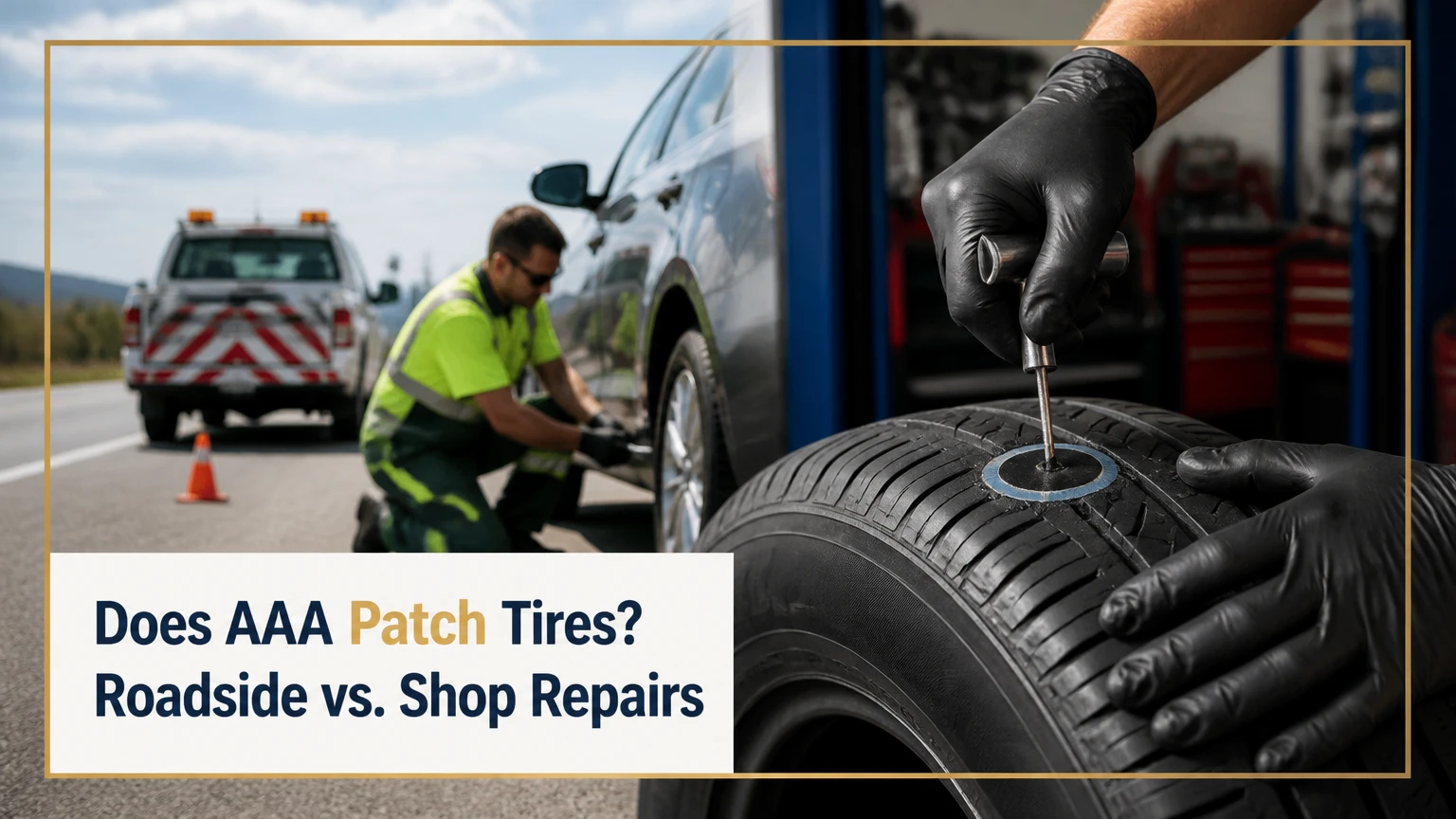
AAA roadside assistance usually does not patch or plug a punctured tire at the breakdown location. A roadside technician normally installs a usable spare tire or arranges a tow to a tire shop. A AAA-owned Auto Repair Center or AAA-approved repair facility may perform a permanent puncture repair after removing and inspecting the tire.
Key Facts at a Glance
- AAA roadside tire service generally changes a flat tire or tows the vehicle; it does not permanently patch the tire at the roadside.
- A proper repair normally combines an internal patch with a plug that fills the puncture channel after the tire is removed from the wheel.
- A tire shop may repair a small tread puncture, but sidewall damage, shoulder damage, internal damage, and oversized holes usually require replacement.
- Typical tire-repair pricing is about $20-$40, although regional labor rates, tire condition, and AAA member discounts change the final bill.
- A temporary spare often has a maximum speed near 50 mph and a limited driving distance, so it should take you to a repair facility rather than become a long-term tire.
- AAA towing mileage depends on the local club and membership plan. Published plan examples commonly range from roughly 3-5 miles for entry plans to 100 or 200 miles for higher tiers.
Does AAA Patch Tires on the Roadside?
AAA roadside assistance generally does not patch tires beside a highway, in a parking lot, or in a driveway. The roadside benefit is designed to restore short-term mobility safely, while a permanent puncture repair requires tire removal, inspection of the inner liner, and controlled repair materials.
Roadside trucks typically carry jacks, lug tools, air equipment, and safety gear for a spare-tire change. They do not usually carry the tire-mounting equipment, vulcanizing materials, or work area required for an approved internal repair. Policies also vary among regional AAA clubs, so the local dispatcher remains the final authority.
The practical answer is simple: request “flat tire service,” not a roadside patch. AAA may install your spare if the spare, tools, and wheel hardware are usable. If the vehicle has no usable spare, AAA normally provides towing within the applicable membership limit.
What Does AAA Do for a Flat Tire?
AAA roadside service usually performs one of two actions: it installs the vehicle’s serviceable spare tire, or it transports the vehicle to a repair location. The technician may also inflate a tire enough to move the vehicle when the tire and wheel remain safe, but inflation is not a puncture repair.
AAA service is not equivalent to a tire-shop inspection. A roadside technician may identify an obvious nail, screw, sidewall tear, or completely destroyed tire, yet the final repair decision belongs to a qualified tire professional. Driving on a severely underinflated tire can create internal damage that cannot be seen from the outside.
How Does the AAA Roadside Visit Work?
The normal AAA flat-tire process takes one service request, one vehicle assessment, and either a spare-tire installation or a tow. Actual arrival time varies with traffic, weather, call volume, road access, and the regional contractor handling the dispatch.
How the Roadside Visit Usually Works
- Request flat-tire service. Use the AAA app or member phone number, and give the exact location, direction of travel, vehicle type, and tire problem.
- Tell the dispatcher about your equipment. State whether the car has a spare, an inflation kit, locking lug nuts, or a damaged wheel.
- Move away from traffic. Turn on hazard lights, remain behind a guardrail when possible, and avoid standing on the traffic side of the vehicle.
- Let the technician inspect the tire. The technician checks the spare, jack points, wheel hardware, tire damage, and safe access to the vehicle.
- Accept the suitable outcome. AAA installs the spare when conditions permit; otherwise, the technician coordinates a tow under the plan’s terms.
- Drive only to a repair facility. A temporary spare or emergency inflation solution is a short-distance measure, not a permanent repair.
The hands-on spare change may take about 15-30 minutes when the wheel lock, jack points, and spare are accessible. The total roadside wait commonly runs 45 minutes to 2 hours, with storm conditions sometimes extending that window.
What Happens at an AAA Repair Facility?
An AAA repair facility normally removes the wheel, demounts the tire, examines the inner liner, and measures the puncture before approving a repair. The facility may be an AAA-owned Auto Repair Center or an independent AAA-approved facility, and those categories are not interchangeable in every location.
A technician should reject a repair when the puncture reaches the sidewall or shoulder, the tire has been driven while flat, the hole exceeds the repairable size, or the tread is too worn. The United States Tire Manufacturers Association describes tire repair as a process that requires removing the tire for inspection, rather than treating an external plug as a complete repair.
A typical shop repair takes 30-60 minutes when the facility has no queue. The process can take longer if the tire needs replacement, the wheel is bent, the TPMS sensor is damaged, or the correct tire is not in stock.
Will AAA Tow a Car Without a Spare?
AAA will generally tow a vehicle that lacks a usable spare, but the destination distance depends on the local AAA club, membership tier, plan rules, and service circumstances. Entry-level plans may provide only a short tow, while higher plans commonly advertise substantially longer limits, such as 100 or 200 miles.
| Membership example | Typical published tow range | Best use case | Important limitation |
|---|---|---|---|
| Classic or Basic | 3-5 miles | Nearest available repair location | May not reach a preferred tire dealer |
| Plus | Up to 100 miles | Regional tire-shop access | Local terms and covered vehicles apply |
| Premier | Up to 200 miles | Specialty tires or rural recovery | Annual service limits still apply |
| Local club variation | Plan-specific | State or regional dispatch | Mileage and benefits require confirmation |
These figures are representative plan examples, not a universal AAA promise. AAA is a federation of regional motor clubs, so the member handbook and local club website control the benefit. Ask the dispatcher which tow distance applies before selecting a distant repair shop.
A no-spare vehicle can also require a flatbed, especially when it is an all-wheel-drive vehicle, an electric vehicle, a low-clearance sports car, or a car with a locked drivetrain. The towing method should follow the vehicle manufacturer’s instructions.
Where Can AAA Permanently Repair a Tire?
AAA-owned Auto Repair Centers and many AAA-approved repair facilities may permanently repair eligible punctures, but not every roadside contractor or AAA-branded location performs tire repairs. Call the specific facility before traveling there, particularly when the vehicle uses run-flat, low-profile, commercial, or uncommon EV tires.
AAA membership may provide a discount at participating facilities, but the amount and eligible labor categories vary by regional club. A typical repair price is $20-$40 before or after a local member discount, while some shops repair eligible flats at no charge when the tire was purchased from that retailer.
| Repair location | Typical puncture service | Typical cost | Typical completion time |
|---|---|---|---|
| AAA-owned repair center | Internal patch-plug inspection and repair | $25-$40 | 30-60 minutes |
| AAA-approved facility | Repair or replacement, facility-specific | $20-$50 | 30-90 minutes |
| Independent tire retailer | Flat repair, often free for purchased tires | $0-$40 | 20-60 minutes |
| Mobile tire service | On-site plug or replacement, availability varies | $75-$150+ | 30-90 minutes |
Prices are typical working ranges, not guaranteed AAA rates. A shop may charge more when it must remove a tire with a damaged valve stem, repair a bent wheel, replace a TPMS sensor, or mount a specialty tire.
Is a Patch Better Than a Plug?
A proper patch-plug repair is generally safer and more durable than an external plug used alone. The plug fills the puncture channel, while the internal patch seals the inner liner; that combination addresses both the path through the tread and the air-retention surface.
An external plug can be useful as a temporary emergency measure, but it does not let a technician inspect the tire’s interior. A plug-only repair may also leave moisture or debris in the puncture channel and cannot correct internal belt damage caused by driving underinflated.
The USTMA tire-repair guidance states, “Never repair a tire that has been previously repaired improperly.” The instruction matters because a second repair can conceal separated belts, an enlarged hole, or damage from an earlier plug.
What Is a Proper Patch-Plug Repair?
A proper repair uses a combination repair unit or equivalent approved method after the tire has been removed from the rim. The technician locates the puncture, checks the inside for abrasion, cleans and prepares the repair area, fills the channel, applies the inner patch, and tests for leaks.
| Repair characteristic | External plug only | Internal patch only | Patch-plug repair |
|---|---|---|---|
| Tire removed from wheel | Usually no | Yes | Yes |
| Puncture channel filled | Yes | Sometimes no | Yes |
| Inner liner sealed | No | Yes | Yes |
| Interior damage inspected | No | Yes | Yes |
| Normal professional choice | Temporary use | Incomplete alone | Preferred eligible repair |
Repair standards and tire-maker instructions can impose different limits, so the facility should follow the tire manufacturer’s procedures. A repair is not automatically safe because the leak stops.
Which Tire Punctures Can a Shop Repair?
A shop can often repair a small, straight puncture in the central tread when the tire has sufficient tread and no internal damage. The technician must evaluate the puncture’s diameter, angle, location, tire construction, speed rating, prior repairs, and inflation history before approving the work.
Typical repairable conditions include a nail or screw hole in the tread, a puncture that is within the manufacturer’s size limit, and a tire that was not driven for a significant distance while flat. A puncture in the shoulder or sidewall is normally not repairable because those areas flex heavily during driving.
| Tire condition | Likely decision | Reason | Safe next action |
|---|---|---|---|
| Small nail in central tread | Repair may be possible | Stable tread repair zone | Use spare or tow for inspection |
| Screw near shoulder | Usually replace | High-flexure location | Do not drive on a low tire |
| Sidewall cut or bulge | Replace | Structural casing damage | Request a tow |
| Tire driven flat | Inspect, often replace | Hidden inner-liner abrasion | Avoid reinflating for travel |
| Two overlapping repairs | Often replace | Compromised repair area | Ask for manufacturer-based evaluation |
Tread depth also affects the decision. A puncture repair does not restore worn tread, uneven wear, dry rot, exposed cords, or an age-related casing problem. A tire with adequate air pressure can still be unsafe if the internal structure has failed.
Can AAA Repair a Tire With a Nail in It?
AAA roadside assistance usually will not remove the nail and patch the tire at the scene. A technician may install the spare or tow the vehicle, while a tire facility decides whether the nail caused a repairable tread puncture.
Do not pull out the nail before help arrives. The object may temporarily limit air loss, and its removal can turn a slow leak into a rapid deflation. If the tire is losing pressure quickly, keep the vehicle stationary and request a roadside response.
How Much Does AAA Tire Repair Cost?
A typical professional puncture repair costs about $20-$40, while AAA roadside assistance for a covered member generally has no separate roadside charge. The final price depends on the regional club, facility, tire condition, repair eligibility, local labor rate, and any applicable member discount.
| Service or outcome | Typical customer cost | Typical time | What changes the result |
|---|---|---|---|
| AAA roadside dispatch | $0 for covered service | 45-120 minutes wait | Membership, call volume, location |
| Spare-tire installation | Included in eligible roadside visit | 15-30 minutes hands-on | Wheel locks, access, rusted hardware |
| Puncture repair at shop | $20-$40 typical | 30-60 minutes | Facility rate and tire inspection |
| Replacement tire | $100-$400+ per tire | 60-120 minutes | Size, brand, rating, EV specification |
AAA member discounts are not uniform nationwide. Confirm whether the discount applies to tire repair, labor only, parts, or a maximum dollar amount before authorizing work.
A roadside service call can still produce out-of-pocket costs when the vehicle is not covered, the membership is inactive, the request exceeds service limits, the tow exceeds the included mileage, or the customer chooses a nonparticipating destination.
What Changes for EVs, Hybrids, and Cars Without Spares?
Electric vehicles, hybrids, sports cars, and many newer sedans may carry an inflator and sealant kit instead of a spare tire. AAA can often tow these vehicles, but an inflator kit cannot safely fix a sidewall tear, large puncture, damaged wheel, or tire that has already been driven flat.
An EV also creates destination constraints. The receiving shop must have the correct load rating, dimensions, noise specification, speed rating, and sometimes a tire approved for the vehicle’s weight and torque. A short Classic-plan tow may reach a general garage but not the retailer that stocks the correct tire.
Before calling AAA, check the owner’s manual for approved towing procedures. Some all-wheel-drive and EV models require a flatbed or prohibit rotating driven wheels on the ground, and incorrect towing can damage the drivetrain.
Can a Sealant Kit Replace a Tire Patch?
A sealant kit provides temporary inflation support and does not replace a professional puncture repair. Sealant can contaminate the tire, interfere with TPMS sensors, and make later inspection more difficult, while sidewall damage remains outside its safe operating purpose.
Some regional AAA fleets have tested emergency inflation or sealant-based systems, including reported pilots in Western and Central New York. Such programs are exceptions, not a nationwide promise that AAA will permanently repair a tire at the roadside.
What Should You Check Before Calling AAA?
Check the vehicle’s spare, tire pressure, jack, lug wrench, wheel-lock key, and owner’s manual before requesting service. These five checks tell the dispatcher whether a spare change is realistic and prevent a second delay after the technician reaches the vehicle.
Use this preparation sequence:
- Locate the spare: Confirm that the tire is present and matches the vehicle’s required size or temporary-spare specification.
- Check spare pressure: A compact spare may require about 60 psi, while a full-size spare follows the pressure printed on its sidewall or vehicle placard.
- Find the wheel-lock key: Place the special socket in the glove box or spare-tire compartment.
- Report the vehicle type: Identify an EV, hybrid, all-wheel-drive car, low-clearance vehicle, or commercial van.
- Describe the damage: Report a sidewall tear, wheel crack, tire bulge, missing valve stem, or exposed cords.
- Give a safe location: Use a highway direction, exit number, mile marker, parking-lot name, or GPS pin.
Never crawl under a vehicle supported only by the factory jack. A roadside technician has better equipment and a safer position for a tire change.
What Problems Commonly Delay Tire Service?
The most common roadside failures are an unusable spare, a missing wheel-lock key, inaccessible vehicle placement, seized lug nuts, and a tow destination that exceeds the plan’s mileage. Each problem changes the service from a quick tire change into a tow or second dispatch.
| Delay or failure | Immediate consequence | Prevention | Likely resolution |
|---|---|---|---|
| Flat compact spare | Spare cannot support travel | Check pressure monthly | Tow to a repair facility |
| Missing wheel-lock key | Wheel cannot be removed normally | Store key in glove box | Retrieve key or arrange alternate service |
| No safe shoulder | Technician cannot work safely | Exit vehicle only when safe | Move vehicle or request law-enforcement support |
| Rusted lug hardware | Spare change takes longer | Maintain wheel hardware | Technician uses approved extraction method |
| Wrong tow destination | Extra customer expense or delay | Confirm mileage before dispatch | Select an eligible facility |
A spare tire that appears inflated can still be unsuitable if it is cracked, expired, incorrectly sized, or below the manufacturer’s pressure. Tire age and storage damage matter even when the spare has never touched the road.
Should You Call AAA, a Tire Shop, or a Mobile Mechanic?
Call AAA first when the vehicle is in traffic, lacks a safe place to work, or cannot be driven without risking wheel and tire damage. Call a tire shop directly when the car is already safely parked and can reach the shop without driving on a compromised tire. A mobile tire provider may be useful when on-site equipment and a professional repair are confirmed.
| Option | Roadside safety | Permanent repair | Typical cost | Best situation |
|---|---|---|---|---|
| AAA roadside | High | Usually no | $0 for covered service | Highway breakdown or unsafe shoulder |
| Tire shop | Moderate if safely driven | Yes, if eligible | $0-$50 | Vehicle parked safely near a facility |
| Mobile tire service | Depends on location | Sometimes | $75-$150+ | Driveway or workplace with access |
| Independent tow | High | No | $75-$200+ | AAA limit or membership unavailable |
A mobile mechanic who offers only an external plug is not equivalent to a tire shop performing an internal inspection. Ask whether the technician will demount the tire and whether the repair follows the tire maker’s limits.
AAA is not always the fastest choice. A nearby tire retailer may complete a repair sooner when the car is safely parked, while AAA remains the safer option when driving would expose the tire to further damage.
When Should You Replace the Tire Instead?
Replace the tire when damage affects the sidewall or shoulder, the casing has internal abrasion, the puncture exceeds the manufacturer’s limit, the tread is severely worn, or the tire has an unsafe previous repair. A low repair price does not justify preserving a structurally compromised tire.
Match replacement tires across axle requirements. On many all-wheel-drive vehicles, replacing one tire with a substantially different circumference can stress the drivetrain, so the manufacturer may require a pair or a complete set.
Ask the shop to measure tread depth on the remaining tires and inspect for uneven wear. If the puncture resulted from a nail, the underlying cause may be alignment, worn suspension, incorrect inflation, or road debris rather than tire age alone.
The Bottom Line
AAA roadside assistance generally does not patch tires where the vehicle breaks down. AAA usually installs a usable spare or tows the vehicle, while a participating AAA repair center or tire shop can inspect the tire and perform a proper internal patch-plug repair when the puncture is small, central, and free of internal damage.
Use AAA immediately when the vehicle is unsafe to drive or lacks a spare. Confirm the local towing mileage, facility availability, member discount, and repair price, then have a qualified tire professional make the final repair-or-replace decision.
Frequently Asked Questions
Does AAA patch tires at home?
AAA roadside technicians generally provide flat-tire assistance at a home, driveway, or workplace by installing a usable spare or arranging a tow. A permanent patch is usually performed at a tire shop because the tire must be removed from the wheel and inspected internally. Local AAA services can differ, so confirm when dispatching.
Will AAA plug a tire for free?
AAA roadside service generally does not provide a free external plug at the breakdown location. Covered members can usually request a spare-tire change or towing, while a tire shop charges according to its own pricing. Some retailers offer free puncture repairs for tires purchased there, but that benefit is separate from AAA.
Can I drive to a shop with a screw in my tire?
Drive only when the tire holds manufacturer-specified pressure, the puncture is in the central tread, and the shop is very close. A tire that is losing pressure, visibly damaged, or driven while flat should not be driven to a shop. Use AAA or another tow provider instead.
How long can I use a temporary spare after AAA installs it?
Use a temporary spare only for the distance and speed printed on its sidewall or in the owner’s manual. Many compact spares specify approximately 50 mph maximum speed and limited mileage, but the vehicle’s instructions control. Schedule a permanent repair or replacement promptly.
Does AAA cover a tire replacement?
AAA roadside membership usually covers assistance for a flat tire, such as a spare change or eligible tow, rather than the cost of a replacement tire. The member pays for the tire and shop labor unless another warranty, road-hazard plan, insurance policy, or retailer program applies.
What if the AAA tow limit cannot reach my preferred tire shop?
Ask the dispatcher for the covered destination distance and choose an eligible nearby facility, or pay the extra mileage if the plan permits that arrangement. Higher AAA tiers may provide longer towing limits, but upgrades and regional rules do not always apply immediately to an active breakdown.


