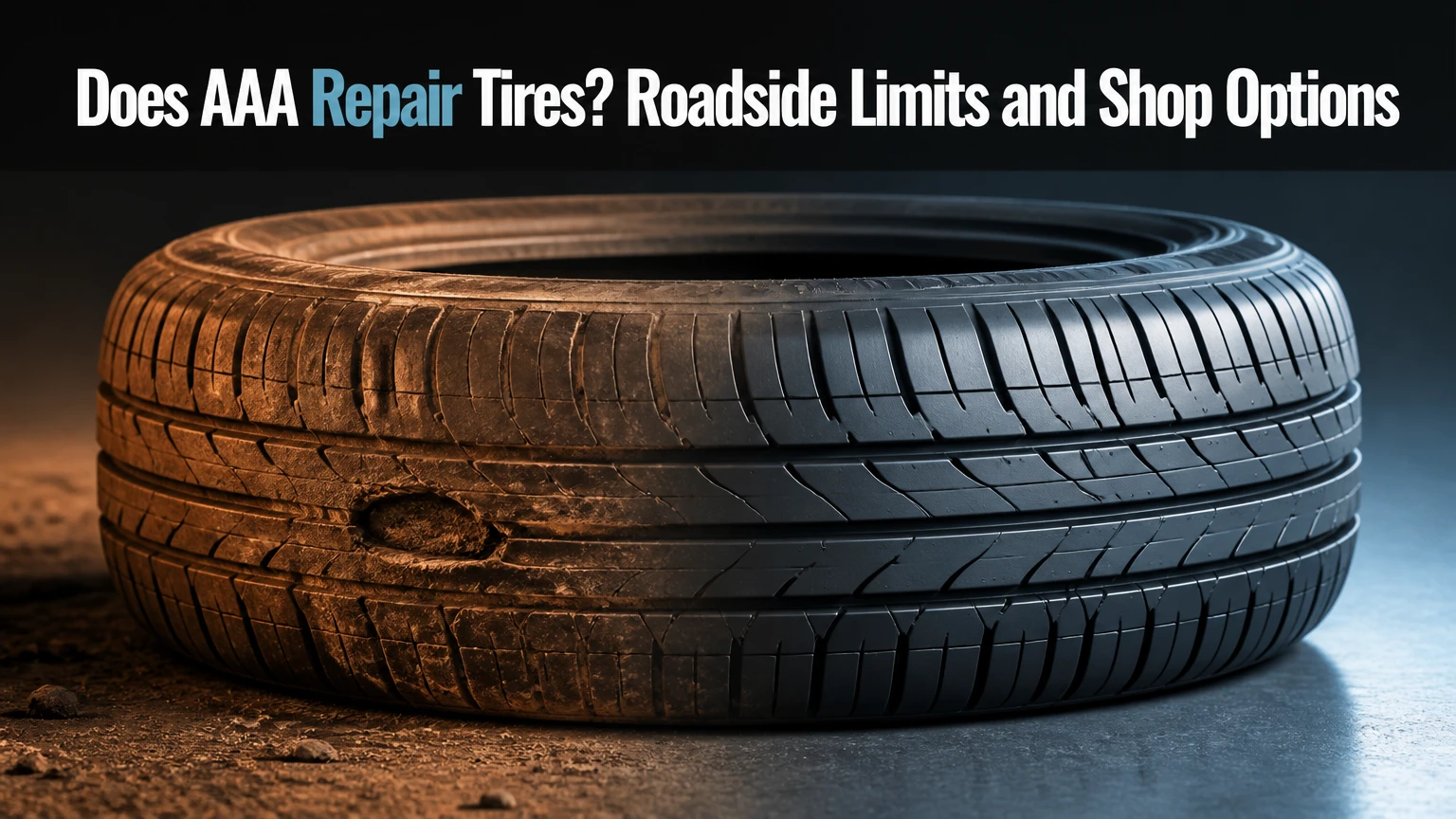
AAA generally does not perform permanent tire repairs from a roadside service vehicle. AAA Roadside Assistance may inspect the tire, add air when appropriate, install your usable spare, or tow the vehicle to a repair facility; permanent puncture repairs may be available at selected AAA Car Care Centers or AAA Approved Auto Repair locations.
Key Facts at a Glance
AAA roadside technicians typically change a flat only when the vehicle has a safe, serviceable spare tire.
A roadside technician may reinflate a tire temporarily, but reinflation does not repair the leak.
AAA membership normally covers roadside assistance, while tire repairs, replacement tires, mounting, and balancing usually cost extra.
A professional tire repair requires removing the tire from the wheel and inspecting its inside.
A repairable puncture is generally in the tread, no larger than 1/4 inch, and free from internal damage.
AAA clubs, facilities, mileage limits, call limits, and discounts vary by geographic region and membership plan.
Does AAA Repair Tires at the Roadside?
AAA roadside assistance is an emergency-mobility service, not a mobile tire-repair garage. The technician’s priority is to move the vehicle to a safe location or restore mobility with the vehicle’s own spare, rather than remove the tire, inspect its inner liner, and install a permanent plug-patch repair beside traffic.
The exact roadside service depends on the local AAA club, contractor, vehicle, tire, weather, and membership terms. A technician may add air to a tire with a minor leak if the tire appears safe for limited travel, but the driver should still go directly to a tire facility. A tire that loses pressure again has not been fixed.
AAA’s public roadside descriptions commonly identify flat-tire help as spare-tire installation or towing when no usable spare exists. Members should treat the membership card and local AAA terms as controlling, because AAA is a federation of regional clubs rather than one uniform operating company.
Why does AAA usually avoid roadside plugs?
AAA usually avoids permanent roadside plugs because a puncture cannot be evaluated safely from the outside. A tire that was driven while flat can suffer internal cord, liner, or sidewall damage that remains invisible while the tire stays mounted on the wheel.
The U.S. Tire Manufacturers Association recommends removing a punctured tire for a complete internal inspection before repair. A proper repair normally combines an interior patch with a plug that fills the puncture channel. An external string plug can stop air loss temporarily, but it cannot prove that the tire’s internal structure remains sound.
A contractor who offers an external plug for cash may be operating outside AAA’s standard roadside procedure. Decline the shortcut and request a spare installation or tow. The immediate inconvenience is smaller than the risk of relying on an uninspected tire at highway speed.
What Happens When AAA Arrives?
AAA’s roadside tire response usually follows four practical stages: location and membership verification, safety assessment, tire evaluation, and either spare installation, limited inflation, or towing. The response is designed to stabilize the vehicle without promising that the damaged tire is roadworthy.
The technician normally parks with warning lights, assesses traffic and terrain, and confirms whether the vehicle can be lifted safely. The technician may check the tire, wheel, valve area, and visible damage, but a roadside visual inspection is not equivalent to an internal tire examination.
If the spare is present and compatible, the technician removes the damaged wheel and installs the spare. If the spare is missing, flat, incompatible, or unsafe, towing is the normal fallback. Some vehicles require special lifting points or equipment, especially low-clearance cars, electric vehicles, and vehicles with locked lug nuts.
Roadside service outcomes
| Situation at the vehicle | Likely AAA action | What the driver must do next |
|---|---|---|
| Full-size spare, correct bolt pattern, inflated | Install the spare wheel | Drive to a tire shop and repair or replace the original tire |
| Compact temporary spare at 60 psi | Install the temporary spare | Follow the sidewall speed limit and mileage restriction |
| Slow leak with intact tread and safe pressure | Add air when permitted | Drive directly to a repair facility, usually within the same trip |
| Sidewall split or visible cord | Tow the vehicle | Replace the damaged tire at a qualified shop |
| No spare or unusable spare | Tow the vehicle | Choose a tire facility or another eligible destination |
| Locked lug nut key missing | Attempt may stop or require towing | Obtain the key or arrange specialized wheel service |
AAA roadside assistance is most useful when the vehicle’s emergency equipment is available and the damage is limited. It is not a substitute for a tire inspection after driving several miles with low or zero pressure.
What If Your Vehicle Has No Spare?
If your vehicle has no usable spare, AAA will generally tow the vehicle instead of permanently repairing the flat at the roadside. Many newer vehicles carry a tire-inflation compressor and sealant kit, run-flat tires, or no emergency tire equipment because manufacturers use the space and weight for other purposes.
Check the owner’s manual before using sealant. Tire sealant can contaminate a tire-pressure sensor, may be incompatible with some tire designs, and often requires prompt replacement rather than a permanent repair. Sealant also cannot restore a tire with a sidewall cut, separated tread, bent wheel, or large puncture.
Tell AAA the vehicle’s exact location, make, model, drivetrain, wheel size if known, and whether the vehicle is carrying cargo. A flatbed may be preferable for some all-wheel-drive vehicles, low-clearance vehicles, electric vehicles, or cars with a damaged wheel.
How should you arrange a tow?
Ask AAA to confirm the allowable destination and mileage before the vehicle is dispatched. Basic, Plus, and Premier memberships can have different towing distances, and some regional clubs use different benefits or restrictions.
A practical destination order is:
- The tire retailer that holds your tire warranty or road-hazard plan.
- A nearby AAA Car Care Center, if that location performs tire service.
- An AAA Approved Auto Repair facility with confirmed tire-repair capacity.
- Your preferred independent tire shop, if the membership permits that destination.
- A manufacturer dealership for specialized EV, run-flat, or performance tires.
AAA Approved Auto Repair status indicates participation in AAA’s facility network, but it does not mean every location offers every tire brand, repair type, or after-hours service. Call the destination before towing when conditions allow.
Which Tire Damage Can a Shop Repair?
A tire shop can usually repair a small puncture in the central tread when the tire has not been driven severely underinflated and the tire’s age, tread, and condition remain acceptable. A shop should reject damage in the sidewall or shoulder because those areas flex too heavily for a dependable permanent repair.
The common industry threshold is a puncture no larger than 1/4 inch, or 6 millimeters, in the repairable tread area. The final decision belongs to the inspecting technician and tire manufacturer’s rules. A nail in the center tread may be repairable, while a similar nail near the shoulder may require replacement.
Professional repair involves demounting the tire, checking the inner liner and cords, preparing the puncture channel, and installing an approved combination repair. A patch placed only on the outside or a plug inserted without internal inspection does not meet the normal professional-repair process.
| Damage or tire condition | Permanent repair status | Typical recommendation |
|---|---|---|
| Nail in central tread, 3-6 mm hole | Often repairable | Remove tire, inspect internally, install plug-patch |
| Cut in shoulder or sidewall | Not safely repairable | Replace the tire |
| Tire driven flat for several miles | Usually reject until inspected | Replace if inner liner has abrasion or wrinkles |
| Bead damage or bent wheel | Tire repair alone is insufficient | Repair or replace wheel, then inspect tire |
| Uneven wear below safe tread depth | Repair may not restore serviceability | Replace tire if tread or casing is unsafe |
| Run-flat with pressure loss | Manufacturer-specific | Follow run-flat inspection and replacement rules |
| Tread separation or exposed cords | Not repairable | Replace immediately |
Can AAA repair a sidewall puncture?
AAA cannot make a sidewall puncture safe through a roadside plug, and a normal tire shop should not permanently repair structural sidewall damage. Sidewalls carry load while flexing repeatedly, so a patch or plug cannot reliably restore the original casing strength.
Replace a tire with a sidewall cut, bulge, exposed cord, puncture outside the repairable tread zone, or evidence of overheating from driving flat. Photograph the damage before removal if you need to submit a road-hazard or tire-warranty claim.
How Much Does AAA Tire Service Cost?
AAA roadside tire assistance is generally included in membership, but the membership itself has an annual fee and the benefit is subject to plan, region, vehicle, and service-call rules. Permanent repair, a replacement tire, mounting, balancing, disposal, and some specialty services normally generate separate charges.
A typical passenger-tire puncture repair at a U.S. tire shop costs about $20-$45. A replacement tire commonly ranges from approximately $100 to more than $400, depending on size, load rating, run-flat construction, EV specifications, performance category, and brand.
The following figures are typical planning ranges, not universal AAA prices. Confirm the quote with the facility before authorizing work.
| Service or charge | Typical amount | Main price variable |
|---|---|---|
| AAA membership | About $50-$150 per year | Club, plan tier, household benefits |
| Roadside flat-tire response | Usually included | Eligibility, call limits, membership status |
| Internal puncture repair | $20-$45 | Shop labor, tire size, local market |
| Passenger replacement tire | $100-$400+ each | Brand, rating, size, run-flat or EV design |
| Mount and balance | $20-$60 per tire | Wheel diameter, sensors, shop package |
| Tire disposal or valve service | $2-$10 per tire | Local fees and replacement parts |
| Noncovered or excess-mileage tow | Varies by club | Membership tier, miles, location, vehicle |
AAA membership does not generally function as tire insurance. Roadside assistance can help after a flat, but it usually does not pay for the damaged tire itself. A separate tire manufacturer warranty, retailer road-hazard plan, vehicle warranty, or insurance policy may provide different benefits.
How Long Does Roadside Tire Help Take?
A roadside tire response commonly takes 45-90 minutes in ordinary traffic, while severe weather, rural locations, major collisions, holiday demand, and contractor shortages can make the wait longer. A spare installation often takes 20-40 minutes after arrival; towing adds loading and travel time.
An in-shop puncture repair often takes 30-60 minutes once a service bay is available. A replacement tire can take longer when the correct size is not in stock, the shop must order a matching tire, or an AWD vehicle requires multiple tires.
| Service stage | Typical duration | Common delay |
|---|---|---|
| AAA request and dispatch | 5-20 minutes | Incorrect location or membership details |
| Roadside arrival | 45-90 minutes | Traffic, weather, rural distance |
| Spare-tire installation | 20-40 minutes | Corroded lug nuts or missing key |
| Vehicle loading for tow | 15-30 minutes | Low clearance or blocked access |
| Internal tire repair in shop | 30-60 minutes | Queue, inspection, balancing |
| Replacement tire installation | 45-120 minutes | Inventory, TPMS service, AWD matching |
Do not wait on an active highway shoulder if a safer location is available. Move behind a barrier when possible, turn on hazard lights, and tell the dispatcher whether the vehicle is blocking traffic or located on a limited-access road.
What Changes for AWD, EV, and Run-Flat Vehicles?
All-wheel-drive, electric, and run-flat vehicles require more specific tire decisions than a conventional front-wheel-drive sedan. A single replacement tire with substantially different circumference can increase drivetrain stress on AWD systems, while EV weight, torque, and tire noise requirements can narrow the correct replacement choices.
For AWD vehicles, compare the remaining tread depth and the vehicle manufacturer’s replacement guidance before installing one new tire. Some manufacturers permit one tire with a defined tread-depth difference; others recommend replacing an axle pair or all four tires.
Electric vehicles may need tires with appropriate load capacity, low rolling resistance, acoustic foam compatibility, and EV-approved fitment. AAA can often install the vehicle’s spare or tow it, but the final tire selection belongs to the owner, manufacturer, or qualified tire shop.
Run-flat tires have manufacturer-specific limits for distance and speed after pressure loss. A run-flat may require replacement even when the puncture looks small because internal damage can occur during the low-pressure drive.
What should you keep in the vehicle?
Keep the spare at its specified pressure, inspect it at least twice a year, and verify that the jack, lug wrench, adapter, and locking-lug key are present. Compact spares often require 60 psi, while full-size spares use the pressure printed on the tire or specified by the vehicle manufacturer.
Check the spare before a road trip, not after the flat occurs. A spare that has sat for years may have low pressure, age cracking, or a tread date that makes it unsuitable for extended use.
Which Option Should You Choose?
Choose AAA roadside assistance for immediate safety, spare installation, or towing. Choose a tire shop for diagnosis, permanent repair, replacement, balancing, and warranty work. Choose a manufacturer dealer when the vehicle has specialized AWD, EV, run-flat, or electronic wheel requirements.
| Your situation | Best first action | Why | Main limitation |
|---|---|---|---|
| Stranded with a full-size spare | Request AAA spare installation | Fastest path to mobility | Original tire still needs inspection |
| Stranded without a spare | Request a tow to a tire facility | Avoids driving on a damaged tire | Destination and mileage rules apply |
| Nail in central tread at home | Visit a tire shop | Internal inspection enables repair | AAA may not provide mobile repair |
| Sidewall bulge or exposed cord | Stop driving and replace tire | Structural damage cannot be patched | Replacement cost is separate |
| AWD vehicle with one damaged tire | Ask shop to measure tread depth | Prevents incompatible circumference | May require two or four tires |
| Tire-pressure warning with no visible damage | Check pressure and inspect promptly | Slow leaks can worsen quickly | Repeated inflation is not a repair |
Is AAA or a tire shop better?
A tire shop is better for permanent tire work because it has a tire machine, balancing equipment, replacement inventory, and the ability to inspect the inner liner. AAA is better for roadside access and transport when the vehicle cannot safely reach that shop.
The two services often work together. AAA can install the spare or tow the vehicle, and the tire facility can determine whether the original tire is repairable under the manufacturer’s safety rules.
Does AAA pay for a new tire?
AAA roadside membership generally does not pay for a replacement tire. The member usually pays for the tire and installation unless a separate road-hazard policy, tire warranty, retailer protection plan, manufacturer assistance program, or insurance policy applies.
Ask the shop to inspect the tire before purchasing a replacement. A tread puncture may cost $20-$45 to repair, while replacing a tire unnecessarily can cost several hundred dollars, but safety and manufacturer limits take priority over price.
Common Mistakes and Safer Fixes
Driving several miles on an empty tire
Driving flat can create heat and internal liner damage even when the puncture is small. Stop promptly, use the spare, or request a tow; do not assume that adding air restores the tire’s condition.
Treating a temporary spare like a normal tire
A compact spare usually has a lower speed rating and a limited service distance printed on its sidewall. Avoid high speed, hard cornering, heavy loads, and unnecessary travel, then replace or repair the original tire quickly.
Accepting an external plug as the final repair
An external plug does not reveal internal damage and may violate the tire maker’s repair procedure. Use it only if a qualified professional specifically approves the tire and completes the required internal inspection, rather than relying on a roadside shortcut.
Ignoring the TPMS warning after inflation
A tire-pressure monitoring system warning can return within minutes when a puncture remains active. Measure all four tires with a gauge, compare readings with the driver-door placard, and arrange a professional inspection.
Replacing one AWD tire without checking tread
A new tire can have a larger rolling circumference than the other three tires. Have the shop measure tread depth and follow the vehicle manufacturer’s AWD replacement specification before authorizing a single-tire replacement.
Choosing a destination without checking coverage
A tow to a preferred shop may exceed the membership’s included mileage or regional rules. Confirm the allowed distance, destination type, and any charges with the AAA dispatcher before the tow begins.
What Should You Ask AAA and the Repair Facility?
Use specific questions because “tire help” can mean roadside mobility, towing, inspection, or permanent repair. Ask AAA whether the service call includes a spare change, whether the technician will inflate the tire, what towing distance applies, and whether the vehicle requires a flatbed.
Ask the repair facility whether it performs internal plug-patch repairs, whether the puncture location and size qualify, whether mounting and balancing are included, and whether the facility is AAA-owned or an independently operated Approved Auto Repair location.
For warranty claims, ask the shop to document the puncture, tread depth, tire identification number, purchase date, and reason for repair or replacement. Those details can determine whether a road-hazard plan pays anything.
Frequently Asked Questions
Can AAA repair a tire in my driveway?
AAA roadside service usually does not perform a permanent driveway tire repair. A technician may install your spare or add air if the tire appears safe for limited travel, but a tire shop must normally remove the tire from the wheel and inspect it before completing a permanent puncture repair.
Will AAA plug a tire for free?
AAA roadside membership generally covers eligible emergency assistance, not a permanent tire plug. Standard roadside procedure normally involves a spare installation, temporary inflation when appropriate, or towing. If a tire shop performs an internal repair, the shop usually charges its own labor fee, often about $20-$45.
Can AAA tow my car to any tire shop?
AAA towing destinations and included mileage depend on the regional club and membership tier. A dispatcher can confirm whether your preferred tire shop qualifies and whether excess mileage or other charges apply. AAA Approved Auto Repair locations may be convenient, but members should verify that the selected facility repairs their tire type.
Does AAA help with a flat tire without a membership?
AAA may sell membership or provide service under local rules, but immediate roadside eligibility, waiting periods, and nonmember prices vary by club. A nonmember should ask for the total service price before dispatch. Auto insurance, a vehicle manufacturer, or a tire retailer may provide an alternative roadside benefit.
Can AAA repair a tire with a nail?
AAA roadside technicians generally do not perform the permanent nail repair beside the vehicle. A tire shop may repair a nail puncture when it is no larger than about 1/4 inch, located in the central tread, and free from internal damage. Shoulder, sidewall, and driven-flat damage normally require replacement.
The Bottom Line
Does AAA repair tires? AAA usually does not patch or plug tires during roadside assistance. AAA can inspect the emergency, install a usable spare, reinflate a qualifying tire temporarily, or tow the vehicle to a shop. A AAA Car Care Center or AAA Approved Auto Repair facility may perform a permanent internal repair, but availability and pricing vary by location.
Use the spare only within its marked limits, avoid driving on a visibly damaged tire, and confirm towing coverage before dispatch. The safest decision depends on puncture location, tire pressure history, internal condition, vehicle drivetrain, and the local facility’s repair policy.