No, wheel alignment usually does not come automatically with new tires. Tire installation commonly includes mounting, inflation, valve service, and wheel balancing, while alignment is a separate suspension-geometry service that typically costs about $50-$150 for a standard appointment. Check the written estimate because retailers sometimes bundle alignment through promotions or service packages.
Key facts at a glance
New tires do not themselves correct or cause wheel-alignment angles.
A typical one-time alignment costs about $50-$150 and takes 45-60 minutes.
Wheel balancing is commonly included with tire installation; wheel alignment usually is not.
Toe, camber, caster, and thrust angle determine whether a vehicle tracks correctly and wears tires evenly.
A tire shop should inspect steering and suspension parts before adjusting alignment.
An alignment is especially sensible when old tires show edge wear, the vehicle pulls, or suspension parts were recently replaced.
Is Alignment Included With New Tire Installation?
Wheel alignment is usually an additional charge, although a retailer may include it in a promotion, road-hazard package, lifetime plan, or vehicle-specific installation bundle. The invoice should identify alignment separately from mounting, balancing, disposal fees, valve stems, tire pressure monitoring system service, taxes, and shop supplies.
Tire installation changes the tire and wheel assembly. Alignment changes the relationship between the wheels, steering system, suspension, and vehicle centerline. Because those jobs use different equipment and technician time, a shop can install four tires correctly without performing any alignment measurement.
The most useful question for a tire retailer is: “Does the quoted installation price include a measured and adjusted alignment, or only balancing?” A free alignment check may provide measurements without including adjustment. A “front-end alignment” may also be a less complete service than the four-wheel procedure recommended for many modern vehicles.
Why do shops commonly include balancing but not alignment?
Tire balancing is commonly included because every newly mounted tire requires the tire and wheel assembly to be checked for rotational weight imbalance. The technician places weights on the wheel after mounting the tire, then verifies the result on a balancer.
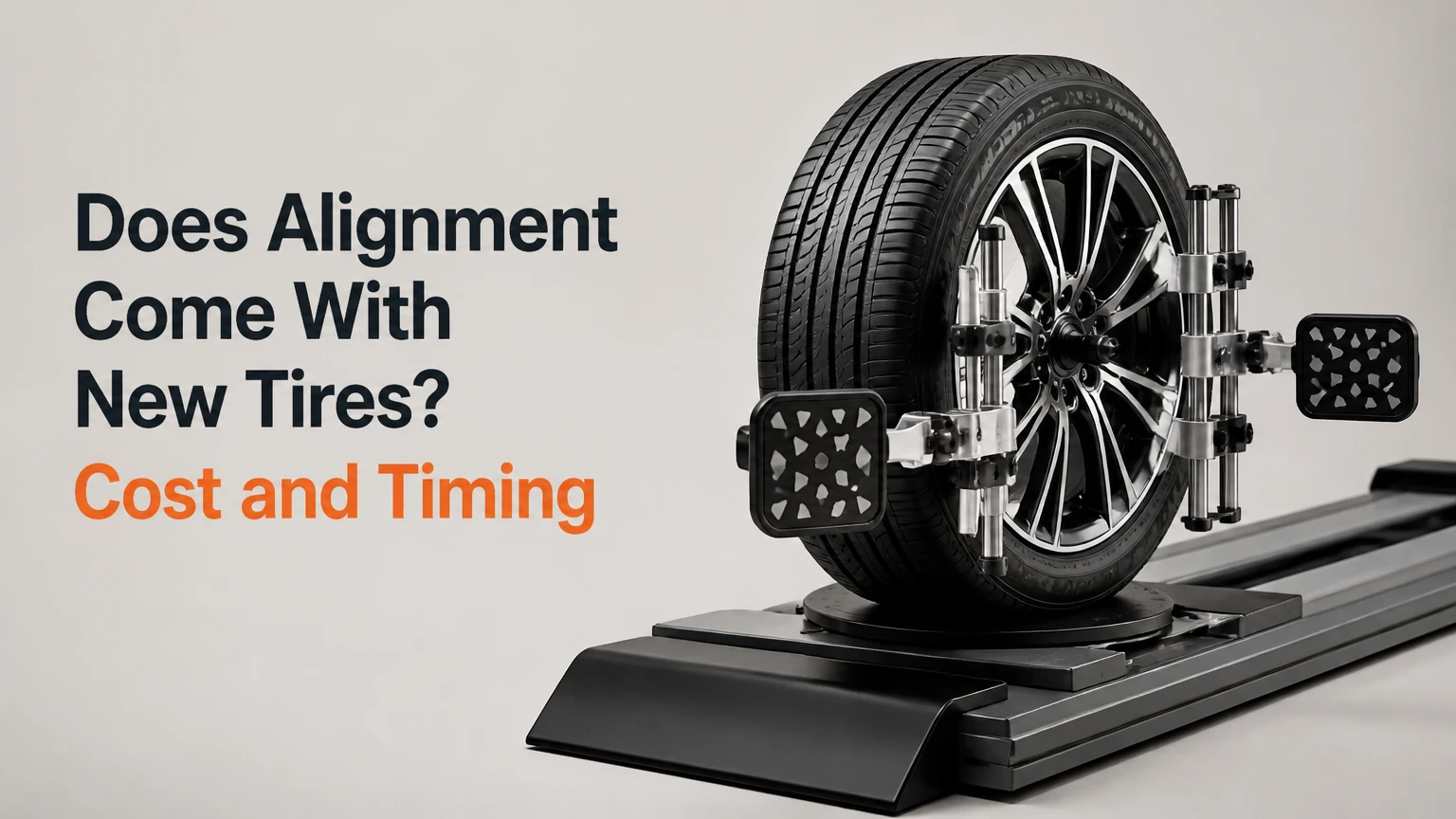
Alignment is different. The vehicle must sit on an alignment rack, targets or sensors must be mounted, suspension angles must be measured against specifications, and adjustable components must be moved. The process often takes 45-60 minutes, and seized adjusters or worn parts can add time.
A tire package that advertises “installation included” therefore often includes balancing but excludes alignment. Package names vary, so the service description matters more than the headline price.
Should You Get an Alignment With New Tires?
You should usually get an alignment with new tires when the previous set has uneven wear, the steering wheel is off-center, the car pulls, or the vehicle recently struck a pothole or curb. If the old tires wore evenly and the vehicle tracks straight, an alignment is not automatically required solely because the tires are new.
New tires provide a useful opportunity for alignment because their full tread depth makes abnormal wear easier to prevent. A vehicle with excessive toe or camber can damage a new tire’s shoulder or create feathering before the owner notices a handling problem.
The recommendation is not a sales rule. Alignment is a measurement and adjustment decision based on vehicle condition. Ask for an alignment check or printed readings when evidence is uncertain, rather than approving an adjustment without knowing whether the angles are outside the manufacturer’s specifications.
Can new tires cause alignment problems?
New tires do not normally change a vehicle’s suspension alignment, but they can reveal an existing problem. Fresh tread has sharper steering response and more visible wear, while the old tires may have gradually concealed a pull through uneven or hardened rubber.
A different tire model can also change steering feel because tread design, sidewall stiffness, rolling resistance, and inflation requirements differ. Those changes do not prove misalignment. A technician should compare tire pressure, tire construction, road crown, and alignment measurements before diagnosing suspension geometry.
One exception involves installation errors or damaged components. A bent wheel, improperly seated bead, incorrect tire size, or wheel disturbed during suspension work can create vibration or handling symptoms, but those problems are not the same as ordinary alignment drift.
What Does a Wheel Alignment Adjust?
A wheel alignment adjusts suspension and steering geometry so the tires contact the road at the intended angles and the wheels track in the correct relationship to the vehicle. The principal measurements are toe, camber, caster, and, on vehicles with a separate rear thrust line, thrust angle.
| Alignment angle | Viewing direction | Vehicle effect | Common tire or handling symptom |
|---|---|---|---|
| Camber | From the front | Controls inward or outward wheel tilt | Inner or outer shoulder wear |
| Toe | From above | Controls whether wheels point inward or outward | Feathered tread and wandering |
| Caster | From the side | Influences steering stability and return | Pull, poor return, heavy steering |
| Thrust angle | From above | Shows rear axle travel direction | Crooked steering wheel or dog-tracking |
What are camber, caster, and toe?
Camber is the inward or outward tilt of the wheel when viewed from the front. Excessive positive camber wears the outer shoulder, while excessive negative camber wears the inner shoulder. The correct target is vehicle-specific, not a universal range such as exactly -0.5 to +0.5 degrees.
Toe describes the direction the tires point when viewed from above. Toe-in means the fronts of the tires point toward each other; toe-out means they point away. Small toe errors can produce rapid feathering because the tire scrubs sideways across the road during normal driving.
Caster is the forward or backward tilt of the steering axis when viewed from the side. Positive caster generally improves straight-line stability and steering return, but many vehicles provide little or no direct caster adjustment. A caster difference between left and right can contribute to a pull.
The manufacturer’s alignment specification is authoritative. Performance vehicles, loaded trucks, and vehicles with modified suspension may use targets that differ substantially from generic consumer figures.
What is thrust angle?
Thrust angle is the direction in which the rear axle pushes the vehicle compared with its geometric centerline. A solid rear axle may not have adjustable toe, but its position still affects the front steering adjustment and the vehicle’s tracking behavior.
A rear axle that points slightly to one side can make the vehicle move forward at an angle, a condition commonly called dog-tracking. The steering wheel may appear crooked while the front wheels are technically aligned to an incorrect reference.
A four-wheel alignment measures the rear axle first, then uses the rear thrust line when setting the front axle. That sequence is more informative than adjusting only the front wheels on a vehicle with an independent or adjustable rear suspension.
Which Alignment Type Does Your Vehicle Need?
The required alignment type depends on the vehicle’s suspension design and which angles can be adjusted, not simply on whether the vehicle is FWD, AWD, or 4WD. Most modern passenger cars benefit from four-wheel measurement, while some solid-rear-axle vehicles receive a thrust-angle procedure with front adjustments.
| Service type | Typical vehicle application | Axles measured | Main limitation |
|---|---|---|---|
| Four-wheel alignment | Modern FWD sedans, crossovers, many AWD vehicles | Front and rear | Rear angles may be measured but not adjustable |
| Thrust-angle alignment | Solid rear axle trucks and older cars | Front plus rear thrust reference | Rear axle usually has limited adjustment |
| Two-wheel alignment | Older vehicles with front-only geometry | Front axle | Can overlook rear tracking errors |
| Performance or modified alignment | Lowered cars, lifted trucks, track vehicles | All available angles | Factory targets may not suit modifications |
AWD and 4WD vehicles do not all use identical suspension layouts. Some have independent rear suspension with adjustable toe and camber; others use a solid rear axle whose position is checked rather than conventionally adjusted. The shop should identify the vehicle’s factory procedure by year, make, model, and suspension configuration.
A two-wheel alignment is not automatically unsafe on every vehicle, but it is incomplete when rear geometry affects the vehicle’s centerline. Ask whether the technician measured the rear axle and checked the thrust angle.
What Happens During an Alignment?
A professional digital alignment normally takes 45-60 minutes when steering and suspension parts are serviceable. The technician checks component condition, sets tire pressures, measures all relevant angles, adjusts available hardware to factory specifications, centers the steering wheel, and verifies the result with a road test or final inspection.
What should the technician check first?
The technician should inspect tie rods, ball joints, control-arm bushings, wheel bearings, springs, struts, shocks, steering components, wheels, and tire condition before making adjustments. Loose or damaged parts can move under load, so alignment readings taken from a worn suspension may not remain valid.
Tire pressures should be corrected before measurement, and the vehicle should be configured according to the manufacturer’s procedure. Some vehicles require a normal fuel load, specified ride height, or steering-angle sensor calibration.
The technician then attaches optical targets, cameras, or wheel sensors and compares measured camber, caster, toe, and thrust angle with a database of vehicle specifications. Adjustable tie rods, eccentric bolts, shims, or control-arm hardware are moved as applicable.
A final report should show before-and-after readings. Green results generally indicate the displayed specification range, but a green reading does not prove that every mechanical problem is fixed. The report is evidence of measured angles, not a substitute for a parts inspection.
A useful definition comes from Firestone Complete Auto Care: “Wheel alignment is the process of adjusting the angles of the wheels so they are positioned relative to each other and the road.” That wording explains why alignment is a suspension service rather than a tire replacement service.
How Much Does Alignment Cost?
A typical one-time wheel alignment costs $50-$150 in the United States, while lifetime or extended alignment plans commonly cost about $180-$250. The final price depends on location, vehicle type, adjustment difficulty, required parts, shop policy, and whether the quoted service measures two or four wheels.
| Service or charge | Typical price | Typical time | What the price usually covers |
|---|---|---|---|
| Alignment inspection | $0-$50 | 10-20 minutes | Measurement or visual check, adjustment often excluded |
| Standard alignment | $50-$150 | 45-60 minutes | Measurement and available adjustments |
| Lifetime alignment plan | $180-$250 | 45-60 minutes per visit | Repeated alignments at one retailer while eligible |
| Replacement adjustment hardware | $20-$200+ | 30-120 minutes | Camber bolts, shims, eccentric hardware, or seized parts |
| Suspension repair before alignment | $150-$1,500+ | 1-8 hours | Parts and labor required to make geometry stable |
A lifetime plan is most likely to make financial sense for a driver who expects several alignments over three or more years, drives on rough roads, owns a modified vehicle, or uses the car for high-mileage work. Read the terms because plans may exclude commercial use, replacement parts, suspension repairs, other locations, or vehicles outside specified classes.
Can alignment be free with new tires?
Alignment can be free with new tires when a retailer is running a promotion or selling a package that explicitly includes the service. “Free alignment check” is not the same as “free alignment,” and “installation included” often means mounting and balancing only.
Before paying, verify four details:
- Whether all four wheels will be measured.
- Whether adjustments are included or billed separately.
- Whether replacement parts and seized hardware cost extra.
- Whether the package applies to the exact vehicle and tire purchase.
When Is Alignment Necessary After New Tires?
Alignment is necessary after new tires when measurable angles fall outside factory specifications or when symptoms indicate a geometry problem. New tires alone are not a mandatory trigger, so an even-wearing old set and a straight-tracking vehicle may reasonably receive tires without a separate alignment.
| Situation | Alignment recommendation | Reason |
|---|---|---|
| Old tires wore evenly, car tracks straight | Check condition, alignment optional | No strong evidence of geometry error |
| Inner or outer shoulder wear | Measure before or during installation | Camber or toe may be incorrect |
| Feathered tread blocks | Measure promptly | Toe error commonly causes lateral scrub |
| Steering wheel remains off-center | Measure and correct | Thrust angle or front toe may be wrong |
| Pothole or curb impact | Inspect and measure | Wheel, tire, or suspension may be damaged |
| Tie rod, control arm, or strut replacement | Align after repair | Ride height and geometry may have changed |
| Lift kit, lowering springs, or altered ride height | Align after installation | Factory angles may no longer apply |
| Vehicle pulls only on crowned roads | Test on a suitable road first | Road slope and tire conicity can mimic alignment |
Manufacturer tire warranties do not universally become void merely because an owner skips an alignment. However, irregular wear caused by misalignment may be excluded from treadwear coverage, and a manufacturer can request maintenance records when evaluating a mileage claim. Check the specific warranty language.
What Problems Can a Bad Alignment Cause?
Bad alignment can cause uneven tread wear, steering pull, a crooked steering wheel, reduced directional stability, and additional rolling resistance. Severe toe or camber errors can destroy usable tread quickly, but the rate depends on the angle error, tire design, load, speed, and mileage.
A vehicle may still feel acceptable while wearing the inside edge of a tire. Drivers often inspect only the visible outer shoulder, so an alignment problem can progress unnoticed until the inner cords become exposed. A tread-depth gauge and inspection across the full tread width provide better evidence.
Alignment does not normally cause a high-speed steering-wheel vibration. Vibration more often indicates wheel imbalance, a bent wheel, tire uniformity variation, or a damaged suspension component. Pulling and vibration can coexist, so a complete inspection may require both alignment measurement and balancing.
What does specific tire wear mean?
- Inner shoulder wear: excessive negative camber, toe error, worn components, or low inflation can contribute.
- Outer shoulder wear: excessive positive camber, cornering loads, or underinflation can contribute.
- Feathered tread: toe misalignment is a common cause, especially when block edges feel different in opposite directions.
- Cupping or scalloping: worn shocks, unbalanced assemblies, bent wheels, or loose suspension parts are more likely than alignment alone.
- Wear across both shoulders: underinflation is a stronger first suspect.
- Wear at the center: overinflation is a stronger first suspect.
These patterns are diagnostic clues, not conclusive proof. Tire pressure, rotation history, load, road surface, and suspension condition must be considered together.
How Is Alignment Different From Balancing?
Wheel alignment corrects suspension angles, while wheel balancing corrects uneven mass distribution in the tire and wheel assembly. Alignment problems usually produce pulling, a crooked steering wheel, or uneven tread wear; balancing problems usually produce vibration at a particular speed.
| Feature | Wheel alignment | Wheel balancing | Tire rotation |
|---|---|---|---|
| Component affected | Steering and suspension geometry | Tire and wheel assembly | Tire positions on vehicle |
| Typical symptom addressed | Pulling or edge wear | Vibration at 50-75 mph | Uneven wear from axle loading |
| Main equipment | Alignment rack and sensors | Spin balancer and weights | Lift, jack, or service rack |
| New tire package status | Often extra | Commonly included | Sometimes included |
| Normal service timing | Trigger-based or after repairs | During tire mounting | Often every 5,000-8,000 miles |
Balancing cannot correct toe, camber, caster, or thrust angle. Alignment cannot correct a tire-and-wheel imbalance. A shop may recommend both services because new tires require balancing and the vehicle may also show alignment symptoms.
What If the Shop Cannot Align the Vehicle?
A shop should not force an alignment adjustment when a steering or suspension component is loose, damaged, seized, or outside its available adjustment range. The correct sequence is to identify the limitation, provide measurements, repair the underlying condition, and then repeat the alignment.
Common causes include worn ball joints, bent control arms, damaged tie rods, seized eccentric bolts, collapsed bushings, broken springs, bent wheels, accident damage, and ride height outside the factory range. On some vehicles, a red alignment reading remains because the design has no factory adjustment for that angle.
Ask the shop for the before readings, the after readings if available, the failed component, and the proposed repair. A recommendation for aftermarket camber bolts or shims may be reasonable on certain vehicles, but the part should be compatible with the manufacturer’s repair procedure.
Expert practice rule: an alignment machine reports geometry; it does not diagnose every cause of geometry. A green screen cannot make a loose tie rod safe.
How Can You Decide Before Buying Tires?
Use the old tires and the vehicle’s behavior as evidence before approving the extra service. Inspect tread depth across the inner, center, and outer sections, confirm pressure against the door-jamb label, and note whether the steering wheel is centered on a relatively flat road.
Choose a standard alignment with the tire purchase when:
- The old set has edge wear or feathering.
- The vehicle pulls consistently on level pavement.
- The steering wheel is off-center.
- A pothole, curb, collision, or suspension repair occurred.
- The vehicle has been lifted, lowered, or fitted with altered suspension.
- The replacement tires are expensive or carry a mileage-based treadwear warranty.
A measurement-only check may be enough when the old tires wore evenly and the vehicle drives straight. Skipping alignment is reasonable when measurements are within specification and no recent impact or suspension work occurred.
Do not approve an alignment solely because a salesperson says every new tire requires one. Conversely, do not reject a measured recommendation when the report shows a substantial toe error or a worn component that threatens the new tires.
The Bottom Line
Does alignment come with new tires? Usually no. New tire installation generally includes mounting and balancing, while wheel alignment remains a separate $50-$150 service unless a promotion or package says otherwise.
Get alignment measured when the old tires show irregular wear, the vehicle pulls, the steering wheel is crooked, or suspension work or an impact changed the vehicle. If the car tracks straight and the old tires wore evenly, new tires do not automatically require alignment. Request the written package terms and a before-and-after alignment report when the service is performed.
Frequently Asked Questions
Do tires need alignment every time they are replaced?
Tires do not require alignment every time they are replaced. Alignment is warranted when tire wear, steering behavior, impact damage, suspension repairs, or measured angles indicate a problem. A vehicle with even tire wear and factory-correct geometry can receive replacement tires without a new alignment, although a periodic check may identify developing issues.
Should alignment happen before or after new tires?
Alignment should normally happen after the new tires are installed and balanced, because the vehicle will then be measured in its actual operating configuration. The technician can set the correct tire pressures and inspect the replacement wheels and tires before recording final geometry. A damaged wheel or incorrect tire size should be corrected first.
How long can new tires last with bad alignment?
New tires can develop damaging irregular wear within a few hundred to several thousand miles when toe or camber is substantially incorrect. No universal mileage limit exists because wear speed depends on angle error, tire compound, vehicle load, road surface, and driving speed. Inspect the tread regularly rather than waiting for a fixed interval.
Does tire rotation fix an alignment problem?
Tire rotation does not fix alignment because it changes tire position rather than suspension geometry. Rotation can distribute normal axle-related wear and extend tire life, but it cannot correct pulling, toe error, camber error, or a crooked steering wheel. Rotate according to the tire and vehicle manufacturer’s pattern and interval.
Do I need an alignment after replacing one tire?
Replacing one tire does not automatically require alignment, but the reason for the replacement may justify inspection. If the tire failed after a pothole impact, the wheel or suspension may be damaged. If one tire shows unusual wear compared with the others, alignment and tire-pressure checks can help identify the cause.
Can an alignment correct a crooked steering wheel?
An alignment can usually correct a crooked steering wheel when the cause is front toe or rear thrust-angle misalignment and the steering components are sound. A steering wheel that remains off-center after service may indicate incorrect adjustment, a bent component, uneven tire conicity, road crown, or a steering-angle sensor issue requiring further diagnosis.