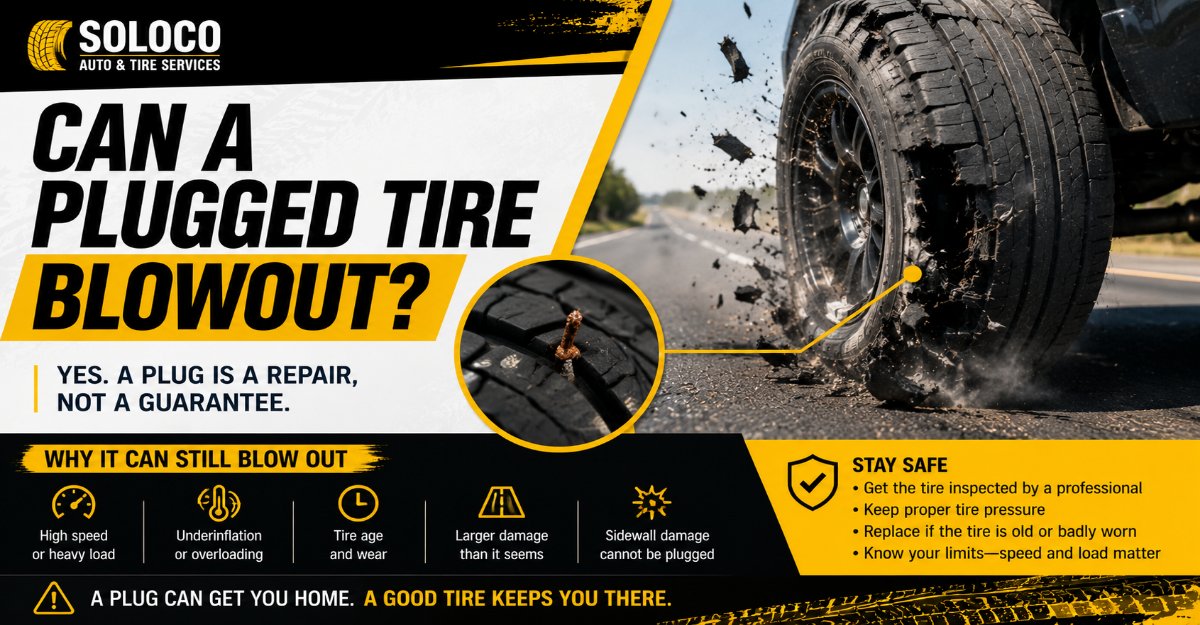
Yes, a plugged tire can blow out, but the blowout is rarely caused by the plug popping out like a cork. Instead, structural failures happen because the underlying tire frame was weakened before repair, or because air slowly leaks into internal steel belts, causing tread delamination at highway speeds.
At a Glance: Key Tire Repair Facts
- The 1/4-Inch Rule: Punctures larger than $1/4$ inch ($6\text{ mm}$) compromise internal steel belts and cannot be safely repaired.
- The Sidewall Margin: Punctures within $1/2$ inch of the tire shoulder or sidewall are unrepairable due to extreme structural flexing.
- Speed Rating Reduction: External string plugs automatically reduce a tire maximum safe speed rating from high performance down to $85\text{ mph}$.
- Underinflation Risk: Running a plugged tire at $25\%$ below recommended pressure creates internal temperatures exceeding $200^\circ\text{F}$.
- The Permanent Standard: Only an internal combination mushroom patch installed by dismounting the tire restores full structural integrity.
Why Do External Tire Plugs Fail at High Speeds?
External string plugs fail at high speeds because they rely purely on friction and adhesive rubber cement rather than a permanent vulcanized bond with the tire inner liner. When a vehicle travels at highway speeds, centrifugal force and continuous tread flexing push against the inserted rubber string. Over time, friction generates heat that softens the raw rubber compound of the plug. If moisture enters the puncture channel, it lubricates the hole, allowing centrifugal force to slowly work the string loose or create micro-channels where pressurized air escapes. Major manufacturers like Bridgestone and Pirelli note that standard rope plugs drop a tire speed rating to a maximum of $85\text{ mph}$. Drivers exceeding this threshold risk progressive air loss and sudden tread separation.
What Is the Difference Between a String Plug and a Mushroom Patch?
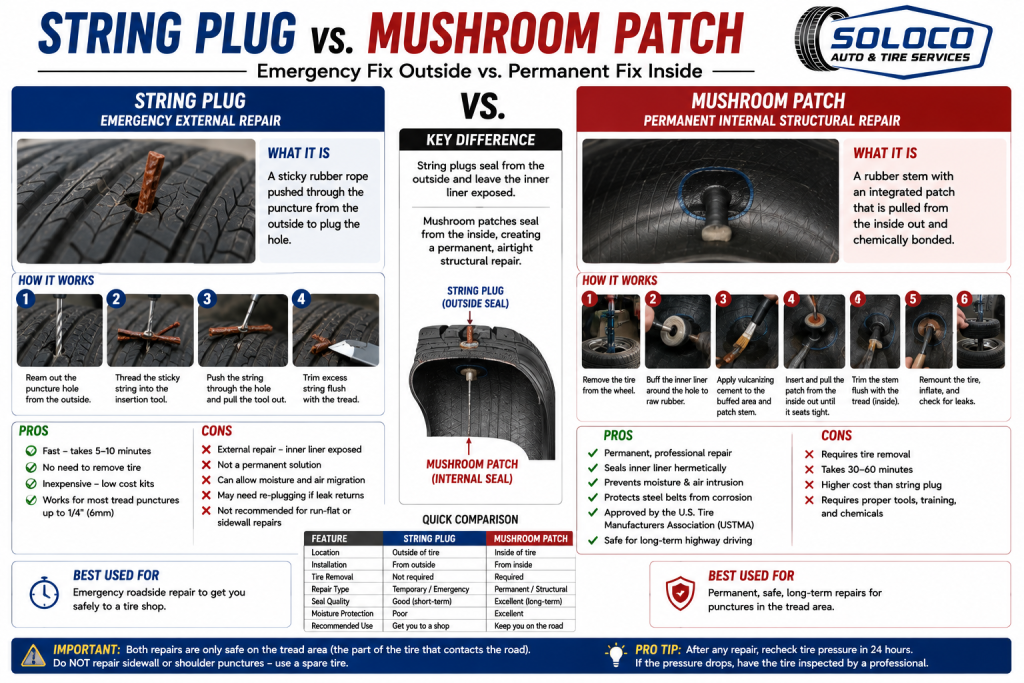
A string plug is an emergency external repair, whereas a mushroom patch is a permanent internal structural fix authorized by the U.S.
Tire Manufacturers Association. An external string plug involves reaming out the puncture hole from the outside and pushing a sticky rubber rope through the steel belts without removing the tire from the wheel rim. This method leaves the inner liner exposed to moisture and air migration.
In contrast, a mushroom patch requires dismounting the tire completely, buffing the inner liner to raw rubber, applying chemical vulcanizing cement, and pulling a rubber stem with an integrated patch from the inside out.
The internal patch seals the inner liner hermetically, while the rubber stem fills the puncture channel completely, permanently preventing moisture intrusion and steel belt corrosion.
Can You Drive on the Highway with a Plugged Tire?
Driving on the highway with a plugged tire is safe only if the puncture was permanently repaired from the inside out using a combination mushroom patch. If the tire was repaired using a temporary roadside string plug inserted from the exterior, driving at high highway speeds introduces significant structural risks. Temporary string plugs are designed for emergency travel to a service station, not for long-distance commuting. When temporary string plugs are subjected to sustained high temperatures and continuous flexing on interstate highways, they can develop slow leaks or slip out of alignment. Motorists with temporary string plugs should limit speeds below $60\text{ mph}$ and visit a professional tire shop immediately to install a permanent internal patch.
How Close Can Two Tire Repairs Be to Each Other?
Two tire repairs must be spaced at least $16\text{ inches}$ apart along the tread circumference to maintain structural integrity. The steel belts inside a passenger tire form a rigid grid designed to distribute load evenly across the contact patch. If two punctures occur close together, the dense concentration of drill reaming and steel cord disruption compromises the tensile strength of the surrounding metal matrix. When the structural grid is weakened in a concentrated zone, the rubber and steel can no longer withstand normal load pressures, leading directly to localized bulging, air leaks, or catastrophic tread separation. Tires with multiple punctures within a $16\text{ inch}$ window must be replaced entirely rather than repaired.
What Is the 1/4-Inch Rule for Tire Punctures?
The 1/4-inch rule dictates that a tire can only be safely repaired if the puncture diameter is $1/4$ inch ($6\text{ mm}$) or smaller. Punctures caused by standard roofing nails or small screws typically fall well within this safe threshold. However, larger debris such as bolts, thick metal spikes, or jagged shrapnel often create holes exceeding $1/4$ inch in diameter. Forcing a plug or patch stem into a hole larger than this threshold fails to engage the surrounding steel belts properly. Without adequate metal support, high-pressure air forces its way through the oversized gap, tearing the surrounding rubber matrix and causing a rapid, dangerous deflation while driving.
Why Are Sidewall and Shoulder Punctures Unrepairable?
Sidewall and shoulder punctures are completely unrepairable because these zones experience extreme structural flexing every time the tire rotates and contacts the pavement. The tread area of a tire is supported by rigid steel belts and heavy polyester plies designed to remain relatively flat under a vehicle load. Conversely, the sidewall and shoulder are engineered to flex, bend, and absorb impacts from potholes and curbs. If a plug or patch is inserted into an area with high flexural strain, the constant bending motion works the repair material loose within miles. Furthermore, sidewall damage compromises the structural casing cords that prevent the tire from bursting outward under internal pressure.
How Does Low Tire Pressure Destroy a Tire Repair?
Operating a plugged tire underinflated by $25\%$ or more below the manufacturer recommendation causes catastrophic structural degradation. When tire pressure drops—such as driving at $24\text{ PSI}$ instead of the recommended $32\text{ PSI}$—the sidewall collapses slightly under the vehicle weight, forcing the tread blocks to scrub excessively against the road surface. This excessive flexing generates internal temperatures exceeding $200^\circ\text{F}$. At this elevated temperature, the chemical adhesives holding a tire plug in place soften and liquefy, destroying the friction bond. The plug migrates out of the puncture channel, and the weakened rubber carcass near the repair zone fails under the compounded thermal and mechanical stress.
What Is Run-Flat Internal Destruction and How It Happens?
Run-flat internal destruction occurs when a vehicle is driven even a short distance on a completely deflated tire, grinding the metal wheel rim directly against the internal rubber liner. As the heavy wheel weight crushes the deflated sidewall against the road, the internal structural polyester cords are pulverized into a fine black powder known as sidewall chewing. If a motorist changes the tire or reinflates it and has a mechanic insert an exterior plug without dismounting the wheel to inspect the interior, the tire remains critically compromised. The shredded internal cords can no longer handle internal pressure, turning the tire into a ticking time bomb that will blow out unpredictably at highway speeds.
Can Moisture Cause a Plugged Tire to Fail Over Time?
Moisture intrusion is a primary long-term cause of plugged tire failures, often triggering blowouts six to twelve months after the initial repair. An exterior-only string plug does not seal the internal casing of the tire against water. When driving through rain or puddles, moisture seeps past the plug material and comes into direct contact with the braided high-tensile steel belts embedded inside the rubber. Once water reaches the unprotected steel, oxidation begins. As the steel rusts, it expands and loses its vital chemical bond with the surrounding rubber compound. Eventually, the corroded steel belts snap under tension, causing the tread to delaminate from the carcass while driving.
How Does Air Migration Cause Tread Delamination?
Air migration occurs when pressurized air ($32\text{ to }35\text{ PSI}$) escapes the inner rubber liner through a poorly sealed puncture and travels between the internal structural plies. Without an interior rubber patch to seal the inner liner completely, high-pressure air forces its way laterally into the microscopic gaps separating the fabric and steel layers of the tire. This continuous pressure creates an expanding internal air pocket or blister. As the vehicle drives at high speeds, the growing bubble destabilizes the tire balance and causes the outer tread layers to delaminate and peel away from the casing in large sheets, resulting in a sudden and violent blowout.
How Many Times Can a Single Tire Be Repaired Safely?
A tire can be safely repaired a maximum of two to three times over its entire operational lifespan, provided all punctures are restricted strictly to the tread crown and spaced at least $16\text{ inches}$ apart. Attempting a fourth repair or patching multiple holes in close proximity overloads the structural integrity of the tire carcass. Each time a tire is punctured, reamed, and repaired, a portion of the steel cord matrix and inner liner is permanently altered. Professional tire technicians evaluate cumulative wear, tread depth, and previous repair locations before servicing any tire. If a tire exhibits multiple previous patches in the same quadrant, replacement is mandatory to prevent structural failure.
How Does Rubber Age and Hardening Affect an Existing Tire Plug?
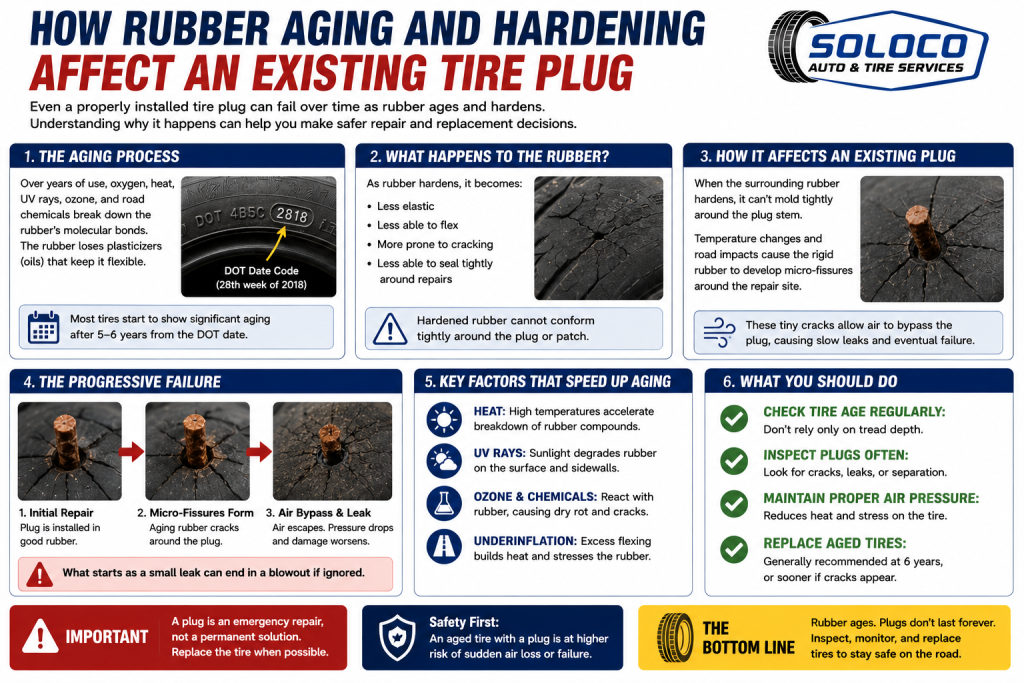
Rubber aging and natural compound hardening over time can compromise the long-term effectiveness of an otherwise correct tire plug. As tires age—typically past the five to six-year mark from their Department of Transportation (DOT) date code—the rubber loses its natural plasticizers, becoming brittle and less elastic.
When a plug is inserted into older, hardened rubber, the surrounding material cannot conform tightly around the plug stem or patch base. During temperature fluctuations and road impacts, rigid, aged rubber develops micro-fissures around the repair site. These fractures allow air to bypass the plug, leading to progressive pressure loss and eventual structural separation.
What Diagnostic Steps Do Professionals Use to Inspect Internal Casings?
Professional tire technicians follow a rigorous multi-step diagnostic procedure before approving any tire for repair. First, the technician inspects the exterior tread and sidewall for bulges, cracking, or embedded debris. Second, the tire is completely dismounted from the wheel rim using specialized mounting equipment to eliminate blind spots. Third, the technician performs a tactile and visual sweep of the inner liner, searching for signs of sidewall chewing, rubber dusting, or moisture intrusion from running flat. Finally, the interior puncture site is probed and measured to ensure it falls within the USTMA 1/4-inch diameter limit and outside the 1/2-inch shoulder margin before applying a vulcanized patch.
What Are the Legal and Liability Risks of Driving on an Improperly Repaired Tire?
Driving on an improperly repaired tire introduces severe legal and liability risks, particularly if a structural failure causes a multi-vehicle accident on public roadways. Commercial tire shops and automotive technicians are legally bound by industry standards set by the USTMA and National Highway Traffic Safety Administration. If a shop performs an improper exterior-only plug on a sidewall puncture or an oversized hole, and that tire subsequently suffers a high-speed blowout resulting in injury or property damage, the business and vehicle owner can face significant legal liability. Insurance investigators routinely inspect failed tires following major collisions to determine if negligence in tire repair practices contributed to the crash.
How Do High-Angle Punctures Compromise a Tire Repair?
High-angle punctures—where a nail, spike, or sharp object enters the tread at an angle steeper than $15$ to $20$ degrees—frequently compromise both temporary and permanent tire repairs. When an object penetrates the tread diagonally, it creates a long, slanted tunnel through the multi-layer steel belts and rubber plies rather than a straight vertical hole. Standard plugs and mushroom patches cannot seat squarely against the walls of an angled channel. The constant shearing forces from tread blocks flexing against the road will gradually slice through the repair stem, working the plug loose and causing rapid, unpreventable deflation. Tires with severe high-angle punctures must be replaced.
The Bottom Line
A plugged tire can indeed blow out, but the root cause is almost always underlying structural damage, moisture corrosion, or improper repair technique rather than a plug popping out. Ensuring long-term safety requires restricting repairs to the tread crown, keeping punctures under $1/4$ inch, maintaining proper inflation pressure, and utilizing an internal mushroom patch installed by a certified professional.