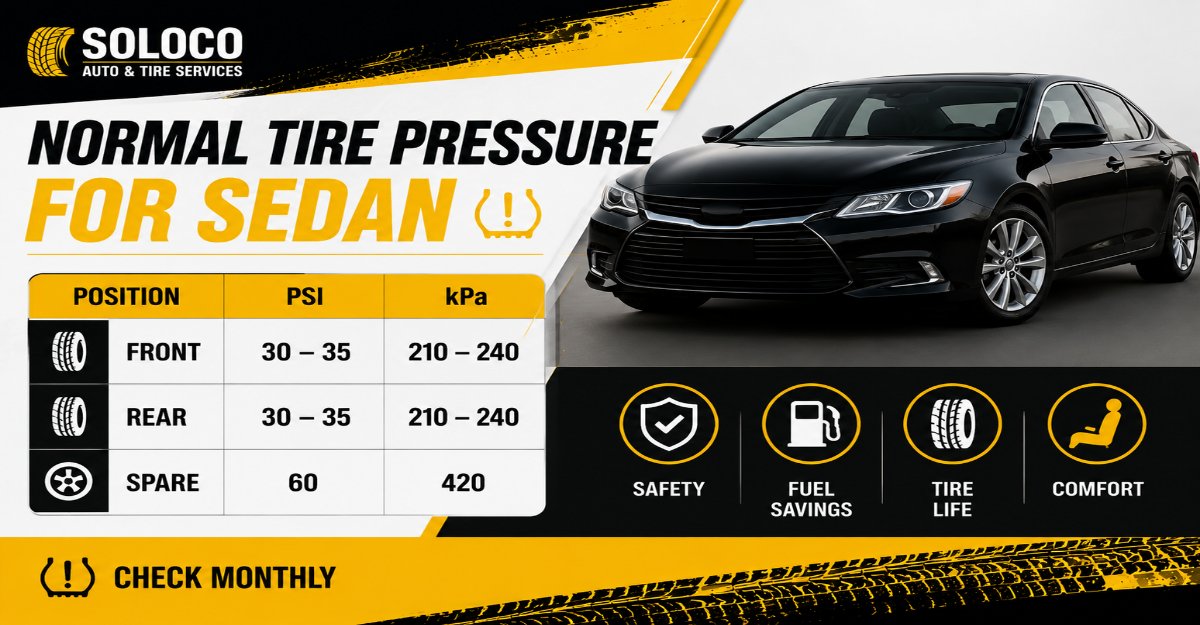
Normal tire pressure for a sedan is the precise amount of compressed air required inside the pneumatic tire to support the vehicle’s gross weight, maintain optimal tread contact patch geometry, and regulate internal sidewall operating temperatures. This measurement is universally expressed in Pounds per Square Inch (PSI) or Bar, with standard modern sedans typically requiring a baseline cold pressure between 32 PSI and 35 PSI.
Key Facts / At a Glance
- Compressed air supports 95% of a sedan’s total vehicle weight, while the structural rubber and steel belt carcass support only 5%.
- Standard cold inflation ranges for modern sedans span from 32 PSI to 35 PSI, varying by gross vehicle weight rating (GVWR).
- Tire pressure drops by approximately 1 PSI for every 5.5°C (10°F) drop in ambient outdoor temperature.
- The maximum pressure rating printed on the tire sidewall is a structural burst safety limit, never the target pressure for daily driving.
- Tires naturally lose roughly 1 PSI of air pressure every month through microscopic butyl rubber liner pores and natural osmosis.
What Is the Normal Tire Pressure Range for a Sedan?
Normal tire pressure for a sedan operating under standard manufacturer specifications ranges between 32 PSI and 35 PSI when measured on completely cold tires. This specific pressure window is engineered by automotive manufacturers to balance three competing physical requirements: ride comfort, braking traction, and structural longevity.
Sedans are categorized primarily by weight class, which dictates their exact pneumatic requirements. Compact sedans like the Honda Civic or Toyota Corolla typically specify 32 PSI to 33 PSI for both front and rear axles. Midsize and full-size sedans like the Toyota Camry or Honda Accord frequently require 35 PSI, particularly when equipped with higher load-index tires or larger alloy wheel packages.
Ignoring this factory-recommended range introduces mechanical penalties. Underinflated tires below 28 PSI experience excessive sidewall flexing, which generates destructive internal heat that degrades the polyester and steel cords, ultimately leading to tread separation or blowout. Conversely, overinflated tires exceeding the placard specification by more than 5 PSI reduce the tire contact patch by up to 20 percent, leading to center-tread wear, harsher ride quality, and reduced emergency stopping traction on wet asphalt.
Where Can You Find Your Sedan’s Exact Tire Pressure Specification?
The exact normal tire pressure for your specific sedan is located on the vehicle certification label, commonly known as the tire information placard, affixed to the driver-side door jamb. When you open the driver’s door and look at the B-pillar or the door edge, you will find a white and yellow federal placard displaying the precise cold PSI requirements for the front tires, rear tires, and the emergency spare tire.
Many drivers make the critical error of reading the maximum pressure rating printed on the tire sidewall, such as Max Press 50 PSI, and inflating their tires to that level. The sidewall stamp represents the absolute structural limit determined by the tire manufacturer during burst testing at maximum load capacity. Inflating your sedan tires to the sidewall maximum turns the vehicle into a rigid, unsafe vehicle with severely compromised braking performance and harsh suspension feedback. Always rely on the vehicle manufacturer door placard, which accounts for the specific weight distribution, suspension tuning, and braking characteristics of your chassis.
How Does Temperature Affect Sedan Tire Pressure?
Tire pressure fluctuates continuously in response to ambient temperature changes due to the ideal gas law, which dictates that gas pressure is directly proportional to absolute temperature. For every 5.5°C (10°F) drop in outdoor ambient temperature, pneumatic tire pressure decreases by approximately 1 PSI.
When autumn transitions into winter, a sedan parked outside with a stable 35 PSI setting in September may drop to 29 PSI by December simply due to the drop in overnight temperatures. This drop frequently triggers the dashboard Tire Pressure Monitoring System (TPMS) warning light on cold mornings. Conversely, driving at highway speeds generates friction that heats the compressed air inside the tire chamber, raising the internal pressure by 3 to 5 PSI. This thermal expansion is entirely normal and expected by automotive engineers, which is why pressure adjustments must only be performed when the tires are completely cold.
How to Check and Adjust Your Sedan’s Tire Pressure
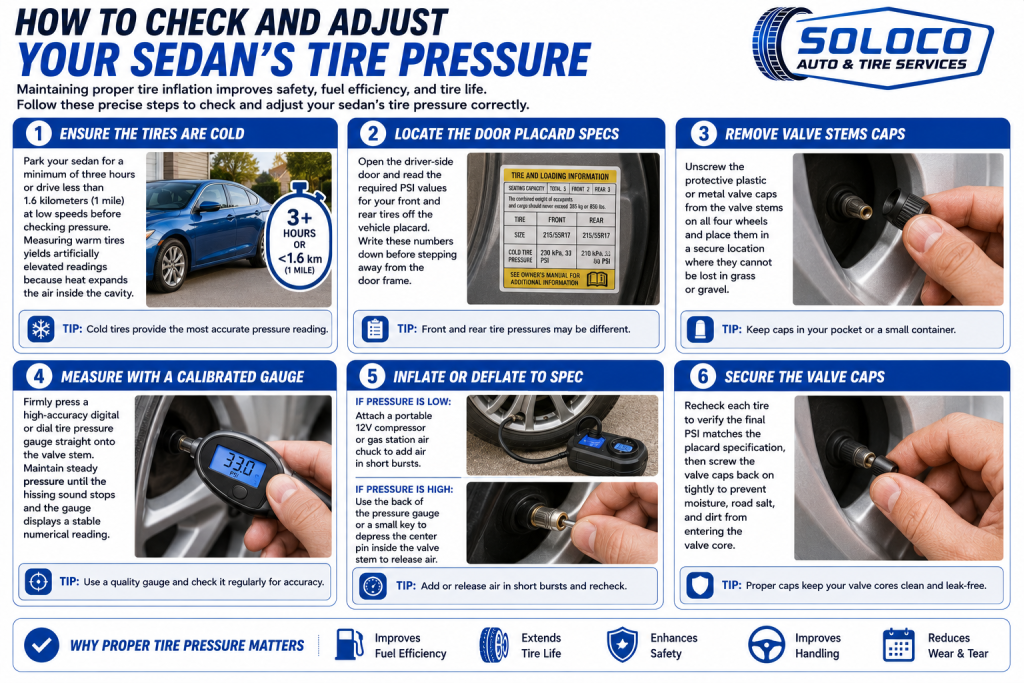
Maintaining proper tire inflation requires a systematic approach using accurate measurement and inflation tools. Follow these precise steps to check and adjust your sedan’s tire pressure correctly.
1. Ensure the Tires Are Cold
Park your sedan for a minimum of three hours or drive less than 1.6 kilometers (1 mile) at low speeds before checking pressure. Measuring warm tires yields artificially elevated readings because heat expands the air inside the cavity.
2. Locate the Door Placard Specs
Open the driver-side door and read the required PSI values for your front and rear tires off the vehicle placard. Write these numbers down before stepping away from the door frame.
3. Remove Valve Stems Caps
Unscrew the protective plastic or metal valve caps from the valve stems on all four wheels and place them in a secure location where they cannot be lost in grass or gravel.
4. Measure with a Calibrated Gauge
Firmly press a high-accuracy digital or dial tire pressure gauge straight onto the valve stem. Maintain steady pressure until the hissing sound stops and the gauge displays a stable numerical reading.
5. Inflate or Deflate to Spec
If the pressure is below the placard requirement, attach a portable 12V compressor or gas station air chuck to add air in short bursts. If the pressure is too high, use the back of the pressure gauge or a small key to depress the center pin inside the valve stem to release air.
6. Secure the Valve Caps
Recheck each tire to verify the final PSI matches the placard specification, then screw the valve caps back on tightly to prevent moisture, road salt, and dirt from entering the valve core.
What Are the Main Types of Tire Pressure Gauges and Inflators?
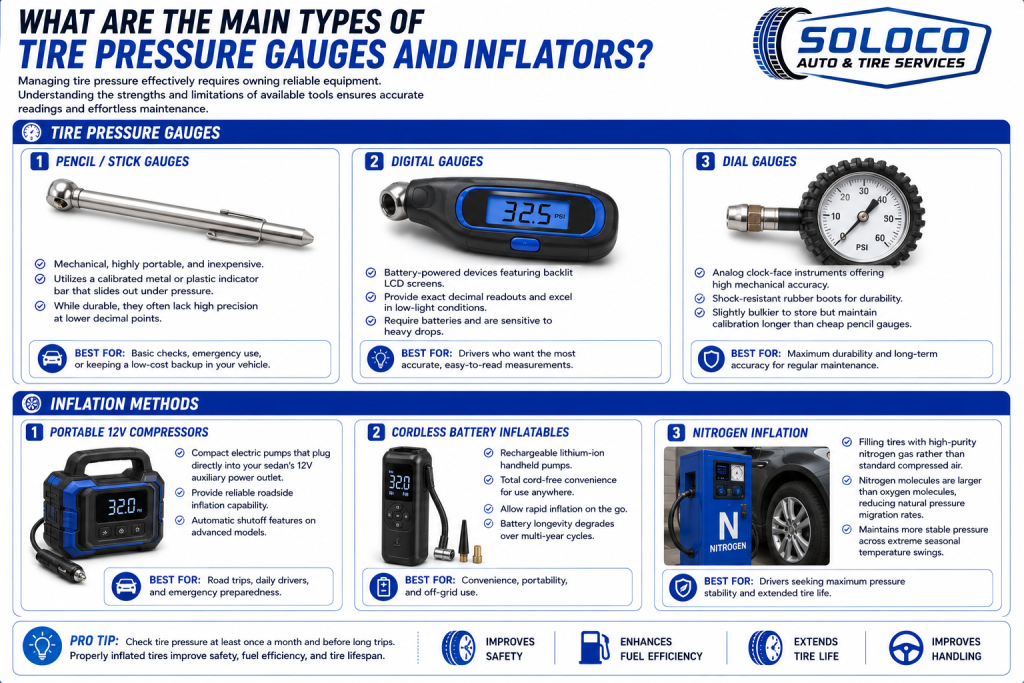
Managing tire pressure effectively requires owning reliable equipment. Understanding the strengths and limitations of available tools ensures accurate readings and effortless maintenance.
Tire Pressure Gauges
- Pencil / Stick Gauges: Mechanical, highly portable, and inexpensive, utilizing a calibrated metal or plastic indicator bar that slides out under pressure. While durable, they often lack high precision at lower decimal points.
- Digital Gauges: Battery-powered devices featuring backlit LCD screens. They provide exact decimal readouts and excel in low-light conditions, though they require operational batteries and are sensitive to heavy drops.
- Dial Gauges: Analog clock-face instruments offering high mechanical accuracy and shock-resistant rubber boots. They are slightly bulkier to store in a glove compartment but maintain calibration longer than cheap pencil gauges.
Inflation Methods
- Portable 12V Compressors: Compact electric pumps that plug directly into your sedan’s 12V auxiliary power outlet. They provide reliable roadside inflation capability and automatic shutoff features on advanced models.
- Cordless Battery Inflatables: Rechargeable lithium-ion handheld pumps offering total cord-free convenience. They allow rapid inflation anywhere, though battery longevity degrades over multi-year cycles.
- Nitrogen Inflation: Filling tires with high-purity nitrogen gas rather than standard compressed air. Nitrogen molecules are larger than oxygen molecules, reducing natural pressure migration rates and maintaining more stable pressure across extreme seasonal temperature swings.
Equipment Comparison Matrix
| Equipment Type | Precision Rating | Power Source | Portability | Typical Cost Range | Primary Advantage |
| Pencil Gauge | Low to Moderate | None (Mechanical) | Pocket-Sized | $2 – $5 | Extremely cheap, requires no batteries or maintenance |
| Digital Gauge | High (0.1 PSI) | Coin-Cell Battery | Pocket-Sized | $10 – $25 | Backlit display, highly legible in dark garages |
| Dial Gauge | High (0.5 PSI) | None (Mechanical) | Glove Box | $15 – $35 | Shock-resistant dial, long-term calibration stability |
| 12V Portable Pump | Moderate | Vehicle 12V Socket | Trunk Storage | $25 – $60 | Unlimited runtime powered directly by the car engine |
| Cordless Pump | Moderate | Lithium-ion Battery | Trunk Storage | $40 – $90 | Complete cordless freedom with digital auto-stop |
| Nitrogen Fill | Variable | Professional Tank | Service Station | $5 – $10 / tire | Slows natural pressure loss by 3x, reduces rim oxidation |
Common Inflation Mistakes and How to Avoid Them
Even experienced drivers fall victim to recurring maintenance errors that compromise safety, tire life, and fuel economy. Avoiding these pitfalls ensures optimal tire performance.
- Inflating Based on Sidewall Numbers: Using the maximum PSI printed on the sidewall instead of the driver door placard results in overinflation, bouncy ride dynamics, and rapid center tread wear.
- Checking Tires While Warm: Measuring pressure immediately after highway driving yields readings that are 3 to 5 PSI higher than actual cold baseline pressure, leading drivers to accidentally underinflate their tires once they cool down.
- Neglecting the Spare Tire: Ignoring the compact space-saver or full-size spare tire stored beneath the trunk floor results in a flat, unusable spare during roadside emergencies when it is needed most.
- Relying Solely on TPMS Dash Lights: Trusting the dashboard warning light as a maintenance schedule is dangerous; standard TPMS sensors do not trigger until pressure drops 25% below the recommended specification, meaning a 35 PSI tire may drop to 26 PSI before alerting the driver.
Troubleshooting Common Tire Pressure Issues
Why Does My Dashboard TPMS Light Stay On After Adjusting Pressure?
A persistent TPMS warning light usually indicates that one or more tires remain below the factory threshold, a sensor battery has reached the end of its lifespan, or the system requires a manual reset. Check all four tires plus the spare with a manual gauge. If all pressures match the door placard, locate your sedan’s TPMS reset button (typically located inside the glove box or within the digital instrument cluster menu) and hold it for 5 seconds until the indicator light flashes and resets.
What Causes One Specific Tire to Constantly Lose Pressure?
A tire losing 1 to 2 PSI per week while other tires remain stable indicates a localized slow leak. Inspect the tread face and shoulder blocks for embedded nails, screws, or sharp gravel. If no foreign objects are visible, spray soapy water around the wheel rim bead and the valve stem base; bubbling indicates a rim corrosion leak or a failing valve core that requires professional repair or replacement.
Why Does Pressure Drop Suddenly During the First Cold Snap of Winter?
This is a normal physical reaction governed by the ideal gas law rather than a mechanical defect. As ambient temperatures drop rapidly overnight, the air molecules inside the tire contract, reducing internal pressure. Inspect and reinflate all four tires back to the exact placard specification using a portable compressor or service station air pump.
Frequently Asked Questions
Can I drive my sedan if the tire pressure is 28 PSI?
Driving on a sedan tire inflated to 28 PSI is possible for short distances at low speeds to reach an air pump, but it is unsafe for sustained highway driving. Pressure at 28 PSI is significantly below the typical 32–35 PSI placard range, causing excessive sidewall deflection, elevated operating temperatures, reduced fuel economy, and accelerated tread wear on the outer shoulders. Inflate the tire to the manufacturer-specified PSI immediately before undertaking high-speed travel.
How often should I check my sedan’s tire pressure?
You should check your sedan’s tire pressure once every 30 days and immediately before embarking on long highway road trips. Because pneumatic tires naturally lose approximately 1 PSI per month through rubber permeation, and ambient outdoor temperatures fluctuate constantly with seasonal weather shifts, monthly manual verification ensures your vehicle maintains optimal stopping distance, cornering stability, and fuel efficiency.
Is nitrogen inflation actually worth it for a standard sedan?
Nitrogen inflation offers minor advantages for standard commuter sedans, but it is generally not worth the added recurring expense for everyday drivers. While nitrogen molecules are larger than oxygen molecules—meaning nitrogen-filled tires lose pressure roughly three to four times slower and experience less interior rim oxidation—regular compressed air already consists of 78 percent nitrogen. Topping off a nitrogen tire with standard station air dilutes the purity, negating its specialized retention properties. Daily drivers achieve identical long-term results by manually checking and topping off standard air once a month for free.
What is the ideal tire pressure for highway driving?
The ideal tire pressure for highway driving is the exact cold pressure listed on your sedan’s door placard, typically between 32 PSI and 35 PSI. You should never bleed air out of your tires before a road trip to compensate for highway heat buildup; the tire manufacturer accounts for expected thermal expansion during high-speed operation when calculating the cold placard specification. Reducing cold pressure beforehand leads to severe underinflation and dangerous tire overheating at sustained speeds.